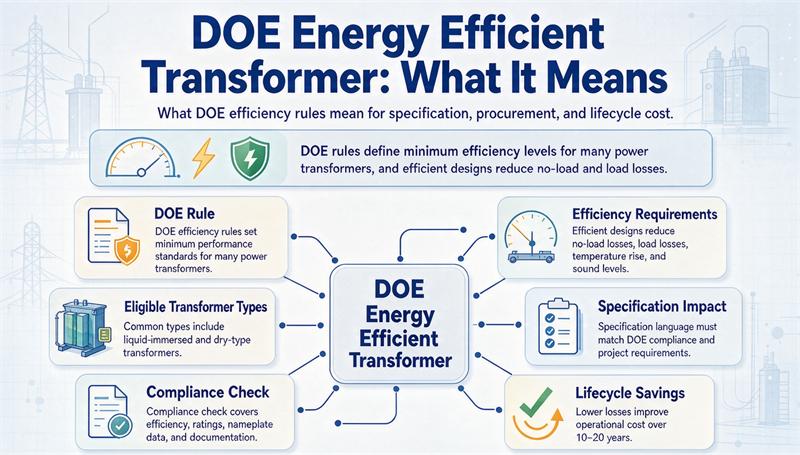
A DOE energy efficient transformer is a distribution transformer that meets the U.S. Department of Energy’s minimum efficiency standards under 10 CFR Part 431, Subpart K. Those rules cap how much power a unit can waste as heat. The amended version most buyers need to plan for takes effect April 23, 2029.
You’ll see “DOE compliant” on quotes from suppliers all over the world. Most of those quotes stop at the words and never show you the number. This guide fixes that. By the end you’ll know exactly what the label does and doesn’t promise, when the next rule change hits, and how to prove a unit is really compliant before you sign.
What “DOE Energy Efficient Transformer” Actually Means
Start with the acronym. DOE is the U.S. Department of Energy. When it shows up on a transformer, it points to one regulation: 10 CFR Part 431, Subpart K — Distribution Transformers. That’s the whole reference. It is not a brand, not a sticker you earn, and not a grade a salesperson invents. It is a federal floor.
A unit either clears the table in 10 CFR 431.196 for its size and type, or it doesn’t. There is no in-between.
Here’s what the number really controls: every transformer loses energy two ways. No-load loss (core loss) is there even when nothing is connected. Load loss (copper loss) grows as current flows. The standard limits the total of both, measured at a set load point. So “DOE efficient” means a hard lid on those two losses — not a vague promise to “save energy.”
The 2029 Deadline That Changes the Math
Most buyers are still quoting against the 2016 numbers. That window is closing. The timeline looks like this:
- 2007 — First federal efficiency standards for distribution transformers.
- Jan 1, 2016 — The current (pre-2029) rules took effect.
- April 22, 2024 — DOE published the amended final rule (89 FR 29834).
- April 23, 2029 — The tighter numbers become law for anything made or imported into the U.S. from that day.
The 2024 update is built on TSL 3. In plain terms: liquid-immersed units cut losses about 5% (single-phase ≤100 kVA and three-phase ≥500 kVA) and about 20% for everything else. Low-voltage dry-type drops about 30% single-phase and 20% three-phase. Medium-voltage dry-type comes down about 20% across the board.
Concrete numbers help it land. A three-phase 75 kVA low-voltage dry-type unit must hit 98.60% efficiency at 35% load today; from April 23, 2029 it needs 98.95%. A 1,000 kVA three-phase unit moves from 99.28% to 99.42%. Tiny on paper, but over a 32-year service life those fractions turn into real watt-hours.
Buyer takeaway: if your project bridges the 2029 line, write the applicable efficiency tier into the contract. Don’t assume the quote you got in 2026 still clears the bar in 2029.
How the Rules Actually Work (the part that trips people up)
Two rulebooks — liquid-immersed and dry-type
Oil-filled and dry-type units don’t share one table. Liquid-immersed and medium-voltage dry-type (MVDT) are measured at 50% of nameplate load. Low-voltage dry-type (LVDT) is measured at 35%. Same kVA, different test point, different required number. Mixing the two up is the fastest way to spec a unit that looks compliant but isn’t.
The load-point trap
That 35% vs 50% figure is where efficiency is proven, not where you’ll run it. Most real circuits sit well below 50% load factor for long stretches. A unit tuned to just clear the minimum at the test point can still bleed money at your actual load. This is exactly why ENERGY STAR and utility procurement specs push past the federal floor.
Single-phase vs three-phase
The tables split by phase and by kVA. A 150 kVA three-phase unit and a 167 kVA single-phase unit are different rows. Match the table to your exact rating and BIL before you trust any “98.x%” claim on a brochure.
How to Tell If a Unit Is Really DOE-Compliant
Get the DOE efficiency test report
Ask the supplier for the efficiency test run to DOE Appendix A — the test method behind 431.196. A nameplate that says “high efficiency” proves nothing. The report does. If they can’t produce it, treat that as your answer.
Check the kVA + BIL row, not the headline
Pull the relevant table in 10 CFR 431.196. Find your kVA, your phase, and — for MVDT — your BIL. If the tested efficiency meets or beats that row for the right manufacture date, it’s compliant. Anything less is a miss, regardless of the marketing language around it.
Watch the manufacture date, not the ship date
The rule keys off when the unit is manufactured or imported, not when you sign. A transformer built in December 2028 and sitting in a warehouse in April 2029 is still the old tier. Confirm build dates on long-lead orders so a “2029 delivery” doesn’t quietly ship a 2028-spec unit.
What It Means for Your Total Cost
The 32-year math
DOE’s own analysis uses a 32-year average service life for distribution transformers. Over that span, even a fraction of a percent of efficiency compounds into real money — often more than the price gap between a minimum unit and a better one. That’s the entire case for going past the floor, and it’s why the cheapest bid can be the most expensive asset.
Beyond minimum: ENERGY STAR and premium efficiency
“DOE compliant” is the floor, not the goal. ENERGY STAR and utility procurement specs set loss limits below the federal minimum, tuned to your actual load factor. If you run a campus, a data center, or a solar farm, asking for above-DOE is usually the cheaper call over the life of the asset.
How to Specify One for Your Project
Give your supplier four things and the conversation gets honest fast: kVA and phase, primary and secondary voltage, liquid-immersed or dry-type, and the efficiency tier you need (current vs 2029). If you’re not sure which type fits your site, our cast-resin dry-type units suit indoor, fire-safe, low-maintenance installs, while our liquid-immersed power transformers handle outdoor, high-capacity distribution. The distribution transformer buyers guide walks the full selection step by step.
Picking a Supplier That Speaks DOE Fluently
This is where a lot of import quotes go quiet. You want a manufacturer who can hand you the 431.196 table row, the test report, and a build date you can put in a contract. TransNinElectric builds its our full transformer range against those tables, and you can review reference installations or dig into the buyer’s guides and standards library before you ask for a quote.
One red flag to keep handy: anyone who answers “how efficient?” with a percentage that isn’t tied to a specific kVA, phase, load point, and date. That’s not compliance — it’s a hope.
Frequently Asked Questions
What does DOE stand for in transformer specs?
DOE stands for the U.S. Department of Energy. In transformer specs it points to one regulation: 10 CFR Part 431, Subpart K (Distribution Transformers). A “DOE compliant” unit must meet the efficiency table in 10 CFR 431.196 for its kVA, phase, and (for medium-voltage dry-type) BIL.
When does the new DOE transformer standard take effect?
The amended standard was published April 22, 2024 (89 FR 29834) and takes effect April 23, 2029. Any distribution transformer manufactured in or imported into the United States on or after that date must meet the tighter 10 CFR 431.196 numbers.
What efficiency must a 75 kVA three-phase DOE transformer meet?
A three-phase 75 kVA low-voltage dry-type unit must reach 98.60% efficiency at 35% of nameplate load under the current rule, rising to 98.95% from April 23, 2029. A 1,000 kVA three-phase unit moves from 99.28% to 99.42%.
Are DOE standards the same for dry-type and oil-immersed transformers?
No. Liquid-immersed and medium-voltage dry-type transformers are tested at 50% of nameplate load; low-voltage dry-type at 35%. They use separate tables in 10 CFR 431.196, so the same kVA can carry different required numbers.
How do I confirm a transformer is actually DOE compliant?
Request the DOE efficiency test report run to Appendix A of 10 CFR Part 431, then check the matching row in 10 CFR 431.196 for your kVA, phase, and BIL. Confirm the manufacture date, not the ship date, against the 2029 deadline.
Is a “high-efficiency” label enough proof?
No. “High efficiency” is a marketing phrase with no legal definition. Only the measured efficiency against the 10 CFR 431.196 table for the correct load point and date counts as DOE compliance.
Do DOE rules apply to transformers imported into the U.S.?
Yes. The standard applies to equipment manufactured in or imported into the United States. Importers and EPCs must meet 10 CFR 431.196 for any unit placed in U.S. service from the applicable date.