If you need this rating built to order, our application engineers size and specify it against your one-line diagram before anything goes to the shop floor — bring your load data and we will return a drawing, a guaranteed loss schedule, and a test plan. The rest of this page is the reference material behind that conversation.
1. What Each Character in S13-M-400/10 Means
Chinese transformer model codes are a compressed spec sheet. Once you can read them, you can screen a quotation in about ten seconds.
| Character | Meaning | What to watch for |
|---|---|---|
| S | Three-phase. (Single-phase units are coded D.) | Confirms it is a three-phase distribution unit, not a single-phase pole-mount. |
| 13 | Performance level code. No-load and load loss are lower than the older S11 series. | The number is a series code, not an efficiency grade. Confirm the actual GB 20052 grade on the test report. |
| M | Hermetically sealed (closed) construction — corrugated fin tank, no conservator tank. | M means sealed. It does not mean copper windings. Copper is usually unmarked or vendor-specific. Ask for winding material in writing. |
| 400 | Rated capacity, 400 kVA. | — |
| 10 | HV side rated voltage, 10 kV. LV is 0.4 kV by default and is omitted from the code. | US equivalents are 12.47 kV or 13.8 kV; LV becomes 480Y/277 V. See section 5. |
Two traps worth naming. First, buyers routinely read M as “copper” — it is not, and aluminium-wound units carry the same code. Second, 13 tells you the losses beat S11 but says nothing about how much; two factories can both ship “S13” with a 160 W spread on no-load loss at this rating, which is real money over a 20-year life.
If you are decoding a nameplate rather than a model string, our walkthrough of how to read a transformer nameplate and technical parameters covers every field and the ones buyers misread most often.
2. Core Technical Parameters
Figures below follow GB/T 6451 and mainstream factory standards. Ranges reflect genuine process differences between builders — they are not a licence to accept a vague quotation.
| Parameter | Typical value | Notes |
|---|---|---|
| Rated capacity | 400 kVA | ≈ 360 kW at 0.9 power factor |
| Voltage combination | HV 10 kV / LV 0.4 kV | Tapping range usually ±5% or ±2 × 2.5%, off-circuit (DETC) |
| Vector group | Dyn11 (common) or Yyn0 | Dyn11 suppresses third harmonics; ANSI drawings label it Dyn1 |
| Cooling | ONAN (oil natural, air natural) | No fans, no pumps — see section 4 |
| Short-circuit impedance | ≈ 4.0% | Sets LV fault level at roughly 14 kA |
| No-load loss | ≈ 410 W – 570 W | Varies by core steel and build; get a guaranteed value |
| Load loss | ≈ 4,300 W (at 75 °C) | Dominates lifetime energy cost at normal loading |
| No-load current | ≤ 0.3% – 0.5% | Drives magnetizing inrush; matters for fuse and relay coordination |
| Insulation level | HV LI75 AC35 / LV AC5 | 75 kV BIL. See the US note in section 5 — this is below the usual 15 kV-class BIL |
| Frequency | 50 Hz | 60 Hz must be stated at the RFQ stage; it cannot be changed after the core is cut |
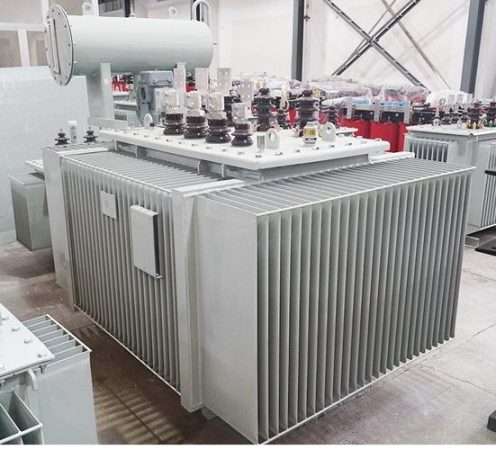
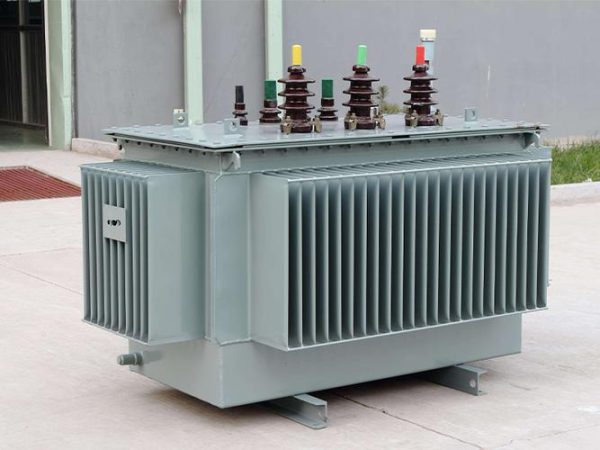
| Construction | Hermetically sealed corrugated-fin tank, no conservator | Core: high-grade cold-rolled grain-oriented silicon steel, fully mitred step-lap joints |
Derived currents you will need for cable and protection sizing:
- HV side at 10 kV: 23.1 A
- LV side at 0.4 kV: 577 A
- Same unit on 480 V secondary: 481 A
- Same unit on a 12.47 kV primary: 18.5 A
Why the no-load loss range matters more than it looks
At $0.12/kWh and 8,760 hours a year, the gap between the best and worst figure in that 410–570 W band is:
160 W × 8,760 h = 1,401 kWh/year ≈ $168/year ≈ $3,360 over 20 years (undiscounted)And the load-loss side dwarfs it. At a 60% load factor:
4,300 W × 0.60² × 8,760 h = 13,560 kWh/year ≈ $1,627/yearSo at this rating, load loss is roughly three-quarters of your lifetime loss cost, while no-load loss is the number marketing copy talks about. Insist on guaranteed values for both, written into the contract, not “typical” catalogue numbers.
3. Dimensions and Weights
Reference figures for a standard build. Treat them as envelope planning numbers and confirm against the certified outline drawing before you pour a pad or cut a cable route.
| Item | Metric | US / Imperial |
|---|---|---|
| Oil mass | ≈ 310 kg | ≈ 683 lb (≈ 350 L / 92 US gal) confirm oil type and density |
| Core and winding assembly | ≈ 820 kg | ≈ 1,808 lb |
| Total mass | ≈ 1,280 kg | ≈ 2,822 lb |
| Outline (L × W × H) | 1,520 × 880 × 1,320 mm | ≈ 59.8 × 34.6 × 52.0 in |
Total weight under 3,000 lb means a standard truck-mounted crane handles it, and the footprint fits a conventional pad. Corrugated-fin tanks are taller and narrower than finned-radiator designs for the same rating — check the height against any overhead clearance.
4. What “Hermetically Sealed” Actually Buys You
The M in the model code is the one letter that changes your maintenance plan.
- Corrugated fin tank, no conservator. The fins flex to absorb oil expansion, so the oil never contacts atmospheric air. No breathers to service, no silica gel to change, no moisture ingress, no oil oxidation from breathing.
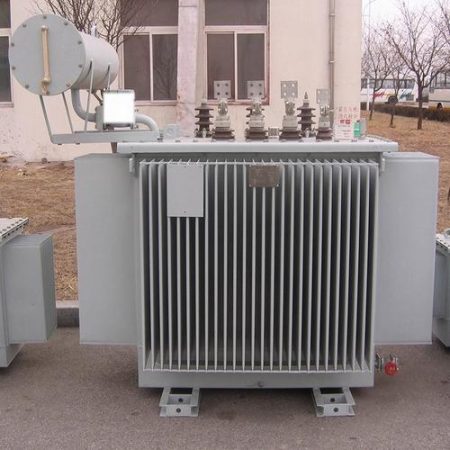
- No conservator means no Buchholz relay. There is nowhere to mount one. Overpressure protection comes from a pressure-relief device and, on larger units, a sudden-pressure relay. If your protection philosophy requires Buchholz, a sealed
Mdesign is the wrong choice — specify a conservator-type unit instead. - Maintenance becomes inspection. Periodic checks are oil level sight glass, bushing condition, terminations (infrared scan), and relief-device status. No oil filtration on a routine cycle, no dielectric testing of oil on a fixed schedule unless site conditions justify it.
Because there are no fans, ONAN is the quietest and lowest-failure-rate cooling class available — but it is also the least forgiving of overload. Our guide to transformer cooling classes (ONAN, ONAF, AN, AF) explains the loading tables behind each class and what you give up with a self-cooled unit.
5. Reading This Spec for a North American Project
This is where most export quotations go sideways. Four translations are required before a 10 kV/0.4 kV Chinese design is buildable on a US site.
| Source spec | North American equivalent | Consequence |
|---|---|---|
| 10 kV primary | 12.47 kV or 13.8 kV distribution class | Rewind or redesigned HV winding |
| 0.4 kV secondary | 480Y/277 V (600Y/347 V in much of Canada) | Different LV winding and bushing layout |
| 50 Hz | 60 Hz | Core and winding redesign; must be stated at RFQ, not after |
| LI75 / AC35 | 15 kV-class practice expects 95 kV BIL | Insulation coordination must be re-checked against the AHJ |
Two further points specific to this rating:
- 400 kVA is not an ANSI/IEEE standard three-phase size. The adjacent standard ratings are 300 kVA and 500 kVA. Ordering 400 kVA for a US project usually turns it into a custom build with custom tooling cost and lead time. Unless your load study pins you to 400 kVA exactly, price 500 kVA and take the headroom.
- The sealed outdoor version maps to a pad-mounted transformer, not to a dry-type unit. If you are budgeting, the pad-mounted transformer sizes and prices buying guide gives the US-format comparison.
Where a sealed oil unit is not acceptable — inside a building, under a occupied floor plate, or anywhere the fire marshal drives the decision — the comparison runs the other way: our breakdown of oil-immersed vs dry-type: how to choose covers the fire-separation, spill-containment and cost trade-offs.
6. The Efficiency Question: What Grade 3 Really Means
This is the part suppliers tend to gloss over, so here it is plainly.
Grade 3 under GB 20052 is the minimum threshold permitted in China — the floor, not a premium tier. S13-class losses typically land there. S20 and S22 sit one and two tiers above it. That has a direct consequence for export: confirm whether Grade 3 losses satisfy your target market, because for the EU (Ecodesign) and the US (DOE 10 CFR 430) the answer may be no. Confirm the current GB 20052 edition and the equivalent DOE or EU Ecodesign tier for your destination market.
That is not an argument against buying S13. At 400 kVA with a modest duty cycle, the loss premium of a higher tier can take a long time to pay back. It is an argument for knowing which tier you are buying and why, rather than assuming “energy-saving type” on a quotation means anything measurable.
If you want the tier comparison at this rating, the S20 series oil-immersed distribution transformer page shows what the next step up costs and saves. Browse the rest of the oil-immersed transformer range for the full rating ladder.
7. Typical Applications
- Community and residential distribution — the classic 10 kV to 0.4 kV step-down for a housing estate or apartment block feed.
- Factory workshops and light industrial — motor loads, lighting, and general power where the duty cycle is moderate.
- Commercial complexes — retail, office and mixed-use buildings with a single main LV board.
- Outdoor pole or pad mounting, or built into a compact substation — the sealed tank is genuinely weatherproof and dust-proof, so it suits long-term outdoor service without a building around it.
- Utility grid refurbishment and rural network upgrades — replacing high-loss legacy units on lightly loaded feeders, where the no-loss saving pays back fastest.
- New infrastructure and solar PV balance-of-plant — low no-load loss matters on circuits that sit idle or lightly loaded for long stretches. For the PV-side step-up duty itself, see our step-up transformers for a 50 MW solar PV plant project.
For completed installations across these duty types, browse the project library.
8. Specifying It: Send Us This
To turn S13-M-400/10 into a buildable order, we need seven items. Missing any one of them is the usual cause of a revised quotation.
- Primary voltage and taps — 10 kV, 12.47 kV or 13.8 kV; ±5% or ±2 × 2.5%; DETC or OLTC.
- Secondary voltage — 400 V, 415 V, 480Y/277 V or 600Y/347 V.
- Frequency — 50 Hz or 60 Hz. This is not changeable later.
- Winding material — copper or aluminium, stated explicitly. The model code does not tell you.
- Guaranteed losses — no-load watts and load watts at 75 °C, with the tolerance (typically +0% / +15% per IEC, or tighter by agreement).
- Vector group and impedance — Dyn11 at 4.0% is the default; confirm against your fault-level study.
- Site conditions — altitude, ambient range, coastal or industrial atmosphere, indoor or outdoor, and whether the AHJ requires a specific listing.
Full product documentation sits in the product catalogue, and the background engineering notes are in the resource library.
9. FAQ
Is 400 kVA the right size for my site?
Size to the load study, not to a guess. At 0.9 power factor, 400 kVA delivers about 360 kW of connected load. If your diversified peak lands between roughly 250 kW and 340 kW, 400 kVA with a 1.2 margin is well matched. Below about 200 kW you are paying for iron you will never use; above about 340 kW sustained, step to 500 kVA.
Does the M in the model code mean copper windings?
No. M means hermetically sealed — corrugated tank, no conservator. Winding material is a separate line item and must be confirmed in writing. Aluminium-wound units carry the identical model code.
How does S13 compare with S20?
S20 typically cuts no-load loss by about 10% and load loss by a further margin over S13, depending on rating and standard edition. Confirm the exact percentage for 400 kVA from the type-test reports. The right question is payback: S20 costs more up front, and at low load factors the extra no-load saving takes years to recover.
Can I use this on a 13.8 kV US system?
Not as catalogued. You need a 12.47 kV or 13.8 kV HV winding, a 480Y/277 V secondary, 60 Hz design, and insulation coordination at 95 kV BIL rather than 75 kV. All four must be specified at RFQ. Also note that 400 kVA is not an ANSI standard size — 300 kVA or 500 kVA are.
Why is there no Buchholz relay on a sealed unit?
A Buchholz relay mounts in the pipe between the main tank and the conservator. A sealed M design has no conservator, so there is nowhere to put one. Protection relies on a pressure-relief device plus electrical protection. If your standard requires Buchholz, order a conservator-type transformer.
What does ONAN mean for overloading?
ONAN is self-cooled: oil circulates by convection and the tank radiates. It has no fan stage to call on, so short-term overload capability comes from the thermal mass of the oil and the winding time constant alone. Loading beyond nameplate must be checked against IEC 60076-7 or IEEE C57.91 for your actual pre-load and ambient — never treat “it has overload capacity” as a design margin.
Is Grade 3 efficiency good enough for export?
Grade 3 under GB 20052 is China’s minimum threshold, not a premium tier. Whether it satisfies EU Ecodesign or US DOE requirements depends on your destination market and the current standard edition — confirm this before you commit. For many export projects the practical answer is to specify guaranteed loss values contractually rather than relying on a grade label.