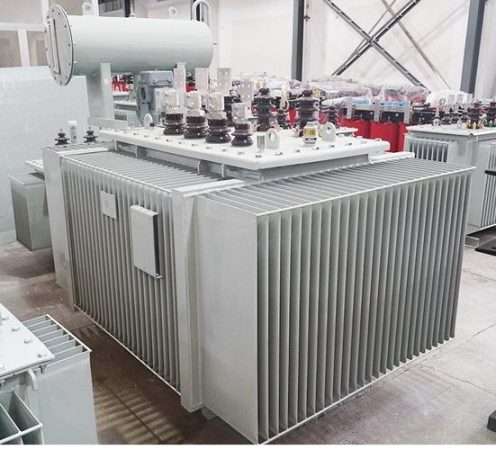
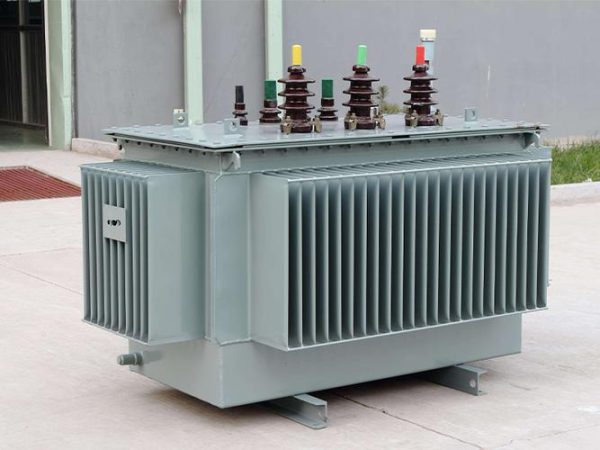
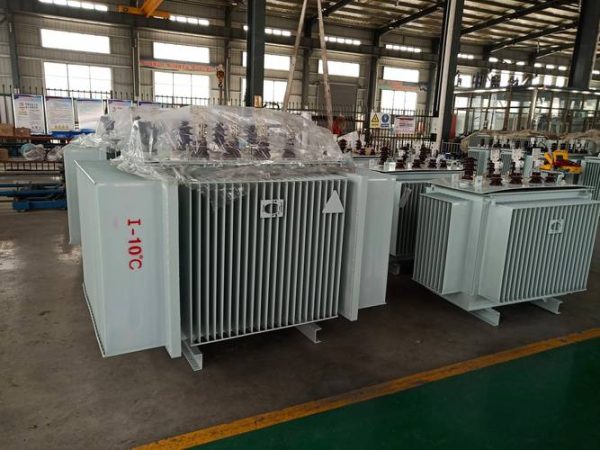
The S11 is a three-phase, oil-immersed, low-loss distribution transformer. It was the upgrade to the old S9 series — lower no-load loss, quieter, and simpler to live with — and for years it was the default choice for utility retrofit work and non-premium commercial distribution. That is no longer true in China’s regulated market, and it is worth knowing exactly why before you buy one for an export project.
1. What the S11 Designation Actually Means
The model code is not marketing — every character carries information you can verify on the nameplate.
| Character | Meaning | What to check |
|---|---|---|
| S | Three-phase | For single-phase pole-mount units the code starts with D |
| 11 | Performance level code | Loss level defined by the manufacturer’s series; confirm the P0/Pk values against the type-test report rather than trusting the number “11” |
| M | Hermetically sealed (fully sealed) | No conservator; oil volume change absorbed by the corrugated tank wall |
| /10 or /35 | HV winding voltage class, kV | North American equivalents are 12.47/13.8 kV and 34.5 kV |
| -250, -630… | Rated capacity, kVA | 30–10,000 kVA; 30–2,500 kVA covers almost every real application |
A suffix you will also see is SZ11 — the Z means on-load tap changing. A plain S11 has either no taps or an off-circuit (de-energised) tap switch, typically ±2×2.5% or ±5% on the HV winding.
2. Hermetically Sealed Construction: The Real Benefit and the Real Cost
The defining feature of the S11-M is that the conservator (oil expansion tank) is gone. Instead, the tank is built with corrugated fins whose elastic deflection absorbs the oil volume change between cold and loaded conditions.
What you gain:
- Oil never contacts ambient air, so moisture uptake and oxidation are dramatically slower. Insulation ageing is the dominant life limiter on a distribution transformer, and this is the single biggest lever on service life.
- No oil level gauge to read, no silica-gel breather to regenerate, no oil topping. For a utility with thousands of units in the field, that is a genuine O&M saving.
- No conservator means a lower profile and less to damage in transport.
What you give up — and this is the part most sales sheets skip:
- A sealed unit cannot accept a Buchholz (gas-actuated) relay. There is no gas collection path to the conservator. Protection relies on a pressure-relief device plus, if you specify it, a sudden-pressure relay, backed by your upstream fuses or breaker. Say so explicitly in your protection philosophy; do not assume the standard oil-transformer protection scheme transfers.
- The corrugated wall is a structural pressure boundary. It must not be welded, drilled, or mechanically restrained on site, and any dent from handling is a leak risk.
- “Maintenance-free” means no oil maintenance. It does not mean no inspection. Terminal torque checks, bushing condition, PRV inspection, and infrared scans still apply, and the oil still has a finite life.
3. Where an S11 Still Makes Sense — and Where It Does Not
Be honest about the use case before you spend money:
Good fits
- Replacing an existing S7/S9 unit on a legacy site where the foundation, cable routes, and protection settings are already built around that envelope.
- Export markets with no mandatory MEPS for distribution transformers, or where the buyer’s own loss evaluation is capacity-only.
- Standby or lightly loaded duty where the no-load loss premium of a higher-grade unit would take decades to recover.
- Budget-constrained retrofit programmes where capital cost, not life-cycle cost, drives the decision.
Poor fits
- New regulated installations in China, where the minimum permitted efficiency level is the binding constraint — confirm the current grade and the loss limits for your exact kVA rating before ordering.
- Projects sold on ESG or carbon reporting, where the loss difference is the whole point.
- Any site where the utility or AHJ applies a loss-capitalisation formula to the bid. In a evaluated bid, the S11 often loses to a higher-grade unit even when its purchase price is lower, simply because the capitalised no-load loss penalty is larger than the price gap.
If a dry-type unit is on the table instead, the trade-off is completely different — start with oil-immersed vs dry-type: how to choose, because sealed oil-filled is the right answer far more often than specifiers assume.
4. Ratings and Service Conditions
Standard catalogue envelope:
- Voltage classes: 10 kV and 35 kV HV. The 10 kV / 0.4 kV combination, 30–2,500 kVA, covers the overwhelming majority of real projects — residential feeders, factory distribution, commercial towers.
- Capacity range: 30 kVA to 10,000 kVA. Above roughly 2,500 kVA you are in power-transformer territory and should be specifying against a different document entirely; for 35 kV main transformers see our guide to 35 kV large-capacity oil-immersed power transformers.
- Frequency: 50 Hz as standard. 60 Hz cannot be added later — the core is cut for a frequency, and a 50 Hz core run at 60 Hz will simply have different (lower) flux and lower loss, while a 60 Hz design requirement changes the core cross-section and the no-load loss guarantee. Raise it at RFQ stage.
- Vector group: Dyn11 as standard, Yyn0 available on request. Dyn11 blocks triplen harmonics from propagating back into the HV network, which is why it is the default wherever the LV side carries single-phase or rectifier load.
- Cooling: ONAN (natural oil, natural air). Sealed corrugated tanks generally have no fan assembly, so there is no ONAF stage to uprate into — derate, do not overrate, if the ambient is hot.
- Impedance: 4% for 250–500 kVA, 4.5% from 630 kVA upward in the typical series. Impedance is your short-circuit current limiter and your voltage regulation penalty; it is specified, not accidental.
Service conditions the standard design assumes:
- Indoor or outdoor installation.
- No corrosive gases, no heavy conductive dust, no severe vibration.
- Altitude up to 1,000 m. Above that, thinner air cools worse: IEC 60076-2 and IEEE C57.12.00 both treat ~1,000 m (3,300 ft) as the baseline and require derating or a specially designed unit above it. Order the high-altitude version rather than derating after delivery — you cannot buy back the copper.
- Ambient and winding temperature rises follow IEC 60076-2 for oil-immersed units: top-oil rise 60 K and average winding rise 65 K are the conventional ONAN limits. Confirm the guaranteed rises and the hotspot calculation basis in your contract, at 40 °C average ambient or whatever your site actually sees.
5. Loss Data: Read the Table, Then Verify It
Typical listed values for the common 10 kV ratings. Treat these as a starting point for comparison, not as a guarantee — the only numbers that bind a supplier are the P0 and Pk values on the type-test report at 75 °C.
| Capacity (kVA) | No-load loss P0 (W) | Load loss Pk (W) | Short-circuit impedance | Vector group |
|---|---|---|---|---|
| 250 | 480 | 2,700 | 4% | Dyn11 |
| 315 | 570 | 3,200 | 4% | Dyn11 |
| 400 | 650 | 3,800 | 4% | Dyn11 |
| 500 | 780 | 4,600 | 4% | Dyn11 |
| 630 | 920 | 6,200 | 4.5% | Dyn11 |
| 1,000 | 1,150 | 10,300 | 4.5% | Dyn11 |
| 1,600 | 1,700 | 14,500 | 4.5% | Dyn11 |
How to turn those into money. Annual loss energy is:
E (kWh/year) = P0 × 8760 + Pk × β² × 8760
  P0 = no-load loss (kW), Pk = load loss at rated (kW), β = average load factor
At $0.12/kWh, one kilowatt of no-load loss costs about $1,051 a year, every year, whether the transformer is loaded or not. One kilowatt of load loss at β = 0.5 costs about $263 a year.
Worked example, 630 kVA at β = 0.5: E = 0.92 × 8760 + 6.2 × 0.25 × 8760 ≈ 21,600 kWh/year ≈ $2,600 a year in losses. If a higher-grade unit cuts no-load loss by roughly 30%, that is about $290/year saved — worth checking against the price premium, because on a lightly loaded feeder the payback can be longer than the buyer expects.
Before you compare quotes, read how to read a transformer nameplate and technical parameters — the three fields buyers most often misread are the loss reference temperature, whether Pk is at rated current or at the tap in use, and the cooling class.
6. Why the S11 Was Superseded
The S11 did not become obsolete because it was unreliable. It became obsolete because the standards moved. Each successive series cut no-load loss roughly 20–30% while leaving load loss broadly similar, because the gain came from core steel and core geometry, not from winding copper:
- S9 → S11: lower no-load loss and lower noise.
- S11 → S13 / S20: further no-load reduction, with the S20 series also trimming load loss.
- SH15 / amorphous: an amorphous-metal core pushes no-load loss down by another large step, at a higher purchase price and usually a physically larger core window.
The practical consequence: if you are buying an S11 today, you are buying because of capital cost or stock availability, not because it is efficient. That can be the right decision — but only if you have actually run the loss-capitalisation maths against your real load factor. Our S20 series oil-immersed distribution transformer page lists the comparison data for the current-generation alternative.
7. Specifying an S11 for a North American or 60 Hz Project
This is where most export orders go wrong. An S11 drawn to 10 kV / 0.4 kV / 50 Hz is not a drop-in for a US or Canadian site:
- Primary voltage: North American distribution primaries are 12.47 kV, 13.8 kV, or 34.5 kV, not 10 kV or 35 kV. The insulation levels (BIL) change with the class, so this is a design input, not a tap adjustment.
- Secondary voltage: 480Y/277 V is the US standard; 600Y/347 V is common in Canada. 400/230 V is not a North American service voltage.
- Frequency: 60 Hz must be stated at RFQ. A 50 Hz core can technically run at 60 Hz, but your loss guarantees, impedance, and sound level all move, and the manufacturer’s type test was not done at 60 Hz.
- Vector group: IEC Dyn11 is the same physical connection as ANSI Dyn1 — the clock-hour convention differs, so a US one-line drawn as Dyn1 and a Chinese nameplate reading Dyn11 describe the same thing. Confirm this in writing so the protection engineer does not reject the drawing.
- Efficiency regulation: in the US, distribution transformer efficiency standards live in 10 CFR Part 431, Subpart K (§431.196–431.198), not the appliance rules in Part 430 — a mix-up that shows up constantly in tender documents. Confirm whether liquid-immersed units of your kVA rating are in scope for your destination market before you quote. If they are not, efficiency becomes a contract term you negotiate, not a compliance box you tick.
- Standards basis: IEC 60076 and ANSI/IEEE C57.12 are not interchangeable on dielectric tests, temperature-rise limits, or sound measurement. Pick one basis for the whole project. The differences are laid out in IEC 60076 vs ANSI/IEEE standards for export transformers.
- Fluid and environment: standard mineral oil is fine outdoors, but sites with fire separation limits, water protection, or sustainability requirements may need a less-flammable fluid or an ester fill. Also check whether your AHJ wants an SPCC spill plan — the oil volume threshold is low enough to catch a 630 kVA unit.
8. Buying Checklist
Ask for these in writing, on the quote, before you release an order:
- Guaranteed P0 and Pk in watts at 75 °C, per rating and per tap if a tap changer is fitted — not percentages, not “meets S11”.
- The type-test report and the routine-test certificate for the actual serial numbers shipped.
- Cooling class (ONAN), insulation system, and guaranteed temperature rises at the site ambient and altitude.
- Altitude statement. If the site is above 1,000 m, get the derating or the high-altitude design in writing.
- Impedance at the principal tap, plus the tolerance.
- Vector group, stated in both IEC and ANSI notation if the project is North American.
- Sound level in dB(A) with the measurement standard and distance — a “low noise” claim without a standard is meaningless.
- Protection provisions: pressure-relief device rating, whether a sudden-pressure relay is fitted and whether it has a trip contact, and confirmation that no Buchholz relay is possible on a sealed unit.
- Tank and finish: corrugated tank grade, coating system, and salt-spray or ISO 12944 corrosivity category if the site is coastal or industrial.
- Spare parts and documentation: bushings, gasket set, PRV, plus a wiring/protection diagram and an oil sample baseline at handover.
Browse the current oil-immersed transformer range for ratings and alternatives, and the full product catalogue if you are specifying more than one unit.
9. Typical Applications
- Residential and neighbourhood distribution — 250–630 kVA pad or platform mounted, feeding LV boards directly.
- Factory and workshop distribution — 400–1,600 kVA, where the sealed design tolerates dust and the load is reasonably steady.
- Commercial buildings — 630–1,600 kVA, usually in a dedicated substation room, valued for the low sound level relative to older series.
- Utility retrofit — replacing S7 and S9 stock on existing plinths. One documented example of utility-scale substation replacement work is this 11 kV / 33 kV compact substation programme for an overseas utility EPC.
- Rural and light industrial feeders — where load factors are low and capital cost dominates the decision.
More installation write-ups are collected under projects.
10. FAQ
Is an S11 transformer still legal to install?
It depends entirely on the market and the rating. In China, the current efficiency standard sets a minimum permitted performance level, and an S11 sits at or near that floor — confirm the grade and the loss limits for your exact kVA rating before you commit. In export markets with no mandatory MEPS, there is no legal barrier at all; the question becomes whether your buyer applies a loss evaluation to the bid.
What does the “M” in S11-M mean?
Hermetically sealed. There is no conservator; the corrugated tank wall flexes to absorb oil expansion. This is why the unit is sold as maintenance-free, and also why it cannot accept a Buchholz gas relay.
Can a sealed S11 still have a Buchholz relay?
No. A Buchholz relay needs a gas path from the main tank up to a conservator, and a sealed unit has neither. Protection is by pressure-relief device, optional sudden-pressure relay, and your upstream overcurrent devices.
Why is the no-load loss more important than the load loss?
Because no-load loss is always running. The core is energised 8,760 hours a year whether or not anything is connected. At $0.12/kWh, 1 kW of no-load loss costs about $1,051 a year unconditionally; 1 kW of load loss only costs that at full load, and scales with the square of the load factor.
Is 4% impedance better than 4.5%?
Neither is “better” — they trade off. Lower impedance means better voltage regulation under load but higher prospective short-circuit current, so your cables, busbars, and protective devices have to be rated for more. Pick the value your fault study and voltage-drop study both accept, then hold the supplier to the tolerance.
Can I run a 50 Hz S11 on a 60 Hz system?
Physically it will operate, but do not do it without the manufacturer’s confirmation. The loss values, impedance, inrush behaviour, and sound level all change with frequency, and your type test was performed at 50 Hz, so your guarantees do not automatically carry over.
What altitude can a standard S11 handle?
1,000 m (about 3,300 ft) is the baseline in both IEC 60076-2 and IEEE C57.12.00. Above that, cooling deteriorates and you either derate or order a high-altitude design. Order the design — you cannot add copper later.
How long will a sealed S11 last?
With intact sealing and normal loading, 20–30 years is a reasonable planning figure, and the sealed design is the main reason it reaches that. The life limiter is insulation ageing, driven by hotspot temperature: every sustained 6–8 K above the design hotspot roughly halves insulation life.