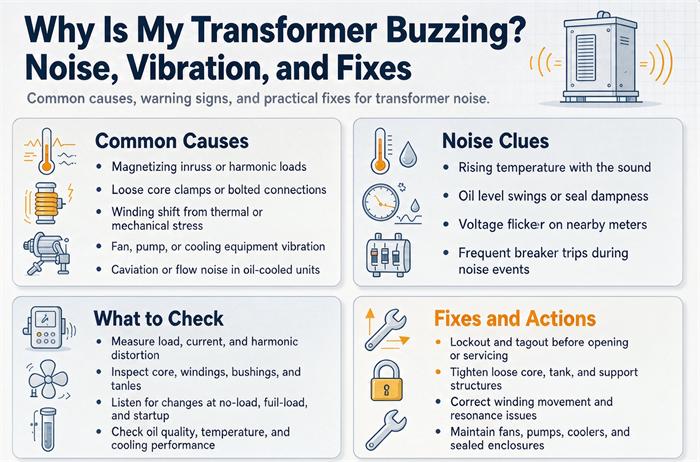
A transformer buzzes because its steel core changes shape twice on every AC cycle, so the hum sits at 120 Hz in North America, not 60. That steady tone is normal. A harsh rattle, a crackle, or a jump of 5 dB or more above the unit’s own baseline points to a mechanical or electrical fault that will not fix itself.
Most pages on this subject give you a list of causes and stop at “consult a professional.” This one gives you the numbers: what each sound measures, where the energy actually sits in the frequency spectrum, what it should read at one meter and at the property line, and what each fix buys you in decibels for the money.
We build quiet units for a living. One of our recent jobs was a low-noise cast resin dry-type installation for a city hospital, where the sound limit was set by a bedroom wall rather than by the electrical code. That job taught us more about noise than any datasheet. This page is what we would tell you on the phone.
What a transformer is actually doing when it hums
There are no moving parts inside a distribution transformer. Nothing spins, nothing rubs, nothing wears against anything else. The sound comes from the steel itself.
Every time the magnetic flux rises, the grain-oriented silicon steel in the core stretches very slightly in the direction of the flux. When the flux falls, it relaxes. This is magnetostriction, and it is a property of the material, not a defect. The strain is tiny, somewhere around one part in ten thousand of the core’s length. On a one-meter core limb that is a tenth of a millimeter. Multiply it by a few tonnes of steel and a tank wall with the stiffness of a drum skin, and you get the hum you hear from thirty feet away.
Two things about that mechanism matter for diagnosis.
The 120 Hz detail that changes every diagnosis
The core stretches once when flux goes positive and once when it goes negative. That is two stretches per full AC cycle. On a 60 Hz supply, the mechanical excitation lands at 120 Hz. On a 50 Hz supply, it lands at 100 Hz.
A lot of write-ups call it a “60 Hz hum.” It is not, and the difference is the first thing to check. If you put a spectrum analyzer on a transformer and the dominant peak is at 60 Hz with almost nothing at 120 Hz, magnetostriction is not your problem. Something is vibrating at line frequency: a loose busbar, a contactor coil, a wireway cover, or a failing winding connection. That is a different fault with a different fix.
You can confirm this with a free spectrum app on a phone. Hold it a foot from the tank, look at the first three peaks. A healthy unit shows a strong 120 Hz peak, a weaker 240 Hz peak, a weaker 360 Hz peak, and very little at 60 Hz. The harmonic ladder is normal and expected. What matters is the shape of the ladder compared with what it looked like last year.
Why the pitch and volume track the load
Core flux is set by voltage, not by load. So the magnetostrictive hum, the steady 120 Hz tone, should be almost constant whether the unit is at 10 percent load or 90 percent load. A small rise is normal because leakage flux in the windings grows with current.
If the sound gets noticeably louder as load rises, you are hearing something else. Winding conductors carry current in the same direction, so they attract each other at twice line frequency. Loose windings, loose blocking, and loose lead supports turn that attraction into physical movement. That sound rises and falls with the ammeter, and it is a mechanical problem inside the tank, not a magnetic one.
The practical split:
- Constant with load, steady tone: magnetic, normal, manage it with distance and barriers.
- Tracks the load, harsh edge: mechanical looseness in windings or leads.
- Louder at light load or at night: voltage-related, or DC in the core.
- Comes and goes with no load change: cooling auxiliaries, control circuits, or intermittent arcing.
That last one deserves its own warning. Something that buzzes for ten minutes and then stops is more worrying than something that buzzes all day, because intermittent usually means a connection is making and breaking.
The four sound families, and what each one points to
Once you stop treating “buzzing” as one thing, diagnosis gets fast. Transformer noise falls into four families, and each family has a signature you can hear and measure.
Magnetic: the steady 120 Hz drone
This is the baseline hum. It is smooth, it does not change much with load, and it is dominated by 120 Hz with a clean harmonic ladder above it.
It gets louder for three reasons: the unit is bigger than you thought it would be, the supply voltage is running high, or the waveform is distorted.
Voltage is the one people miss. Core flux is proportional to voltage divided by frequency (B ∝ V/f), and magnetostrictive strain scales roughly with the square of flux density. A 5 percent voltage rise pushes strain up about 10 percent, which is under 1 dB. That is small. But the relationship is not linear forever. Once the core approaches saturation, the curve steepens sharply, and the same 5 percent can cost you 2 or 3 dB with a harsher tone on top. Utilities routinely run 2 to 4 percent high at night when load drops, which is half the reason your unit sounds worse at 2 a.m.
Distorted supply is the other half. A waveform with 8 percent voltage THD carries harmonic flux components, and each one generates its own magnetostrictive excitation at its own frequency. That is why a transformer fed from a building full of drives sounds rougher than the same unit fed from a clean feeder. It is not broken. It is being asked to reproduce a waveform that is not a sine wave.
If your facility is harmonic-heavy, the fix is at the load, not at the transformer. Filters, line reactors on the drives, and moving single-phase electronic loads onto different phases all reduce the excitation at the source.
Mechanical: the harsh buzz and the rattle
Loose laminations sound different from magnetostriction, and most people can hear the difference once they know what to listen for. Magnetostriction is a pure tone. Loose laminations are a buzz with grit in it, a rough edge that sits on top of the 120 Hz fundamental, plus energy at 240 and 360 Hz that grows faster than the fundamental does.
The core is stacked from hundreds of thin steel sheets, clamped between frames and held by bolts that pass through the stack with insulating sleeves. Those clamps are torqued at the factory. Then the unit runs for fifteen years, thermal cycling works on the joint, the varnish bond between laminations cures and shrinks, and the stack starts to move as a collection of loose sheets instead of one solid block. Each sheet now vibrates on its own, and sheets rubbing against each other add a broadband hiss that pure magnetostriction never produces.
Loose tank panels and radiator fins produce a related but different sound: a rattle or a flap that you can often locate by ear. Press a hand flat against the panel while it is running and the sound will change. That test alone tells you whether you have a panel problem or a core problem.
Windings and lead supports fall in this family too. The signature is load-dependent, which is the giveaway.
Aerodynamic: fans, pumps, and the sound that starts at 70 percent load
Cooling auxiliaries are the easiest thing to rule out and the easiest thing to blame wrongly. A fan-cooled unit (ONAF or ONAN/ONAF) runs its fans only above a set winding temperature or a set load threshold. So the noise steps up at a specific point in the load curve, and it steps back down when the unit cools.
That step change is diagnostic. Magnetic and mechanical noise ramp smoothly. Fan noise arrives in one jump.
Fan noise also has a different character. It is broadband, it has a directional pattern, and it carries blade-pass frequency tones that sit well above 120 Hz. A failing bearing adds a whine or a chirp. An unbalanced blade adds a once-per-revolution thump.
Before you spend money on acoustic treatment, isolate the auxiliaries. Switch the fans off for sixty seconds at stable low load, or override the control, and measure again. If the level drops 5 dB, you have your answer. If it drops nothing, the fans were never the problem. Details on which cooling mode runs when are in our guide to ONAN, ONAF, and AN/AF cooling classes.
Electrical: the crackle, the sizzle, and the growl
Three sounds in this family need immediate attention, and one is a genuine emergency.
Crackling or popping. That is arcing. Arcing inside a transformer means a connection is opening under load or insulation is breaking down. It generates acetylene in oil-filled units, and acetylene is the one dissolved gas that means stop. If you hear crackling, de-energize and get a dissolved gas sample before you do anything else.
Hissing or sizzling, especially in humid weather. That is usually corona or surface tracking on bushings and cable terminations, not the transformer body. It is often harmless in fog and serious in dry weather. Either way it means contaminated or degraded insulation surfaces that need cleaning or replacement.
A low growl that comes in waves. This is the signature of DC offset, and it is the one cause that most pages get wrong. They attribute it to geomagnetic storms, which is real but rare in most of the United States. The common building-level version is a half-wave rectified load, a failing neutral, or stray DC from welding equipment, variable-speed drives with a fault, or electric transit return current finding a path through your grounding system.
How it works: a small DC current in a winding shifts the flux so it is no longer centered. The core then saturates on one half-cycle and stays linear on the other. The result is asymmetric excitation, an audible growl at 60 Hz rather than a clean 120 Hz tone, and even harmonics (120, 240 Hz) appearing in the current where they should not be. If a DC-capable clamp meter shows anything other than essentially zero on the grounding conductor, that is a finding worth chasing.
The signature table
| What you hear | Dominant frequency | Tracks load? | Likely cause | Urgency |
|---|---|---|---|---|
| Smooth steady drone | 120 Hz plus odd-overtones | Barely | Magnetostriction, normal | None |
| Rough buzz with grit | 120 Hz with strong 240/360 Hz | Slightly | Loose laminations or clamps | Plan a fix |
| Rattle, flap, or tick | Broadband, panel-localized | No | Loose panel, radiator, or cover | Plan a fix |
| Step up in level at a load point | Broadband plus blade tones | Yes, in steps | Cooling fans or pumps | Routine |
| Buzz or growl at light load | 60 Hz plus even harmonics | Inversely | DC offset, overvoltage | Investigate |
| Crackle, pop, or snap | Impulsive, broadband | Intermittent | Internal arcing | Stop the unit |
| Hiss or sizzle, weather-linked | High frequency | No | Corona or tracking on bushings | Inspect |
How loud is too loud
The honest answer is that “too loud” has three separate definitions, and buyers routinely confuse them.
The equipment definition is the guaranteed sound level on the nameplate, measured under standard conditions. The code definition is what your jurisdiction allows at a property line or a receptor. The human definition is whether the person in the nearest office can concentrate. A unit can pass the first, fail the third, and be perfectly legal under the second, all at once.
What the standards actually rate, and which one applies to your unit
Three documents do most of the work, and they do not cover the same equipment.
| Document | Covers | What it gives you |
|---|---|---|
| NEMA TR 1 | Liquid-immersed distribution and power transformers | Maximum A-weighted sound levels by kVA rating |
| NEMA ST 20 | Dry-type transformers for general applications | Same idea, dry-type ratings |
| IEC 60076-10 | All power transformers, international | Measurement method, near-field and far-field |
For liquid-filled distribution units, the published limits run roughly 55 to 65 dBA at one meter across the common 0 to 2,500 kVA range, rising with rating. Dry-type units generally sit a few dB higher at the same kVA because there is no oil to absorb energy and no heavy tank wall to block it.
Two cautions on using those tables. First, the nameplate governs. If the plate says 62 dBA and the standard table says 60, the contract is 62. Second, sound level rises with rating roughly 3 dB per doubling of kVA, which is worth remembering when someone proposes two small units instead of one large one: two units at 58 dBA each, running together, produce about 61 dBA. Splitting for redundancy usually costs you a decibel or two, not zero. That is one reason the number on the nameplate and technical parameters page deserves a second look before you sign.
The A-weighting trap
Here is the part almost nobody explains, and it is the reason noise complaints survive “but we measured it and it’s fine.”
A-weighting is a filter built into sound level meters that rolls off low frequencies to approximate how the ear responds at moderate levels. At 1,000 Hz it reads zero. At 500 Hz it is about 3 dB down. At 250 Hz, about 9 dB down. At 120 Hz, about 16 dB down. At 60 Hz, about 26 dB down.
So a 120 Hz tone that carries 70 dB of real acoustic pressure reads as 54 dBA on the meter. The energy is there. The meter discounts it. The neighbor still hears it.
This produces a specific and common failure. Two transformers both rated 58 dBA can sound completely different in a room, because one has its energy spread across the spectrum and the other has almost all of it at 120 and 240 Hz. Same number, different experience, and the person who bought the second one cannot understand why.
When you specify or measure, ask for both A-weighted and linear (or Z-weighted) readings, plus a one-third octave spectrum. If a supplier cannot produce a spectrum, they do not have a guaranteed sound level, they have a marketing number.
Three decibel rules you will use at the property line
Sound behaves predictably, and three rules cover most field arguments.
Doubling distance drops about 6 dB. In open air, away from reflecting surfaces, going from 1 m to 2 m costs 6 dB, and 1 m to 10 m costs 20 dB. A 62 dBA unit reads about 52 dBA at 3 m and about 36 dBA at 20 m.
Doubling the number of sources adds 3 dB. Two identical units side by side give +3 dB. Four give +6 dB. Ten give +10 dB. This is why a vault with six units is louder than anyone predicted from the individual nameplates.
A perceived doubling of loudness needs about 10 dB. A 3 dB change is measurable but hard to notice. A 10 dB change sounds twice as loud. Any fix that buys you 3 dB will disappoint the neighbor. Any fix that buys 10 dB will end the complaint.
Two placement facts that cost nothing. A unit jammed into a corner with two walls and a floor has three reflecting surfaces, and coherent reflection in a corner can add 8 to 9 dB compared with free-standing placement. A unit sitting on a light structural slab transmits vibration into the building, where the floor becomes a loudspeaker. Mounting on a mass that is at least ten times the transformer’s weight, isolated from the building frame, is the old rule for a reason.
A 40-minute diagnosis you can run on site
You do not need a laboratory to sort this out. You need a meter, a phone, a wrench, and a log.
| Step | What you do | What you are looking for |
|---|---|---|
| 1 | Measure background with the unit off | A floor 10 dB below the unit reading, or your data is invalid |
| 2 | Measure at 1 m from each of four sides at mid-height | A spread over 3 dB between sides points at a local source |
| 3 | Measure at the property line or the nearest occupied space | This is the number that decides whether you have a complaint |
| 4 | Capture a spectrum at 1 m | Whether 120 Hz dominates, and where the harmonics sit |
| 5 | Switch cooling fans off for 60 seconds | A 5 dB drop means the auxiliaries are the story |
| 6 | Press a hand on tank panels and covers in turn | A change in sound localizes a loose panel |
| 7 | Check clamp and cover bolt torque against the drawing | Anything under spec is a candidate |
| 8 | Thermal scan of bushings, connections, and the tank | A hot joint next to a loud buzz is a different problem |
| 9 | Pull oil for dissolved gas analysis, if liquid-filled | Hydrocarbon gases separate thermal, arcing, and corona |
Record all of it in one file with the date, the load, the ambient temperature, and the supply voltage. The single most useful thing you can own is a baseline from the day the unit was commissioned. Without it, every future reading is an opinion.
The tap test for panel resonance
With the unit de-energized and locked out, tap the tank wall, radiator, and enclosure panels with a rubber mallet and listen. A dead thud means the panel is stiff and well damped. A ringing tone means it has a resonant mode somewhere in the low hundreds of hertz, and it will be driven hard if that mode lands near 120 or 240 Hz.
You can go further with an accelerometer and a spectrum analyzer, but the mallet test answers the question in five minutes and costs nothing. If one panel rings and the rest thud, you have found the radiating surface, and stiffening that one panel is often the cheapest meaningful fix on the list.
When to stop and call someone
Stop measuring and secure the area if you hear crackling, if you smell ozone or hot varnish, if the tank is hot to the touch beyond normal, or if you see smoke or oil weeping from a seam. Do not touch the enclosure. A faulted unit can put the casing at a potential that will kill you, and an arc flash from distribution-class equipment is not survivable at close range.
Keep people back at least 20 feet, call the utility if the unit is utility-owned, and call a qualified high-voltage contractor if it is not. Work on the equipment only under a proper lockout and tagout procedure, as described in OSHA 1910.147.
Fixes, ranked by cost per decibel
Most articles list fixes without saying which ones actually work. This is the order we would spend money in, from cheapest to most expensive, with what each one typically buys.
| Fix | Typical reduction | Cost index | Best for |
|---|---|---|---|
| Re-torque core clamps and panel bolts to spec | 2 to 6 dB | 1 | Rough buzz, rattling panels |
| Replace hardened or missing base pads | 3 to 8 dB in the receiving room | 3 | Structure-borne noise, upper floors |
| Break rigid conduit, busway, and cable tray at the unit | 4 to 10 dB in the quiet space | 2 | Any isolated installation that still transmits |
| Stiffen or damp the resonant panel | 2 to 5 dB at that panel’s mode | 6 | One loud radiator or cover |
| Harmonic mitigation at the load | 2 to 5 dB, plus cooler operation | 15 | Drive-heavy facilities |
| Ventilated acoustic enclosure | 10 to 25 dB at 1 m | 30 | Boundary complaints, tight sites |
| Replace with a low-noise design | 5 to 15 dB versus the old unit | 100 | End of life, or a target that cannot be met otherwise |
The cost index is relative, with the cheapest mechanical work set at 1. Absolute numbers vary too much by site to quote responsibly, so get three contractor bids for anything above index 6.
The installation mistake that cancels every pad you buy
This is the one we see most often, and it undoes thousands of dollars of isolation hardware in a single afternoon.
You install resilient pads or spring isolators under the transformer base. The transformer is now floating. Then the electrician lands rigid conduit from the floor into the enclosure, bolts a length of cable tray to the wall and to the unit frame, and tightens a bonding jumper from the tank to a structural steel column.
You have just built a bypass. Vibration travels down the pads, finds the rigid conduit, and goes straight into the building through the stiffest path available. The pads are still doing their job at the pad. The sound is arriving through the conduit.
The fix is a flexible section in every connection between the isolated mass and the building: a flexible conduit whip, a braided bonding jumper with slack, a pipe coupling rated for the movement, and no rigid tray or strut bridging the gap. Detail this on the drawing, because nobody installs it by instinct.
There is a second-order problem in seismic zones. Isolation and restraint fight each other. You need restrained isolators with snubbers, or a seismic restraint design that engages only during an event. If your project is in a high seismic category, get the restraint and isolation designed together by one engineer, not by two suppliers who never speak.
Do not over-torque the core
When the diagnosis points to loose laminations, the instinct is to tighten everything hard. Resist it.
Core clamp bolts pass through the lamination stack inside insulating sleeves, and the whole point of those sleeves is to keep the bolt from shorting one lamination to the next. Over-torque crushes the sleeve or the insulation, creates a metallic path through the stack, and you have just built a shorted turn that heats at exactly the place you were trying to quiet. The unit gets noisier and starts losing efficiency.
Use the manufacturer’s torque value, use a calibrated wrench, and tighten in a cross pattern in stages. If the drawing does not give a value, ask the manufacturer rather than guessing. On older units with unknown history, a thermal scan before and after will tell you whether you helped or hurt.
Dry-type versus liquid-filled: the noise path is different
The same physics drives both, but the path from core to ear is not the same, and the fixes differ.
In a liquid-filled unit, the core and windings sit in oil. Oil attenuates high frequencies well and provides mass damping. The tank wall is the radiator, and it is also a large flexible plate that can resonate. Most of what you hear from a pad-mount is the tank, not the core. That is why stiffening a panel and adding mass works so well on these units, and why an enclosure around a pad-mount is often more effective than people expect.
In a dry-type unit, there is no oil and no tank. The cast resin or vacuum-pressure-impregnated winding surface radiates directly. A cast resin coil is a stiff, well-damped cylinder that behaves reasonably well, but the core end frames and the enclosure panels become the weak points. The enclosure is not just a guard on a dry-type unit, it is the acoustic design. Perforated covers, thin access panels, and cable entry cutouts all leak sound.
Dry-type units are also more sensitive to harmonic excitation, because there is no oil mass to damp the winding movement. At the same rating, a dry-type in a small electrical room is often the louder complaint, even though its nameplate number is similar. If you are still choosing between the two technologies, our comparison of oil-immersed versus dry-type transformers covers the trade-offs beyond noise, and the dry-type product range shows how enclosure options change the acoustic result.
One more dry-type specific: cast resin units are quieter at low harmonic content and much noisier under heavy K-factor duty, because the winding is not clamped the way an oil-filled winding is. If your load is drive-heavy, that is a design conversation, not an after-the-fact fix. The approach we used on a K-rated dry-type installation for a hyperscale data centre is a reasonable template.
When buzzing stops being an annoyance
Three thresholds convert a noise complaint into a safety or compliance item, and each one has a different owner.
The occupational threshold. OSHA’s noise standard sets an action level at 85 dBA as an eight-hour average, with hearing protection and a hearing conservation program above that. A single distribution transformer at one meter is nowhere near 85 dBA, so a transformer room is rarely a noise exposure problem for a person walking through it. It becomes one in a vault with several large units, forced cooling running, and an operator stationed there for a full shift. Measure, do not assume. The rule is at OSHA 1910.95.
The municipal threshold. Local noise ordinances usually set a limit at the property line or at a residential receptor, and many of them add a penalty of about 5 dB for tonal or impulsive sound. That penalty matters here, because transformer noise is tonal by nature. A unit measuring 55 dBA against a 55 dBA limit passes on the raw number and fails at 60 dBA once the tonality penalty is applied. Check the ordinance language before you buy, not after a complaint. And check whether the limit applies at the property line, at the nearest dwelling, or at the nearest window, because those three points are very different distances from your pad.
The insurance and asset threshold. A sudden change in sound is a condition-monitoring signal even when the absolute level is fine. A unit that has run at the same level for a decade and then climbs 8 dB in a month has a developing problem, and the cheapest moment to deal with it is now. This is the reasoning behind routine dissolved gas analysis and thermography, which we cover in transformer routine testing.
Buying quiet: what to put in the RFQ
If you are specifying a new unit and noise is a real constraint, the specification is where you win or lose. Six lines do most of the work.
- A guaranteed A-weighted sound level at 1 m, under stated conditions. Not a typical value, not a calculated value. A guaranteed maximum, with the measurement standard named (NEMA TR 1 or IEC 60076-10).
- The measurement conditions. Load, voltage, cooling mode, and whether fans are running. A fan-cooled unit quoted with fans off is a fiction.
- A tolerance and a consequence. Ask for the permitted tolerance in dB and what happens if the tested unit exceeds it. A supplier who will not discuss a penalty clause is telling you something.
- A one-third octave spectrum, not just a single number. This is where the low-frequency content hides, and it is what the neighbor will actually hear.
- The K-factor or harmonic duty, if the load is non-linear. A K-rated unit fixes heating. It does not fix sound. Say both things explicitly so nobody assumes one covers the other.
- The mounting and connection detail. Isolation pads, flexible connections, and seismic restraint should be on the drawing as a system, not sold as accessories afterwards.
For anything above roughly 1 MVA, ask for the sound level of the specific design, not the family. Core grade, flux density, and clamp design move the number by several dB, and the buyer who specifies only kVA and impedance is buying whatever the factory happened to build that week.
If you already have a plate in hand and the unit is louder than the plate claims, send us the plate and a spectrum. We will tell you whether the number is defensible or whether you have a warranty conversation on your hands.
What this means for your project
Almost every buzzing transformer is behaving exactly as designed. Magnetostriction is physics, not a fault, and the 120 Hz tone you hear is the sound of a core doing its job.
The judgment call is narrower than most articles admit. Three questions decide it:
- Is the sound stable and tonal, or is it changing? Stable and tonal is normal. Changing, harsh, or intermittent is not.
- Is it above the number on the plate, measured properly? If yes, you have a warranty or specification issue before you have an acoustic one.
- Does it exceed a limit that has an owner? A property line limit, a lease clause, or an occupied-space target. Noise with no limit attached is an annoyance. Noise against a limit is a project.
Answer those three and the fix usually picks itself. Torque and damping for the rough buzz. Flexible connections when the pads did not work. A spectrum before you buy an enclosure, because an enclosure that ignores the low-frequency content is an expensive way to stay unpopular.
FAQ
Is a buzzing transformer dangerous?
Usually not. A steady hum from magnetostriction is normal and harmless. The dangerous version is crackling, popping, or snapping, which points to internal arcing, or a buzz accompanied by heat, smoke, or an ozone smell. In those cases keep people at least 20 feet back, do not touch the enclosure, and call the utility or a qualified high-voltage contractor before anything else.
Why does my transformer hum at 120 Hz instead of 60 Hz?
Magnetostriction stretches the core once when flux rises and once when it falls, so the mechanical excitation happens twice per electrical cycle. On a 60 Hz supply that is 120 Hz, and on a 50 Hz supply it is 100 Hz. If a spectrum shows the dominant peak at 60 Hz with little at 120 Hz, the source is a loose busbar or connection, not the core.
How loud should a transformer be at one meter?
For liquid-immersed distribution units, published NEMA TR 1 limits run roughly 55 to 65 dBA at one meter across the common 0 to 2,500 kVA range, rising with rating. Dry-type units typically sit a few dB higher at the same kVA. The nameplate governs over the table every time. If your reading is more than 5 dB above the plate, the measurement conditions or the unit need investigating.
Why is my transformer louder at night?
Two effects stack. Background noise in a residential area can drop 10 dB or more after dark, and a 10 dB drop is what the ear reads as half the ambient loudness, so the same hum dominates. Utilities also let voltage rise 2 to 4 percent when load falls, and higher voltage means higher core flux and a louder hum. The unit is not changing. The context is.
Can I just build a box around the transformer?
Only if the box is designed for it. A sealed box traps heat and will cook the unit. A ventilated acoustic enclosure works, but the ventilation path has to be lined and baffled or the sound escapes through it. Expect 10 to 25 dB from a properly engineered enclosure, and expect to pay for the engineering. A plywood box from a maintenance shop typically buys 3 to 5 dB and a thermal problem.
Does changing the oil stop the hum?
No. Oil quality affects cooling and insulation, and dirty or wet oil can make a unit run hotter, but it does not change magnetostriction or loose laminations. Replacing oil to fix a hum is money spent on the wrong system. If the oil is bad, fix the oil for the oil’s sake and diagnose the noise separately.
Why does a brand new transformer buzz?
Because a new unit is supposed to buzz. The 120 Hz hum is normal from the first energization. What catches people out is that a new installation often sounds louder than the old one it replaced, because the old unit was in a different location, or the enclosure is thinner, or the room is more reflective. Also check for installation faults: shipping braces left in, pads not fitted, rigid conduit landed, and panel bolts loosened for rigging and never re-torqued.
How do I tell loose laminations from DC offset?
Listen to the frequency and watch the load. Loose laminations give a rough buzz dominated by 120 Hz with unusually strong 240 and 360 Hz content, and the level barely moves with load. DC offset gives a growl with a 60 Hz component and even harmonics, and it often appears or worsens at light load when voltage is high. A DC-capable clamp meter on the grounding conductor settles it.
Will a K-rated transformer fix harmonic noise?
No. A K-factor rating addresses additional eddy-current heating from harmonic currents, so the unit runs cooler on a non-linear load. It does not remove the harmonic flux that produces the extra noise. If harmonic noise is the problem, the fix is at the load: line reactors, filters, or redistributing single-phase electronic loads across phases.
How much does it cost to quiet a transformer?
It scales steeply. Re-torquing clamps and panels is a few hundred dollars of labor and buys 2 to 6 dB. Breaking rigid conduit and adding flexible connections is typically a day of electrical work. A properly engineered acoustic enclosure for a 1 MVA unit usually lands in the tens of thousands installed. Replacement is the most expensive option and only makes sense at end of life. Get three bids above the enclosure line, and always measure a spectrum first.