Thirty years is not a maintenance outcome. It is a chemical budget. A 65 °C rise unit running at rated load in a 30 °C room sits at a 110 °C hot spot, and that spends its reference life in 20.5 years. Everything after that is arithmetic: heat, water, oxygen, and load decide how fast the clock runs.
Most checklists on this topic are calendars. Monthly, quarterly, annual, every three to five years, with a task in each box and no number attached to any of them. That format survives because it is easy to write and easy to ignore. It also explains why so many units pass every inspection and still fail at year twenty two. This page works the other way around. It starts from what ends a transformer’s life, gives the thresholds that tell you how much of that life is left, and only then builds the schedule around them.
Two pages on this site sit next to this one. If you are still deciding what to buy rather than how to keep it, start with oil-immersed vs dry-type: how to choose. And if your question is whether the unit you just received was built right, that is a factory question and it belongs on routine testing: what every unit should pass. This page picks up after commissioning, when the only thing standing between you and year thirty is what you do every year in between.
Why 30 years is a chemical budget, not a calendar
The number 30 comes from field experience, not from a standard. No document in the industry promises it. What the standards do give you is a way to spend insulation life at a known rate, and once you have that, 30 years becomes a target you can hit or miss on purpose.
The reference life behind the number
ANSI/IEEE C57.91 defines normal insulation life for a 65 °C average winding rise unit as 180,000 hours at a 110 °C hot spot. That is 20.5 years of running flat out, all day, every day, in a 30 °C room.
Read that again, because it reframes the whole subject. The reference life is shorter than the service life everyone quotes. A unit that runs at nameplate continuously is not on a 30-year plan. It is on a 20-year plan, and the extra decade that people remember from somewhere comes from the fact that almost nothing actually runs at nameplate continuously.
Why the formula predicts a century and the record says thirty
Here is the uncomfortable part. Put a 1000 kVA unit at 80 percent load in a 30 °C room and the C57.91 hot spot model lands near 78 °C. Run the Arrhenius factor at 78 °C and you get an aging rate around 0.03, which works out to something close to 700 years of reference life. The model is not broken. It is just answering a narrower question than the one you asked.
Thermal aging is one mechanism. Field failures at 25 to 30 years are usually not thermal. They are water, oxygen, acid, sludge, mechanical duty from through faults, a tap changer that ran out of contact, or a bushing that cracked at the flange. A 1996 unit that failed last year almost never failed because its hot spot averaged 112 °C instead of 106. It failed because a gasket let air in for fifteen years and nobody pulled an oil sample.
So use the thermal model for what it is good at: telling you how much faster you are spending the finite thing you cannot replace. Then treat water and oxygen as the two clocks that actually decide whether you get to year thirty.
What a 30-year life costs in degrees
If reference life is 180,000 hours at a 110 °C hot spot, then a target life sets an aging budget. Thirty years is 262,800 hours, so the average aging factor you can afford is 180,000 divided by 262,800, which is 0.685.
| Target life | Allowed average aging factor | Average hot spot | What that asks of you |
|---|---|---|---|
| 20 years | 1.03 | 110 °C | Rated load, 30 °C room, no derating, no surprises |
| 25 years | 0.82 | 108 °C | About 5 °C below rated hot spot, or a slightly cooler room |
| 30 years | 0.685 | 106 °C | Roughly 96 to 97 percent average loading in a 30 °C room |
| 40 years | 0.51 | 104 °C | Roughly 94 percent average loading, and a healthy oil program |
Those load figures come from the standard hot spot model with typical loss ratios, so treat them as the shape of the answer rather than a promise. The shape is what matters: 30 years is not a different maintenance philosophy from 20 years. It is about four degrees of average hot spot and a decade of not letting water in.
The one-degree rule
At the 110 °C reference, each additional degree of hot spot multiplies the aging rate by about 1.107. Over a 30-year horizon that works out to roughly three years of life per degree of average hot spot.
Five degrees is worth about twelve years. That is the single most useful number on this page, because it prices every decision that touches temperature. Cleaning a radiator bank, replacing four fans, opening a blocked louver, moving a unit out of a room that peaks at 45 °C: each of those is worth years, and the arithmetic tells you how many before you spend the money.
The five clocks that run on a transformer
Insulation life is one number, but it is advanced by five separate mechanisms, and each one has a different test that reads it. Sorting them this way turns a 60-item checklist into five questions.
| Clock | What advances it | What reads it | What is at stake |
|---|---|---|---|
| Heat | Load, ambient, airflow, fouled cooling surfaces | Winding temperature, hot spot calculation, infrared on connections | About 10 percent of life per degree |
| Water | Breather, gaskets, bladder failure, breathing cycles | Karl Fischer moisture in oil, paper moisture by equilibrium | A doubling of paper moisture can cut mechanical life by half |
| Oxygen | Free breathing, failed seals, open conservator | Acidity, interfacial tension, sludge, color | Years, and it makes the water problem worse |
| Mechanical duty | Through faults, thermal cycling, loose clamping | SFRA, winding resistance, turns ratio | One bad fault can end a unit that was fine an hour earlier |
| Operating count | Tap changer operations, fan starts, pump hours | Contact wear, OLTC oil condition, motor current | Tap changers are the largest single failure category in most surveys |
The first three are slow and manageable. The last two are sudden, and they are the reason a 28-year-old unit with perfect oil still needs a fault-current study and a tap changer inspection.
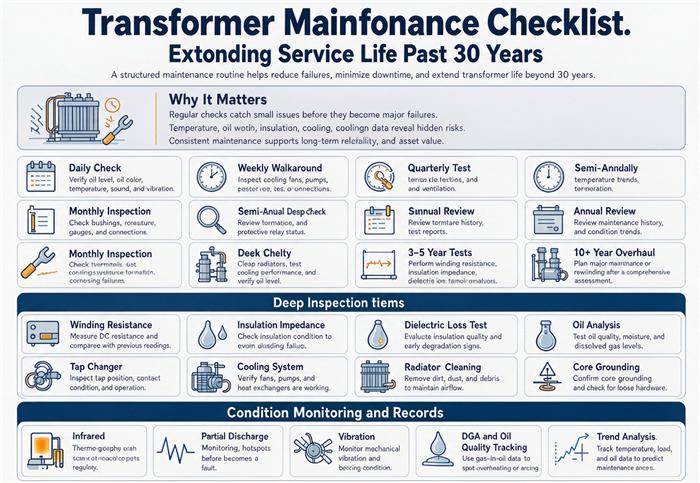
Tier 1: the monthly walk that takes 25 minutes
No tools, no shutdown, no lab. This tier exists to catch the four things that go wrong between annual samples: a leak that started, a fan that stopped, a gauge that moved, and a sound that changed. Write the readings down. A number with no history is an opinion.
| Check | Pass | Investigate |
|---|---|---|
| Oil level in the sight glass or conservator | Between marks at expected temperature | Falling trend over two visits, or above the top mark when cold |
| Top oil temperature gauge | Within 10 °C of the load-based expectation | Rising at constant load and constant ambient |
| Winding temperature gauge | Tracks oil gauge plus a stable gradient | Gradient wider than it was last quarter |
| Breather desiccant | Blue or orange, depending on type | Pink, white, or clumped, which means it is saturated |
| Breather oil cup | Oil present at the mark | Dry cup, which means the seal is gone |
| Fans and pumps | Running when called, no unusual bearing noise | A fan that is not turning on the hottest day of the year |
| Tank, welds, gaskets, valve stems | Dry | Fresh oil film, drip stains, or a sheen in the containment |
| Paint and grounding connections | Intact, tight | Rust-through, or a ground strap that has been painted over |
| Sound | Steady 120 Hz hum at the same level as last month | New rattle, crackle, or a hum you can hear from the door |
Three of those deserve a note.
The desiccant is the cheapest life extension device on the whole unit. When it saturates, the oil cup behind it is the only thing left between the conservator and humid air, and the oil cup only works if the level is right. A dry cup on a 25-year-old unit means the transformer has been breathing unconditioned air for however long nobody looked.
The temperature gauge is not a thermometer you read for comfort. It is a proxy for the hot spot, and the gap between what it reads and what the load predicts is diagnostic. A gap that widens at constant load means the cooling path is losing effectiveness, usually fouled radiators or a fan that is turning slower than it should.
The sound check needs a baseline, so make one on day one with a phone recording at a fixed distance and a fixed position. You cannot judge “louder than last month” from memory.
Tier 2: the annual oil sample carries the program
For a liquid-filled unit, one annual sample answers more questions about remaining life than every other test on the schedule combined. NFPA 70B moved from recommended practice to standard in 2023, ties intervals to a condition assessment, and for liquid-filled transformers it adds a fluid sampling interval on top of the general one. In practice that means annual for anything you care about. The transformer chapter uses the general interval table for maintenance, and sampling annually is the conservative reading everyone I know follows.
The tests and what each one answers
| Test | Method | The question it answers |
|---|---|---|
| Dissolved gas analysis | ASTM D3612 | Is something happening inside right now |
| Moisture | ASTM D1533, Karl Fischer | How wet is the insulation, and is it getting wetter |
| Dielectric breakdown voltage | ASTM D877 or D1816 | Can the oil still hold voltage across a gap |
| Acidity, neutralization number | ASTM D974 | How far has oxidation gone |
| Interfacial tension | ASTM D971 | Is the oil producing sludge that will coat the windings |
| Power factor of the oil | ASTM D924 | Are there polar contaminants or dissolved aging products |
| Furan compounds, mainly 2-FAL | ASTM D5837 | How degraded is the paper, not the oil |
| PCB content, one time | EPA method or ASTM D4059 | Is this oil regulated under 40 CFR 761 |
| Corrosive sulfur, one time on pre-2005 units | IEC 62535 or ASTM D1275B | Is there a copper sulfide risk on the windings |
The first seven go on the annual ticket. The last two are one-time tests whose answer never changes, and they are the two most often skipped on old units.
Limits worth writing into the purchase order
Vendors love a test report with no thresholds. Ask for the limits in writing before the first sample, then every report becomes a pass or a decision instead of a page of numbers.
| Parameter | Good | Watch | Act |
|---|---|---|---|
| Moisture in oil, units at 69 kV and below | 15 ppm or less | 16 to 20 ppm | Above 20 ppm, or rising on trend |
| Moisture in oil, 69 kV to 230 kV | 10 ppm or less | 11 to 15 ppm | Above 15 ppm |
| Acidity | 0.05 mg KOH/g or less | 0.05 to 0.10 | Above 0.15, or doubling in a year |
| Interfacial tension | 30 mN/m or more | 25 to 30 | Below 25, and below 20 plan for reclamation |
| Breakdown voltage, D877 flat disk | 40 kV or more | 30 to 40 | Below 30 |
| Oil power factor at 25 °C | 0.5 percent or less | 0.5 to 1.0 | Above 1.0 |
| 2-FAL | Under 300 ppb | 300 to 1,000 ppb | Above 1,000 ppb, confirm with DP |
| Paper moisture, by equilibrium | Under 1.5 percent | 1.5 to 2.5 | Above 3 percent, dry out or plan replacement |
Two caveats. The moisture limits move with voltage class, and IEEE C57.106 and IEC 60422 tabulate them by class, so use the row that matches your winding rather than the first row. And the 2-FAL to DP relationship has a wide scatter. An old unit can read 400 ppb at a DP of 500, and a hot unit can read 900 ppb at a DP of 380. Use furan to decide whether to spend money on paper sampling, not as a life certificate on its own.
Sampling mistakes that make the result worthless
A bad sample does not fail. It returns a clean report, which is worse, because you will believe it.
- Sampling from a dead leg. The valve body holds oil that has not moved in years. Flush two to three liters before the bottle.
- Sampling from the bottom drain only. That is where free water and sludge sit, so you get a worst-case reading you cannot trend against a top sample taken last year. Pick one point and keep it.
- Letting the bottle breathe. Syringes for gas, sealed bottles for the rest, filled with no headspace, labelled with the unit, the date, the sampling point, and the oil temperature.
- Sample temperature not recorded. Moisture, breakdown voltage, and viscosity all move with temperature. A 20 ppm result at 30 °C oil and a 20 ppm result at 60 °C oil are not the same finding.
- No baseline. The first sample is worth less than the second. If the factory test report is missing, get one sample now and start the trend today.
- Filing the report. A report that never enters an asset record is a lab fee.
Water is the clock you can actually slow
Moisture equilibrium is the concept that makes oil sampling harder than it looks. Paper and oil hold water in a ratio that shifts with temperature. Cold oil holds less water per unit volume, so for a given parts-per-million reading, colder oil means wetter paper.
Rough field numbers from published equilibrium curves: at 20 ppm in the oil, paper moisture sits near 1 percent when the oil is at 70 °C, and closer to 3 percent when the same oil is at 40 °C. Same test result. Very different amount of life left. This is why the sample temperature on the label matters and why a winter sample from a lightly loaded unit can look better than it is.
Which means: if a unit reads above 20 ppm twice, or the paper estimate crosses 2 percent, dry it out. Field dry-out by low frequency heating or vacuum processing is a fraction of replacement cost and it buys back years, not months. Doing it once at year eighteen is normal practice on a unit you intend to keep to year thirty five.
The two one-time tests on old units
PCBs. In the United States, mineral oil at 50 ppm or more is regulated equipment under 40 CFR 761, and the units most likely to contain it were built before 1979. A unit from 1985 is now 41 years old, so this is not ancient history. Test before you cut a gasket, before you drain, and before you sell the unit as scrap. The test costs a few hundred dollars and the alternative is a disposal problem that follows the transformer to whoever owns it next.
Corrosive sulfur. Oil from roughly the 1990s and early 2000s has been associated with copper sulfide deposits on winding insulation, which is a failure mode that develops quietly and shows up as an unexpected dielectric breakdown. On a pre-2005 unit you intend to keep, run IEC 62535 once. If it comes back corrosive, you have a decision to make that is cheaper to make now than after a fault.
Tier 3: the electrical tests on a three to six year cycle
These need an outage, which is why they get deferred, which is why the deferral is usually the most expensive thing on the schedule. None of them take long on a distribution unit.
| Test | Interval | What good looks like |
|---|---|---|
| Insulation resistance and polarization index | 3 years | PI of 2.0 or better on oil-filled, stable against baseline |
| Winding resistance, all phases | 3 years | Phase spread under 2 percent, no drift from baseline |
| Turns ratio, all taps | 3 years | Within 0.5 percent of nameplate |
| Excitation current | 3 years | Within 10 percent of baseline, no phase asymmetry |
| Winding power factor, or tan delta | 3 to 6 years | Under 0.5 percent corrected to 20 °C |
| Bushing power factor and capacitance | 3 to 6 years | Under 1 percent, capacitance change under 5 percent |
| Sweep frequency response analysis | Once for a baseline, then after any fault or move | A fingerprint that matches itself |
| Protection and alarm function test | 3 years | Every alarm and trip actually operates |
Insulation resistance is a trend, not a number
The only absolute rule worth remembering is the old field floor of one megohm per kilovolt plus one. A 13.8 kV winding should never read below about 14.8 MΩ regardless of temperature. Anything above that is only meaningful against the unit’s own history, because insulation resistance roughly halves for every 10 °C rise. A 100 MΩ reading at 20 °C becomes 12.5 MΩ at 50 °C with nothing wrong.
The polarization index filters out some of that temperature sensitivity, which is why it is the more useful of the two. Below 1.5 on an oil-filled unit is a wet or contaminated winding until proven otherwise. Between 1.5 and 2.0 is a unit you watch. Above 2.0 is normal.
For dry-type units the numbers run lower and the test is less decisive. Judge those against baseline and against how the unit behaves after a humid week.
Power factor is where bushings get caught
Winding power factor creeps upward as insulation absorbs moisture and aging products. A single reading under 0.5 percent at 20 °C is fine. A reading that has moved from 0.3 to 0.6 percent over six years is telling you something is coming, even though both numbers pass.
The same test on the bushings is the one that prevents the most dramatic failures. Bushing insulation is a small, highly stressed component sitting on top of a large, expensive one, and it fails at the flange seal, in the rain, usually at night. Capacitance change beyond 5 percent from nameplate, or power factor above 1 percent, means plan a replacement rather than wait for the next test cycle.
Get an SFRA fingerprint before you need it
Sweep frequency response analysis compares the unit’s electrical signature against a stored baseline. It is the only test that reliably catches winding deformation and core clamping changes after a through fault, and it is worthless if you have no baseline to compare against.
So take one. It takes an hour, it costs very little compared to the outage you already have, and it converts “the transformer seems fine after that fault” into a measurement. On a unit you plan to keep past 30 years, the baseline is the difference between repairing a deformed winding and replacing a failed one.
Tier 4: the parts that fail before the winding does
Winding failures get the attention. Components cause most of the outages, and they are the ones a checklist can actually prevent.
Tap changers
Tap changers are the largest single failure category in most published transformer failure surveys, and on a 30-year-old unit the count of operations is the number nobody recorded. A de-energized tap changer gets inspected at an outage and its contacts dressed or replaced. An on-load tap changer needs its own oil sampled separately, because the oil compartment is isolated from the main tank and a clean main-tank DGA says nothing about it.
Two habits matter. Sample the diverter oil on its own schedule and trend it on its own chart. And count operations. If the mechanism has a rated mechanical life and you have no count, the only honest position is that its remaining life is unknown, which makes it a candidate for inspection rather than a candidate for another decade of service.
On units where the tap changer is the weak point, a vacuum retrofit or a switch to a de-energized changer is a legitimate life extension, and it is usually cheaper than replacing a healthy transformer because one component ran out.
Bushings
Bushings fail in three ways: a cracked porcelain from mechanical or seismic load, a failed flange seal that lets water into the paper core, and a thermal runaway from a loose connection at the terminal. The first two show up in the power factor test. The third shows up in an infrared scan under load.
Check the terminal torque at every outage. A loose connection at a bushing terminal is a slow heater that cooks the seal from the inside, and the fix is a torque wrench.
Cooling: fans, pumps, and the contactor
Every summer, some facility loses a transformer to a control contactor that costs less than a dinner. Four fans served by one contactor means one failed coil removes a quarter to a third of the unit’s capacity, and the temperature alarm may not fire until the load is already above what the remaining cooling can carry.
Test the cooling by forcing it, not by looking at it. Command the fans on, confirm current on each motor, confirm the alarm annunciates, and confirm the trip stage works. Do that in spring, not in July.
Then clean. Radiator fins clogged with seed fluff, dust, or a decade of pollen lose effectiveness quietly, and the gauge tells you months later. On dry-type units in dusty plants, cleaning is the single highest return task in the entire program.
Gaskets, leaks, and the 1,320-gallon line
A 30-year-old unit has usually had three or four gasket generations, and the current one is the one leaking. Nitrile hardens, cork shrinks, and the leak at the radiator flange gets a pan under it and a note in a log nobody reads.
That is a compliance question in the United States, not just a housekeeping one. A single oil-filled container at or above 1,320 gallons falls under Spill Prevention, Control, and Countermeasure requirements. A 500-gallon distribution unit does not cross that line alone, but three of them in one yard do, and a chronic drip is the fact that turns an inspection into a finding. Fix the leak while it is a gasket.
Dry-type units: the same program, different failure modes
Dry-type units have no oil, so the oil program disappears and three other things take its place. The intervals change, the failure modes change, and the tests that carry the most information are different.
| Task | Oil-filled | Dry-type |
|---|---|---|
| Visual walk | Monthly | Monthly |
| Fluid sample and DGA | Annual | Not applicable |
| Infrared scan under load | Annual | Annual, and more useful here |
| Cleaning windings and ducts | Not applicable | Annual in dusty sites, more often in severe ones |
| Insulation resistance | 3 years | 3 years |
| Winding resistance and ratio | 3 years | 3 years |
| Winding power factor or tan delta | 3 to 6 years | 3 to 6 years, interpreted against baseline |
| Partial discharge test | On condition | Every 3 years on critical units |
| Torque check on accessible connections | At outage | Every 3 years, this is the main failure path |
Dust is the whole game
A dry-type winding cools by air moving through ducts between coil layers. Dust does two things at once: it insulates the surface, which raises winding temperature, and it blocks the duct, which removes the airflow that was supposed to carry the heat away. Neither shows up until the winding temperature alarm does.
In a plant with airborne dust, cleaning is not annual housekeeping. It is the main reliability task, and it should be on the same ticket as the infrared scan so the scan is done on a clean unit rather than on a dust blanket.
Also check the room, not just the unit. A dry-type transformer rated for a 40 °C ambient in a room that reaches 48 °C in August is running a hot spot nobody designed for. Louvers blocked by stored pallets, filters never changed, and recirculation from a nearby chiller are the usual causes, and all three are free to fix.
Resin, partial discharge, and the humidity that finds cracks
Cast resin does not absorb water the way paper does, which is why dry-type units are popular in damp locations. But resin cracks. Thermal cycling, mechanical stress, and vibration open hairline cracks, and moisture finds them, and then partial discharge starts in a place you cannot see.
An ultraviolet or acoustic partial discharge survey every few years on critical cast resin units is cheap insurance. On the inspection side, look for the visible signs: white powder deposits at the coil ends, tracking marks, discoloration at the top of a winding, or a resin surface that has gone from smooth to crazed.
Loading: the only lever that moves life by the decade
Everything else on this page is maintenance. This section is operation, and it moves the number more than any checklist item.
What a warm room costs
Take a 65 °C rise unit at rated load. Hold the load constant. Change only the room.
| Room ambient | Hot spot at rated load | Aging factor | Reference life at continuous rated load |
|---|---|---|---|
| 30 °C | 110 °C | 1.00 | 20.5 years |
| 35 °C | 115 °C | 1.66 | 12.4 years |
| 40 °C | 120 °C | 2.71 | 7.6 years |
| 45 °C | 125 °C | 4.38 | 4.7 years |
Those are reference-life years at continuous rated load, which almost no unit actually runs. The table is not a prediction of failure dates. It is a price list for room temperature, and the prices are steep enough that ventilation repairs belong in the capital plan rather than the housekeeping budget.
The reason this catches people is that ambient is the one variable nobody measures. Load is metered, temperature is gauged, but the room is assumed. Put a data logger in the room for two weeks in July and you will often find a 5 °C swing between the nameplate assumption and the afternoon reality, which the table prices at several years.
Short peaks and the cheap overflow
C57.91 exists because short overloads are not the same as sustained overload. A cool unit with a light historical load can carry well above nameplate for an hour or two during a peak and spend very little insulation life, because the winding has thermal mass and the aging rate only matters while the hot spot is actually high.
The reverse is the trap. The same overload on a unit that already sits at 110 °C costs real life per hour, and the units that fail in August are usually the ones that had no margin left before the peak arrived. So the operating rule is not “never exceed nameplate.” It is “know how much margin you have before you need it,” which is a load study and a temperature trend, not a guess.
One arithmetic note that matters for planning: load loss rises with the square of current, so 150 percent current is 225 percent of the copper loss, not 150. That is why a unit can feel fine at 120 percent and go into alarm at 140.
Records: the baseline that makes every later number mean something
Every test on this page is a comparison. Without a baseline there is nothing to compare against, and the test becomes a lab fee that produces a number nobody can act on.
The minimum record for each unit:
- Nameplate data transcribed once, including the connection diagram and the tap table. If the plate is faded, read it field by field and photograph both sides before it gets worse.
- Factory test reports, if they exist. If they do not, say so in the record so nobody mistakes the first field test for a baseline.
- Every oil sample with date, sampling point, oil temperature, and the full result set.
- Every infrared scan with load and ambient at the time of the scan.
- Every electrical test with the instrument, the temperature, and the correction applied.
- Every event: faults, trips, overloads, tap changer operations if counted, cooling failures.
- Every maintenance action with a date and a name.
A single spreadsheet per site beats a filing cabinet. The test that matters is whether a new maintenance lead can answer “how has this unit been trending for ten years” in five minutes.
Repair, re-rate, or replace
At some point the arithmetic stops being about maintenance. Here is how to make that call without emotion, and without waiting for the failure to decide for you.
Remaining life in three numbers
| Indicator | Healthy | Aging | Plan for replacement |
|---|---|---|---|
| Degree of polymerization of paper | Above 600 | 400 to 600 | Below 400, and below 250 it is a risk decision |
| 2-FAL in oil | Under 300 ppb | 300 to 1,000 ppb | Above 1,000 ppb, confirm with DP |
| Paper moisture | Under 1.5 percent | 1.5 to 2.5 percent | Above 3 percent, dry out or replace |
| Cumulative aging factor | Under 0.7 | 0.7 to 1.0 | Above 1.0, reference life is spent |
DP needs a paper sample, which usually means a unit that is already open, or an estimate from furan. Historically, a DP of 200 is treated as the point where paper is brittle enough that a through fault will tear it. Many owners set their planning threshold at 400 because that is where the decline stops being gradual.
The deferral arithmetic
Maintenance is not spending. It is buying time, and time has a price you can calculate.
Say a replacement is $150,000 installed. Deferring it ten years at a 7 percent discount rate means the present value of that spend drops to about $76,000. The deferral is worth roughly $74,000 in current dollars.
Now the maintenance side. An annual oil sample, an infrared scan, and a few hundred dollars of gaskets and filters runs maybe $2,000 a year on a 1000 kVA unit. Over ten years at the same discount rate that is about $14,000 in present value. The ratio is roughly five to one. That is the whole business case, and it holds as long as the test results keep saying the unit has time left.
What lead time does to your decision date
This is the part that changed after 2021 and that most maintenance plans still ignore. Distribution transformers are running weeks to months on lead time, and larger units run into a year or more. If your oil results say three years of life left and your replacement lead time is twelve months, your decision date is not in three years. It is now.
So set the trigger on remaining life minus lead time. A simple version: if any of the three numbers above crosses into the replacement column, start the specification process immediately, even if the unit is still running fine. The alternative is buying an emergency unit at emergency pricing and taking whatever rating is on the shelf.
If you are at that point, our S20 oil-immersed industrial spec page lists the loss values and options that a 2029-compliant replacement has to meet, and the power transformer buying guide walks the specification from the other end. For indoor or fire-restricted locations, the Grade 1 cast resin range is the dry-type equivalent worth comparing against.
When the losses decide it for you
Sometimes the replacement case does not need a failure risk at all. It needs a meter.
Take a 1000 kVA unit from the mid-1990s with no-load loss around 2,400 W and load loss around 12,500 W, compared with a current compliant unit at roughly 1,500 W and 9,000 W. At 40 percent average load, the old unit burns about 4,400 W and the new one about 2,940 W, a difference of roughly 1.5 kW.
That is about 12,800 kWh a year, or roughly $1,280 at 10 cents, or about $15,900 in present value over thirty years at 7 percent. Add the capacity you get back from a unit that no longer runs hot, and the case builds itself. Those loss figures are our own illustrative pair, not a quotation, but the shape is typical: efficiency replacement is often a better argument than failure risk, and it is the one that survives a budget review.
A twelve-month plan you can actually staff
Most maintenance programs fail on staffing, not on knowledge. This schedule assumes one competent person, a few hours a month, and one planned outage a year.
| Quarter | What gets done | Who does it |
|---|---|---|
| Q1 | Transcribe nameplates, rebuild the asset record, order missing factory reports, book the annual oil sample | Maintenance lead, office time |
| Q2 | Spring cooling test before the heat: force fans and pumps, confirm alarms and trips, clean radiators or windings, clear the room | Qualified person, one day |
| Q3 | Annual oil sample and DGA, infrared scan under peak load, thermography on connections | Lab plus qualified person |
| Q4 | Planned outage: insulation resistance and PI, winding resistance, ratio, power factor on windings and bushings, torque check, tap changer inspection, gasket work | Qualified person plus contractor |
| Every month | The 25-minute walk, with readings written down | Facility staff |
| Every 3 to 6 years | SFRA against baseline, protection function test, bushing power factor | Specialist |
If you can only fund part of it, fund the oil sample and the spring cooling test. Those two catch the largest share of what actually kills units, and both are cheap.
The RFQ line items below are the ones worth putting in front of a supplier when you are buying the replacement, because they are what makes the next thirty years possible rather than hopeful.