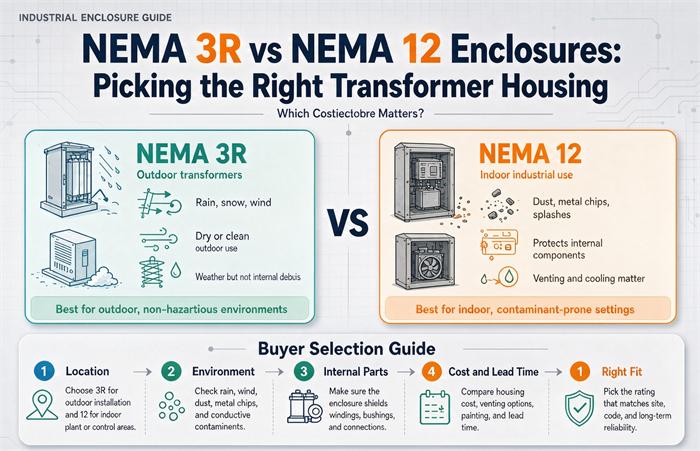
NEMA 3R and NEMA 12 are not two grades of the same protection. Type 3R is an indoor or outdoor rating against rain, sleet, snow and external ice formation. Type 12 is an indoor-only rating against circulating dust, lint, fibers and dripping or lightly splashing non-corrosive liquids. Choose 3R where water falls on the enclosure, and 12 where dust or oil mist floats around it indoors.
That is the whole answer, and it takes about fifteen seconds. The reason it is worth another ten minutes is that on a dry-type transformer the enclosure is not a cover. It is part of the cooling system, and it is part of your code compliance. Change the type and you change the kVA you can actually pull, the room you are allowed to put the unit in, and in the U.S. whether the DOE efficiency table applies at all. Most quotes get the type right and the consequences wrong.
Four numbers decide most orders:
- 1,000 V. Above that, ANSI/NEMA 250 does not apply and the enclosure is an engineered item.
- 112.5 kVA. Above that indoors, NEC 450.21(B) wants a one-hour fire-rated room unless the enclosure and the insulation class earn you an exception.
- 15 kVA. At or above it, the DOE efficiency table applies unless the unit is nonventilated or sealed.
- 40 °C and 1,000 m. The rating basis, and the two conditions your enclosure decides for you.
NEMA 3R vs NEMA 12 Side by Side
Both ratings come from ANSI/NEMA 250, and both are written as a list of conditions, not as a score. A higher number does not mean more protection. Type 12 sits above 3R numerically and still has no rating for rain.
| Condition | NEMA 3R | NEMA 12 |
|---|---|---|
| Where it is allowed | Indoor or outdoor | Indoor only |
| Access to hazardous parts | Yes | Yes |
| Falling dirt | Yes | Yes |
| Windblown dust | No | No |
| Circulating dust, lint, fibers, flyings | No | Yes |
| Settling airborne dust | No | Yes |
| Rain, sleet, snow | Yes | No |
| Undamaged by external ice formation | Yes | No |
| Dripping and light splashing water | Yes | Yes |
| Hose-directed water | No | No |
| Oil and coolant seepage | No | Yes |
| Oil or coolant spraying and splashing | No | No |
| Corrosion protection | No (3RX adds it) | No |
| Ventilation | Normally vented, with drains | Sealed, no knockouts |
Read that table top to bottom and two things jump out. First, 3R and 12 overlap on almost nothing that matters. Second, neither one handles windblown dust or hose water, which is why so many outdoor 3R installs fail at cement plants and so many indoor 12 installs fail at washdown bays.
What the Standard Actually Says
It is worth reading the definitions once, because a lot of the confusion online comes from people paraphrasing them.
Type 3R, in NEMA’s own words
Enclosures constructed for either indoor or outdoor use to provide a degree of protection to personnel against access to hazardous parts, to provide a degree of protection of the equipment inside the enclosure against ingress of solid foreign objects (falling dirt), to provide a degree of protection with respect to harmful effects on the equipment due to the ingress of water (rain, sleet, snow), and that will be undamaged by the external formation of ice on the enclosure.
Note the solid-object list. Falling dirt, full stop. No windblown dust, no circulating dust. That is why a 3R box can legally carry louvers and drain holes, and why it works so well on a rooftop and so badly next to a grain elevator.
Type 12, 12K and 13, in NEMA’s own words
Type 12 is constructed without knockouts, for indoor use, against access to hazardous parts, ingress of solid foreign objects (falling dirt and circulating dust, lint, fibers, and flyings), and ingress of water (dripping and light splashing).
Type 12K is the same list, constructed with knockouts. That is the only difference between 12 and 12K. If your shop wants factory knockouts for conduit, ask for 12K and stop arguing about it.
Type 13 adds protection against the spraying, splashing, and seepage of oil and non-corrosive coolants. If the transformer is going next to a machining center that throws coolant, 12 covers seepage but 13 covers spray.
One scope note before you quote any of this: NEMA’s free enclosure-types document reproduces the definitions from NEMA 250-2003, while the edition whose scope NEMA currently publishes is ANSI/NEMA 250-2020. The type wording above is stable across editions, but if a contract names an edition, quote that edition.
The 1,000 V ceiling
ANSI/NEMA 250 covers enclosures for equipment rated 1,000 volts or less. It also sorts its types by location: 1, 2, 5, 12, 12K and 13 are indoor; 3, 3X, 3R, 3RX, 3S, 3SX, 4, 4X, 6 and 6P are indoor or outdoor.
So a 480 V dry-type distribution transformer plays inside this system nicely. A medium-voltage dry-type unit, which DOE defines as having a rated primary between 601 V and 34.5 kV, does not get its housing picked from this table. The enclosure for an MV unit is an engineered item on the manufacturer’s drawings, and asking for “NEMA 3R” on a 13.8 kV cast resin unit is asking the wrong question.
What the Enclosure Does to the kVA You Paid For
Here is the part that separates transformer enclosures from control-panel enclosures. A panel sheds a few hundred watts. A transformer sheds kilowatts, and it is rated on the assumption that those kilowatts get out.
NEMA 250 does not cover heat
The standard says so directly. It does not cover the requirements for the protection of the enclosed equipment against conditions such as condensation, gas vapor ignition, thermal damage, icing, corrosion, or contamination which may occur within the enclosure or which may enter via conduit or unsealed openings.
That sentence is the most useful one in the whole document for a transformer buyer. A type rating tells you what stays out of the box. It says nothing about what happens to the heat that stays in.
The numbers behind the temperature
Dry-type transformer ratings are built on usual service conditions in IEEE C57.12.01: a maximum ambient of 40 °C, a 24-hour average of 30 °C, and altitude up to 1,000 m. Your enclosure decides whether the windings actually see that.
On a totally enclosed non-ventilated build, Eaton’s harsh-environment line ships a 220 °C insulation system with a standard 150 °C winding temperature rise, and 80 °C or 115 °C rise available as options, in single-phase 15 to 75 kVA and three-phase 15 to 225 kVA. Those three rise classes are the lever you pull when a sealed box is non-negotiable.
Here is the arithmetic, with the assumption stated: take a 75 kVA unit at 98 percent efficiency, at full load. About 1.5 kW is leaving as heat. In a vented 3R enclosure, moving air carries most of it off. In a sealed 12 enclosure, all of it has to leave through the sheet metal, and the enclosure has to be bigger, or the rise class has to be lower, or the kVA on the nameplate has to come down. You pay for the sealed box three times: in steel, in derating, and in the larger footprint.
NEC 450.9 puts the duty on the install
The code does not leave this to interpretation. Ventilation shall dispose of the transformer full-load heat losses without creating a temperature rise in excess of the transformer rating, and transformers with ventilating openings shall be installed so those openings are not blocked by walls or other obstructions.
Two practical consequences. If you specify a ventilated 3R enclosure, you now own the clearance around it, and pushing it into a corner against a wall is a code problem, not a tidiness problem. If you specify a sealed 12 enclosure, you have taken the ventilation route away, so the surface area and the rise class have to do the job instead. Either way, get the manufacturer’s derate factor for the exact enclosure in writing before you sign.
Sun, altitude and room temperature
Three conditions are outside the NEMA type entirely and still land on your transformer:
- Solar gain. A dark enclosure in direct sun runs hotter inside than the air around it. Light-colored finishes and a sun shield cost very little and buy real margin.
- Altitude. Above 1,000 m, thinner air cools worse and standard ratings need derating.
- Hot rooms. Rooms full of drives and UPS units routinely run past 40 °C. Specify the real ambient, not the default.
Condensation is the same story. A sealed box in a humid space with daily temperature cycling will make water on the inside. That is why outdoor enclosures often need a rated breather drain, a thermostatically controlled anti-condensation heater, or both. None of it is covered by the type number.
Two Code Consequences Buyers Miss
NEC 450.21: the indoor fire rules your enclosure can change
For dry-type transformers installed indoors, the code splits at 112.5 kVA.
At 112.5 kVA or less, NEC 450.21(A) wants at least 12 in. (305 mm) of separation from combustible material, or a fire-resistant heat-insulating barrier between them.
Above 112.5 kVA, NEC 450.21(B) wants a transformer room of fire-resistant construction with a minimum one-hour fire rating. Two exceptions get you out of the room, and both of them run through the enclosure and the insulation system:
- Class 155 or higher insulation, separated from combustible material by a fire-resistant heat-insulating barrier, or by at least 1.83 m (6 ft) horizontally and 3.7 m (12 ft) vertically.
- Class 155 or higher insulation, with the transformer completely enclosed except for ventilating openings.
Above 35,000 V, NEC 450.21(C) requires a full vault under Part III. No exceptions.
The takeaway for specifiers: on a unit over 112.5 kVA, the combination of insulation class and how completely the enclosure closes up is the difference between a one-hour fire-rated room and no room at all. That is a construction cost, not a hardware cost, and it belongs in the enclosure decision.
DOE 10 CFR 431.192: sealed and nonventilated units sit outside the efficiency table
The U.S. DOE distribution-transformer rule applies to a dry-type unit with an input of 34.5 kV or less, an output of 600 V or less, 60 Hz, and a capacity at or above 15 kVA. Amended levels adopted in the April 2024 final rule (89 FR 29834) apply to units manufactured on or after April 23, 2029.
Now the part nobody in the enclosure articles mentions. The definition of distribution transformer explicitly excludes a nonventilated transformer and a sealed transformer, alongside eleven other categories. DOE defines them this way:
- Nonventilated transformer: constructed so as to prevent external air circulation through the coils of the transformer while operating at zero gauge pressure.
- Sealed transformer: designed to remain hermetically sealed under specified conditions of temperature and pressure.
So a sealed enclosure can pull a unit out of the DOE table. Eaton states the same thing from the product side: totally enclosed non-ventilated transformers are excluded from the scope of U.S. DOE energy efficiency requirements, and its TENV line runs 15 to 75 kVA single-phase and 15 to 225 kVA three-phase at any voltage combination below 600 V.
Do not lean too hard on this one, because it is exactly where suppliers overclaim. A NEMA 12 box around a vented core and coil does not automatically make the transformer a nonventilated transformer under DOE’s definition. What matters is how the transformer itself is constructed, and that classification belongs on the manufacturer’s certification, not in your assumptions. Put the question in the RFQ in writing: is this unit, in this enclosure, certified as within or outside 10 CFR 431 Subpart K, and on what basis. Make them answer it.
Where Each One Wins on Real Sites
| Site | Pick | Why |
|---|---|---|
| Rooftop or outdoor pad, clean air, no washdown | 3R | Rain and snow are the hazard; it needs to breathe |
| Outdoor yard with visible airborne dust | 3, or 3R with filtered ventilation | 3R alone has no windblown-dust rating |
| Coastal, de-icing salt, chemical, wastewater | 3RX or 4X | Corrosion is the hazard, and 3R and 12 have none |
| Washdown bay, food processing, car wash | 4 or 4X | Hose-directed water; 3R and 12 both fail |
| Machine shop, CNC cells, oil mist and coolant seepage | 12 | Circulating dust plus oil seepage, indoors |
| Textile, paper mill, lint and fibers in the air | 12 | Flyings are exactly what Type 12 covers |
| Clean, conditioned electrical room | 1 or 2 | Nothing to protect against; do not over-buy |
| Indoor area with water dripping from overhead pipes | 3R or 12 | Both cover dripping; 3R also gives you ventilation |
| Outdoor, freezing climate, latches must work in ice | 3S | External mechanisms stay operable when ice laden |
When Neither Type Is Right
Both types have hard edges. This is the escalation path.
| If the site adds | Move to | What it buys you |
|---|---|---|
| Windblown dust outdoors | 3 | Adds windblown dust to the 3R list |
| Corrosion outdoors | 3RX | 3R plus a corrosion level; Eaton ships these in 304 with 316 optional |
| Hose-down, indoors or outdoors | 4 | Hose-directed water plus windblown dust |
| Hose-down plus corrosion | 4X | Type 4 plus corrosion; specify 304 or 316 by name |
| Coolant or oil spray | 13 | Spraying, splashing and seepage of oil and coolants |
| You want factory knockouts | 12K | Same protection as 12, with knockouts |
| Occasional flooding or submersion | 6 or 6P | Limited-depth submersion, temporary or prolonged |
One rule that trips up a lot of assemblies: the installed rating drops to the least-protected part. A Type 12 enclosure with a Type 1 vent, an unrated cable gland, or a field-cut hole is no longer a Type 12 installation. Ask what the louvers, breather drains, gland plates and windows are rated to.
NEMA vs IP: Why “Equivalent” Fails on Export Orders
Specifications written for North America say NEMA Type. Specifications written almost everywhere else say IP, per IEC 60529. Buyers then try to translate, and the charts they find disagree: 3R gets paired with IP14 in several of them, while 12 shows up as IP52 in one and IP54 in another.
The reason the charts disagree is that the two systems do not test the same things. IP codes cover access to hazardous parts, solid-object ingress and water ingress. NEMA types add corrosion, external ice formation, oil and coolant exposure, gasket aging and construction requirements. NEMA’s own guidance is that an IP code should not be described as equivalent to a NEMA Type.
For an export order, that has a very practical shape. A spec that reads “NEMA 3R or IP equivalent” lets a bidder satisfy the words with a cheaper vented cabinet that has none of the corrosion or icing performance the Type number was chosen for. Write the Type you want, name the edition, and if the destination market works in IP, write both and say which one governs.
For a packaged substation rather than a bare transformer, the conversation moves again, to IEC 62271-202, which layers mechanical impact (IK) and internal arc (IAC) classes onto the enclosure. Neither NEMA 250 nor IEC 60529 addresses those.
Is It Listed, or Just Claimed
One more thing worth knowing before you compare quotes. NEMA has published that it is not a testing laboratory or a certification body, and that it neither tests products nor certifies that a product complies with a NEMA standard. A Type rating on a quote is, by default, the manufacturer’s own declaration against ANSI/NEMA 250.
A UL Type rating is different. UL 50 covers construction and UL 50E covers environmental performance, and an NRTL tests and follows up. For the transformer itself in North America, look for listing to UL 1561 for dry-type units at 600 V and below, and for the enclosure look for a UL Type rating with a file number you can check.
A supplier who has done the testing will hand over the file number without hesitation. A supplier who starts explaining why it is not needed has told you what you needed to know.
Before You Send the RFQ: The Enclosure Checklist
Nine lines. Fill them in and the quote you get back will be worth reading.
- Indoor or outdoor, and whether anyone will point a hose at it.
- NEMA Type, with the edition (for example ANSI/NEMA 250-2020), plus 12 or 12K if knockouts matter.
- What is in the air: circulating dust, lint, fibers, oil mist, salt, or nothing.
- What falls on it: rain, sleet, snow, drips from overhead piping, or coolant spray.
- Real maximum ambient, real 24-hour average, and site altitude.
- Temperature rise class: 150 °C, 115 °C or 80 °C, over a 220 °C insulation system.
- Manufacturer’s derate factor for the unit in that exact enclosure, in writing.
- Whether the unit, in that enclosure, is inside or outside 10 CFR 431 Subpart K in the U.S., with the basis.
- Listing: UL 1561 for the transformer, UL 50 / UL 50E Type rating and file number for the enclosure, or CE and IEC documentation for export.
Send those nine lines with your site photos and you will get a price you can defend. For help filling them in, send us your site conditions and our engineers will come back with a marked-up spec sheet.
Spec Mistakes We See on Quotes
- Treating 12 as an upgrade over 3R because the number is higher. Type 12 has no rain rating at all.
- Specifying 3R for a dusty outdoor yard, then wondering why the windings are coated two years later.
- Asking for a sealed Type 12 without asking for the derate factor, so the 300 kVA you bought behaves like something smaller.
- Ordering “NEMA 4X stainless” without naming 304 or 316, and receiving the cheaper one on a coastal site.
- Accepting “IP66 equivalent” on a North American project where the AHJ expects a listed Type.
- Cutting a vent or a gland plate into a rated enclosure in the field and assuming the rating survives.
- Specifying a NEMA Type on a 13.8 kV unit, where the standard’s 1,000 V ceiling means the question does not apply.
Bottom Line
Start with location, because that is the only question the type numbers answer. Water falling from the sky means 3R or better. Dust and oil floating around an indoor floor means 12, or 13 if coolant actually sprays. Neither type covers windblown dust, hose water or corrosion, and those three hazards are where most real projects get escalated to 3, 4 or 4X.
Then finish with the two things the type number does not tell you. Ask for the derate factor in writing, because NEMA 250 says nothing about heat and a sealed box changes what your kVA is worth. And ask where the unit lands under 10 CFR 431 Subpart K, because sealed and nonventilated construction can move it outside the DOE table while vented 3R construction almost certainly leaves it inside, with amended levels applying from April 23, 2029.
Get those two answers and the enclosure stops being the last line on the spec and starts being the cheapest insurance on the project.
Our dry-type transformer range covers vented and totally enclosed builds, and the outdoor enclosed cast resin units are built for exposed sites where 3R is only the starting point. If you are still deciding between dry and liquid-filled, read how to choose a dry-type transformer first. For market-by-market standards, see our ANSI/IEEE vs IEC standards guide. To see this specified on shipped projects, browse our reference installations or the full transformer catalog at TransNin Electric.
Frequently Asked Questions
What is the difference between NEMA 3R and NEMA 12?
Type 3R is rated for indoor or outdoor use against rain, sleet, snow and external ice formation. Type 12 is rated for indoor use against circulating dust, lint, fibers, and dripping or lightly splashing non-corrosive liquids. Neither covers windblown dust, hose-directed water or corrosion.
Can I use a NEMA 12 enclosure outdoors?
No. ANSI/NEMA 250 lists Type 12, 12K and 13 as indoor types, and Type 12 has no rating for rain, sleet or snow. For outdoor service the minimum is 3R, and 3RX or 4X where corrosion is present.
Is NEMA 3R dust-tight?
No. Type 3R covers falling dirt only. It does not cover windblown dust or circulating dust, and 3R enclosures are normally vented with drain holes. If the air carries visible dust, step up to Type 3 outdoors or Type 12 indoors.
Does a sealed NEMA 12 enclosure reduce my transformer’s kVA?
It can. A sealed box removes the convection path, so all the losses leave through the sheet metal. The fix is a bigger enclosure, a lower temperature rise class such as 80 °C instead of 150 °C, or a lower nameplate. Ask the manufacturer for the derate factor in writing.
Does NEMA 250 cover condensation inside the enclosure?
No. The standard states it does not cover protection of the enclosed equipment against condensation, gas vapor ignition, thermal damage, icing, corrosion or contamination inside the enclosure or entering through conduit and unsealed openings.
Does the DOE efficiency rule apply to a transformer in a sealed enclosure?
Possibly not. DOE’s definition of a distribution transformer at 10 CFR 431.192 excludes nonventilated transformers and sealed transformers, among others. Whether your unit qualifies depends on how the transformer is constructed, so get the manufacturer’s classification in writing.
Which NEMA type do I need for a washdown area?
Type 4 for hose-directed water, or Type 4X where corrosion is also present, in 304 or 316 stainless named explicitly. Neither 3R nor 12 carries a hose-down rating.
What should I ask for on the quote besides the type number?
Ask for the standard edition, the UL Type rating and file number for the enclosure, UL 1561 listing for a low-voltage dry-type transformer, the derate factor for that enclosure, and the unit’s status under 10 CFR 431 Subpart K.