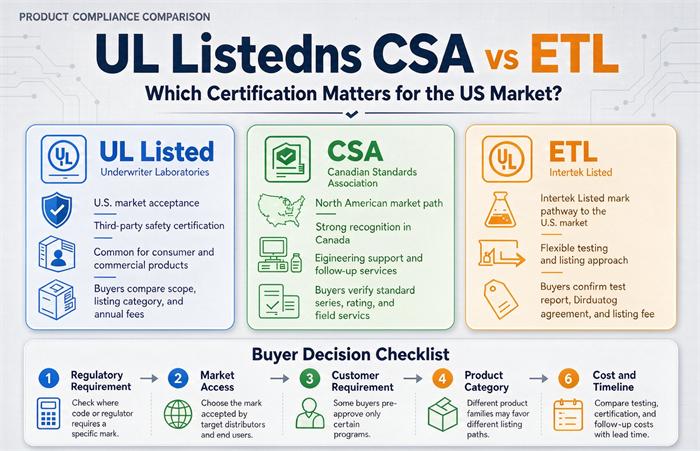
For the US market, no single mark is legally required by name. OSHA requires products used in the workplace to be certified by a Nationally Recognized Testing Laboratory (NRTL). UL Solutions, Intertek (ETL) and CSA Group are all recognized NRTLs, so a UL, ETL or CSA mark carries the same code weight.
That is the whole answer in one paragraph. The rest of this article is about the part that answer leaves out, and it is the part that actually costs buyers money: equivalent does not mean interchangeable. Three marks can carry identical legal weight and still get your equipment rejected at inspection. It usually happens for one of three reasons, and none of them have anything to do with how safe the product is.
- The certifying body was never recognized for the specific standard your product falls under.
- The mark on the nameplate covers only one country, and your project is in the other one.
- The standard named on the certificate is not the standard your voltage and kVA actually require.
Everything below is written for people buying transformers, panels and distribution equipment for North American projects. If you are sourcing consumer goods, most of this still applies, but the standard numbers will differ.
Why three marks confuse buyers: two countries, two systems
The confusion starts because North America looks like one market and is not. The US and Canada each run their own conformity system, with their own accreditor, and the same three companies happen to be licensed in both.
In the US, OSHA runs the NRTL program
OSHA does not test anything. Under its Nationally Recognized Testing Laboratory program, OSHA recognizes private laboratories that meet the requirements in 29 CFR 1910.7, then publishes each one’s scope of recognition: the list of test standards that lab is currently recognized to certify against.
The key sentence, and it comes straight from Intertek’s own ETL page, is that OSHA does not require UL specifically. It requires certification by a recognized NRTL. That single fact settles the “is ETL as good as UL” argument before it starts. At federal level, there is no hierarchy.
CSA Group’s OSHA recognition is a matter of public record. OSHA’s own NRTL page lists CSA Group Testing and Certification Inc. under docket OSHA-2006-0042, headquartered in Etobicoke, Ontario, with recognized testing sites that include Cleveland, Irvine, Alpharetta and Plano. So a body whose name says “Canadian Standards Association” is an OSHA-recognized NRTL for the US market too. That surprises a lot of buyers.
For scale: OSHA’s Federal Register notice of 25 February 2011 on NRTL fees recorded 15 NRTLs operating 49 sites at that time, including Canadian Standards Association (6 sites), Intertek Testing Services NA (13 sites) and Underwriters Laboratories Inc. (15 sites). Treat that as a 2011 figure. The current roster is published on OSHA’s NRTL pages and changes over time, so check the live list rather than quoting a number from any article, including this one.
In Canada, the SCC accredits certifiers and the provinces enforce
Canada separates the roles. The Standards Council of Canada (SCC) is the national accreditation body. It does not issue product certificates. It accredits the organizations that do, and CSA Group, UL and Intertek are all on that list alongside a few dozen others.
The actual enforcement sits one level lower, with provincial and territorial electrical safety regulators. They are the ones who decide whether equipment gets connected. What they look for is a valid certification mark issued by an SCC-accredited body, for the right Canadian standard. They do not insist on CSA over cUL or cETL.
There is also a second route in Canada. For specialized equipment or short production runs, an accredited inspection body can evaluate the unit in the field against SPE-1000 or SPE-3000 and apply a special inspection label. It is not a substitute for certification on a production line, but it is how one-off and low-volume gear gets legally installed.
Where the NEC fits in
Three articles of NFPA 70, the National Electrical Code, do the work here:
- 110.2 requires conductors and equipment to be *approved*, meaning acceptable to the authority having jurisdiction (AHJ). Note what that means: listing is not the Code’s approval mechanism. The AHJ is. Listing is the evidence the AHJ normally relies on.
- 90.7 says factory-installed internal wiring and the construction of listed equipment need not be re-inspected at installation, except to detect alterations or damage. This is the practical reason listing saves you time on site.
- 110.3(B) reads: “Listed or labeled equipment shall be installed and used in accordance with any instructions included in the listing or labeling.” One sentence, and it converts the manufacturer’s installation instructions into enforceable code. If your transformer is listed for a dry location and you set it outdoors in a NEMA 3R enclosure it was never evaluated for, the listing does not cover it, and you are in violation of 110.3(B) even though the product itself is fine.
That third point is where most field failures happen. Not because the mark was fake, but because the equipment was used outside the conditions it was tested for.
UL Listed vs ETL vs CSA: what each mark actually tells you
Here is the comparison, with the marketing language stripped out.
| UL Solutions | ETL (Intertek) | CSA Group | |
|---|---|---|---|
| Who issues it | UL LLC / UL Solutions | Intertek Testing Services NA, Inc. | CSA Group Testing and Certification Inc. |
| US standing | OSHA-recognized NRTL | OSHA-recognized NRTL | OSHA-recognized NRTL (docket OSHA-2006-0042) |
| Canadian standing | SCC-accredited (via ULC / UL) | SCC-accredited TO and CB | SCC-accredited |
| Tests against | UL / ANSI standards it also writes | Existing UL, ANSI and CSA standards | UL, ANSI, CSA and IEC standards |
| Writes its own standards | Yes | No, it tests to others’ standards | Yes, for CSA standards |
| Typical perception | Longest track record in the US | Faster and cheaper, same test | Default choice in Canada |
UL Solutions
UL writes the standards and certifies against them. That combination is why the mark carries the recognition it does, and why a lot of US spec sheets simply say “UL listed” out of habit. For buyers, the useful part is not the brand. It is that UL maintains a public certification database where a file number can be checked. When a supplier sends you a UL certificate, you can verify it independently.
One distinction worth knowing: UL Listed means a complete product was evaluated for its end use. UL Recognized means a component was evaluated for use inside something else, subject to conditions of use. A Recognized component mark on a finished transformer is a red flag.
ETL, issued by Intertek
Intertek does not write UL standards. It tests against the same UL, ANSI and CSA standards that UL Solutions does. Intertek says plainly that products carrying the ETL Mark are equivalent to those with the UL Mark in terms of US safety compliance, that OSHA accepts the ETL Mark, and that local inspectors and AHJs recognize it.
The practical difference buyers report is commercial: Intertek tends to quote faster and cheaper for comparable scope. Directory acceptance is the same. If your spec says “UL listed” and your supplier offers “ETL listed to UL 1561”, the two statements describe the same standard. Whether your AHJ or your customer accepts the substitution is a commercial question, not a code question.
CSA Group
CSA Group is the Canadian standards body that also holds OSHA NRTL recognition and SCC accreditation. It tests to UL, ANSI, CSA and IEC standards, and it has recognized testing sites inside the US as well as in Canada and Asia.
The reason CSA comes up in US projects is usually dual-market coverage. If you are shipping the same design to Texas and Ontario, one certification program that covers both beats running two. CSA also tends to be well regarded outside North America, which matters when the equipment is going into an EPC project with international financing behind it.
Reading the mark: the small letters that decide your inspection
This is the section that prevents the most expensive mistake on the list. A certification mark tells you which country’s standards the product was assessed against, and it does that with small letters around the logo.
| Mark | Issued by | Covers | What it means |
|---|---|---|---|
| UL (no c) | UL Solutions | US only | Not valid for a Canadian installation |
| cUL | UL Solutions | Canada only | Canadian standards only |
| cULus | UL Solutions | Canada + US | One mark, both markets |
| ETL (no c) | Intertek | US only | Not valid for a Canadian installation |
| cETL | Intertek | Canada only | Canadian standards only |
| cETLus | Intertek | Canada + US | One mark, both markets |
| CSA / CSA-US | CSA Group | Canada / US respectively | Single-country forms |
| cCSAus | CSA Group | Canada + US | One mark, both markets |
| UR / cURus | UL Solutions | Component | Recognized component, not a finished product |
The lowercase c means Canadian standards were met. The lowercase us means US standards were met. Both present means one certification covers both markets.
Two habits that save projects:
- Look at where the c sits. Canadian guidance puts the indicator at roughly the 8 o’clock position on the mark, bottom left. A plain UL or ETL mark with no c is a US-only certification, and it will not pass a Canadian inspection.
- Decide your market combination before you certify. If you certify US-only and then win a Canadian order, you go back and add the Canadian evaluation. Doing both up front is almost always cheaper than doing them in sequence.
The five things that actually differ (safety is not one of them)
Safety equivalence is settled. These five are where the real decisions live.
1. Whether your customer or spec names a body
This outranks everything else. If the contract, the tender or the customer’s approved-vendor list says “UL listed”, then UL is what you need, regardless of what the code would allow. Some Canadian industrial and public-sector tenders name CSA the same way. Argue this at bid stage, not at submittal.
2. Scope of recognition
This is the one almost nobody checks, and it is the one that quietly kills projects. OSHA recognition is granted per standard, per laboratory. A body can be an NRTL in general and still not be recognized for the specific standard your product needs.
Before you accept a quote, ask the certifier one question: *are you currently recognized for this standard, and is this product category inside your scope?* Get it in writing. The answer is published on OSHA’s NRTL pages, one page per laboratory.
3. Factory follow-up inspection
A listing is not a one-off test. It comes with periodic, usually unannounced, factory inspection to confirm production still matches what was certified. Bodies differ in cadence and in how predictable they are to work with. If you are the manufacturer, this is an ongoing operating cost. If you are the buyer, ask how recent the last follow-up was.
4. Lead time and commercial terms
Bodies genuinely differ here. What we will not do is print a price table. Published figures for UL and ETL certification range wildly depending on who you read, and none of the numbers you see in comparison articles carry a verifiable source. Instead, here is what actually drives the quote, so you can compare offers properly:
- Number of standards and models in a single file
- Whether the design is new or a modification of an existing listing
- Sample count, weight and shipping to the lab
- Whether Canadian coverage is included
- Factory audit travel
- How many retests the first samples survive
Ask for a fixed-scope quote from two bodies and compare on those six items.
5. How easily you can verify the certificate
Every one of the three bodies publishes a searchable directory. UL, Intertek and CSA all let you check a file number or certificate number. A supplier who sends a PDF but no file number is asking you to take a screenshot at face value. Do not.
What this means for transformers and distribution equipment
Here is where the generic certification articles stop helping. For dry-type transformers, the standard depends on voltage first and kVA second.
The 601 V line: UL 1561 vs UL 1562
- UL 1561 covers dry-type general purpose and power transformers rated 600 V and below. The 480 V delta to 208Y/120 V unit feeding a commercial building is a UL 1561 product. Per UL’s standard page as cited by industry sources, edition 4 was published in March 2011 and reaffirmed as an American National Standard on 31 August 2023 with no technical changes. Confirm the current edition on UL’s standard page before you write it into a spec.
- UL 1562 picks up where 1561 stops: dry-type distribution transformers from 601 V to 35,000 V, including solid cast and resin encapsulated constructions. Per the same sources, edition 4 was published January 2013 and last revised 11 August 2020, when insulation system requirements were updated. The 13.8 kV cast resin unit feeding a data hall is a UL 1562 product.
The two look similar on a drawing and cannot share a test card. Getting this wrong at RFQ stage means retesting.
UL 5085 and UL 1446: the two names that get confused
- UL 5085 is the general standard for smaller transformers, the control and small isolation units that feed PLCs, sensors and control circuits. Where exactly the boundary sits against UL 1561 depends on construction and rating, so confirm against the standard scope rather than a rule of thumb.
- UL 1446 is the insulation system standard. It qualifies the insulation materials and construction, not the finished machine. A UL 1446 file is not a product listing, and a supplier who offers it as one either misunderstands or is hoping you do.
Exclusions that kill a submittal
Both dry-type standards have exclusion lists, and every line on them has caught a buyer somewhere. Commonly excluded: liquid-filled transformers, voltage regulators, instrument transformers, motor-starting autotransformers and reactors, arc furnace transformers, rectifier transformers, mining transformers, and specialty transformers.
One exclusion surprises project managers more than the rest. Transformers under the exclusive control of an electric utility fall outside UL 1562 even when the voltage sits right in the middle of its range. If the unit is on the utility side of the meter, the utility specification and the NESC govern. If it is behind the meter, at a data center, a hospital or a plant, UL 1562 is the document your inspector will reference.
Energy efficiency is a separate track entirely
A safety listing and an energy compliance obligation are two different things, and buying one does not get you the other. In the US, distribution transformer efficiency sits under DOE 10 CFR 431, with the compliance date of 23 April 2029 applying to the current rule (89 FR 29834; see also 90 FR 43371). An ETL listed, UL listed or CSA certified transformer can still fail to meet the DOE efficiency table. Check both columns.
A 7-step check before you accept any certificate
Run this on every certificate a supplier sends you. It takes about ten minutes.
- Get the file number, not just the certificate image. No file number, no verification.
- Look it up in the issuing body’s directory. UL, Intertek and CSA all publish searchable databases.
- Match the nameplate to the certificate. Same model, same ratings, same voltage class.
- Check the standard number. For dry type, UL 1561 at 600 V and below, UL 1562 from 601 V to 35 kV.
- Check the country letters. No lowercase c means no Canadian coverage.
- Check the scope. Confirm the body is currently recognized for that standard under the OSHA NRTL program.
- Check the date and the follow-up status. An expired listing, or one suspended for a failed factory audit, is not a listing.
If step 2 through step 7 all pass, you have what you need for submittal. If any one of them fails, find out before the container ships, not after.
So which one should you buy?
Read the decision in this order, and stop at the first line that applies to you.
- Your spec, contract or customer names a body. Take that one. Nothing else matters yet.
- You ship to Canada as well as the US. Take a dual mark: cULus, cETLus or cCSAus. One program, both markets.
- You ship US only, and nobody named a body. Pick on scope, lead time and quote. Confirm the body is recognized for your standard before you sign.
- You are buying transformers specifically. Confirm UL 1561 or UL 1562 first, then pick the body. The standard decides the test plan, and the body decides who runs it.
That is the whole decision. The mark itself is the least interesting part of it.
If you are specifying dry-type or cast resin transformers for a US or Canadian project, send us the primary and secondary voltage, the kVA, the application and the installation country. You get the governing standard and the test plan back in the same reply, instead of discovering a mismatch at drawing approval.
FAQ
Is ETL the same as UL listed?
Yes, for US code compliance. Intertek states that products with the ETL Mark are equivalent to those with the UL Mark, because both bodies are OSHA-recognized NRTLs testing to the same UL and ANSI standards. The difference is commercial: cost, lead time and brand familiarity.
Does OSHA require UL certification specifically?
No. OSHA requires certification by a recognized NRTL, and it does not name UL. Intertek states this directly on its ETL page. UL Solutions, Intertek and CSA Group all hold OSHA NRTL recognition.
Is a CSA mark accepted in the United States?
Yes. OSHA’s NRTL program lists CSA Group Testing and Certification Inc. under docket OSHA-2006-0042, with recognized testing sites in the US as well as Canada. A CSA mark is accepted the same way a UL or ETL mark is, provided the standard falls within the body’s scope.
Can I use a UL listed transformer in Canada?
Not with a plain UL mark. A mark without the lowercase c covers US standards only. For a Canadian installation you need cUL, cULus, cETLus, cCSAus or an equivalent SCC-accredited certification for the right Canadian standard.
What is the difference between cUL and cULus?
cUL means the product was certified to Canadian standards only. cULus means one certification covers Canadian and US standards, so a single mark works in both markets. The same logic applies to cETL versus cETLus from Intertek.
Which UL standard applies to my dry-type transformer?
UL 1561 for transformers rated 600 V and below, such as a 480 V to 208Y/120 V building unit. UL 1562 for 601 V to 35,000 V, including cast resin units at 13.8 kV. Small control and isolation transformers generally fall under UL 5085.
Is UL 1446 enough to call a transformer UL listed?
No. UL 1446 qualifies the insulation system, which is a component-level evaluation. It does not cover the finished transformer. A complete product needs a listing under UL 1561, UL 1562 or UL 5085 as applicable.
Does a safety certification cover DOE energy efficiency rules?
No. Safety listing and energy efficiency are separate obligations. US distribution transformer efficiency falls under DOE 10 CFR 431, with the compliance date of 23 April 2029 for the current rule. Verify both.
How can I verify that a certificate is real?
Ask for the file or certificate number and look it up in the issuing body’s public directory. UL, Intertek and CSA all publish searchable databases. Then confirm the model, ratings, standard number, country letters and current status.
Does CE marking replace UL, ETL or CSA in North America?
No. CE is a manufacturer’s declaration for EU directives and carries no North American approval. Equipment for US or Canadian installations needs a mark from an OSHA-recognized NRTL and, in Canada, an SCC-accredited certification body.