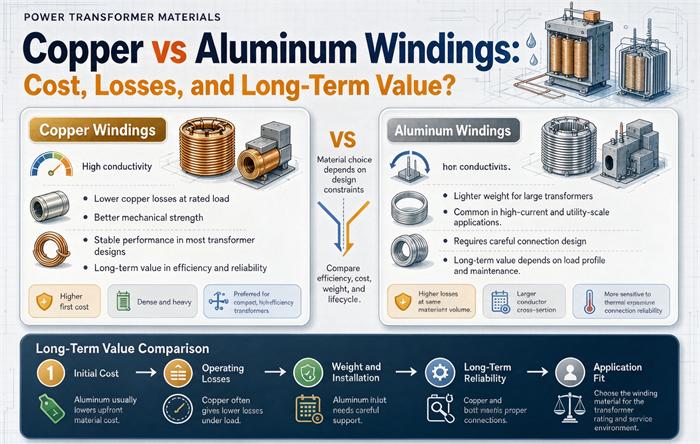
Copper windings cost more up front but run with lower I²R losses and more forgiving connections. Aluminum windings cost about 15 to 30 percent less and weigh roughly half as much for the same rating, but they give some of that saving back through higher lifetime energy loss and need careful terminations. The right pick depends on load factor, duty, and how you value losses.
This guide walks through the real tradeoffs so you can spec the right conductor on your next transformer, write it cleanly on an RFQ, and avoid the cheap quotes that quietly cost you later.
The 30-Second Answer
If you only read one table, read this one.
| If your priority is… | Lean copper | Lean aluminum |
|---|---|---|
| Lowest first cost | ✅ | |
| Lightest unit (roof, crane, shipping) | ✅ | |
| Lowest lifetime energy loss | ✅ | |
| Toughest connections and abuse tolerance | ✅ | |
| Compact coil in a tight enclosure | ✅ | |
| Steady, low load factor duty | ✅ | |
| Harsh, humid, or coastal site | ✅ |
Neither metal is “better.” They meet the same performance standards. They just spend your money in different places.
What the Winding Actually Does
The winding is the conductor coil, high voltage and low voltage, that carries current and makes the voltage change happen. The metal you choose does not change what the transformer is for. It changes four things that matter to you:
- how big the coil has to be for a given current density,
- how much heat the coil makes at full load,
- how the connections at the leads behave over years of thermal cycling, and
- how heavy the active part is when you lift and ship it.
Both materials can be built to the same standard, whether that is IEEE C57.12.00 in North America or IEC 60076 in Europe and most export markets (see our IEEE vs IEC standards note for export buyers). Material is a design choice inside that standard, not a pass or fail on the standard itself.
The Conductivity Math (Where It Starts)
Copper sets the reference. Annealed copper is defined as 100 percent IACS (International Annealed Copper Standard). Electrical-grade aluminum runs about 61 percent IACS. That single number drives almost everything else.
Resistance is R = ρ × L / A. For an aluminum coil to carry the same current at the same resistance as copper, the cross-sectional area has to grow to roughly 1.6 times the copper area. The coil gets bigger.
But aluminum is light. Its density is about 2.70 g/cm³ against copper’s 8.96. So even with 1.6 times the volume, an equivalent aluminum winding still weighs roughly half as much as the copper one. That is why aluminum dominates where shipping weight and crane limits rule.
| Property (20°C reference) | Copper | Aluminum |
|---|---|---|
| Conductivity (% IACS) | 100 | ~61 |
| Resistivity (10⁻⁸ Ω·m) | ~1.68 | ~2.82 |
| Density (g/cm³) | 8.96 | 2.70 |
| Cross-section for equal resistance | 1.0× | ~1.6× |
| Weight for equal performance | 1.0× | ~0.5× |
| Tensile strength (general) | Higher | Lower |
| Thermal expansion (10⁻⁶/°C) | ~17 | ~23 |
These are textbook reference values. The point is not the decimals. It is that aluminum buys its weight saving with a larger coil and a higher resistance per unit volume, and that difference shows up later as loss and connection behavior.
Cost: What You Pay Up Front
Aluminum raw metal has historically traded at roughly a third of copper’s price per tonne. That sounds like a slam dunk, but the finished winding is not just metal. You also pay for the larger coil, the extra insulation wrap, the different jointing process, and the terminations. In a finished transformer, a well-designed aluminum unit typically lands about 15 to 30 percent below the copper equivalent on first cost.
Two cautions before you bank the saving.
First, both metals are volatile. Copper swings hard with EV demand, construction cycles, and speculation. Aluminum is steadier but not flat. Ask for a valid quote window and do not treat a material price as fixed for the year.
Second, do not let a supplier turn the saving into a mystery. A credible quote states the conductor grade, the guaranteed losses, and the termination type. If those are missing, the low price is not a saving yet. It is a question.
Losses: Where the Real Money Goes
This is the part most spec sheets gloss over. The load loss is I²R, and resistance is where aluminum gives ground. A bigger coil can be designed back to the same guaranteed loss, but that costs coil and core, which is exactly why the finished price gap is smaller than the metal gap.
Here is an illustrative number, not a quote. Take a 1,000 kVA distribution transformer at a 60 percent average load factor, running 8,760 hours a year, at $0.12/kWh. A comparable aluminum design might show roughly 0.4 to 0.6 kW higher average effective load loss than the copper one. Call it 0.5 kW:
- 0.5 kW × 8,760 hours = 4,380 kWh per year
- 4,380 × $0.12 = about $526 per year
- over 20 years, before any energy inflation, that is roughly $10,500
Add one field visit to retorque a loose aluminum termination and the upfront saving can shrink fast. The lesson is not “copper always wins.” It is that the metal name matters less than the guaranteed no-load and load losses on the nameplate. A tight aluminum design in the right efficiency class can beat a lazy copper design on lifecycle cost.
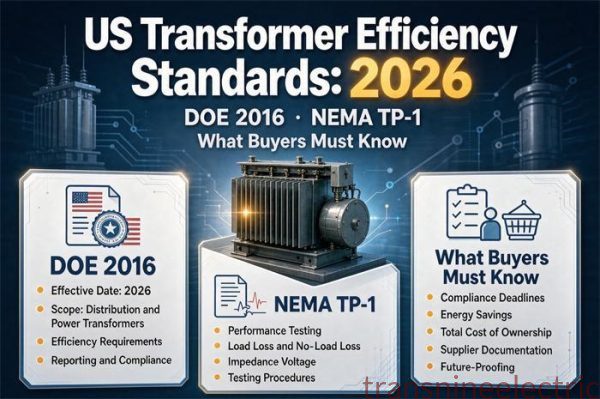
That is also why U.S. efficiency rules do not pick a winner. DOE distribution transformer standards under 10 CFR Part 431 set minimum efficiency through total losses. They are material-neutral. A manufacturer can hit the level with either conductor. The 2026-era tightening (the next update lands with an April 23, 2029 compliance date) pushes losses down further, but it still does not tell you which metal to use.
Utilities and large owners often go further and put a dollar value on losses, then buy on that capitalized cost. In those models, even a small guaranteed-loss difference can move the winning bid. If you buy like that, you are already buying on losses, not on copper versus aluminum.
Connections and Reliability
Inside the tank or cast resin, the joints are the manufacturer’s problem and they handle it with plating, welding, or approved mechanical connectors. The part that becomes your problem is the lead and termination where your installer lands the cable.
Aluminum forms a dense oxide (Al₂O₃) that does not conduct. Copper oxide is softer and breaks under contact pressure, so copper connections stay friendlier. Aluminum also creeps: under sustained pressure and thermal cycling it flows, and a bolt can loosen over time. Its thermal expansion coefficient, about 23 versus copper’s 17 per °C, makes that cycling a little more aggressive.
In the U.S., this is not optional reading. NEC 110.14(B) requires terminations rated for the conductor. An aluminum lead must land on a connector listed AL-CU, with the right antioxidant and torque. Skip that and you build a hot spot. None of this is a reason to avoid aluminum. It is a reason to spec the termination and the jointing practice, not just the metal.
Long-Term Value: Life, Maintenance, Theft, Scrap
Well-designed units of either metal run 30 to 40 years. The difference is in the edges.
Aluminum asks for more attention at the connections. Plan for periodic torque checks, especially in the first year of thermal cycling. In humid or coastal air it oxidizes faster, so enclosures and siting matter more.
Copper carries a heavier scrap value. That sounds like a plus, until you remember that a copper-wound padmount sitting outdoors is also a more attractive theft target. Aluminum’s lower scrap value is, oddly, a small security advantage for exposed sites.
On end-of-life economics, the “copper is worth more as scrap” argument is real but distant. Discounted to today, the upfront aluminum saving usually beats the future copper scrap by a wide margin, which is the standard net-present-value case for aluminum. Neither should drive the decision alone.
North America and the EU: What Buyers Actually See
In North American utility and many commercial oil-immersed distribution transformers, aluminum is the mainstream winding. Decades of field proof, steadier metal cost, and weight savings pushed it there. In U.S. commercial buildings, dry-type units are still frequently copper, especially where the enclosure is tight or the owner wants the lower loss and the easier connections.
In Europe, IEC 60076 is the frame and both materials are common, with the same application logic: aluminum where weight and first cost lead, copper where loss and reliability lead. The standard does not prefer one. Your specification does.
So when a vendor tells you “aluminum is fine, everyone uses it,” that is true for a lot of distribution duty and false as a blanket rule for critical or high-load sites. Read the duty, not the trend.
Copper or Aluminum? A Decision Matrix
| Application | Usually copper | Usually aluminum | Why |
|---|---|---|---|
| Data center, critical UPS feed | ✅ | Low loss, tight enclosure, few failure points | |
| Utility/large commercial distribution | ✅ | Steady load, weight, first cost | |
| Industrial, frequent faults or overload | ✅ | Short-circuit strength, abuse tolerance | |
| Commercial building dry-type | ✅ | Enclosure space, connections, loss | |
| EV charging aggregate load | ✅ | High sustained load factor | |
| Roof-mounted or crane-limited | ✅ | Weight | |
| Backup or lightly loaded standby | ✅ | Low hours, first cost wins | |
| Coastal or humid outdoor | ✅ | Corrosion and connection stability |
If your load factor is high and your hours are long, copper’s loss saving compounds. If the unit sits lightly loaded or moves around, aluminum’s first-cost saving is the better deal.
Red Flags When a Quote Looks Too Good
A few tells that the “copper” price is not what it says.
- Copper-clad aluminum (CCA). A copper skin over an aluminum core. It looks like copper, tests poorly like aluminum, and is a known cost-cut. Insist on the conductor grade in writing and a material certificate.
- “Copper wound” at an aluminum price. If the number only works if the metal is aluminum, ask directly what the winding is.
- No guaranteed losses on the offer. A serious supplier states no-load and load loss at rated temperature. If they dodge, the loss saving you wanted may not exist.
- No standard or test reference. For the U.S., ask for IEEE C57.12.00 compliance and the relevant listing. For export, IEC 60076. No reference means no yardstick.
We cover what a clean test package looks like in our transformer routine testing guide.
What to Write on Your RFQ
Give your supplier enough to quote the unit you actually need, not the one that is cheapest to build.
- kVA or MVA, HV and LV voltages, vector group, impedance
- Applicable standard: IEEE C57.12.00 (North America) or IEC 60076 (export), and any listing such as UL
- Guaranteed no-load and load losses at rated temperature, not just “copper” or “aluminum”
- Winding conductor: copper, aluminum, or “manufacturer to propose for stated losses and duty”
- Termination type and whether leads are aluminum (then AL-CU listed fittings apply)
- Site: indoor or outdoor, ambient, altitude, coastal or corrosive
- Whether the unit will parallel an existing transformer (attach the nameplate photo)
Our buyer’s guide for 2026 walks the wider spec, and our nameplate guide shows where the guaranteed losses live on the plate. For the enclosure and cooling choice that wraps around the winding, see oil-immersed vs dry-type.
Frequently Asked Questions
Is copper or aluminum better for transformer windings?
Neither is universally better. Copper gives lower losses, stronger short-circuit behavior, and easier connections. Aluminum gives lower first cost and about half the weight. The right choice follows your load factor, duty, and loss valuation.
Why are aluminum windings cheaper?
Aluminum metal costs roughly a third of copper per tonne, and even after the larger coil and extra processing, a finished aluminum winding typically lands 15 to 30 percent below copper on first cost. Prices move, so confirm the quote window.
Do aluminum windings last as long as copper?
A well-designed aluminum transformer lasts 30 to 40 years, similar to copper. The difference is upkeep: aluminum connections need periodic torque checks and fare worse in humid or coastal air.
How much more energy does an aluminum winding waste?
At equal design it should not waste more, because the coil is enlarged to hit the same guaranteed loss. In a looser design, the gap can be 0.4 to 0.6 kW on a 1,000 kVA unit, worth roughly $500 to $600 a year at $0.12/kWh.
Can you mix copper and aluminum in one transformer?
The winding metal is usually consistent per coil, but leads and bus bars may differ. Any copper-to-aluminum joint must use a proper transition connector and listed practice, or it becomes a hot spot.
Does the DOE efficiency standard force copper or aluminum?
No. U.S. DOE distribution transformer rules under 10 CFR Part 431 set minimum efficiency through total losses and are material-neutral. Either conductor can comply.
Which standard applies, IEEE or IEC?
North American units usually follow IEEE C57.12.00. Export and European units follow IEC 60076. Both cover either winding material; the standard does not prefer one.
What is copper-clad aluminum and should I accept it?
CCA is an aluminum core with a thin copper skin. It cuts cost but behaves like aluminum electrically and is a known substitution risk. For important loads, specify solid copper or aluminum in writing and ask for a material certificate.
How do I verify what the winding is really made of?
Read the nameplate conductor material field, request a material certificate, and rely on factory tests. Our routine testing write-up lists the tests a clean unit should pass.
Bottom Line
Pick copper when loss, reliability, and abuse tolerance earn their keep: critical feeds, high load factor, tight enclosures, harsh sites. Pick aluminum when first cost and weight lead and the duty is steady: utility distribution, lightly loaded standby, crane-limited roofs. And remember the one rule that beats the metal argument: buy on guaranteed losses and the termination practice, not on the word “copper” or “aluminum.”