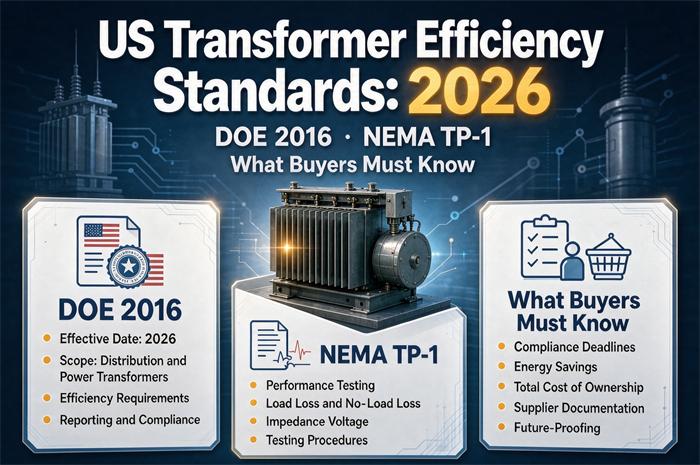
The US transformer efficiency standards that actually govern a 2026 purchase are the DOE 2016 rules (10 CFR Part 431, Subpart K). NEMA TP-1 is the older voluntary benchmark they replaced, and the next mandatory upgrade doesn’t take effect until April 23, 2029. Everything else you’ll read about a “2026 efficiency mandate” for standard distribution transformers needs a second look — we’ll get to that.
If you’re specifying, importing, or buying a distribution transformer for a US or US-territory project in 2026, you’ve probably seen three labels thrown around: NEMA TP-1, DOE 2016, and now a wave of “2026 / 2027 efficiency rule” headlines. They’re easy to confuse, and confusing them can cost you — a denied customs entry, a failed inspection, or a unit that’s legal but needlessly expensive.
This guide cuts through it. We’ll walk the timeline, show the actual efficiency numbers, flag the one detail that trips up even experienced buyers, and give you a five-point checklist you can drop straight into a purchase spec.
The 30-second version
Here’s the whole story on one table:
| Standard | Type | Effective | Status in 2026 |
| NEMA TP-1 (1996 / 2002) | Voluntary industry guide | 1996, updated 2002 | Superseded — the old baseline |
| DOE 2007 (EPAct 2005) | Mandatory federal law | January 2007 | = TP-1 levels; still the floor for some units |
| DOE 2016 | Mandatory federal law | January 1, 2016 | The law you’re buying under right now |
| DOE 2024 amendment (431.192) | Mandatory federal law | April 23, 2029 | Future — affects units built on/after that date |
Plain English: if a transformer is manufactured and imported in 2026, it needs to meet DOE 2016. TP-1 is history. The 2029 rule is real, but it’s a few years out.
First, what NEMA TP-1 actually was (and why it still shows up)
It was voluntary, not a law
NEMA — the National Electrical Manufacturers Association — published TP-1 in 1996 (later tweaked in 2002) as a guide for minimum distribution-transformer efficiency. It was the first nationally recognized benchmark, and it cut losses roughly 50% versus the pre-TP-1 units that were common at the time (Bonneville Power Administration, “Dry-Type Transformer New Construction and Retrofit Energy Savings Potential,” 2021).
The key word is guide. TP-1 was never federal law. What made it stick was that Congress borrowed its numbers: the Energy Policy Act of 2005 turned TP-1 levels into a mandatory federal floor, effective January 2007.
Why the name won’t disappear
You’ll still see “TP-1” on nameplates, in old distributor stock, and across supplier brochures. That’s normal — units built to TP-1 before 2016 are perfectly legal to sell and install. But when someone says “TP-1 compliant” in 2026, what they usually mean is “meets the old minimum,” not “meets today’s law.” Know which one you’re being quoted.
DOE 2016 — the rule that actually governs your 2026 order
What’s in scope (and what isn’t)
DOE 2016 lives in 10 CFR Part 431, Subpart K. It covers distribution transformers with:
- primary voltage at or below 34.5 kV,
- secondary at or below 600 V,
- 60 Hz,
- liquid-immersed units from 10 to 5,000 kVA,
- dry-type units from 15 to 5,000 kVA.
Anything above those limits — large power transformers, units above 34.5 kV — falls outside this rule and under different standards. If your spec is a 2,500 kVA padmount at 13.8 kV to 480 V, you’re squarely inside DOE 2016.
The efficiency numbers buyers ask for
For low-voltage dry-type three-phase units, here are the DOE 2016 minimum efficiencies (measured at 35% of nameplate load, per the DOE test method in Appendix A to Subpart K). These figures are mirrored across Hammond Power Solutions, Eaton, Siemens, and ABB documentation:
| kVA (3-phase) | Min. efficiency |
| 15 | 97.89% |
| 30 | 98.23% |
| 45 | 98.40% |
| 75 | 98.60% |
| 112.5 | 98.74% |
| 150 | 98.83% |
| 225 | 98.94% |
| 300 | 99.02% |
| 500 | 99.14% |
| 750 | 99.23% |
| 1,000 | 99.28% |
Liquid-immersed units are tested at 50% load (not 35%), so don’t line up a dry-type 35%-tested number against a liquid 50%-tested number — they’re measured differently on purpose.
One gotcha: single-phase dry-type didn’t move in 2016
This surprises people. Under the 2016 update, single-phase dry-type transformers kept their old TP-1 (2007) efficiency levels. Sales volumes were too small to justify new testing, so DOE left them alone (BPA; Eaton). If you’re buying single-phase dry-type, the “DOE 2016” table you see quoted may quietly be the 2007 numbers. Always confirm the exact kVA and phase on the compliance document.
The 2029 rule — what changes, and when
Loss reductions by type
DOE finalized a tighter update in 2024 (Federal Register 89 FR 29834), with a compliance date of April 23, 2029. It lowers allowed losses further:
- Liquid-immersed: about 5% loss reduction at single-phase 100 kVA and below and at three-phase 500 kVA and above; about 20% for the sizes in between.
- Low-voltage dry-type: about 30% for single-phase, about 20% for three-phase.
Does your 2026 order need it?
No — not if it’s built and shipped before the deadline. The rule applies to units manufactured on or after April 23, 2029. A transformer made in 2026, 2027, or 2028 follows DOE 2016. If you’re ordering far ahead, just confirm the build date lines up with the standard you’re being held to.
“But I read there’s a 2026 efficiency rule…”
You’re not wrong that the phrase is floating around. But here’s the straight talk: for the standard distribution transformers covered by 10 CFR 431.192, the binding federal efficiency change is 2029, not 2026.
So where does the “2026” noise come from? A few places:
- Different equipment classes. Very-high-voltage power transformers (think 161 kV and above) sit under separate efficiency rules, not 431.192. Headlines about those can read like they apply to everything.
- Trade and tariff measures dated 2026 that affect transformers but aren’t efficiency standards at all.
- Spun or misdated content from low-quality trade blogs that conflate proposals, tariffs, and efficiency.
Before you let a “2026 mandate” claim reshape a spec, check it against the eCFR (10 CFR Part 431) or the DOE Appliance and Equipment Standards portal. If it’s not there, it’s not law yet. Don’t delay a perfectly good 2016-compliant 2026 purchase over a headline.
What you must check before you sign the PO
1. Match the right table
Efficiency minimums depend on three things: transformer type (liquid vs dry), phase (single vs three), and kVA. Pull the value from the correct table — and remember the single-phase dry-type exception above.
2. Get the test report, not just a promise
Ask the supplier for a compliance statement or test report that references 10 CFR Part 431, Subpart K and states the exact test load point (35% for dry-type, 50% for liquid). A nameplate that just says “high efficiency” isn’t enough if a regulator or utility asks.
3. Watch the manufacture date vs the 2029 line
If your delivery slips into 2029, confirm the unit will meet the tighter 2029 loss limits. Build date — not order date — is what counts.
4. Don’t mix up three different compliance tracks
Efficiency (DOE 431) is separate from safety listing (UL 1561 for dry-type, UL 1562 for liquid-immersed) and from performance standards (IEEE C57 series). A unit can be efficient and still lack the UL mark your AHJ requires. Verify all three.
5. Run a quick TCO check
Purchase price is the wrong number to optimize. No-load (core) losses run 24/7; load losses scale with the square of your load. A slightly pricier high-efficiency unit often pays the difference back in a few years through lower energy bills — and over a 20-to-30-year life, the savings can be dramatic. Utilities routinely score bids on capitalized losses, not sticker price. You should too.
Frequently asked questions
Q1: Are NEMA TP-1 transformers still legal to buy and install in 2026? Yes. Units built to TP-1 before the 2016 rule took effect are still legal to sell and install in the US. But TP-1 is the old minimum — new units must meet DOE 2016.
Q2: Is DOE 2016 the same as NEMA Premium? Roughly. DOE 2016 minimums landed close to the old NEMA Premium (2010) voluntary levels. So “DOE 2016 compliant” and “NEMA Premium level” often describe similar efficiency, but only DOE 2016 carries the force of law.
Q3: When does the next US transformer efficiency standard take effect? April 23, 2029, for the DOE amendment finalized in 2024 (89 FR 29834). It applies to units manufactured on or after that date.
Q4: Does the 2029 standard apply to transformers I import in 2026? No. It only applies to units manufactured on or after April 23, 2029. Importing in 2026–2028 means you’re under DOE 2016.
Q5: How do I verify a supplier’s transformer meets DOE 2016? Request a written compliance statement or test report citing 10 CFR Part 431, Subpart K, with the correct test load point for the unit’s type. Cross-check the kVA and phase against the official table.
Q6: What’s the difference between DOE efficiency compliance and UL listing? Different tracks. DOE 431 sets minimum efficiency; UL 1561/1562 are safety listings your local Authority Having Jurisdiction (AHJ) typically requires. A transformer needs both to clear a US project — they’re not the same certificate.
Q7: Do these standards apply to transformers above 5,000 kVA or above 34.5 kV? Not under 431.192. Those larger or higher-voltage units fall outside the distribution-transformer rule and follow different standards. Confirm the exact classification with your engineer before assuming.
Key numbers at a glance
- DOE 2016 effective: January 1, 2016 (10 CFR Part 431, Subpart K)
- Scope: primary ≤ 34.5 kV, secondary ≤ 600 V, 60 Hz; liquid 10–5,000 kVA; dry 15–5,000 kVA
- Test points: dry-type at 35% load; liquid-immersed at 50% load
- Sample minimum (3-phase dry-type): 150 kVA → 98.83%; 500 kVA → 99.14%; 1,000 kVA → 99.28%
- Single-phase dry-type: unchanged from 2007 (TP-1) levels
- Next rule: compliance April 23, 2029 (89 FR 29834); tighter loss limits
Bottom line
In 2026, buy to DOE 2016. Treat NEMA TP-1 as the history lesson, and plan for 2029 only if your build date crosses that line. Match the right table, get the test report in writing, and don’t let “2026 mandate” rumors shake a spec that’s already compliant.
If you’re importing or specifying distribution transformers for a US project and want units with clean DOE 2016 documentation — plus help planning around the 2029 deadline — [reach out for a compliance pack and quote → https://www.transninelectric.com/contact-us/].