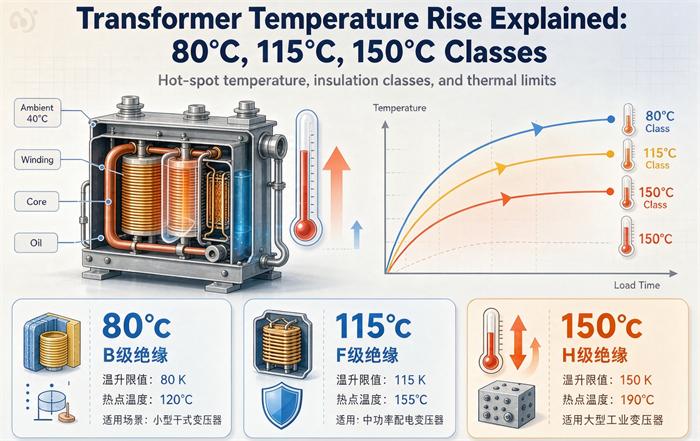
Transformer temperature rise classes, 80°C, 115°C, and 150°C, are the maximum average winding temperature increases above a 40°C ambient that dry-type transformers are built for. The lower the rise, the cooler the windings run, the longer the insulation lasts, and the more overload headroom you get, but the higher the upfront price.
If you have ever spec’d a dry-type transformer for a plant, a data center, or a commercial building, you have seen those numbers on the nameplate: 80°C rise, 115°C rise, 150°C rise. They look like fine print. They are not. Those three classes decide how much overload the unit can take, how many years it will last, and what you pay today versus over the next two decades.
This guide breaks down what each class actually means, puts the numbers side by side, and gives you a straightforward way to pick the right one for your job. No engineering degree required.
What “Temperature Rise” Really Means (and Why It Isn’t the Same as Insulation Class)
Here is the first thing that trips people up. Temperature rise is not the transformer’s operating temperature. It is how many degrees the windings heat up above the surrounding air when the unit runs at its rated load.
So a 150°C-rise transformer sitting in 40°C air has windings averaging about 190°C. And that is the average. The hot spots inside the coil run higher still.
The insulation class is a different number. It is the maximum temperature the insulation system can survive long term without breaking down. The trick: you can wrap the same 220°C insulation system around a transformer designed for a 150°C, 115°C, or 80°C rise. Same insulation, different design target. Keep those two numbers separate or you will size the wrong unit.
The Formula That Ties It Together
Every rating boils down to this:
Ambient + Rise + Hot Spot = Insulation Rating40°C + 150°C + 30°C = 220°C (Class H/R)
That hot-spot term is a built-in allowance, usually 10 to 30°C, because some spots inside a winding always run hotter than the average. It is why you should never just add ambient and rise and call that your insulation limit.
Why 40°C Is the Baseline
Almost every dry-type rating assumes a 40°C maximum ambient temperature. That is NEMA ST-20 and IEEE C57.12.01 talking. If your site runs hotter, a desert substation or a cramped electrical room, you need to derate. We get to that below.
The Three Classes at a Glance
This is the table most buyers bookmark. It shows what you actually get from each class when the unit runs at its nameplate in 40°C air.
| Temperature rise | Avg winding temp at 40°C ambient | Typical insulation system | Hot-spot temp | Continuous overload vs 150°C | Best for |
|---|---|---|---|---|---|
| 80°C | ~120°C | 220°C (Class H/R) | ~150°C | +30% | Heavy or cyclic loads, hot sites, maximum life |
| 115°C | ~155°C | 155 to 220°C (Class F/H) | ~180°C | +15% | General purpose, balanced cost and life |
| 150°C | ~190°C | 220°C (Class H/R) | ~220°C | 0% | Budget jobs, steady light loads |
80°C Rise: Coolest, Most Efficient, Priciest Up Front
An 80°C-rise unit is the premium build. It runs about 30 to 35% lower full-load losses than a 150°C unit (per Acme Electric / Hubbell loading data), which means it wastes less energy as heat. That same thermal margin gives it roughly 30% continuous overload capacity.
The payback math is real: manufacturer loading studies show an 80°C transformer recovers its price premium in about 1 to 2 years when you load it at 75% or more, continuously, and in roughly a year at full load.
The trade-off is simple. Bigger conductors cost more, so the purchase price is the highest of the three.
Who picks it: data centers, foundries, any site with harmonic or K-rated loads, or anywhere the ambient climbs above 40°C. If the unit needs to survive abuse, this is the one.
115°C Rise: The Practical Middle Ground
This is the workhorse most engineers default to. It cuts full-load losses by roughly 20 to 30% versus 150°C and carries about 15% continuous overload.
Payback over a 150°C unit lands at about 2 years when the load sits above 65% of nameplate, and about a year at 90% load. For a typical commercial or light-industrial building, that is a sweet spot.
One watch-out: below roughly 50% load, the efficiency edge mostly disappears. If your transformer will loaf along at a third of its rating, the extra copper does not pay for itself.
150°C Rise: Standard and Cheapest, Zero Overload Headroom
The 150°C rise has been the industry default for decades, and for good reason on the right job: lowest purchase price, widely stocked, perfectly fine when the load is steady and well under nameplate.
The catch is headroom. At nameplate you are at the insulation limit, so there is no continuous overload capacity built in. The moment you add motor starting surges, harmonics, or a hot room, that comfortable margin is gone.
It is the right call when capex is tight and the load is predictable. It is the wrong call the day you need 10% more than you planned for.
How to Choose the Right Class
This is the part most articles skip. Here is a decision path you can actually use.
By Load Profile
- Steady load under 50% of nameplate: 150°C. Cheapest, no penalty.
- Variable or peaky load, 65% to 100%: 115°C. Balanced.
- Cyclic overloads, motor starting, sustained 75%+: 80°C. Buy the margin.
By Environment
- Ambient above 40°C (desert, enclosed room): a lower rise buys thermal margin, or you derate the unit.
- Harmonics or K-rated loads: go lower rise. Extra heat from harmonics eats into the budget fast.
- NEMA ST-20 derating when you cannot lower the rise: 50°C ambient drops you to 0.91 of rating, 55°C to 0.87, 60°C to 0.82. Add sun or confined airflow and it gets worse.
By Budget
- Tight capex, stable load: 150°C.
- Lifecycle savings matter: 80°C or 115°C. Run the payback at your real load percentage, not the brochure’s best case.
ANSI/IEEE vs IEC (North America vs Europe)
North American jobs follow NEMA ST-20 and IEEE C57.12.01 at 60 Hz, with the rise classes above. European and much of Asian business follows IEC 60076-11 at 50 Hz. The 80/115/150 concepts carry over, but the enclosure and climate codes do not: IEC uses IP ratings and the C1/C2, E0/E1/E2, F0/F1 climate classes.
If you ship to both markets, confirm frequency, enclosure rating, and climate class, not just the rise number. A transformer that is perfect on paper in one standard can miss the mark in the other.
Worked Example: A 1,000 kVA Data-Center Feed
Picture a data center that needs 1,000 kVA, runs at 85% average load around the clock, in a room that tops out at 40°C.
- 150°C: cheapest, but at 85% load with no overload headroom. Any growth means a new unit.
- 115°C: +15% overload handles about 1,150 kVA, and pays back in about a year at 90% load.
- 80°C: +30% gives roughly 1,300 kVA of headroom, about 35% lower loss, payback in 1 to 2 years at 75%+.
Our pick: 80°C if the capex stretches, because it future-proofs the feed. 115°C if the budget is fixed. Either beats 150°C on this duty.
Frequently Asked Questions
Is a lower temperature rise the same as a higher kVA rating?
No. An 80°C-rise 1,000 kVA transformer is still 1,000 kVA on the nameplate. The lower rise gives you thermal margin and overload headroom, not a bigger rating. Do not uprate a transformer just because it runs cooler.
Can I use a 150°C-rise transformer in a 50°C environment?
Not at full nameplate. Per NEMA ST-20 you derate to about 0.91 of rating at 50°C ambient, and less with direct sun or confined airflow. A lower-rise unit or forced-air cooling is often cheaper than oversizing.
Which temperature rise class lasts the longest?
The lower the rise, the cooler the windings and the slower the insulation ages. 80°C units typically outlive 150°C units under the same load. Sustained overheating roughly halves insulation life for every 8 to 10°C above rating, the IEEE 10-degree rule.
Do these 80°C, 115°C, 150°C classes apply to oil-filled transformers?
No. Liquid-filled transformers use 55°C or 65°C average winding rise under IEEE C57. The 80°C, 115°C, and 150°C classes are specific to dry-type transformers.
80°C vs 115°C rise: which should I specify?
If your load stays above about 65% of nameplate most of the time and you care about lifecycle cost, 115°C pays back fast. If you have heavy peaks, harmonics, or a hot site, 80°C is the safer long-term buy.
Bottom Line
The three dry-type temperature rise classes, 80°C, 115°C, and 150°C, are really three answers to one question: how much thermal margin do you want to pay for? 150°C is the budget default with zero overload headroom. 115°C is the balanced workhorse. 80°C is the efficient, long-life choice for demanding sites.
Match the class to your load profile, your environment, and your budget, and you avoid both overspending today and a premature failure ten years from now. Get that right and the nameplate stops looking like fine print.