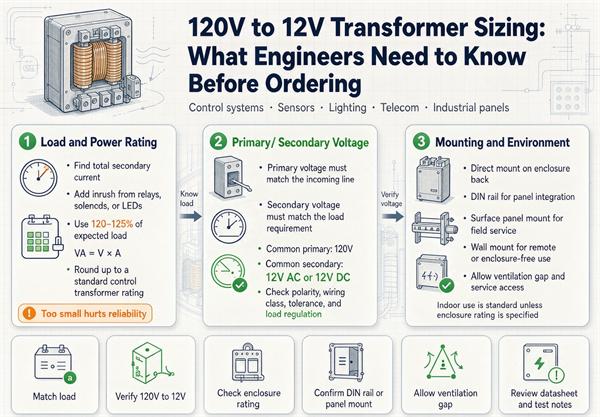
A 120V to 12V transformer steps 120 V AC mains down to 12 V AC so you can run LED lighting, sensors, relays, and low-voltage controls safely. To size one before ordering, lock down four numbers: the VA or kVA rating from your real load including inrush, the 120 V primary that matches your supply, the 12 V secondary current (VA divided by 12), and the enclosure or mounting style for your site. Get those right and the unit runs cool and quiet for years. The single-phase transformer range from TransNin Electric covers chassis, DIN, panel, and outdoor builds for exactly this job.
How a 120V to 12V Transformer Works
A 120V to 12V unit is a step-down isolation transformer. The primary winding connects to 120 V AC; the secondary delivers 12 V AC. The voltage ratio equals the turns ratio, so 120 to 12 is a 10 to 1 ratio. Because power stays roughly constant once you subtract small losses of 5 to 10 percent, the secondary current is about 10 times the primary current. That single fact drives most of your wire and breaker choices.
Remember the output is AC. If your load needs 12 V DC, most LED drivers, sensors, and PLC I/O do, a transformer alone will not give it. You need a transformer plus a rectifier, or a 120 V AC to 12 V DC power supply. We dig into that trap below.
The Sizing Math: VA, kVA, and Current
Transformers are rated in VA (volt-amps) or kVA (1,000 VA), not watts. Watts are real power; VA includes the reactive part from coils and drivers. For a load with power factor below 1.0, VA is higher than watts.
Quick rule: VA equals watts divided by power factor. A 4 W LED with a 0.85 power factor actually pulls 4.7 VA.
Primary Current (120 V Side)
Primary current in amps equals VA divided by 120.
Secondary Current (12 V Side)
Secondary current in amps equals VA divided by 12. Because 120 divided by 12 is 10, the 12 V side carries roughly 10 times the primary current. A 100 VA unit draws about 0.83 A on the primary but 8.3 A on the secondary. Size your 12 V wiring for that reality, not the line side.
Convert VA to kVA
kVA equals VA divided by 1,000. A 300 VA unit is 0.3 kVA. Most 120V to 12V units sit well under 1 kVA, so you will usually spec in VA.
Sizing Quick-Reference Table
| Load (W, PF 1.0) | VA at PF 0.85 | VA with 1.25 margin | Suggested standard size |
| 10 W | 11.8 VA | 15 VA | 20 VA |
| 20 W | 23.5 VA | 29 VA | 30 VA |
| 40 W | 47 VA | 59 VA | 75 VA |
| 60 W | 71 VA | 88 VA | 100 VA |
| 100 W | 118 VA | 147 VA | 150 VA |
| 150 W | 176 VA | 220 VA | 250 VA |
| 200 W | 235 VA | 294 VA | 300 VA |
| 300 W | 353 VA | 441 VA | 500 VA |
Standard VA steps run 20, 30, 40, 50, 75, 100, 150, 200, 300, 500, 750, and 1000 VA and up. Round up to the next step, never down.
Secondary Current by Size
| Unit VA | Primary current (120 V) | Secondary current (12 V) |
| 20 VA | 0.17 A | 1.67 A |
| 100 VA | 0.83 A | 8.33 A |
| 300 VA | 2.50 A | 25.0 A |
| 500 VA | 4.17 A | 41.7 A |
Why Steady Watts Are Not Enough
Two things blow up a transformer that was sized right on watts alone: inrush and poor power factor.
Inrush Current
Coils and capacitor-input loads pull a big surge at switch-on. Control-transformer coils can draw 8 to 10 times their sealed VA for a fraction of a cycle. A capacitor-input DC supply after rectification can need 1.8 times the DC wattage in transformer VA. If you size only for sealed or steady current, the transformer overheats or the primary fuse nuisance-trips.
Worked example: a contactor coil sealed at 20 VA but with 9x inrush needs a transformer rated for the inrush, not the 20 VA. A 50 VA control transformer covers it. For a rectified 12 V DC load drawing 2 A (24 W), size the transformer at 24 x 1.8 = 43 VA, then round to 50 or 60 VA.
Power Factor
LED fixtures with internal drivers often show PF around 0.7 to 0.9. Use VA equals W divided by PF, then add the 1.25 continuous-load margin from NEC 210.20(A) and 215.3. Skipping this is the most common reason a 12 V system dims at the far end of a run.
Voltage Drop on the 12 V Side
The 12 V secondary is unforgiving. A drop of just 1.5 V is 12 percent of the supply, and LEDs dim or shut off. Keep the farthest point above about 10.8 V for reliable LED operation.
Three levers fix drop:
- Use heavier wire. Move from 16/2 to 14/2 or 12/2 on long runs.
- Shorten the run or home-run each zone from the transformer.
- Use a multi-tap transformer with 12, 13, 14, and 15 V taps; pick the higher tap for the longer leg.
| Distance from transformer | Suggested tap (multi-tap unit) |
| Under 50 ft | 12 V |
| 50 to 100 ft | 13 V |
| 100 to 150 ft | 14 V |
| 150 to 200 ft | 15 V |
Verify with a voltmeter at the farthest fixture under load and adjust the tap. Never run the transformer above 80 percent of its VA rating, or heat shortens its life.
AC or DC? The 12V AC vs 12V DC Trap
This is the mistake that wastes the most orders. A 120V to 12V transformer outputs 12 V AC. If your equipment says 12 V DC, a transformer by itself will not power it and may damage sensitive electronics.
- Need 12 V AC (halogen landscaping, some relays, bell circuits): a transformer is correct.
- Need 12 V DC (most LED drivers, sensors, PLC I/O, cameras): specify a 120 V AC to 12 V DC power supply, or a transformer followed by a rectifier and regulator.
- Not sure: check the load label. “12 VAC” means transformer. “12 VDC” means you need a supply, not a bare transformer.
Spell this out in your RFQ. It is the fastest way to avoid a return.
Enclosure and Mounting Options
Where the unit sits decides the enclosure. Pick from this short list:
| Mounting or enclosure | Best for | Rating to look for |
| Chassis mount | Inside a panel or enclosure | Open frame, IP00; protect with the host panel |
| DIN rail | Control cabinets | Easy clip-in, pair with IP20 cabinet |
| Panel mount | Through a metal enclosure wall | Gland or knockout, IP20 to IP23 |
| PCB mount | Board-level electronics | Solder terminals, low VA only |
| Wall or outdoor | Landscape, building facade | NEMA 3R minimum, IP54 to IP67 for wet sites |
For outdoor or washdown sites, insist on NEMA 3R as a floor; step up to NEMA 4 or 4X (IP66) for hose-down or coastal. Confirm the operating temperature range and altitude if the site is hot or high. Our technical resource library carries the deeper standards material behind these choices.
Standards and Certifications Engineers Should Check
Before you release a BOM, confirm the unit carries the marks your market requires:
- NEC Article 450: general transformer installation and protection.
- NEC Article 725: Class 2 low-voltage circuits. A 12 V AC circuit under 100 VA from a listed Class 2 source stays in the easy Class 2 wiring rules.
- UL 5085: safety standard for control transformers in North America.
- IEC 61558-2-2: control transformers and power supply units in Europe and global markets.
- IEC 60076-11: dry-type transformer general requirements.
- NEMA ICS 2: industrial control equipment.
- ISO 9001: quality management at the manufacturer.
For the full standard breakdown, see our ANSI/IEEE vs IEC standards guide.
A note on U.S. efficiency law: the DOE distribution-transformer rule (10 CFR 431 Subpart K) sets loss limits for liquid-immersed and dry-type distribution transformers, but it targets units in the 15 kVA and larger range. Most 120V to 12V control and power transformers sit far below that threshold and fall outside the rule. So “meets DOE” is not a meaningful claim for them. Ask the supplier for the measured no-load and load-loss figures from the test report instead, and compare those numbers directly.
Before You Order: The Engineer’s Pre-Spec Checklist
Run this list before the PO goes out:
- Load in VA (watts divided by power factor, with the 1.25 NEC margin).
- Inrush VA for every coil or capacitor-input load that switches on together.
- Output: 12 V AC or 12 V DC (this decides transformer vs supply).
- Primary: 120 V AC, 60 Hz (state 50 Hz if the market needs it).
- Secondary current for wire and breaker sizing (VA divided by 12).
- Enclosure and mounting (chassis, DIN, panel, PCB, or outdoor NEMA 3R+).
- Voltage-drop plan for long 12 V runs (wire gauge, multi-tap, or shorter runs).
- Required marks: UL 5085 and NEC Class 2, or IEC 61558-2-2 with CE, plus ISO 9001.
- Test documentation: routine test report with measured losses, turns ratio, and insulation resistance. For nameplate reading, see how to read a transformer nameplate.
Common Sizing Mistakes
- Sizing on watts and forgetting power factor, so the real VA is 15 to 30 percent higher.
- Ignoring inrush, then nuisance-tripping the primary fuse.
- Forgetting the 12 V side carries 10x the primary current, so the low-voltage wires are the ones that burn.
- Ordering a transformer for a 12 V DC load.
- Loading the unit to 100 percent, which cooks it; stay at 80 percent.
- Skipping voltage drop, so the far fixtures dim.
Bottom Line
A 120V to 12V transformer is simple in principle and easy to get wrong in practice. Size by VA with the power-factor and inrush margins, keep the 12 V side under 80 percent load, plan for voltage drop, and confirm AC versus DC before you buy. For project proof, see our reference installations, and for every rating in one place, browse the full transformer catalog.
Frequently Asked Questions
How do I calculate VA for a 120V to 12V transformer?
VA equals watts divided by power factor. A 60 W load at PF 0.85 needs 71 VA; add the NEC 1.25 margin for 88 VA, so pick a 100 VA unit. If several loads share the secondary, add their VA first, then apply the margin once.
What size transformer do I need for 12V LED lighting?
Add every fixture’s VA (watts divided by PF), then multiply by 1.25, then round up to the next standard size and keep loading at or below 80 percent. A 200 W LED string at PF 0.85 is 235 VA times 1.25 equals 294 VA, so a 300 VA transformer. Plan the 12 V wire gauge and use multi-tap for long runs.
Can a 120V to 12V transformer power a 12V DC device?
No. A transformer outputs 12 V AC. A 12 V DC load (most LED drivers, sensors, PLC I/O) needs a 120 V AC to 12 V DC power supply, or a transformer plus rectifier and regulator. Check the load label: 12 VAC means transformer, 12 VDC means supply.
How much inrush does a 120V to 12V transformer see?
Control-transformer coils can draw 8 to 10 times their sealed VA at switch-on. A capacitor-input DC supply after rectification can need about 1.8 times the DC wattage in transformer VA. Size the transformer for the inrush, not the sealed or steady figure, or the primary fuse will nuisance-trip.
Does the U.S. DOE efficiency rule apply to 120V to 12V transformers?
Usually not. The DOE distribution-transformer rule (10 CFR 431 Subpart K) targets liquid-immersed and dry-type distribution transformers in the 15 kVA and larger range. Small 120V to 12V control and power transformers sit far below that and fall outside it. Ask for measured no-load and load-loss figures from the test report instead.
What standards should a 120V to 12V transformer meet?
In North America: NEC Article 450, NEC Article 725 (Class 2 if under 100 VA), and UL 5085. In Europe and global markets: IEC 61558-2-2 and IEC 60076-11, with CE and ISO 9001. Confirm the exact marks your market and insurer require before release.