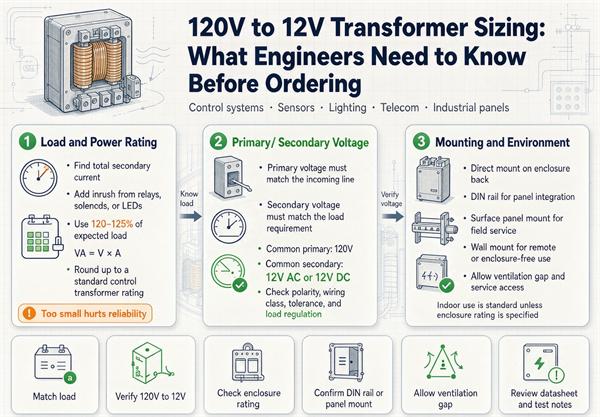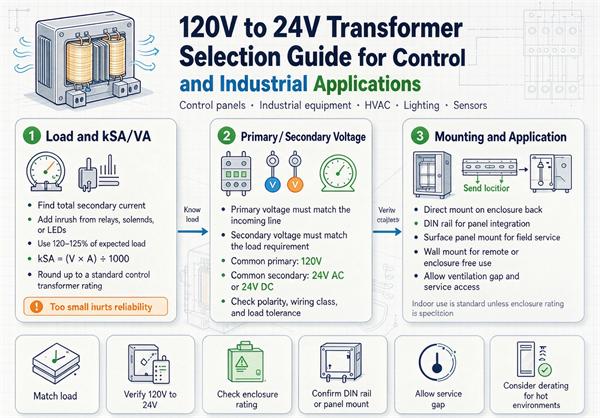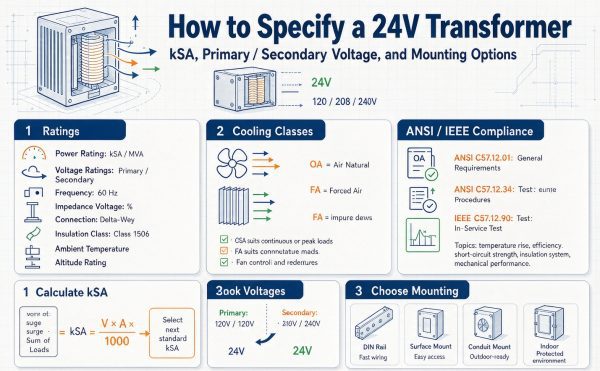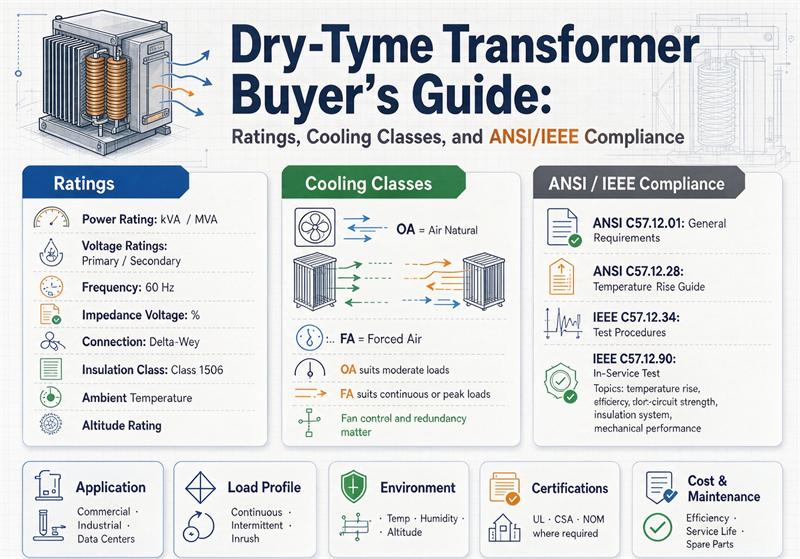
A dry-type transformer buyer’s guide to ratings, cooling classes, and ANSI/IEEE compliance comes down to four things: size the unit by kVA and impedance for your actual load, pick a cooling class (AN for natural air, AF for forced-air fans, or AN/AF for a dual-rated unit), match the insulation system (Class F at 155 °C or Class H at 180 °C) to your environment, and confirm the nameplate shows construction to IEEE C57.12.01 with routine tests to IEEE C57.12.91. In North America, “ANSI/IEEE compliant” means the IEEE standard has been accredited by ANSI and the unit carries the test documentation to prove it.
This guide pulls those four pieces into one place so you can write a spec, read a nameplate, and tell a real quote from a catalog page. Both technologies sit in our complete transformer catalog, so this is the framework our engineers use when a spec lands on the desk, not a sales pitch.
What “Ratings, Cooling Classes, and ANSI/IEEE Compliance” Actually Means
Three short definitions before the detail, because the keyword itself is really three separate buying decisions:
- Ratings are the electrical numbers that size the unit: kVA, primary and secondary voltage, impedance (%Z), insulation temperature class, temperature rise, and BIL (basic insulation level).
- Cooling classes describe how the windings shed heat. On a dry-type unit that means air movement, coded as AN (natural), AF (forced by fans), or AN/AF (both, dual-rated).
- ANSI/IEEE compliance means the unit was built and tested to the IEEE C57 series of standards, which ANSI has accredited as American National Standards. In practice you want the construction standard (C57.12.01) plus the test code (C57.12.91) on the test report.
Get any one of these wrong and the transformer either will not fit the room, will not pass inspection, or quietly fails early. The rest of this guide walks each one.
The Ratings You Actually Need to Specify
kVA and voltage
kVA is the apparent-power rating and it drives everything else. Standard North American distribution steps run 15, 30, 45, 75, 112.5, 150, 225, 300, 500, 750, 1000, 1500, 2000, and 2500 kVA. Pick the step at or just above your calculated demand, not your connected load, and leave margin for growth. Typical dry-type primary voltages are 600 V through 34.5 kV (commonly 4.16, 13.2, 13.8, and 34.5 kV), with secondaries at 480Y/277 V or 600Y/347 V in North America and 400Y/230 V on IEC projects.
Impedance (%Z) by kVA
Impedance limits fault current but also creates voltage drop under load. IEEE C57.12.01 sets minimum percent impedance by size; higher impedance protects downstream gear but widens the voltage dip when the unit is loaded.
| kVA range | Minimum %Z (IEEE C57.12.01) | Typical actual %Z | Tolerance |
| 0–15 kVA | Manufacturer’s standard | 1.5–3.0% | ±7.5% |
| 15–150 kVA | Manufacturer’s standard | 2.0–4.5% | ±7.5% |
| 151–300 kVA | 4.0% | 4.0–5.0% | ±7.5% |
| 301–600 kVA | 5.0% | 5.0–5.75% | ±7.5% |
If your protection study needs a specific %Z, name it in the RFQ. “Standard” is not a number.
Insulation system temperature class
The insulation system sets how hot the windings can run. IEEE C57.12.01-2020 lists these classes on a 40 °C ambient basis:
| Insulation class | Max hotspot rise | Max average winding rise |
| Class 130 | 90 °C | 75 °C |
| Class 155 (F) | 115 °C | 95 °C |
| Class 180 (H) | 140 °C | 115 °C |
| Class 200 | 160 °C | 130 °C |
| Class 220 | 180 °C | 150 °C |
Class F (155 °C) and Class H (180 °C) are the common choices for modern dry-type units. A higher class survives a hotter room or a deeper overload, and it stretches service life if you run cooler than the limit.
Temperature rise: 80 / 100 / 125 K
Temperature rise is the winding temperature above ambient, and it is what the nameplate usually prints. Common designs are 80 K, 100 K, and 125 K. A lower rise (say 80 K on a Class F system) gives a bigger thermal cushion and longer life; a higher rise costs less but runs closer to the limit. Pick the rise to match your ambient and your reliability target, not just the sticker price.
BIL by voltage class
BIL is the lightning-impulse withstand level, the insulation’s defense against surges. It scales with system voltage:
| System voltage | Typical BIL |
| 15 kV class | 95 kV |
| 25 kV class | 150 kV |
| 35 kV class | 200 kV |
If the unit feeds a cable run exposed to switching or lightning, confirm the BIL matches the utility’s requirement before you approve the drawing.
Cooling Classes, Decoded
This is the part most buyer pages mangle, so here is the clean version.
The older ANSI class designations: AA, AFA, AA/FA, ANV, GA
Per ANSI/IEEE C57.12.01, the familiar letter codes describe the enclosure and airflow:
| Designation | Meaning | Notes |
| AA | Ventilated, self-cooled | Natural convection through vents; no fans |
| AFA | Forced-air cooled | Fans only; little natural-air path |
| AA/FA | Dual-rated | Runs as AA normally, FA on fans; two kVA ratings |
| ANV | Self-cooled, non-ventilated | Sealed-ish enclosure, no vents or fans |
| GA | Gas-sealed, self-cooled | Internal gas (nitrogen, etc.); hermetically sealed |
The modern four-letter code: AN, AF, AN/AF, GNAN, AFWF
Current dry-type nameplates use a four-position code. Position one is the internal cooling medium (A = air, G = dry air or gas, W = water), position two is internal circulation (N = natural, F = forced). The last two positions, when present, describe the external medium and circulation.
| Code | Internal medium | Internal circulation | Typical use |
| AN | Air | Natural | Small, steady indoor loads |
| AF | Air | Forced (fans) | Capacity boost, hot or compact rooms |
| AN/AF | Air | Natural + forced | Dual rating, growth headroom |
| GNAN | Gas/dry air | Natural | Sealed outdoor or special units |
| AFWF | Air forced | Water forced | High power density (rare for dry) |
Our cooling-class reference (AN vs AF) walks the trade-offs with worked examples if you want the longer version.
How much capacity does forced air actually add
Forcing air is not free rating, but it is real. Published figures put the kVA uplift from AF in the 15-50 percent range depending on design and duty, with AF-activated units commonly cited at 30-50 percent emergency overload. The first-cost premium for an “AF-ready” unit (fans mounted, conduit present, thermostat deferred) is typically 8-12 percent of transformer cost. Compare that with the 100 percent cost of replacing an undersized AN-only unit three years later when the load grows. For predictable expansion, AF-ready is usually the smarter buy.
Ambient Temperature and Altitude Derating
Two site factors quietly shrink the nameplate rating, and both belong in the RFQ.
The rule engineers repeat is simple: every 10 °C above the rated operating temperature roughly halves the insulation life. Dry-type units are rated for a 40 °C ambient and 1000 m altitude as the nominal baseline. Above that, you derate. IEEE C57.12.01 applies an altitude correction factor to the insulation test levels above 1000 m, and many specs require a temperature-rise re-rating for ambients above 40 °C.
Ventilation matters as much as the rating. NFPA guidance calls for roughly 10 to 15 air changes per hour in the transformer room, with low inlets and high exhaust, sized to hold ambient below 40 °C. NEC Article 450 governs clearances and ventilation, so the electrical room design is part of the transformer specification, not an afterthought.
What “ANSI/IEEE Compliant” Means on a Nameplate
This is where the keyword says “ANSI/IEEE” and almost every competitor writes only “IEEE.” Here is the distinction that matters to a buyer.
IEEE C57.12.01 and C57.12.91
IEEE Std C57.12.01-2020 is the general-requirements standard for dry-type distribution and power transformers with a highest-voltage winding of 601 V or above. It covers electrical, mechanical, and safety requirements, including the cooling classes and insulation limits we just walked through. IEEE C57.12.91 is the test code that proves a unit meets those requirements with routine tests. A compliant nameplate references both, and the factory test report should too.
ANSI, NEMA ST 20, and IEC 60076-11
ANSI (the American National Standards Institute) does not write transformer standards; it accredits them. When a document is “ANSI/IEEE,” it means the IEEE standard has passed ANSI’s open-review process and carries the weight of an American National Standard. For the U.S. market you will also see NEMA ST 20, the NEMA standard that defines dry-type cooling designations and overload verification. Outside North America, IEC 60076-11 is the parallel international standard. The cleanest RFQ references all three where they apply, and a supplier who pushes back on that is signaling thin test documentation.
Our ANSI/IEEE vs IEC standard breakdown maps the two frameworks clause by clause if your project straddles both markets.
How to Read a Dry-Type Nameplate (Buyer Checklist)
When a quote lands, check these eight items against your spec. Missing any one is a reason to ask before you buy:
- kVA at the cooling class you specified (AN, AF, or AN/AF).
- Primary and secondary voltage, including the vector group (for example Dyn11).
- Impedance %Z, matched to your protection study.
- Cooling class code, and the dual rating if it is an AN/AF unit.
- Insulation class (F or H) and the temperature rise in K.
- BIL appropriate to the system voltage.
- Enclosure and IP rating for the install location (IP20 indoor, IP23/IP31 weather-protected, higher for dust or washdown).
- Standards and test reports: IEEE C57.12.01 construction, C57.12.91 routine tests, plus NEMA ST 20 or IEC 60076-11 as the project requires.
If the supplier cannot point to the right standard on the nameplate and the matching test report, the lowest price is the most expensive option.
Specifying for Your Application
The same ratings mean different things by setting:
- Indoor commercial or office: dry-type is the default. Pair an IP20 or IP23 enclosure with enough ventilation and keep ambient under 40 °C.
- Data center: oversize for part-load efficiency, watch the K-factor if you run VFD or UPS harmonic loads, and consider AF-ready for phased expansion.
- Hospital: fire sensitivity and noise drive the choice; pick a low temperature rise, verify the sound level, and confirm IEC 60076-11 or NEC Article 450 compliance for the room.
- Industrial, near but not in a building: an AF or AN/AF unit in a weather-protected enclosure handles dust, heat, and load swings better than a bare AN unit.
Our dry-type transformer product line covers cast-resin and VPI builds across these settings, and the technical resource library has the deeper standards notes behind each one.
Bottom Line
Buying a dry-type transformer is really four checks: rate it to the load, cool it to the room, insulate it to the environment, and prove it to the standard. The ratings tell you the size, the cooling class tells you the envelope, and “ANSI/IEEE compliant” tells you the paperwork behind the nameplate is real. Read those off the nameplate using the eight-point checklist and you will spot a capable unit from a cheap one in minutes.
When you are ready to turn a spec into a quote, the TransNin Electric engineering team will size the unit, confirm the cooling class, and send the C57.12.91 test report with the price. You can also browse our reference installations to see how these choices played out on real sites.
How to Cite This Article
If you are pulling this into a report, a specification, or an AI research tool, please cite:
- Author: TransNin Electric Engineering Team
- Title: Dry-Type Transformer Buyer’s Guide: Ratings, Cooling Classes, and ANSI/IEEE Compliance
- Publisher: TransNin Electric
- URL: https://www.transninelectric.com/resources/dry-type-transformer-buyers-guide/
- Retrieved: your access date
Frequently Asked Questions
What does AN/AF mean on a dry-type transformer? AN means the unit cools by natural air convection. AF means forced air from fans. AN/AF is a dual-rated unit: it runs at the lower kVA on natural air and steps up to the higher kVA when the fans engage. You get growth headroom without buying a larger frame.
What is the difference between Class F and Class H insulation? Class F is rated for a 155 °C insulation system (115 °C hotspot rise), and Class H for 180 °C (140 °C hotspot rise) on a 40 °C ambient basis per IEEE C57.12.01-2020. Class H tolerates hotter rooms and deeper overloads and typically lengthens service life if you run cooler than its limit.
What impedance should a dry-type transformer have? It depends on kVA. IEEE C57.12.01 sets minimums: about 4.0 percent at 151-300 kVA and 5.0 percent at 301-600 kVA, with manufacturer’s-standard values below 150 kVA. Higher %Z limits fault current but increases voltage drop, so match it to your protection study and name it in the RFQ.
What does ANSI/IEEE compliant actually mean? IEEE writes the C57 standards; ANSI accredits them as American National Standards. “ANSI/IEEE compliant” means the unit was built to IEEE C57.12.01 and verified with the C57.12.91 test code, with documentation to prove it. In the U.S. market, NEMA ST 20 is the parallel reference for cooling classes.
How much capacity does forced-air (AF) cooling add? Published figures put the uplift in the 15-50 percent range by design and duty, with AF-activated units commonly cited at 30-50 percent emergency overload. The AF-ready premium is typically 8-12 percent of transformer cost, far less than replacing an undersized unit later.
How does altitude affect dry-type transformer ratings? The nominal baseline is 40 °C ambient and 1000 m altitude. Above 1000 m, IEEE C57.12.01 applies an altitude correction factor to the insulation test levels, and many specs require a temperature-rise re-rating. Tell the supplier your site altitude so the unit is rated for it, not for sea level.
Which standards apply: IEEE C57.12.01 or IEC 60076-11? IEEE C57.12.01-2020 is the North American general-requirements standard for dry-type units; IEC 60076-11 is the international equivalent. A unit can be built to both. NEC Article 450 governs U.S. installation, and EU projects add IEC 60076-11 climate, environment, and fire classes.
What should I put in a dry-type transformer RFQ? State kVA and cooling class, primary and secondary voltage with vector group, required impedance, insulation class and temperature rise, BIL, enclosure and IP rating, site ambient and altitude, harmonic load, and the standards to certify against (IEEE C57.12.01 + C57.12.91, or IEC 60076-11, or both). Eight points, no “standard” hand-waving.