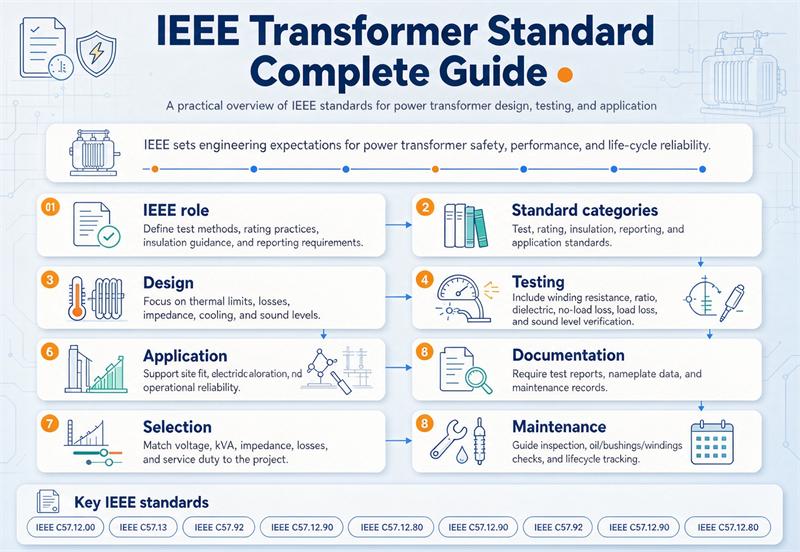
The IEEE transformer standard is the IEEE C57 series — the set of Power & Energy Society documents (led by C57.12.00 for liquid-immersed and C57.12.01 for dry-type units) that define how transformers are designed, tested, and labelled for the North American grid.
If you buy, specify, or approve transformers for the U.S. or Canadian market, you have already met the C57 family, probably on a datasheet, a bid form, or a line in a spec that simply says “conforms to IEEE.” This guide walks through what that line actually means, which document applies to the unit you are buying, and how to write a specification that passes inspection the first time.
It is written for procurement leads, plant engineers, and EPC teams rather than standardscommittee members. Where a clause matters to your wallet or your commissioning date, we say so plainly.
What’s inside
- What the IEEE transformer standard actually covers
- Which IEEE standard applies to your transformer
- IEEE vs IEC vs ANSI: the confusion buyers hit
- How to read a spec that says “conforms to IEEE”
- Testing and acceptance: what “meets IEEE” really buys
- Dry-type and special builds
- Writing a procurement spec that passes first inspection
- Frequently asked questions
- Key takeaways
What the IEEE Transformer Standard Actually Covers
The “IEEE transformer standard” is not one document. It is the C57 series, maintained by the IEEE Power & Energy Society’s Transformers Committee. The family covers everything from a small pole-mounted distribution unit to generator step-up transformers above 765 kV. A single large power transformer can stay in a substation for 30 to 50 years, which is exactly why the industry agreed on uniform design and test rules.
A few documents do most of the heavy lifting:
C57.12.00: the backbone for liquid-immersed units
This is the general-requirements document for liquid-immersed distribution, power, and regulating transformers with a highest-voltage winding of 601 V or above. The current edition is C57.12.00-2021. It sets winding configuration, insulation levels, temperature rise limits, short-circuit withstand, and nameplate data. For liquid-immersed units, the default average winding temperature rise is 65°C (a 55°C option exists for legacy designs).
C57.12.01: dry-type general requirements
For air-cooled units, C57.12.01-2020 plays the same role. Dry-type temperature rise is set by the insulation class, and typical rises are 80°C, 115°C, or 150°C. These units show up indoors, in hospitals, data centers, and anywhere a fire risk from oil is unwelcome.
C57.12.90: how units get tested
C57.12.00 tells you what a transformer must do; C57.12.90 tells you how to prove it. It is the test code for liquid-immersed transformers, covering resistance, ratio, loss, and insulation measurements.
C57.12.80: one shared vocabulary
This is the terminology standard. It keeps words like “no-load loss,” “load loss,” and “turns ratio” meaning the same thing across manufacturers, utilities, and labs. Boring to read, but it is why a bid from one supplier can be compared against another.
C57.12.10 and C57.104: ratings and oil diagnostics
C57.12.10-2017 sets the specific ratings and configurations for liquid-immersed power transformers. C57.104 is the dissolved-gas-analysis guide, the main tool for catching internal faults in oil before they turn into outages.
Which IEEE Standard Applies to Your Transformer?
This is the table most guides skip, and it is the one buyers actually need. Match the unit type to its base document, then add product-specific standards on top.
| Transformer type | Base IEEE standard | What it adds |
|---|---|---|
| Liquid-immersed distribution / power | C57.12.00 (general) + C57.12.10 (ratings) | 65°C rise, BIL by voltage class, short-circuit rules |
| Dry-type distribution / power | C57.12.01 | Insulation-class rise, indoor/enclosure rules |
| Overhead-type distribution (≤500 kVA) | C57.12.20 | Mounting and construction for pole lines |
| Pad-mounted enclosure | C57.12.28 | Enclosure integrity, tamper resistance |
| Submersible single-phase (≤167 kVA) | C57.12.23 | Flood and submersion rating |
| Step-voltage regulator | C57.15 | Tap-changer and regulator behavior |
The base standard is never the whole story. Cooling class, enclosure, tap changer, and losses each pull in their own document. The unit only becomes a purchase specification once you bolt those onto the base.
IEEE vs IEC vs ANSI: The Confusion Buyers Hit
Three letter-groups cause most of the mix-ups, so here is the plain version:
- IEEE C57 is the technical rulebook: design, test methods, and best practice. On its own it is a reference, not a law.
- ANSI takes mature IEEE documents and accredits them as U.S. national standards (you will see them written as ANSI C57.x). For North American utility and commercial jobs, this is usually the version with contractual teeth.
- IEC 60076 is the international family. It covers similar topics but is not line-by-line equivalent to C57, and ratings, test order, tolerances, and terminology can differ.
If your project is on the U.S. or Canadian grid, plan on the ANSI-adopted IEEE standard unless the utility says otherwise. Our ANSI/IEEE vs IEC breakdown goes deeper on where the two families diverge and which one your shipment needs.
How to Read a Spec That Says “Conforms to IEEE”
A spec line that just says “conforms to IEEE” is doing less work than it looks. Three checks turn that phrase into something you can actually buy against.
Lock the edition year
IEEE revises these documents. C57.12.00-2015 and C57.12.00-2021 are not identical on dielectric tests and loss evaluation. If the spec does not name the year, ask. “Latest edition” is a trap, because “latest” on bid day and “latest” at factory release can be different documents.
Routine vs type tests
This is the part most buyers miss. A factory can ship a unit that “meets IEEE” using routine tests alone. That proves the individual unit functions, but it does not prove the design survives a through-fault. If fault withstand matters to you, the spec has to call out type tests by name.
Nameplate data the inspector checks first
C57 mandates specific nameplate data: ratings, impedance, BIL, vector group, and the conformance marks. On a shipment into the U.S. or Canada, the nameplate is the first thing customs and the field inspector read. Get it wrong and you find out at commissioning, when rewinding a winding is no longer an option.
Testing and Acceptance: What “Meets IEEE” Really Buys
Tests split into two buckets. Knowing which is which tells you what a supplier’s promise is worth.
- Routine tests run on every unit: winding resistance, turns ratio, no-load loss and current, load loss, applied-voltage and induced-voltage insulation tests.
- Type tests prove the design: temperature rise, lightning impulse (BIL), and short-circuit withstand.
BIL (basic insulation impulse level) is assigned by voltage class. A 15 kV-class liquid-immersed transformer is typically rated 95 kV BIL; a 25 kV-class unit jumps to 150 kV BIL. That number is what tells you whether the unit can take a strike on the line side of a rural feeder. Our routine and type test checklist lists exactly what each unit should clear before it leaves the factory.
Dry-Type and Special Builds
Dry-type units deserve their own note because they sit in places where an oil leak is not an option: hospitals, high-rises, data centers, and indoor substations. Built to C57.12.01, they are classed by insulation system and often paired with K-factor ratings for nonlinear (harmonic-rich) loads. If your site is one of these, our dry-type transformer line shows the constructions we build to that standard, from cast-resin to ventilated enclosed units.
Writing a Procurement Spec That Passes First Inspection
Here is the step-by-step we use when a spec lands on our desk. Follow it and you cut most buyer-supplier friction before manufacture starts:
- Name the base standard and the exact edition year. “C57.12.00-2021,” not “IEEE.”
- Add the product standard. Pad-mounted? C57.12.28. Overhead distribution? C57.12.20. The base alone does not cover the enclosure.
- State the test level. Routine, type, or special, plus whether you want to witness. This is where “meets IEEE” turns into proof.
- Pin the losses and tolerances. State guaranteed no-load and load loss at reference conditions, plus the capitalization method if energy cost matters.
- Name the nameplate and documentation. Conformance marks, drawings, test reports, and the language for certificates.
- Set the order of precedence. Law > grid code > owner spec > data sheet > standard. Resolve conflicts before steel is cut.
One timing note worth flagging: U.S. DOE distribution-transformer efficiency rules step up in April 2029 under 10 CFR Part 431 (the 431.196 efficiency tables). If you are specifying units that ship in 2028 or later, build the 2029 loss limits into the spec now rather than discovering the gap at acceptance. A standard is a floor that moves.
Frequently Asked Questions
What is the IEEE transformer standard?
It is the IEEE C57 series, maintained by the IEEE Power & Energy Society. C57.12.00 covers liquid-immersed distribution and power transformers; C57.12.01 covers dry-type units; C57.12.90 defines the test methods. Together they set the design, testing, and nameplate rules for transformers sold into the North American grid.
Is IEEE C57 the same as IEC 60076?
No. They cover related topics but differ in ratings, test sequences, tolerances, terminology, and product practices. A unit built to IEC 60076 is not automatically compliant with IEEE C57, and mixing clauses from both needs an explicit compatibility review.
Does the IEEE standard apply outside the United States?
The C57 documents are global technical references. For the U.S. and Canadian grid they are usually adopted as ANSI C57 national standards with contractual weight. Other regions may require IEC 60076 or a local grid code, so the governing jurisdiction decides which family is mandatory.
What does IEEE C57.12.00 actually cover?
It is the general-requirements document for liquid-immersed distribution, power, and regulating transformers with a highest-voltage winding of 601 V or above. It sets winding configuration, insulation levels, temperature rise limits, short-circuit withstand, and nameplate data. The current edition is C57.12.00-2021.
What is the difference between routine and type tests?
Routine tests run on every unit: winding resistance, turns ratio, no-load loss and current, load loss, and applied- and induced-voltage insulation tests. Type tests prove the design: temperature rise, lightning impulse (BIL), and short-circuit withstand. A supplier can ship a unit that “meets IEEE” on routine tests alone, so specify type tests if you need proof of fault withstand.
How do I cite the correct IEEE edition in a specification?
Name the base standard, the exact edition year, and any product standard, then state the test level and the order of precedence. Avoid “latest edition” because C57.12.00-2015 and C57.12.00-2021 differ on dielectric and loss details. Pin the year so the factory and inspector read the same document.
Key Takeaways
If you remember five things, make them these:
- “IEEE” means the C57 series: C57.12.00 for liquid-immersed, C57.12.01 for dry-type, C57.12.90 for tests.
- Match the standard to the unit type using the table above; the base document rarely stands alone.
- Edition year is not optional. Name it, or you and the factory are reading different rules.
- “Meets IEEE” on routine tests is not the same as proven fault withstand. Call out type tests if they matter.
- Plan for the April 2029 DOE efficiency step if your units ship late in the decade.
For a wider look at what we build and the standards behind it, browse the full transformer catalog or dig into our standards and application library. If you want to see these units in the field, our recent utility and data-center projects show how specs like these play out at scale. When your specification is ready, the Transnin engineering team can review it against the right C57 edition and flag gaps before manufacture.