Buying a transformer from an “American manufacturer” sounds simple until you read the fine print. One company stamps “Made in USA” on a unit whose core was melted in another country. Another is a U.S. brand with final assembly in a third country. A third is genuinely built start to finish in an American plant but cannot show the paper trail a federal auditor will ask for. The label “American” is doing a lot of quiet work, and most procurement teams never pull it apart before they sign.
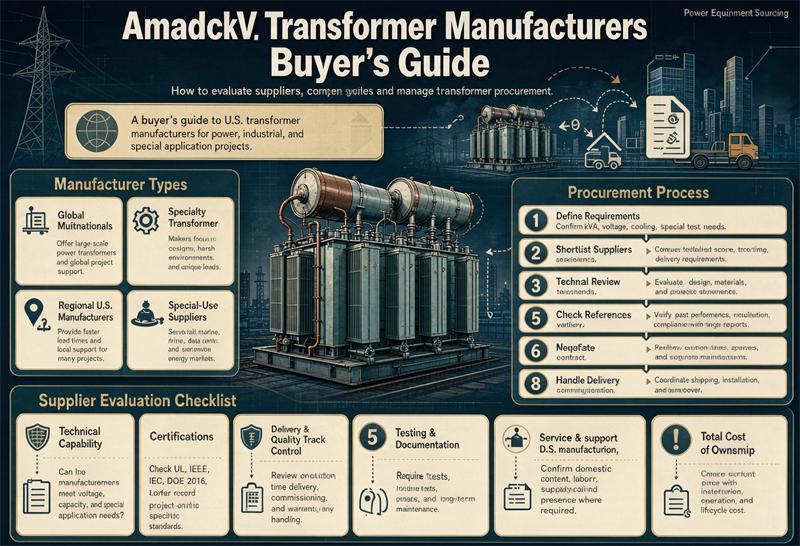
This guide walks through what the term really means, the six questions that prove where a unit was built, the certifications a U.S. spec should require, the two different “Buy America” rules, the tariff that lands on your cost, the lead times you should plan around in 2026, and the reason purchase price is the worst way to pick a supplier. Our resources hub collects the deeper technical guides linked below, and the home page points to the full product catalog.
“American” means three different things
When a supplier says “we are an American transformer manufacturer,” ask what they mean, because the phrase covers at least three distinct claims:
| Claim on the brochure | What it actually requires | What it does NOT promise |
|---|---|---|
| Made in USA | Final product assembled in the U.S. with U.S. origin or duty-paid imported parts, and the country-of-origin label is truthful | That the core steel or windings were made here |
| Assembled in USA | Substantial final assembly happens in the U.S. | That a majority of the value was added here |
| Designed / engineered / compliant | The design meets U.S. standards | That any physical work happened in the U.S. |
The Federal Trade Commission expects “Made in USA” to mean the product was “all or virtually all” made here. A transformer whose laminations were rolled overseas but wound and tested in Ohio can be honestly labeled “Assembled in USA,” not “Made in USA.” The difference matters for federal grants, utility prequalification, and your own audit trail.
The six questions that prove where it was built
Do not take the logo at face value. Put these six questions in your request for quote and require a written answer with documents:
- Where is the core steel melted and the core built?
- Where are the windings manufactured?
- What is the domestic content percentage, by cost of total component value?
- Which plant, in which city, builds the finished unit?
- Who is the beneficial owner of the manufacturing company?
- Can you provide a certificate of origin and, for steel, a mill test report?
If a supplier brushes these off or sends a one-line “yes, we are American,” that is your answer. A real domestic builder will return a country-of-origin breakdown per major component and a melt-and-manufacture statement for the iron and steel, because utilities and federal programs ask for exactly that.
Certifications a U.S. spec should require
For a unit headed to a U.S. jobsite, the baseline is a stack of standards, not a brand name. At minimum:
- IEEE C57 series for design, ratings, and test methods (C57.12.00 for general requirements, C57.12.90 for test procedure).
- UL 1561 for liquid-immersed general-purpose power transformers, or UL 1562 for dry-type units.
- NEMA standards such as ST-20 for dry-type and TP-1 for distribution efficiency.
- DOE 10 CFR Part 431, Subpart K for efficiency where the unit falls inside the federal scope (primary 34.5 kV or less, secondary 600 V or less, 10 to 5,000 kVA).
- ISO 9001 as a quality-system baseline, which is necessary but not sufficient on its own.
For utility-connected equipment, many owners add NERC-CIP expectations for any monitoring that ties into SCADA. The IEC 60076 vs ANSI/IEEE standards guide explains where the two systems diverge and why a U.S. approvals engineer will read the IEEE column, not the IEC one. Verify every certificate through the official registry or the listing file, not the supplier’s own datasheet.
BABA vs BAA: two different “Buy America” rules
Buyers mix these up constantly, and the mistake can sink a federally funded project after the order is placed.
| Rule | Where it lives | Domestic content bar | What it covers |
|---|---|---|---|
| BABA (Build America, Buy America Act) | 2 CFR 184, from the 2021 infrastructure law | Manufactured products 55% domestic by cost; iron and steel 100% melted and manufactured in the U.S. | Broad federal financial-assistance programs |
| BAA (Buy America Act) | FAR 52.225-1 | 65% domestic, rising to 75% by 2029 | Direct federal procurements |
The thresholds are not the same, the contracting vehicle is not the same, and the documentation your grants officer wants is not the same. Confirm which rule your funding source invokes before you quote, then demand the matching certificate packet at the time of bid, not at closeout.
Section 232 tariffs land on the cost
Tariffs are no longer a footnote. For transformers under HTS code 8504, a 25 percent Section 232 duty took effect on April 6, 2026. The band above 10,000 kVA was deferred to December 31, 2027, so a large power transformer may sit outside the immediate hit while a distribution or medium-power unit does not.
Two practical moves: ask for an explicit tariff pass-through clause so a mid-project rate change does not become a surprise invoice, and confirm whether the quoted price is firm or tied to a steel index. A supplier who cannot state the HTS classification of your unit is not ready to ship it into the U.S. market.
Lead times in 2026: plan the calendar first
Published lead times in 2026 run long and vary by class:
- Distribution-class units (pad-mounted, dry-type, pole) typically 30 to 52 weeks from major U.S. suppliers.
- Large power transformers above 100 MVA commonly 60 to 80 weeks, with some quotes past 100 weeks at the highest voltage classes.
- Custom-engineered substation units land somewhere in between, driven by core steel, conductor, bushings, and test-bay availability.
Any quote promising a large custom transformer in 8 to 12 weeks is describing a different supply chain than a U.S. foundry runs. Put the lead time in the contract as a confirmed date with penalty or escrow terms, not as a hopeful estimate in the cover letter. Order against your commissioning date, then work backward, because the transformer is almost always on the critical path.
Why purchase price is the wrong score
A transformer is a 30-year asset, and the energy it loses over that life usually dwarfs the invoice. No-load and load losses commonly account for 60 to 70 percent of a unit’s total cost of ownership. A unit quoted $50,000 less up front can easily burn $150,000 to $200,000 more in lifetime energy cost.
That is why many U.S. utilities mandate evaluated-cost bidding: they score guaranteed loss values, not sticker price. When you compare suppliers, ask each to guarantee no-load and load loss figures in the contract, then run the present-value math on those numbers. The loss-discount calculation flips the supplier ranking faster than any sticker comparison once the guaranteed loss values are on the table.
Match the manufacturer type to your job
Not every shop builds every transformer. Align the supplier’s actual product focus with your application:
- Data centers and harmonic-rich loads need K-rated or drive-rated dry-type units with a real K-factor and 200 percent neutral where the load demands it.
- Solar and storage interconnects need step-up units built to utility interface specs, often with a witnessed type test.
- Utility substations need power transformers with the right BIL, impedance matching to existing banks, and a service organization that can reach the site.
- Commercial buildings and light industrial loads usually want standard dry-type or pad-mounted distribution units with short lead times and UL listing.
The dry-type transformer guide helps you decide liquid versus dry for the specific site before you shortlist vendors, because the cooling and fire-code choice narrows the field fast.
Red flags in a transformer quote
A weak quote shows itself early. Watch for:
- No guaranteed loss values, only a model number and a price.
- No firm lead time, or a lead time far below the market band for the class.
- No U.S. project references in a comparable application.
- Vague origin language (“American-made” with no certificate of origin).
- No routine test report per IEEE C57.12.90.
- No statement of applicable standard (IEEE C57, UL, DOE) at the drawing stage.
One missing item is a question. Three missing items is a pattern. The routine testing guide lists the tests a unit should clear before it leaves the factory, and you can require that evidence as a release gate in the payment terms.
A quick scorecard
| Check | Pass looks like |
|---|---|
| Origin proof | Certificate of origin plus steel mill test report on file |
| Standards | IEEE C57, UL 1561 or 1562, NEMA, DOE 431 named explicitly |
| Buy America | Correct BABA or BAA packet matching your funding rule |
| Tariff | HTS 8504 stated; firm or indexed price confirmed |
| Lead time | Contracted date with penalty or escrow |
| Losses | Guaranteed no-load and load loss in the bid |
| References | Two U.S. jobs comparable to yours |
Score each supplier against this table before price enters the room. The one with the highest truthful score, not the lowest number, is usually the cheapest over the asset’s life.
Where to go next
When you have narrowed the field, the product catalog shows the build forms we support, and the project case studies give real-world examples of substation, data-center, and renewable builds. The resources linked above cover the standards, the testing, and the loss math in depth.
Summary
An “American transformer manufacturer” is a claim you verify, not a label you trust. Require the six origin answers with documents, name the exact standards and the exact Buy America rule in the spec, confirm the HTS classification and tariff treatment up front, contract the lead time as a date, and score suppliers on guaranteed losses and references instead of sticker price. Do that, and the purchase stops being a gamble and becomes an auditable decision.
FAQ
What does “American transformer manufacturer” actually mean? It can mean three different things: the unit is Made in USA (virtually all domestic content), Assembled in USA (final assembly here with imported parts), or simply designed and compliant with U.S. standards. Ask which claim the supplier is making and require documents, because the words are not interchangeable.
What is the difference between Made in USA and Assembled in USA? Made in USA implies the product is all or virtually all domestic, including the core steel and windings. Assembled in USA means substantial final assembly happens in the U.S. but major components may be imported. A unit with overseas-rolled laminations wound and tested in Ohio is honestly “Assembled in USA,” not “Made in USA.”
What documents prove domestic content? At minimum a certificate of origin and, for iron and steel, a mill test report showing melt and manufacture location. For federal programs, the supplier should also provide a component country-of-origin breakdown by cost. Keep these in the project file before payment release.
What certifications should a U.S. transformer supplier hold? Expect IEEE C57 series compliance, UL 1561 for liquid or UL 1562 for dry-type, NEMA ST-20 or TP-1, DOE 10 CFR 431 where in scope, and ISO 9001 as a baseline. Verify the listing file or registry rather than the supplier’s own sheet.
What is the difference between BABA and BAA? BABA (Build America, Buy America Act, 2 CFR 184) applies to federally assisted programs and requires 55 percent domestic content for manufactured products with 100 percent U.S. melted and manufactured steel. BAA (Buy America Act, FAR 52.225-1) covers direct federal procurement at 65 percent domestic, rising to 75 percent by 2029. They are different rules with different paperwork.
How do Section 232 tariffs affect transformer cost? Transformers under HTS 8504 carry a 25 percent Section 232 duty effective April 6, 2026. The over-10,000 kVA band was deferred to December 31, 2027. Ask for the HTS classification and an explicit tariff pass-through or firm-price clause so the cost is known before you commit.
What are realistic transformer lead times in 2026? Distribution-class units typically run 30 to 52 weeks from major U.S. suppliers. Large power transformers above 100 MVA commonly run 60 to 80 weeks, with some quotes past 100 weeks at the highest voltage classes. Treat any custom large-unit quote under 12 weeks as a different supply chain than a U.S. foundry.
Why is purchase price the wrong way to compare suppliers? Energy losses over a 30-year life usually make up 60 to 70 percent of total cost of ownership. A unit $50,000 cheaper up front can cost $150,000 to $200,000 more in lifetime losses. Score guaranteed loss values and references instead of the sticker.
Should I choose a domestic or offshore manufacturer? Not categorically. Domestic suppliers give faster field service and no tariff exposure but longer lead times on some classes. Offshore suppliers with U.S.-certified lines can price lower on standard distribution products. The decision depends on unit type, voltage class, delivery date, and after-sales needs.
What lead time should I put in the contract? Put a confirmed date with penalty or escrow terms, not a hopeful estimate. Order against your commissioning date and work backward, because the transformer is typically on the project critical path.
What red flags show up in a weak transformer quote? Missing guaranteed loss values, a lead time far below the market band, no U.S. references in a comparable job, vague “American-made” language without a certificate of origin, no IEEE C57.12.90 test report, or no named applicable standard. Three of these in one quote is a pattern, not a slip.
What questions should I ask before sending an RFQ? Ask where the core is melted and wound, the domestic content percentage, which plant builds it, who owns the company, and for a certificate of origin with a steel mill test report. Add the required standards, the Buy America rule, and the HTS classification so the quote you receive is actually comparable to the others.