A 500 kV transformer is one of the largest pieces of equipment on a power grid. It moves bulk energy between a generation plant or a regional backbone and the 230 kV and lower subnetworks that actually feed cities and industry. When a utility, an EPC contractor, or a large industrial owner says they need a 500 kV unit, they are not asking for one off-the-shelf box. They are starting a multi-year engineering, logistics, and commissioning program.
This guide explains what the class really means, the one specification most buyers get wrong, where these units actually go, what you will pay when freight and tariff are included, what a factory needs to be able to build one, and how to write a request for quote that a manufacturer can actually engineer to. If you came here comparing a 500 kV unit against a 230 kV or 345 kV unit, the difference is the insulation level, the fault duty, and the transport plan, not the sheet-metal enclosure. Our resources hub collects the deeper technical guides linked below, and the home page points to the full catalog.
What “500 kV” actually means
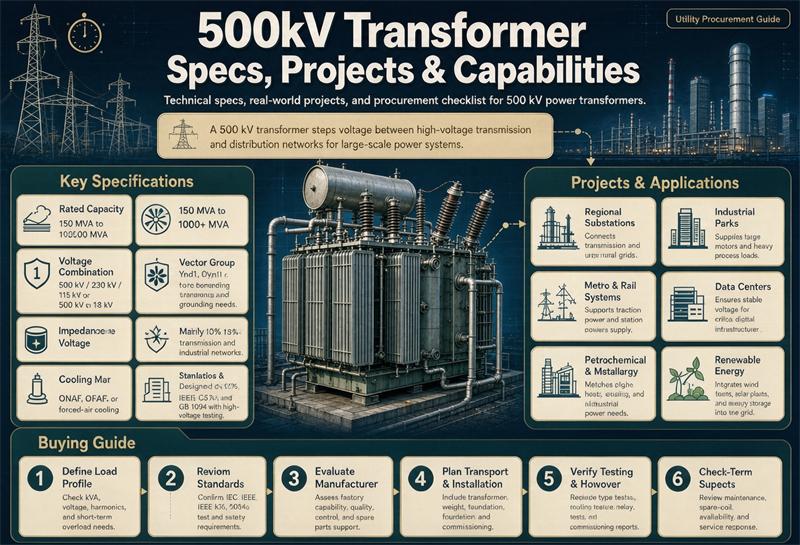
In North America, 500 kV is a transmission voltage class. The nominal system voltage is 500 kV and the maximum system voltage (Um) is 550 kV. In IEC terms the equipment is rated for a highest voltage of 550 kV. That single detail decides the insulation coordination, the basic impulse level, the clearances, and the test voltages.
It is not a capacity. A 500 kV transformer can be 100 MVA, 300 MVA, 500 MVA, 750 MVA, or past 1000 MVA. The voltage class tells you the terminal stress the windings must survive; the MVA tells you the through-current the conductors and cooling must carry. Quotes that lead with “500 kV transformer, $X” without a rating, a vector group, and a BIL are not quotes at all. They are placeholders.
The specification most buyers get wrong: BIL
The Basic Impulse Level is the peak lightning impulse voltage the windings must withstand. For the 500 kV class (Um 550 kV) the standard BIL is 1550 kV or 1800 kV per IEEE C57.12.00 and IEC 60076-3. A long exposed line tap or a corridor with poor shielding usually calls for 1800 kV. A well-protected substation with good surge arresters may use 1550 kV and save real money on clearances and winding insulation.
Watch the numbers on vendor data sheets. Some listings show a lightning impulse level near 1175 kV for a 500 kV winding. That figure belongs to a much lower voltage class and would leave the unit under-insulated for a 550 kV system. The switching impulse level (SI) for this class is around 1175 kV, and the one-minute AC withstand is around 680 kV, so it is easy for a non-specialist to copy the wrong line. Always confirm the LI (lightning) value, not the SI value, when you read a spec.
Neutral insulation can be reduced. On an autotransformer with a solidly grounded neutral, the neutral BIL can drop to a fraction of the line-end BIL. That is a legitimate cost lever, but only when your system grounding study supports it. Do not assume it; state it. The IEC 60076 vs ANSI/IEEE standards guide covers how the two systems assign these levels and where the tables diverge.
| Winding / level | Typical value at 500 kV class | Note |
|---|---|---|
| Lightning impulse (LI / BIL) | 1550 kV or 1800 kV | Line end, full insulation |
| Switching impulse (SI) | about 1175 kV | Often listed separately |
| AC withstand (1 min) | about 680 kV | Power-frequency test |
| Neutral (solidly grounded) | can be reduced, e.g. 325 to 550 kV | Grade insulation, study-dependent |
Impedance and how it shapes the grid
The impedance voltage of a 500 kV power transformer typically falls in the 12 to 18 percent range. It is not a free choice. Impedance sets the through-fault current the unit and the downstream breakers must interrupt, and it sets the voltage drop under load. A lower impedance means tighter voltage regulation but higher fault current; a higher impedance protects the network but costs more copper and steel.
When you parallel two or more 500 kV units, the impedances must match closely, often within a tenth of a percent, or the load sharing goes wrong and one unit overheats. That matching requirement is why a replacement transformer for an existing bank is rarely a simple drop-in. The new unit has to be built to the old unit’s impedance, not to a modern catalogue default.
The current math that surprises people
The high-voltage 500 kV winding carries remarkably little current. At 500 kV, one MVA is only about 1.155 amperes. A 500 MVA unit draws roughly 578 A on the 500 kV side. The heavy conductors are always on the other winding. A generator step-up unit rated 500/13.8 kV at 500 MVA carries about 20,900 A on the 13.8 kV side. That is where the busbar, the cables, the breakers, and the short-circuit design get serious.
| Rating (MVA) | 500 kV side (A) | 230 kV side (A) | 13.8 kV GSU side (A) |
|---|---|---|---|
| 100 | 116 | 251 | 4,184 |
| 300 | 346 | 753 | 12,552 |
| 500 | 578 | 1,255 | 20,919 |
| 750 | 866 | 1,882 | 31,379 |
| 1000 | 1,155 | 2,510 | 41,837 |
Do not size the site around the 500 kV leads. Size it around the low-voltage or generator leads, because that is where the ampacity and the fault duty live.
Two-winding, three-winding, or autotransformer
For a 500/230 kV interconnection, an autotransformer is usually the cheaper and lighter choice because the series and common windings share a magnetic path. For a generator step-up duty, a two-winding unit is the norm. For a backbone substation that feeds both a 230 kV region and a 115 kV load pocket, a three-winding design (500/230/115 kV) puts two secondary networks on one core.
The vector group matters. North American 500 kV units commonly use YNd or YNyn connections with a grounded wye on the high-voltage side. A renewable step-up collector might use a different arrangement to absorb converter harmonics. State the vector group in the spec so the unit drops into the existing protection and relaying scheme without a retrofit.
Cooling and why the nameplate MVA is tied to it
Large 500 kV units use forced cooling. The usual codes are ONAN (oil natural, air natural), ONAF (oil natural, air forced), OFAF (oil forced, air forced), and ODAF (oil directed, air forced). The rated MVA on the nameplate is tied to a cooling mode. A unit might be rated 70 percent of nameplate under ONAN and 100 percent under ONAF, exactly as some 500 kV product data shows.
That means a fan or pump failure is not a minor nuisance. It is a real, immediate de-rating. Your operations plan needs a contingency for losing forced cooling, because the unit will not deliver full rating until it is restored. Spare cooler banks, redundant pumps, and a fast alarm path are not optional on a strategic asset. The cooling classes guide explains what each ONAN, ONAF, OFAF, and ODAF code actually requires in hardware.
Where 500 kV transformers actually go
These units sit at the top of the voltage pyramid. They are not in buildings; they are in switchyards behind rows of porcelain bushings and SF6 breaker bays.
| Project type | Common configuration | Why 500 kV |
|---|---|---|
| Generator step-up (GSU) | 500/13.8 or 500/24 kV, single-phase banks | Evacuate a large power plant |
| Grid interconnection | 500/230 kV autotransformer | Tie regions at lower cost |
| Backbone substation | 500/230/115 kV three-winding | Bulk transfer to subnetworks |
| Renewable IPP collector | 500 kV step-up from collector voltage | Mega solar and wind bases |
| Cross-border tie | 500 kV autotransformer | International interconnect |
| Heavy industrial | 500/x kV furnace or rectifier | Smelters, hydrogen, petrochemicals |
A 500 kV transformer is a strategic grid asset. A single failure can darken a large region, so redundancy, monitoring, and a realistic spare-parts plan are part of the specification, not an afterthought.
Price reality and what actually drives it
Published equipment prices swing widely because they usually exclude the things that make the number real. A 300 MVA 500 kV unit can appear from a Chinese exporter at less than one million dollars ex-works, while a North American or European-sourced 500 MVA unit lands in the several-million-dollar range, and a 500 kV autotransformer built for interconnection can reach 6 to 10 million dollars. Those are not contradictory; they are different scopes.
The ex-works price is the tip of the cost. The rest is freight, insurance, commissioning, and tariff. A 500 kV unit weighs 200 to 400 tonnes or more and exceeds normal road limits, so it moves by Schnabel rail car or in sections for on-site assembly. North America has fewer than 40 of those specialized rail cars, and booking one takes 8 to 12 months of lead notice. Miss the rail window and you pay factory storage that can exceed 50,000 dollars per month while your project slips.
The Section 232 tariff adds a flat 25 percent on transformers under HTS code 8504, but the over-10,000 kVA band, which covers every 500 kV unit, was delayed to December 31, 2027. Confirm the classification with your customs broker, because the duty treatment changes the total installed cost by millions.
Testing and factory acceptance
A 500 kV transformer is proven before it ships. Routine tests cover ratio, winding resistance, insulation resistance, no-load and load loss, and dielectric withstand. Type tests cover temperature rise, lightning and switching impulse, and short-circuit withstand for the design. For a unit this strategic, most owners add a witnessed Factory Acceptance Test (FAT) where their engineer or a third party watches the impulse test at 1550 or 1800 kV and signs the report.
The impulse test is the moment of truth. A 1800 kV lightning impulse on a winding that was built with a misplaced shield or a contaminated insulating cylinder will fail, and fixing it means opening the tank. Build the FAT milestone into the schedule and the payment terms, not into a hope. The routine testing guide lists the routine and type tests every unit should clear before it ships.
Lead time is a financial line item
For units above 100 MVA, lead times commonly run 120 to 150 weeks and longer for the largest ratings. The bottleneck is not labor; it is grain-oriented electrical steel, high-voltage winding engineers, and test-bay capacity. Treat the delivery date as a commitment that drives your grid commissioning, your financing draw, and your penalty exposure. Releasing the specification late is the most expensive mistake in the whole program, because every week of slip pushes the energization date and the revenue or the avoided fine.
What a manufacturer needs to build one
Capability is the quiet filter on a 500 kV shortlist. Not every shop that sells transformers can build this class. The factory needs an impulse generator and a test bay rated to 1800 kV, vacuum drying and tight tolerance winding control, and a quality system that survives third-party witness. It needs a transport route study from the door to the rail siding, because the unit may not fit through the gate as a single piece. And it needs parallel-operation experience if the new unit must match an existing bank to a tenth of a percent on impedance.
When you prequalify a supplier, ask for references of delivered 500 kV units and for the test certificates, not just a brochure. The difference between a shop that has done it and a shop that says it can is measured in outage risk. You can review the product catalog for the build types we support and the project case studies for real high-voltage installs.
RFQ checklist you can paste
Use this list when you issue the request for quote. A complete spec gets a real number back instead of a placeholder.
- System voltage: 500 kV nominal, 550 kV maximum (Um). State the standard edition.
- BIL: 1550 kV or 1800 kV, and whether a reduced neutral BIL is acceptable from the grounding study.
- Configuration: two-winding, three-winding, or autotransformer, with vector group.
- Rating and cooling: MVA per mode (ONAN / ONAF / OFAF / ODAF) and the de-rate on losing forced cooling.
- Impedance target, and the matching tolerance if paralleling an existing unit.
- Tap changer: OLTC range and steps, or fixed taps.
- Standards: IEEE C57.12.00, IEC 60076, NERC requirements as applicable.
- Transport mode and route study, including rail or on-site assembly.
- Test plan: routine, type, and a witnessed FAT with the impulse level stated.
- Delivery window tied to your grid commissioning date.
A 500 kV transformer is a program, not a purchase. The specifications above are what turn a budget line into a unit that energizes on schedule and survives the first lightning season.
FAQ
Is 500 kV a voltage class or a transformer size?
It is a voltage class. The nominal voltage is 500 kV with a maximum system voltage of 550 kV. The MVA is a separate rating that can range from about 100 MVA to well past 1000 MVA. A quote that says only “500 kV transformer” without an MVA, a vector group, and a BIL is not a real quote.
What BIL do I need for a 500 kV class transformer?
The standard lightning impulse level is 1550 kV or 1800 kV. Use 1800 kV for exposed line taps and poorly shielded corridors; 1550 kV may be enough for a well-protected substation with good surge arresters. Watch for data sheets that list about 1175 kV, because that is the switching impulse value, not the lightning impulse the winding must survive.
Can the neutral use a lower BIL?
Yes, on an autotransformer with a solidly grounded neutral the neutral insulation can be reduced, sometimes to a few hundred kV. It is a legitimate saving, but only when your grounding study supports it. State it explicitly in the specification.
What impedance should a 500 kV transformer have?
Typically 12 to 18 percent. Lower impedance tightens voltage regulation but raises fault current; higher impedance protects the network but costs more material. When paralleling units, match impedance within about a tenth of a percent.
How much current is on the 500 kV winding?
At 500 kV, one MVA is about 1.155 amperes. A 500 MVA unit draws roughly 578 A on the 500 kV side. The large currents are on the low-voltage or generator winding, where a 500 MVA generator step-up unit can carry about 20,900 A at 13.8 kV.
Should I use an autotransformer or a two-winding unit?
For a 500/230 kV interconnection, an autotransformer is usually lighter and cheaper because the windings share a magnetic path. For generator step-up duty, a two-winding unit is the norm. A three-winding design serves a substation that feeds two secondary voltage networks.
What cooling modes apply and why do they matter?
Large units use ONAN, ONAF, OFAF, or ODAF. The nameplate MVA is tied to the cooling mode, often 70 percent under ONAN and 100 percent under ONAF. Losing forced cooling is an immediate de-rating, so the operations plan needs a contingency.
How much does a 500 kV transformer cost?
Ex-works figures range from under one million dollars for a 300 MVA unit from some exporters to several million for North American or European 500 MVA units, and 6 to 10 million dollars for an interconnection autotransformer. Landed cost adds heavy-haul rail, insurance, commissioning, and tariff, so the final number is far above the equipment price alone.
Does the Section 232 tariff apply to 500 kV units?
The 25 percent tariff under HTS 8504 applies to transformers, but the over-10,000 kVA band, which includes every 500 kV unit, was delayed to December 31, 2027. Confirm the classification with your customs broker because it changes the installed cost by millions.
Is there a US federal efficiency standard for 500 kV transformers?
No. The federal efficiency rules in 10 CFR 431 cover only units with a primary at or below 34.5 kV and a secondary at or below 600 V. A 500 kV transformer sits far outside that scope, so efficiency is a design choice between you and the supplier, not a federal mandate. Vendors who stamp “DOE 2016” on a 500 kV unit are using the label incorrectly.
What tests should a 500 kV unit pass before shipment?
Routine tests cover ratio, resistance, insulation, and loss measurements. Type tests cover temperature rise, impulse, and short-circuit withstand for the design. Most owners add a witnessed Factory Acceptance Test where an engineer watches the 1550 or 1800 kV impulse test and signs off.
How long is the lead time and why does it matter?
For units above 100 MVA, lead times commonly run 120 to 150 weeks and longer for the largest ratings. The bottleneck is grain-oriented electrical steel, high-voltage winding engineers, and test-bay capacity. Treat the delivery date as a financial commitment that drives commissioning and penalty exposure, and release the specification early.