A 220 kV transformer is the kind of machine you do not buy from a catalog. It is a custom-engineered piece of grid hardware that moves hundreds of megavolt-amperes between the transmission backbone and whatever sits below it. If you landed here, you are probably specifying one, pricing one, or trying to make sense of a bid that quotes 220 kV next to a number like 150 MVA or 300 MVA.
This guide breaks down what the voltage class actually means, the specifications that separate a solid unit from a risky one, where these transformers really go, what they cost when you include freight and tariffs, and the exact line items you should put in a request for quote. We also call out a couple of mistakes we see on supplier spec sheets, because at this voltage a wrong BIL or impedance number is not a typo, it is a failure waiting for a lightning strike.
First, 220 kV is a voltage class, not a size
The number 220 kV describes the insulation system and the system it connects to. It is not a capacity. A “220 kV transformer” could be 31.5 MVA or 420 MVA, oil-immersed or (rarely) special, step-down or generator step-up. Treat the voltage and the megavolt-amperes as two separate questions every time you read a datasheet.
There is also a naming split you should know about. In IEC grids the class is 220 kV with a maximum system voltage of 245 kV. In North America the matching standard is 230 kV under IEEE C57.12.00. A US utility that says “230 kV” and a utility that says “220 kV” are often describing the same tier of equipment, and the difference shows up in the basic insulation level and the grid code you must meet. Our writeup on IEC 60076 versus ANSI/IEEE standards for export transformers walks through how those two frameworks line up.
The specifications that actually matter
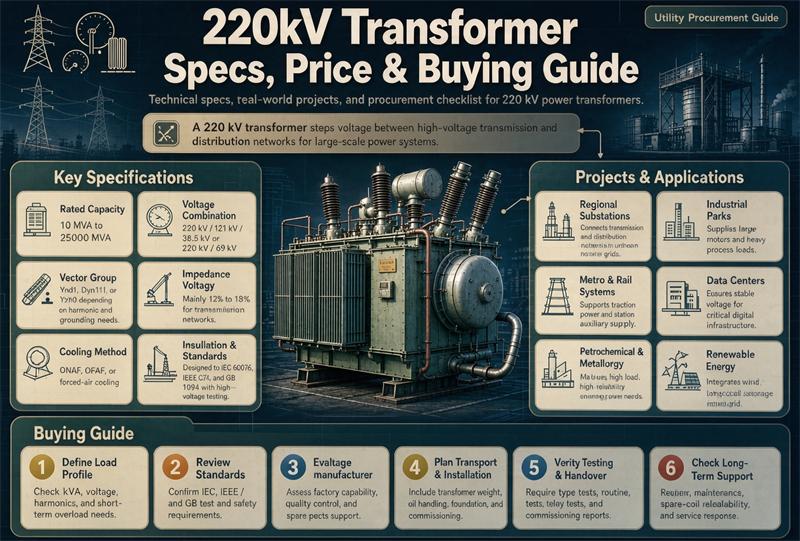
Here is the short list of numbers that decide whether a 220 kV unit is built right.
Basic Insulation Level (BIL). For the 220/245 kV class the lightning impulse withstand is 950 kV, with a switching impulse around 850 kV and a one-minute power-frequency withstand near 460 kV. If a supplier hands you a “220 kV” transformer with a BIL of 220 kV, stop. That number is the system voltage, not the impulse level, and it is a red flag that someone copied the wrong column. We have seen it on real product pages.
Short-circuit impedance. Expect roughly 12 to 18 percent at this class, rising with size and with three-winding designs. This number drives fault current, voltage drop under load, and how the unit shares load when it runs in parallel with an existing transformer. Nail it down in the spec instead of leaving it open.
Cooling. At this size you are almost always in forced cooling: ONAN for light load, ONAN/ONAF or ODAF/OFAF when you push it. The cooling mode changes the rated output, so a 300 MVA nameplate may be 240 MVA natural and 300 MVA forced. Our explainer on transformer cooling classes, ONAN, ONAF, AN and AF shows how the modes stack up.
Windings and tap changer. Most 220 kV units are two-winding or three-winding, with an on-load tap changer (OLTC) for voltage regulation. For a 220 kV to 110 kV step-down where the two voltages are close, an autotransformer is often cheaper and more efficient, but it gives up the galvanic isolation of a two-winding design and has different short-circuit behavior. For generator step-up or a radial feed, stick with two-winding.
Vector group. Step-down distribution typically uses Dyn11 or YNd11. Generator step-up and interconnections get matched to the machine and the grid code, so do not guess this one.
The current math (and why the heavy cable is on the low side)
A common worry is that 220 kV means massive conductors. It does not. The high-voltage winding carries a modest current because the voltage is so high. The big amps live on the low-voltage side.
| Rating | HV current at 220 kV | LV current at 13.8 kV | LV current at 33 kV |
|---|---|---|---|
| 100 MVA | about 262 A | about 4,184 A | about 1,749 A |
| 150 MVA | about 394 A | about 6,276 A | about 2,623 A |
| 200 MVA | about 525 A | about 8,368 A | about 3,499 A |
| 300 MVA | about 787 A | about 12,551 A | about 5,248 A |
So when you size the secondary containment, the buswork, and the protection, the work is on the low-voltage side. The 220 kV bushings and leads are comparatively small. That also means the fault current the transformer can feed is set by the low-voltage system impedance, not by anything dramatic on the high side.
Where 220 kV transformers actually go
This is not a distribution transformer you bolt to a pad outside a strip mall. The project archetypes look like this:
| Project type | What the unit does |
|---|---|
| Grid backbone step-down | Drops 220 kV to 110 kV or 33 kV for regional distribution |
| Generator step-up (GSU) | Raises generator voltage (13.8 to 24 kV) up to 220 kV for the grid |
| Renewable IPP interconnection | Connects large solar, wind, or BESS sites to the transmission network |
| Railway electrification | Feeds 25 kV or 50 kV traction supply from the transmission backbone |
| Cross-border interconnection | Heavy autotransformers linking two grid systems |
| Heavy industry | Steel, mining, and chemical sites with their own transmission intake |
You can see how units like these are specified in the field in our project case studies, which cover traction, solar, and industrial builds.
What it really costs, and why the cheap quotes mislead
Real 220 kV transformers are custom, not shelf stock. Third-party market data puts a 100 to 200 MVA, 220 kV unit in the range of roughly 800,000 to 1.5 million dollars FOB, while a 200 MVA base unit runs about 2.8 to 4.5 million dollars in 2026. A 100 MVA unit has been quoted everywhere from 500,000 dollars up past 2 million depending on the market and the testing scope.
Two things distort those numbers. First, the low FOB quotes you see on trading sites are for the bare unit, not the landed cost. Add freight (these weigh 90 to 245 tonnes and need Schnabel rail cars plus route surveys), insurance, commissioning, spare parts, and customs, and the installed price climbs well past the headline. Second, on a custom unit the final signed number usually lands 15 to 25 percent above the first quote once GOES electrical steel shortages, specialized high-voltage bushings, and the OLTC are priced in.
The cost is dominated by raw material and a few bottleneck components: grain-oriented electrical steel is roughly a quarter to a third of the build, copper windings another 15 to 20 percent, and bushings plus the OLTC are 10 to 15 percent on their own, with long lead times of their own.
Efficiency rules: there is no US federal floor here
Unlike small distribution transformers, a 220 kV unit sits well outside the US federal efficiency standard. The DOE rule under 10 CFR 431 only reaches primary voltages of 34.5 kV or less and secondaries of 600 V or less. At 220 kV there is no federal efficiency mandate, so losses are a commercial negotiation between you and the supplier, not a pass-fail compliance line.
Europe does have a floor. EU 548/2014 applies to power transformers above 3,150 kVA where the highest voltage exceeds 36 kV or the rating reaches 40 MVA, using a peak-efficiency index. If your unit ships into the EU, that calculation matters. In the US, you win on losses by specifying guaranteed no-load and load loss values and weighing them in the bid, not by pointing at a compliance certificate.
On tariffs, note that the Section 232 25 percent duty on transformers under HTS 8504 was set to hit units at or below 10,000 kVA first, with the over-10,000 kVA band delayed to December 31, 2027. Since every 220 kV transformer is far above 10 MVA, the heavy-duty tariff band is the one that applies to you, and it is on the later clock. Confirm the exact classification with your customs broker before you budget.
Testing you should insist on
Every unit should clear routine tests: ratio, winding resistance, insulation resistance, no-load and load loss, and dielectric tests. For a transformer this large, do not stop there. Ask for type tests covering temperature rise, lightning impulse at the full 950 kV class level, and short-circuit withstand, plus a factory acceptance test (FAT) with a witness point. Our guide on routine and type testing every transformer should pass lists the full set and what each one proves. Independent witnessed short-circuit testing is worth the premium on a unit this expensive.
How to write the spec (copy this checklist)
When you send a request for quote, give the factory enough to bid apples to apples:
- Rated power and whether it is two-winding, three-winding, or autotransformer
- Primary and secondary voltages, and the exact class (220 kV IEC or 230 kV IEEE)
- BIL and switching impulse level (950 kV / 850 kV for this class)
- Short-circuit impedance, with tolerance
- Cooling modes and the corresponding ratings (ONAN and ONAF/ODAF)
- OLTC range and step size, or off-load taps if regulation is not needed
- Vector group
- Mineral oil or natural ester insulation
- Guaranteed no-load and load loss values
- Altitude, ambient temperature range, and seismic requirement if any
- Routine plus type test scope, and whether you want a witnessed FAT
- Logistics envelope: weight, dimensions, and transport route limits
Hand a supplier that checklist and you will get comparable bids instead of three quotes that each hide a different assumption.
Wrapping Up
A 220 kV transformer is a transmission-class custom build, not a product you compare by sticker price. Lock the voltage class and the BIL at 950 kV, state the impedance, size the low-voltage side for the real amp numbers, and price the landed cost rather than the FOB teaser. Insist on type testing at this tier, and write a spec tight enough that every bidder answers the same questions. When you are ready to compare real builds, the product catalog and our resources library show how these units are specified and tested, and the home page points you to the full line.
FAQ
Is 220 kV the same as 230 kV?
Not exactly. 220 kV is the IEC class with a maximum system voltage of 245 kV. In North America the equivalent standard is 230 kV under IEEE C57.12.00. Many projects that say 220 kV really mean the same transmission tier, but the difference changes the BIL and the grid code you must meet, so confirm which one your specification requires.
What BIL does a 220 kV transformer need?
The correct lightning impulse withstand is 950 kV, with a switching impulse around 850 kV and a one-minute power-frequency withstand near 460 kV. If a supplier quotes BIL below that at this class, question it, because the number belongs to a much lower voltage system. We have seen 220 kV listed as the BIL, which is wrong.
What impedance should a 220 kV transformer have?
Plan on roughly 12 to 18 percent, rising with rating and with three-winding or autotransformer designs. State the value and its tolerance in the spec so fault levels and parallel operation with existing units stay predictable.
How much current is on the 220 kV winding?
About 262 amperes per 100 MVA. A 200 MVA unit draws around 525 A on the high-voltage side, which is modest. The large currents show up on the low-voltage winding, where a 200 MVA unit at 13.8 kV carries about 8,368 A.
Why does the low-voltage side need buswork, not cables?
Because the current is huge. At 13.8 kV a 200 MVA unit pulls over 8,300 A and a 300 MVA unit over 12,500 A, far beyond what a few cables handle. Those levels call for busway or engineered parallel conductors sized to the low-voltage fault duty.
Where do 220 kV transformers get used?
Mostly in transmission work: grid backbone step-down to 110 kV or 33 kV, generator step-up at power plants, renewable interconnection for large solar and wind sites, railway electrification feeds, cross-border interconnections, and heavy industrial intakes for steel, mining, and chemical plants.
How much does a 220 kV transformer cost?
Market data puts a 100 to 200 MVA unit around 800,000 to 1.5 million dollars FOB, and a 200 MVA base unit about 2.8 to 4.5 million dollars in 2026. The final signed price typically runs 15 to 25 percent above the first quote once steel, bushings, and the tap changer are priced in.
Why are the cheap online quotes misleading?
Those low numbers are usually FOB or EXW prices for the bare unit. A real 220 kV transformer weighs 90 to 245 tonnes and needs special heavy haul, insurance, commissioning, and customs on top. Landed and installed, the true cost is well above the headline figure.
Is a 220 kV transformer covered by US DOE efficiency rules?
No. The federal rule under 10 CFR 431 only reaches primary voltages of 34.5 kV or less and secondaries of 600 V or less. At 220 kV there is no federal efficiency mandate, so losses are negotiated in the bid, not certified to a standard.
Does the EU have an efficiency rule for these units?
Yes. EU 548/2014 applies to power transformers above 3,150 kVA where the highest voltage exceeds 36 kV or the rating reaches 40 MVA, using a peak-efficiency index. If your unit ships into Europe, that calculation is part of the specification.
Does the Section 232 tariff apply to 220 kV transformers?
The 25 percent duty under HTS 8504 was structured so the over-10,000 kVA band is delayed to December 31, 2027. Every 220 kV transformer is far above 10 MVA, so the later, heavy-duty band is the one that applies. Confirm the classification with your customs broker.
What tests should a 220 kV transformer pass before shipment?
Routine tests cover ratio, winding resistance, insulation resistance, no-load and load loss, and dielectric tests. For a unit this large also require type tests for temperature rise, lightning impulse at the full 950 kV class level, and short-circuit withstand, plus a witnessed factory acceptance test.