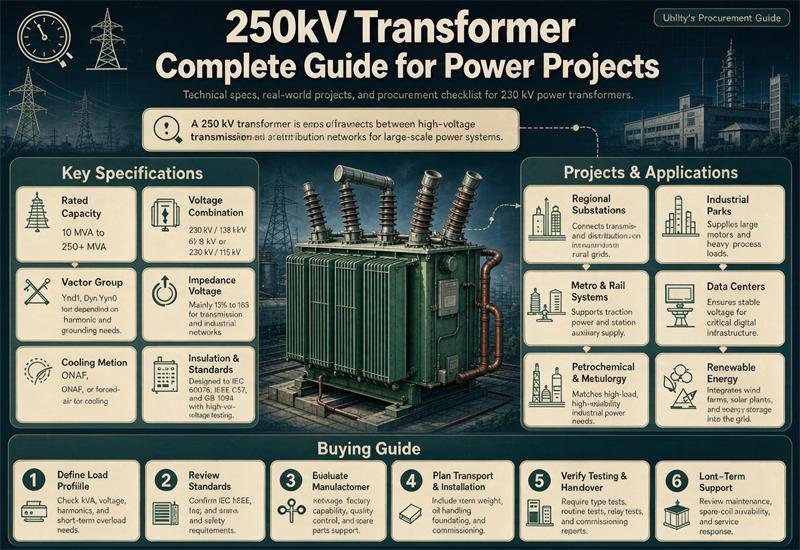
A 230 kV transformer sits at the top of the transmission voltage range most North American utilities actually build to. It is the workhorse that steps bulk power down to a regional 115 kV, 69 kV, or 34.5 kV bus, and the same machine steps generator output up onto the grid at hydro, gas, wind, and solar plants. If you are scoping a substation, an IPP interconnection, or a plant upgrade, this is the unit you will be buying, and the spec decisions here are expensive to undo later.
This guide walks through what the voltage class really means, the one specification most buyers get wrong, how the currents and cooling actually behave, what you will pay, and how to write a request for quote a factory can build to without a dozen change orders. The thing to keep front of mind: 230 kV in IEEE terms is the same hardware IEC markets as 220 kV, and that naming difference changes which insulation table your supplier is quoting from.
What a 230 kV transformer actually is
It is a liquid-immersed, three-phase power transformer whose high-voltage winding is rated for a 230 kV nominal system (maximum system voltage 242 kV under IEEE C57.12.00). The low-voltage, or generator, winding can be almost anything the project needs: 115 kV, 69 kV, 34.5 kV, 13.8 kV, or a tertiary for station power. Ratings run from roughly 20 MVA up past 500 MVA, and every unit above about 100 MVA is engineered to order, not pulled from a shelf.
In North America the class is almost always built and tested to IEEE C57.12.00 (liquid-immersed power transformers). In markets that follow IEC, the identical voltage class is called 220 kV with a maximum voltage Um of 245 kV, and it is built to IEC 60076. Same volts on the line, different rulebook, and that is where the first trap lives.
The specification most buyers get wrong: BIL is a range, not a number
Ask ten vendors for a 230 kV transformer and you will get BIL figures from 900 kV down to 650 kV, plus a few that quietly quote the IEC 1050 kV value. All of them can be “correct,” and that is the problem. IEEE C57.12.00-2010 lists four lightning impulse (BIL) levels at 230 kV: 650, 750, 825, and 900 kV. The 900 kV level is the usual choice for exposed outdoor transmission. IEC 60076-3, for the equivalent 220 kV (Um 245 kV) class, fixes the lightning impulse withstand at 1050 kV.
So the number you see on a quote is not a quality grade. It is an insulation-coordination decision. A line that runs through flat, low-lightning-risk terrain with good surge-arrester protection may legitimately use 650 or 750 kV and save real money on clearances, winding insulation, and losses. A long exposed tap or a mountainous corridor needs 900 kV. The mistake is letting a supplier default to the cheapest BIL without checking your exposure, or silently quoting the IEC 1050 kV against an IEEE specification.
| Standard | Class | Max system voltage | Lightning impulse (BIL) |
|---|---|---|---|
| IEEE C57.12.00 | 230 kV | 242 kV | 650 / 750 / 825 / 900 kV (selectable) |
| IEC 60076-3 | 220 kV (Um 245 kV) | 245 kV | 1050 kV (fixed) |
One more lever most specifiers miss: the neutral terminal. For a solidly grounded wye (YN) winding, IEEE C57.12.00 permits a reduced neutral insulation level, commonly 200 kV BIL, instead of the full phase-terminal level. That single allowance can take meaningful cost and weight out of a 200 MVA unit, and almost no off-the-shelf quote calls it out.
Impedance and what it controls
System impedance at 230 kV typically lands in the 12 to 18 percent band, higher than the 5.75 to 8 percent you see on distribution units, because the short-circuit duty and voltage-regulation needs are heavier. The exact value is a project decision, not a catalog default. It sets how much fault current the unit feeds into the bus, how the voltage sags under load, and whether a new unit can parallel an existing one without fighting it. Substation upgrades in particular require the new transformer to match the impedance of the units already on the pad, often to a tenth of a percent, or load sharing goes wrong and one unit overheats.
The current math that surprises people
The high-voltage side draws surprisingly little current. At 230 kV, one MVA is about 2.51 amperes, so a 100 MVA unit pulls roughly 251 A on the 230 kV winding. A 200 MVA unit pulls about 502 A. The heavy conductors are on the other winding. A generator step-up unit rated 230/13.8 kV at 200 MVA carries about 8,368 A on the 13.8 kV side. That is where busbar, cable, and breaker sizing get serious, and where the thermal and short-circuit design lives. Do not size the site around the 230 kV leads; size it around the low-voltage or generator leads.
| Rated power | 230 kV side current | Low-voltage side current (at 13.8 kV) |
|---|---|---|
| 100 MVA | about 251 A | about 4,184 A |
| 200 MVA | about 502 A | about 8,368 A |
| 300 MVA | about 753 A | about 12,551 A |
Cooling: ONAN, ONAF, OFAF, and friends
Every 230 kV unit is liquid-immersed, and cooling is staged. ONAN (oil natural, air natural) is the base rating. Add fans and you get ONAF, which typically lifts the continuous rating 12 to 15 percent. Add oil pumps and forced-air and you get OFAF, used on the largest units. The key planning point is that the nameplate MVA is tied to a cooling mode: a unit rated 200 MVA ONAF may be only about 170 MVA under ONAN, so a fan or pump failure is not a minor event, it is a derating you have to plan generation or load around. For the cooling-class details and how AN versus AF changes your redundancy math, see the cooling class explainer.
Where these units actually go: project archetypes
The same 230 kV transformer shows up in very different jobs, and the differences change the spec:
- Backbone step-down: 230 kV down to 115 or 69 kV at a grid substation, OLTC on the high side, full 900 kV BIL, heavy fault duty.
- Generator step-up (GSU): 13.8, 18, or 34.5 kV generator side up to 230 kV at hydro, gas, wind, and solar plants, often YNd11, with a tertiary for station service.
- Renewable IPP interconnection: large solar and wind farms step their collector voltage up to 230 kV to reach the grid; low-loss core and reactive support matter.
- Railway and transit feed: 230 kV feeds the traction substation that then derives the 25 kV or 25 kV-class catenary supply.
- Cross-border or asynchronous interties: phase-shifting and back-to-back duties where the 230 kV transformer is a grid-stability node.
- Heavy industrial: steel, mining, and petrochemical sites that need their own bulk supply and can tolerate a dedicated substation.
What you will really pay
The published price tables are a starting point, not a quote. As a rough international market range by capacity: 20 to 30 MVA sits around 200,000 to 500,000 dollars, 100 MVA around 800,000 to 1.5 million, 200 MVA around 2 to 3.5 million, and 300 MVA and up past 4 to 6 million. North American installed cost runs higher because of freight, heavy-haul logistics, commissioning, and tariff: a 100 MVA 230 kV unit is roughly 4.5 to 7.2 million for the equipment and about 6 to 9.5 million installed. A base 200 MVA quote commonly finishes 15 to 25 percent above the initial number once GOES electrical steel, bushings, the OLTC, and site-specific engineering are fixed.
Watch the landed cost, not the FOB number. A low ex-works price from an overseas mill is only part of the story once ocean freight, Schnabel rail cars for a 90 to 245 tonne unit, port handling, insurance, and US duty are added. For transformers under HTS code 8504, the 25 percent Section 232 tariff applies at or below 10,000 kVA, and the over-10,000 kVA band is delayed to December 31, 2027, which means virtually every 230 kV unit lands in the tariff window. Confirm the classification with your customs broker before you budget.
Standards and the efficiency question
Build and test to IEEE C57.12.00 (or IEC 60076 for export). Routine tests should cover ratio, winding resistance, insulation resistance, no-load and load loss, and dielectric tests. For a critical unit, ask for type tests covering temperature rise, lightning and switching impulse at your selected BIL, and short-circuit withstand, plus a witnessed Factory Acceptance Test.
Here is the part most buyers misunderstand: there is no US federal efficiency standard for a 230 kV transformer. The DOE distribution- and medium-voltage transformer rules in 10 CFR 431 only cover units with a primary at or below 34.5 kV and a secondary at or below 600 V. A 230 kV unit is far outside that scope, so any “DOE compliant” label on a 230 kV quote is either a mistake or marketing. Your efficiency lever is the loss evaluation in the specification (bidding no-load and load losses against a dollar-per-watt penalty), not a federal table. The European market does have ecodesign rules under EU 548/2014 for large power transformers, so an IEC-supplied unit may carry a PEI value you should review.
For the standard-mapping details between the two rulebooks, the IEC versus ANSI/IEEE guide lays out where they diverge and where they meet.
What every unit must pass before shipment
Do not treat factory testing as a formality. At minimum, every 230 kV transformer should clear ratio, winding resistance, insulation resistance, no-load and load loss, and dielectric tests. For a unit this size and this critical to the grid, insist on temperature-rise, lightning impulse at the BIL you specified, switching impulse, and short-circuit withstand as type or special tests, and book a witness point at the factory. The full routine testing checklist covers what to put in the acceptance plan.
Lead time is its own budget line
Custom 230 kV transformers are not fast. Depending on core steel, copper, bushings, OLTC, and test scheduling, practical delivery runs from about 32 to 48 weeks for an agile supplier to well over a year for a tier-one OEM. For a data center or IPP that loses real revenue per week of delay, that lead time belongs in the financial model, not just the schedule. Release the specification early and freeze the interface drawings before you need power.
A request-for-quote checklist you can paste
Hand a supplier this and you will get comparable numbers instead of brochures:
- Rated power and whether it is OA/FA rated or OFAF
- HV voltage 230 kV, LV or generator voltage, and frequency
- Vector group (commonly YNd11 or Dyn11)
- Impedance percentage and tolerance
- BIL level for line and neutral terminals, stated explicitly
- OLTC range and location, or off-circuit taps
- Cooling method and staged ratings
- Insulation fluid (mineral oil versus natural ester)
- Standards (IEEE C57.12.00 or IEC 60076) and test plan
- Seismic qualification if the site needs IEEE 693
- Surge arrester coordination and neutral grounding method
- Shipping weight, dimensions, and transport mode
Bottom line for project teams
A 230 kV transformer is a standard class but a custom product, and the savings and the risks both live in the specification. Get the BIL level matched to your exposure instead of accepting a default, fix the impedance to your parallel and fault requirements, size the site around the low-voltage conductors, and budget the landed cost and the lead time honestly. Do those and the unit will serve the grid for decades; skip them and you will pay for it in change orders and deratings.
You can compare the product catalog against your shortlist, review reference projects for real 230 kV-class builds, and start from the resources hub for the deeper technical guides linked above. If you are new to the site, the home page points to our full product and solution range.
FAQ
Is 230 kV the same as 220 kV?
Not by name, but by voltage they are the same class. 230 kV is the IEEE and North American term, governed by IEEE C57.12.00 at a 242 kV maximum system voltage. 220 kV is the IEC term for the equivalent class, with a maximum voltage Um of 245 kV under IEC 60076. Same line voltage, different standard and a different BIL table, so confirm which one your specification calls for.
What BIL do I need for a 230 kV transformer?
IEEE C57.12.00 offers four levels: 650, 750, 825, and 900 kV, with 900 kV the usual choice for exposed outdoor transmission. IEC 60076-3 fixes the equivalent 220 kV (Um 245 kV) class at 1050 kV. The right number depends on your lightning exposure and surge-arrester coordination, not on a vendor default, so specify it rather than accept whatever appears on the quote.
Can the neutral insulation be lower than the line terminals?
Yes. For a solidly grounded wye winding, IEEE C57.12.00 permits a reduced neutral insulation level, commonly around 200 kV BIL, instead of the full phase-terminal level. That reduces cost and weight, and a good specification states it explicitly rather than letting the neutral be over-built.
What impedance should a 230 kV transformer have?
Plan for roughly 12 to 18 percent. The exact value controls fault current into the bus, voltage regulation, and whether the unit can parallel existing transformers. Substation upgrades often require matching the existing unit’s impedance to a tenth of a percent, so treat it as a project decision, not a catalog value.
How much current is on the 230 kV winding?
About 2.51 amperes per MVA. A 100 MVA unit draws roughly 251 A on the high-voltage side and a 200 MVA unit about 502 A. The large currents are on the low-voltage or generator winding, so size the site bus, cables, and breakers there, not at 230 kV.
What cooling modes apply to these units?
ONAN is the base rating, ONAF adds fans for about a 12 to 15 percent boost, and OFAF adds oil pumps for the largest units. Because the nameplate MVA is tied to a cooling mode, a fan or pump outage is a real derating you must plan around, not a minor trip.
How much does a 230 kV transformer cost?
As a rough international range, 20 to 30 MVA is about 200,000 to 500,000 dollars, 100 MVA about 800,000 to 1.5 million, 200 MVA about 2 to 3.5 million, and 300 MVA and up past 4 to 6 million. North American installed cost is higher after freight, heavy-haul logistics, commissioning, and tariff.
Does the Section 232 tariff apply to 230 kV transformers?
For transformers under HTS code 8504, the 25 percent tariff applies at or below 10,000 kVA, and the over-10,000 kVA band is delayed to December 31, 2027. Since essentially every 230 kV unit exceeds 10,000 kVA, most of them land in the tariff window, so confirm the classification with your customs broker before budgeting.
Is there a DOE efficiency standard for 230 kV transformers?
No. The DOE rules in 10 CFR 431 cover only units with a primary at or below 34.5 kV and a secondary at or below 600 V, so a 230 kV transformer is outside that scope. Your efficiency control is the loss evaluation written into the specification, bidding no-load and load losses against a dollar-per-watt penalty.
What tests should every 230 kV unit pass?
At minimum, routine tests for ratio, winding resistance, insulation resistance, no-load and load loss, and dielectric strength. For a critical unit, add type or special tests for temperature rise, lightning and switching impulse at your specified BIL, and short-circuit withstand, plus a witnessed Factory Acceptance Test.
How long does delivery take?
Practical lead time runs from about 32 to 48 weeks for an agile supplier to over a year for a tier-one OEM, driven by core steel, copper, bushings, OLTC, and test scheduling. For revenue-sensitive projects, treat that lead time as a financial line item and release the specification early.
What should I put in the request for quote?
State rated power and cooling mode, HV and LV voltages, frequency, vector group, impedance and tolerance, BIL for line and neutral, OLTC or tap range, insulation fluid, applicable standard and test plan, seismic needs, surge-arrester coordination, neutral grounding, and shipping weight with transport mode. A complete RFQ gets you comparable numbers instead of brochures.