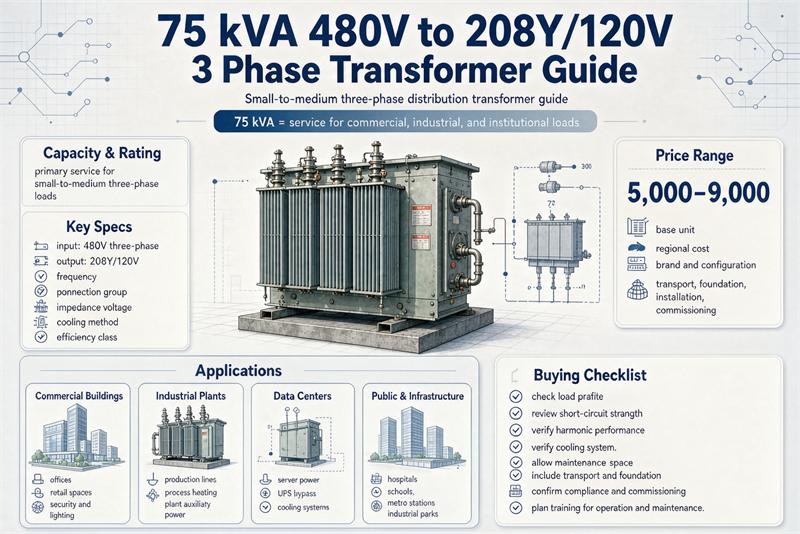
If your building gets 480 V three phase from the utility but your panels, receptacles, and equipment need 208 V three phase and 120 V single phase, a 75 kVA 480 delta to 208Y/120 wye dry type transformer is the unit that bridges the gap. It is the most common commercial voltage conversion in North America, and 75 kVA is a standard IEEE C57.12.00 rating, not a custom size.
Here is the short version before we get into the wiring. A 75 kVA unit at 480 V draws about 90.2 A on the primary and delivers about 208.2 A on the 208Y/120 V secondary. The primary breaker is a 125 A device, the secondary can be protected up to a 300 A device, and a stock ventilated unit runs roughly $4,000 to $7,000 before tariff. The single step that fails more inspections than any other is the separately derived system grounding at NEC 250.30, and we cover it in plain language below.
This guide walks through the real numbers, the National Electrical Code rules that actually apply at this size, what you will pay, and a buyer checklist you can paste into a request for quote. For the full catalog of sizes and types, start from our home page.
Quick specs at a glance
These are the numbers you will see on the nameplate of a typical 75 kVA, 480 V delta primary, 208Y/120 V wye secondary, 60 Hz, three phase dry type unit.
| Parameter | Typical value |
| Rated power | 75 kVA |
| Primary voltage | 480 V, 3 phase, delta |
| Secondary voltage | 208Y/120 V, 3 phase, wye with neutral |
| Frequency | 60 Hz |
| Primary full load amps | 90.2 A |
| Secondary full load amps | 208.2 A |
| Type | Dry type, ventilated or encapsulated |
| Insulation system | 150 C (80 C rise) standard, Class H available |
| Percent impedance (%Z) | 2.5 to 6.5 percent, 3.5 to 5.75 percent typical |
| BIL | 10 kV |
| Taps | plus or minus 2 x 2.5 percent |
| Enclosure | NEMA 1, 3R, or 12 |
| Sound level | 45 to 50 dB |
| Weight | about 500 to 650 lb |
| Dimensions | roughly 24 to 43 in tall, 20 to 30 in wide |
Why 480 V to 208Y/120 V
Most commercial and light industrial buildings are served at 480 V three phase. That voltage keeps feeder losses low over long runs and lets you pull more power through smaller wire. The problem is that almost nothing inside the building actually runs on 480 V. You need 120 V for receptacles, lighting, and controls, and you need 208 V three phase for rooftop HVAC, pumps, and smaller motors.
A single 480 delta to 208Y/120 wye transformer gives you both at once. The wye secondary puts out 208 V line to line for three phase equipment and 120 V line to neutral for everything that plugs into a wall. That is why this exact configuration shows up in nearly every office build out, warehouse, and machine shop in the country.
If you want the deeper background on how a dry type unit works and where it fits, our dry type transformer explainer covers the basics.
The two amp numbers that actually matter
Everything downstream starts with the full load current on each winding. The formula is the same on both sides: kVA times 1000, divided by the square root of 3, divided by the line voltage.
Primary, 480 V: 75,000 divided by (1.732 times 480) equals 75,000 divided by 831.4, or about 90.2 A.
Secondary, 208 V: 75,000 divided by (1.732 times 208) equals 75,000 divided by 360.3, or about 208.2 A.
Those two numbers drive your breaker sizes, your wire sizes, and your grounding. Write them on the nameplate photo before you bend a single stick of conduit. If a supplier quotes you a unit and the amp figures do not match this math, something on the voltage or phase is different from what you asked for. Our nameplate reading guide shows exactly which lines on the tag carry these values.
Sizing the overcurrent protection
NEC 450.3(B) governs transformers 1000 V and below. For a primary only protected installation, the primary device is capped at 125 percent of primary full load current. That is 90.2 A times 1.25, or 112.8 A, rounded up to the next standard size in 240.6(A), which is a 125 A breaker.
The secondary is a different story. Because a delta wye unit creates a new grounded system, the secondary conductors need their own protection. Table 450.3(B) allows the secondary device up to 125 percent of secondary full load current: 208.2 A times 1.25 equals 260.3 A, rounded up to a 300 A device. That 300 A is the maximum, not a recommendation. In practice the downstream panel often carries a 225 A or 250 A main, which sits comfortably under the 300 A ceiling and leaves a little headroom.
One detail worth flagging: some sizing charts on the web list the 75 kVA secondary breaker at 250 A. That number describes a common panel main, not the 450.3(B) maximum. The code maximum is 300 A, and you should know the difference when an inspector or an engineer questions the rating.
Sizing the conductors
The breaker is only half the job. The wire has to carry the load and land in lugs that are almost always rated for 75 C, even when you pull 90 C THHN. You use the 75 C column in NEC Table 310.16 at the termination, full stop.
Primary side, 90.2 A load: a 125 A device is protected by No. 1 AWG copper (130 A at 75 C) under the 240.4(B) next size up allowance, and No. 3 AWG copper (100 A at 75 C) also satisfies the load with a 125 A protector. The equipment grounding conductor is No. 6 AWG copper per Table 250.122 for a 125 A circuit.
Secondary side, 208.2 A load: for a 250 A panel main use 250 kcmil copper (255 A at 75 C); if you size to the full 300 A maximum, step up to 350 kcmil copper (310 A at 75 C). Do not try to squeeze this onto 3/0 (200 A), because that violates the continuous load rule once you account for the 125 percent.
The grounding step that fails inspections
This is the part that trips up more jobs than any other, and most product pages never mention it. A 480 to 208Y/120 transformer is a separately derived system under Article 100, because the secondary has no direct electrical connection to the primary. That means you build a new grounding reference at the transformer, and NEC 250.30 tells you exactly how.
Three connections land at the X0 neutral terminal and nowhere else but there (or at the first disconnect, your choice, never both):
- The secondary neutral conductor.
- The system bonding jumper, which ties X0 to the transformer enclosure. For 250 kcmil secondary phase conductors, Table 250.102(C)(1) sizes that jumper at No. 2 AWG copper.
- The grounding electrode conductor, which bonds the system to a grounding electrode such as building steel, a water pipe, or a driven rod.
The rule that breaks people: bond the neutral to ground at the source or the first disconnecting means, pick one, and never do both. A neutral to ground bond at both ends creates a parallel path that lets neutral current flow on the equipment grounding conductor, which is a real shock and fire hazard. Inspectors look for this first.
Neutral sizing for harmonic loads
Because the secondary is a wye, the neutral carries the imbalance between the three phases plus any triplen harmonics. Modern offices, server rooms, and VFD driven HVAC are nonlinear loads, and those generate harmonic current that piles onto the neutral. On a standard unit the neutral is often sized at 100 percent of the phase conductor, which is fine for clean linear loads.
If the transformer feeds IT closets, LED drivers, or variable frequency drives, specify a K factor rated unit, usually K 13 or K 20. A K rated dry type uses a heavier core, often an electrostatic shield, and a neutral bus sized at 200 percent of the phase conductors to handle the triplen harmonics without overheating. Skipping this is the classic cause of a transformer that runs hot and smells burnt in an office build out.
Dry type decisions: enclosure and cooling
At 75 kVA you are almost always looking at a dry type, and the question is ventilated versus encapsulated, and what NEMA rating the enclosure needs. Ventilated units shed heat through louvers and cost less, but they need clear air space around them per NEC 450.9. Encapsulated (epoxy filled) units are sealed against moisture and dust and suit damp or harsh sites, at a price premium.
NEMA 1 is indoor general purpose. NEMA 3R adds rainproof protection for outdoor or wet locations. NEMA 12 keeps out dust and dripping non corrosive liquids for dirty indoor environments. Match the box to the room, not to the catalog photo.
Cooling class matters too. Most 75 kVA dry types are self cooled (AN). If you expect the unit to run hot or you want headroom, some are available with forced air (AF) that adds capacity when fans run. Our cooling class guide explains the AN and AF ratings and when they pay off.
Fault current and AIC rating
Here is a reassuring point that the big unit guides scare you about: at 75 kVA the fault current is modest. Using a typical 5.75 percent impedance and assuming an effectively infinite primary bus, the secondary fault current is 208.2 A divided by 0.0575, or about 3,620 A. Real primary impedance pulls that down a bit, so plan around 3.5 kA.
That means a standard 10 kA AIC panelboard downstream is more than adequate. You do not face the 22 kA or 42 kA short circuit rating crisis that shows up on 1500 kVA and larger units. Still, read the available fault current from the utility or the upstream gear and confirm the AIC rating on every breaker in the secondary panel. Guessing here is how arc flash incidents happen.
Also note the vault rule. NEC 450.26 requires a transformer vault for an indoor dry type rated over 112.5 kVA when it does not meet the clearance and ventilation rules. At 75 kVA you are under that line, so no vault is required in a normal electrical room with adequate ventilation. That is a real cost and space saving versus a 150 kVA or 225 kVA unit.
Efficiency and DOE compliance
A stock 75 kVA dry type today meets DOE 2016 efficiency levels, and you will see that stamped on the nameplate. The relevant rule for low voltage dry types is 10 CFR 431.196, and the updated efficiency levels carry a compliance date of April 23, 2029. When you buy in 2026, ask the supplier whether the unit already meets the 2029 levels or only the 2016 levels. A unit that meets 2029 now protects you from having to replace it later and usually runs a little cooler.
Core losses are constant the moment you energize the primary, so grossly oversizing the transformer wastes energy even when the load is light. Stay close to your calculated load instead of jumping two sizes.
What you will actually pay
Prices for a 75 kVA 480 to 208Y/120 dry type span a wide band depending on winding material, enclosure, and whether it is ventilated or encapsulated. Here is an honest 2026 range drawn from published distributor and manufacturer listings.
| Type | Typical 2026 price |
| Ventilated, aluminum winding, DOE 2016 | $3,700 to $5,000 |
| Ventilated, copper winding, DOE 2016 | $4,500 to $6,500 |
| Encapsulated or isolation type | $5,400 to $9,900 (about $7,300 to $13,400 CAD) |
| Premium (copper, seismic rated, integrated metering) | up to about $21,800 |
Those figures are published list or distributor prices, not landed cost. If the unit is imported, the Section 232 tariff adds 25 percent on HTS code 8504 for transformers under 10,000 kVA, effective April 6, 2026. A $5,000 imported unit becomes about $6,250 landed before freight and markup. Ask the supplier for the country of origin and whether the price is EXW, FOB, or delivered, because those three numbers are not the same thing.
You can browse our product lines for the enclosure and winding options that match your site.
Buyer checklist and RFQ template
Paste this into your request for quote so suppliers quote the same thing:
- Primary voltage and connection: 480 V, 3 phase, delta.
- Secondary voltage and connection: 208Y/120 V, 3 phase, wye with neutral.
- Rated power: 75 kVA, 60 Hz.
- Enclosure: NEMA 1, 3R, or 12, and ventilated or encapsulated.
- K factor: K 1 for linear loads, K 13 or K 20 for IT or VFD heavy sites.
- Taps: plus or minus 2 x 2.5 percent.
- Efficiency: confirm DOE 2016 and ask whether it meets the April 23, 2029 levels.
- Neutrals: 200 percent if K rated.
- Country of origin and whether the quote includes the Section 232 tariff.
- Confirm the nameplate shows 90.2 A primary and 208.2 A secondary for these voltages.
A couple of reference projects show how similar dry type units were specified for commercial and data center jobs, which is handy when you need a real world comparison for your own submittal. For more guides like this one, browse the full resources library.
Bottom line
A 75 kVA 480 to 208Y/120 V transformer is a standard, off the shelf size that does one job extremely well: it turns a 480 V service into the 208 V three phase and 120 V single phase that a building actually uses. The engineering work is not in finding the unit. It is in the 90.2 A and 208.2 A numbers, the 125 A and up to 300 A protection, the 75 C termination wire sizing, and most of all the separately derived system grounding at NEC 250.30. Get those right, confirm the fault current against your AIC ratings, and pick an enclosure and K factor that match the room and the load. Do that, and inspection day is boring in the best way.
FAQ
What does a 75 kVA 480V to 208Y/120V transformer actually do? It steps 480 V three phase delta service down to a 208Y/120 V wye secondary. That gives you 208 V three phase for equipment and 120 V single phase for receptacles and lighting from one dry type unit, which is the standard commercial voltage conversion in North America.
How many amps is a 75 kVA 480 to 208Y/120 transformer? On the 480 V primary it draws about 90.2 A. On the 208Y/120 V secondary it delivers about 208.2 A. Those figures come from kVA times 1000 divided by the square root of 3 times the line voltage on each side.
What size breaker do I need for a 75 kVA transformer? The primary breaker is 125 A under NEC 450.3(B), sized at 125 percent of the 90.2 A primary full load current. The secondary can be protected up to a 300 A device, though many installations use a 225 A or 250 A panel main, which is allowed under that ceiling.
What size wire for 75 kVA 480 to 208/120? Use No. 1 AWG copper for the 125 A primary (No. 3 also meets the load) with a No. 6 copper grounding conductor. For the secondary, use 250 kcmil copper for a 250 A main or 350 kcmil copper for the full 300 A, and size the neutral at 100 percent or 200 percent if the unit is K rated.
Why does my 480 to 208Y/120 transformer need special grounding? The secondary is a separately derived system with no metallic tie to the primary, so NEC 250.30 requires you to build a new grounding reference at the transformer. You bond X0 to the enclosure with a system bonding jumper and run a grounding electrode conductor to a grounding electrode. This is the step inspectors check first.
Do I bond the neutral at the transformer or the panel? Pick one location and bond there only, either at the transformer or at the first disconnecting means, never both. A neutral to ground bond at both ends creates a parallel path that puts neutral current on the equipment grounding conductor, which is a shock and fire hazard.
What NEMA enclosure do I need? NEMA 1 is indoor general purpose, NEMA 3R adds rainproof protection for outdoor or wet sites, and NEMA 12 keeps out dust and non corrosive drips for dirty indoor rooms. Match the enclosure to the actual environment, not to the cheapest listing.
Do I need a K factor transformer for my office? If the load is mostly computers, LED lighting, or VFD driven HVAC, yes. Those are nonlinear and push triplen harmonics onto the neutral. A K 13 or K 20 dry type has a heavier core and a 200 percent neutral to handle that without overheating.
How much does a 75 kVA 480 to 208/120 transformer cost? A stock ventilated unit runs about $4,000 to $7,000, with copper winding at the high end. Encapsulated or K rated types run $7,000 to $10,000, and premium seismic or metering equipped units can reach about $21,800. Imported units add a 25 percent Section 232 tariff.
Does a 75 kVA dry type transformer need a vault? No. NEC 450.26 requires a vault for an indoor dry type only above 112.5 kVA when clearance and ventilation rules are not met. At 75 kVA you are under that threshold, so a properly ventilated electrical room is enough.
Can I run it in a hot mechanical room? You can, but you derate. At a 40 C ambient a standard 75 kVA unit effectively becomes about a 68 kVA unit, so either improve ventilation or step up to 112.5 kVA. Always check the manufacturer thermal curve for your room temperature.
Is a 75 kVA 480 to 208/120 transformer a standard size? Yes. 75 kVA is a preferred rating in IEEE C57.12.00, sitting in the standard ladder between 45 kVA and 112.5 kVA. You are buying a catalog item, not a custom build, which is why lead times are short and prices are published.