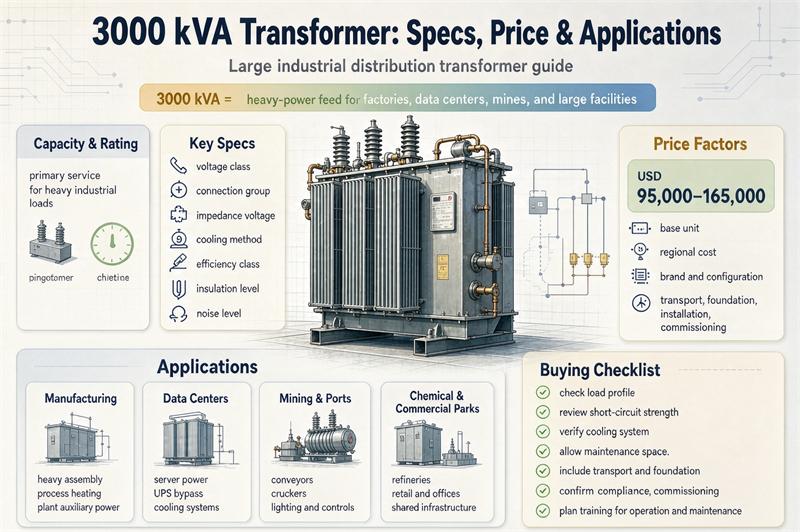
A 3000 kVA transformer is the unit that shows up when a project has outgrown a 2500 kVA and is not quite ready for a 3750 kVA. It is 3 MVA of apparent power, which is why you will see it written both ways on the same page. The problem is that almost every “specs and price” article on the first page of Google treats 3000 kVA like a bigger 1000 kVA unit. It is not. The moment you put a 3000 kVA transformer on a 480 V secondary it pulls about 3608 A and generates a fault current that blows past the 22 kA rating of a standard switchboard. Get those two numbers wrong and the unit arrives with no safe way to connect it.
This guide covers what a 3000 kVA transformer actually is, where it sits in the rating ladder, the amp and fault math you need to size it, what it costs in 2026, where these units go, and exactly what to put in a request for quotation so a supplier answers in numbers. It is written by the engineering desk at TransNine Electric.
Where 3000 kVA sits in the rating ladder
Here is the catch most buyers never hear until they are stuck. The IEEE C57.12.00 preferred three-phase ratings run 1500, 2000, 2500, then jump to 3750 and 5000 kVA. Three thousand is not a preferred rating. What it is, in practice, is the round metric number (3 MVA) that specifiers ask for, and several manufacturers list it as a pad-mount or substation size. So when you get a “3000 kVA” bid, one of three things is happening: you are being quoted a true custom build, you are being quoted a 3750 kVA frame that the seller rounded down on the quote, or you are looking at a unit that simply is not a stock item.
The practical read: before you chase a 3000 kVA nameplate, decide whether 2500 kVA covers your load. It is a preferred size, ships from catalog, and costs less. If your continuous load is under about 2000 kVA, a 2500 kVA unit with headroom is the cheaper, faster answer. If you are truly at 3000 kVA peak, ask the supplier to confirm the frame size in writing so you are not comparing a 2500 against a 3750 in the same spreadsheet.
The specs that actually matter
A nameplate has a lot of fields. These are the ones that change your design.
| Field | Typical 3000 kVA value | Why it matters |
|---|---|---|
| Rated power | 3000 kVA, three-phase, 60 Hz | The apparent power, not real power |
| Primary voltage | 12.47 kV, 13.8 kV, 34.5 kV | Sets primary current and switchgear |
| Secondary voltage | 480Y/277 V or 4160 V | Drives the conductor problem |
| Impedance | 5.75% to 7.5% | Sets fault current and voltage drop |
| Vector group | Dyn11 or Yd11 | Grounding and harmonic behavior |
| Cooling | ONAN/ONAF (oil), AN/AF (dry) | Continuous versus overload rating |
| Temperature rise | 65C (oil), 80C or 100C (dry) | Insulation coordination |
| Efficiency tier | DOE 2029 level | Operating cost for the next 30 years |
The two fields that decide whether your project works are the secondary voltage and the impedance. Everything else is adjustable. Pick those two first.
How many amps does a 3000 kVA transformer pull?
This is the number every guide should lead with and almost none do. For three-phase, full-load current is kVA times 1000 divided by (1.732 times line voltage).
| Primary | Secondary | Primary FLA | Secondary FLA |
|---|---|---|---|
| 12,470 V | 480Y/277 V | 138.8 A | 3608.4 A |
| 13,800 V | 480Y/277 V | 125.5 A | 3608.4 A |
| 4160 V | 480Y/277 V | 416.4 A | 3608.4 A |
| 34,500 V | 480Y/277 V | 50.2 A | 3608.4 A |
Notice the secondary current does not move. Drop the primary from 34.5 kV to 12.47 kV and the secondary is still 3608.4 A because the kVA is fixed. That 3608.4 A is the headline. It is what your 480 V bus, your breakers, and your conductors have to carry, every hour, at full load.
The 480 V conductor cliff
A 3000 kVA, 480Y/277 V secondary carries 3608.4 A continuously. At 75C copper, a single 1000 kcmil conductor is good for about 545 A. Divide 3608.4 by 545 and you get 6.6. You would need seven 1000 kcmil conductors in parallel per phase, or a busway. Three parallel runs per phase, which is the comfortable limit for a 1000 kVA unit, only delivers 1635 A and falls about 1970 A short.
So a 3000 kVA transformer on a 480 V secondary is a busway job, full stop. If your existing gear is cable-terminated at 2000 A, this unit will not land without a busway upgrade or a secondary voltage change. That is why a lot of 3000 kVA jobs actually run at 4160 V secondary: the current drops to 416.4 A and the conductor problem nearly disappears. You trade a bigger transformer winding for a much smaller downstream bus.
The 22 kA SCCR ceiling is gone
Short-circuit current rating is the second cliff, and at 3000 kVA it is worse than at 2000 kVA. NEC 409 and 110.10 require the gear around the transformer to ride through the available fault current. A common 480 V switchboard is rated 22 kA. Now compute the secondary fault current. It is full-load current divided by impedance. At 7.5 percent impedance, 3608.4 divided by 0.075 is about 48.1 kA. At 5.75 percent, it is about 62.8 kA.
Both are more than double the 22 kA ceiling, and even the 42 kA boards you might use at 2000 kVA are not enough at the lower impedance. You need 65 kA rated gear, or you split the load into two 1500 kVA units on separate buses. If a proposal hands you a 3000 kVA transformer and a 22 kA or 42 kA panel in the same package, that is a coordination problem to resolve before you sign, not after the unit is on site.
Dry type versus oil immersed at 3 MVA
Both technologies reach 3000 kVA, but they behave differently at this size. Cast-resin dry-type transformers top out around 2500 kVA for low-voltage (480 V) service in common practice. A 3000 kVA dry unit at 480 V is at or beyond that practical ceiling and almost always needs forced-air cooling (the AF in AN/AF) just to hold nameplate. Oil immersed units scale past 5000 kVA without trouble and run ONAN to full rating.
| Factor | Dry type (cast resin) | Oil immersed |
|---|---|---|
| Indoor, fire-sensitive site | Strong yes | Needs vault or separated room |
| Outdoor, open yard | Needs enclosure (IP23/IP54) | Natural fit, NEMA 3R tank |
| First cost at 3000 kVA | Higher | Lower |
| Forced cooling | Usually required (AF) | Optional (ONAF) |
| Maintenance | Minimal, no fluid | Fluid checks, sampling, SPCC |
| Max practical size | about 2500 kVA LV, higher MV | 5000 kVA and up |
The honest answer is that a 3000 kVA dry-type unit makes sense in a hospital basement or a data center where a fluid fire is unacceptable, but expect forced-air fans in the specification. An oil unit makes sense in a fenced yard. Our full comparison is in the oil immersed versus dry type guide.
Cooling classes in plain terms
Cooling shows up as a code on the nameplate and it changes your install. For liquid units it is ONAN (oil natural, air natural) or KNAN for sealed types, with ONAF or KNAF adding forced air for overloads. For dry units it is AN (air natural) and AF (air forced). At 3000 kVA the dry unit runs AN to some fraction and switches to AF fans for continuous or overload duty, while the oil unit holds ONAN to full rating and only adds ONAF for temporary peaks.
The point for a buyer: forced cooling buys you temporary or sustained capacity depending on the design, but confirm with the manufacturer which rating is continuous. Do not read “AF capable” and assume the unit is rated 3000 kVA without fans. See the cooling classes guide for the full code breakdown.
What a 3000 kVA transformer really costs in 2026
Prices on the first page swing from about 11,000 dollars to over 180,000 dollars for the same nameplate. The spread is real, and most of it comes from three things: where the unit is built, what efficiency grade it carries, and whether it is a new 60 Hz unit or a refurbished 50 Hz one.
| Build and grade | Indicated 2026 price | What drives the number |
|---|---|---|
| 50 Hz dry, ex-works Asia | about 11,000 to 20,000 USD | Not a 60 Hz North American unit; verify frequency |
| Refurbished or surplus oil pad mount | about 24,000 to 37,000 USD | Used, DGA history required, no warranty |
| New oil immersed, 13.8 kV to 480 V, 60 Hz | about 90,000 to 160,000 USD | Compliant, UL, new fluid, tested |
| New dry type, 13.8 kV to 480 V, 60 Hz | about 140,000 to 220,000 USD | Forced air, fire-safe, IP54 option |
| Packaged substation, 3 MVA | about 180,000 USD and up | Transformer plus switchgear in one enclosure |
Those bands are third-party published indications and trade listings, not quotations. The number that matters to you is the landed cost. For a unit imported to the US, add the Section 232 tariff of 25 percent on HTS 8504 transformers (in effect since 2026-04-06; the over-10,000 kVA delay to 2027 does not apply at 3000 kVA), then add UL 1561 or UL 1562 listing, ocean freight, crating, and margin. A realistic landed US price for a new, compliant 3000 kVA unit lands in the 100,000 to 220,000 dollar range depending on dry or oil and whether it ships as a substation. The 11,000 dollar listings are almost always 50 Hz or mislabeled smaller units, not a comparable 60 Hz transformer.
For deeper context on sourcing and landed cost, browse the resources library and the project case studies.
Where 3000 kVA units actually go
The application map below is the fastest way to see whether this size is yours.
| Setting | Typical primary | Typical secondary | Why 3000 kVA fits |
|---|---|---|---|
| Mid-size industrial plant | 13.8 kV | 480Y/277 V | Feeds a motor control center and plant distribution |
| Large commercial campus | 13.8 kV | 480Y/277 V | Several buildings off one substation |
| Data center hall | 13.8 kV | 480Y/277 V | One of several N+1 units behind UPS |
| Hospital | 13.8 kV | 480Y/277 V | Critical branch with isolation and redundancy |
| Solar collection station | 34.5 kV | 480 V or 4160 V | Step-up to the interconnection point |
| Packaged substation | 34.5 kV | 480Y/277 V | Transformer and switchgear in one pad |
Notice the recurring 480Y/277 V secondary. That is exactly the choice that creates the 3608 A conductor and 48 kA fault problem from earlier. If you are speccing one of these, plan the bus before you plan the transformer. For the product family overview, start at our product catalog.
Standards and compliance
A 3000 kVA transformer touches several code and standard regimes, and mixing them up is a common way to buy the wrong unit.
- IEEE C57.12.00: general requirements for liquid-immersed and dry-type power transformers, and the source of the preferred rating ladder (2500 then 3750, with 3000 as a non-preferred step).
- NEC Article 450: overcurrent protection. Primary-only protection is 125 percent of primary FLA, rounded to the next standard device in NEC 240.6(A).
- NEC 409 and 110.10: the gear around the transformer must ride through the available fault current, which at 3000 kVA is well past 22 kA.
- IEC 60076: the export-language standard. If the unit is built to IEC and shipped to North America, confirm the NEC and IEEE gaps are closed.
- DOE 10 CFR 431: covers liquid-filled units from 10 kVA up and dry-type from 15 kVA up, so 3000 kVA is inside the scope. The revised standards have a compliance date of April 23, 2029.
If your project commissions after that date, specify the 2029 DOE level in the contract and do not accept a 2016 label as the finish line. Our IEC 60076 versus ANSI/IEEE guide covers the export gap in detail.
What to verify on the nameplate
The nameplate is where sales talk meets steel. Before you pay, confirm these fields against your specification:
- Rated power and cooling class (ONAN, KNAN, AN/AF)
- Voltage ratio and vector group (Dyn11, Yd11, Yyn0)
- Impedance in percent, because it sets your fault current
- Temperature rise (65C for liquid, 80C or 100C for dry)
- BIL (basic impulse level) for insulation coordination
- K-factor rating if the load is nonlinear (drives, VFDs, rectifiers)
- Certification marks (UL, CSA, CE, or the local authority requirement)
- Frame size in writing, because 3000 kVA may be a 3750 kVA frame
A copy-ready RFQ clause
Paste this into your specification and a serious supplier will answer in numbers instead of adjectives.
Transformer, 3000 kVA, three-phase, 60 Hz
Primary: 13800 V, Delta or GRDY, tap changer +/-2x2.5%
Secondary: 480Y/277 V, 3-wire + ground
Impedance: 7.5% max (state band, confirm fault current)
Cooling: ONAN/KNAN (oil) or AN/AF (dry) per type selected
Losses: confirm P0 and Pk at 75C reference
Compliance: DOE 10 CFR 431 (2029 level), UL 1561 or UL 1562
Fault coordination: gear rated for secondary fault (about 48 kA at 7.5%)
Bus: 480 V busway rated for 3608 A continuous
Tests: routine per IEEE C57.12.90, type test report on file
Submittals: nameplate drawing, impedance, fan curve, warranty, frame size
Adjust the primary voltage to your service. The impedance and fault lines force the busway and SCCR conversation up front. The frame-size line removes the “is this really 3000 or a 3750” ambiguity.
Ten mistakes buyers make at 3000 kVA
- Chasing a 3000 kVA nameplate when 2500 kVA (a preferred size) would cover the load.
- Sizing the transformer but not the 480 V bus, which has to carry 3608 A.
- Assuming a 22 kA or 42 kA panel is enough when the secondary fault is 48 to 63 kA.
- Quoting an 11,000 dollar listing as the US price when it is a 50 Hz or mislabeled unit.
- Forgetting the 25 percent Section 232 tariff on a unit imported to the US.
- Accepting “DOE 2016” on a project that commissions after April 2029.
- Specifying a dry-type unit without forced-air cooling at this size.
- Leaving K-factor blank on a VFD-heavy or rectifier load.
- Skipping the type test report and trusting the routine test alone.
- Writing “UL listed” with no standard number, so the clause means nothing.
The bottom line
A 3000 kVA transformer is a common request but not a preferred IEEE rating, so the first decision is whether 2500 kVA or 3750 kVA is the honest size for your load. After that, two numbers decide whether the project actually works: about 3608 A on the 480 V secondary and roughly 48 to 63 kA of available fault current. Plan a busway and 65 kA gear for those, specify the 2029 DOE level and a real loss band, and write the RFQ so the supplier answers in numbers. Do that and the 3 MVA unit that shows up on the flatbed will bolt in the first time.
FAQ
What is a 3000 kVA transformer, and is it the same as 3 MVA? A 3000 kVA transformer is a three-phase unit rated for 3000 kVA of apparent power. Three MVA is the same thing written in metric prefix form, because 1 MVA equals 1000 kVA. The rating describes capacity, not real power in kW.
Is 3000 kVA a standard transformer size? It is not a preferred IEEE C57.12.00 rating. The preferred three-phase ladder runs 2500 then 3750 kVA, so 3000 sits between them. Many makers quote 3000 kVA as a pad-mount or substation size or as a 3750 kVA frame, so confirm the frame size in writing.
How many amps does a 3000 kVA transformer draw at 480 V? On a 480Y/277 V secondary it draws 3608.4 A at full load, three-phase. The primary current depends on the primary voltage: about 125.5 A at 13.8 kV and 138.8 A at 12.47 kV.
What size wire do I need for a 3000 kVA 480 V transformer? The secondary needs 3608.4 A at 75C copper. A single 1000 kcmil conductor carries about 545 A, so you need seven 1000 kcmil conductors per phase in parallel or a busway. Three runs per phase only gives 1635 A and falls about 1970 A short.
Can a 22 kA panel handle a 3000 kVA transformer? No. With a typical 5.75 to 7.5 percent impedance the secondary fault current is about 48 to 63 kA, well past the 22 kA rating and even past a 42 kA board. You need 65 kA rated gear or two smaller units on separate buses.
What size breaker protects a 3000 kVA transformer? Per NEC 450.3(B), primary-only protection is 125 percent of primary FLA, rounded to the next standard size. At 13.8 kV primary that is 125.5 A x 1.25 = 156.9 A, so the next standard device is 175 A. Confirm with the authority having jurisdiction.
Is a 3000 kVA transformer dry type or oil immersed? Both reach this size, but dry-type at 480 V is at or beyond the common 2500 kVA practical ceiling and usually needs forced-air cooling. Oil immersed scales past 5000 kVA and runs ONAN to full rating. The choice is about location and spill risk.
How much does a 3000 kVA transformer cost? Indicated 2026 prices run from about 11,000 USD for a 50 Hz or mislabeled unit to over 180,000 USD for a packaged substation. A new, compliant, 60 Hz unit lands around 100,000 to 220,000 USD depending on dry or oil, before adding US tariff, UL listing, and freight.
Does a 3000 kVA transformer meet DOE efficiency rules? Yes. DOE 10 CFR 431 covers liquid-filled units from 10 kVA up and dry-type from 15 kVA up, so 3000 kVA is inside the scope. The revised standards have a compliance date of April 23, 2029, so specify the 2029 level for later commissions.
How heavy is a 3000 kVA transformer? A liquid pad mount in this range weighs roughly 9000 to 14000 lb dry and about 16000 to 22000 lb filled, because of the insulating fluid. Dry cast-resin units weigh about 6 to 9 metric tons with no fluid. Both need a crane and a pad rated for the filled weight.
What should I put in a 3000 kVA transformer RFQ? State the kVA, phase, frequency, primary and secondary voltages, impedance band, cooling class, a loss band, the DOE 2029 compliance level, UL listing, the required fault coordination and bus rating, and the tests. A copy-ready clause is in the guide above.
Can I run a 3000 kVA transformer at more than its rating? Brief overload is possible with forced cooling (AF for dry, ONAF for oil), but the continuous nameplate stays at 3000 kVA. Plan forced cooling as temporary or confirmed continuous capacity, not as your rated load, and confirm the manufacturer’s overload curve.