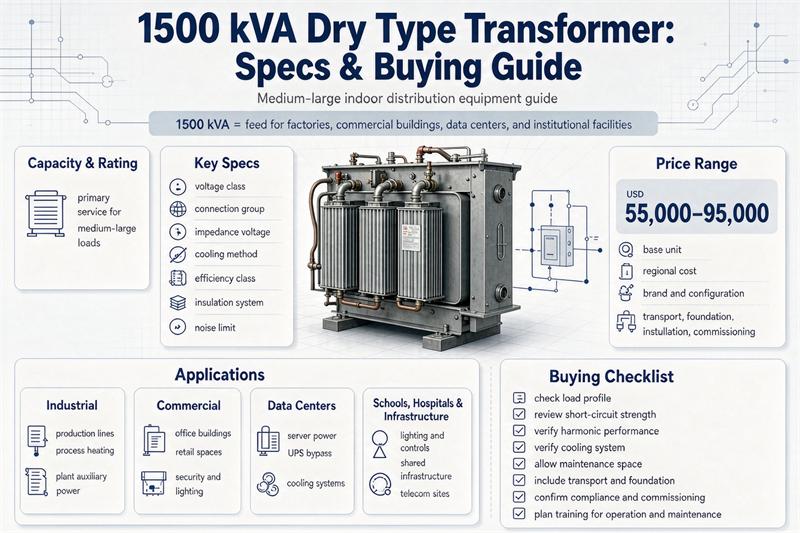
A 1500 kVA dry type transformer is a big, air-cooled unit that steps medium voltage down to 480 V (or 208Y/120 V) for large commercial and industrial loads. It is a genuine standard size on the IEEE C57.12.00 preferred ladder, so you can buy one off the shelf from several makers. The trap is not finding a 1500 kVA unit. The trap is sizing everything around it.
At 480 V the secondary pulls about 1804 amps, the bolted fault current lands near 31 kA, and the downstream gear has to be rated for 42 kA interruption. Miss any of those three numbers and the transformer arrives on a truck but never gets approved for energization. This guide walks through the specs that actually matter, the dry-type details competitors skip, and what a 1500 kVA dry type really costs once it lands in the United States. For the full product line, browse the TransNine Electric catalog or jump straight to our dry-type units.
Is 1500 kVA a standard size?
Yes. Unlike 3000 kVA, which is not a preferred IEEE rating (the ladder jumps from 2500 to 3750 kVA), 1500 kVA sits right on the standard three-phase sequence: 1000, 1500, 2000, 2500. That means you are not paying a custom premium for the core size itself.
What you are buying is a standard frame with a lot of options bolted on: primary voltage, enclosure, cooling method, K-factor, and monitoring. The standard frame is the easy part. The options are where projects stall, because each one changes the ampacity, the fault rating, and the footprint.
The 480 V secondary reality: 1804 amps
Most North American installations land a 1500 kVA dry type on a 480 V secondary. The full-load current is not a rounding error you can ignore:
| Parameter | Value |
|---|---|
| Rated power | 1500 kVA, three-phase |
| Typical primary | 13.8 kV, 12.47 kV, or 4.16 kV (medium voltage) |
| Secondary | 480 V (often 480Y/277 or 480 delta to 208Y/120) |
| Full-load current at 480 V | 1804 A |
| Nameplate impedance | 5.75 percent typical |
| Temperature rise | 150 deg C (Class F or H insulation) |
| Cooling | AN (self-cooled) / AF (forced air) |
That 1804 A number drives everything downstream. It is the single most useful figure on the nameplate for a buyer, and almost no vendor page prints it.
The conductor cliff you cross at 1500 kVA
Here is the part most spec sheets gloss over. Three sets of 1000 kcmil copper per phase carry about 1635 A at 75 deg C. That comfortably feeds a 1000 kVA unit (about 1203 A) but it does not clear the 1804 A of a 1500 kVA secondary. You have crossed the conductor cliff.
| Secondary feeder option (per phase) | Approx. ampacity | Covers 1804 A FLA? |
|---|---|---|
| 3 x 1000 kcmil Cu | 1635 A | No |
| 4 x 1000 kcmil Cu | 2180 A | Yes, at FLA |
| 5 x 750 kcmil Cu | 2375 A | Yes, with 125 percent headroom |
| Busway (rated) | per schedule | Yes, and cleaner to install |
If your overcurrent device is sized at the NEC 125 percent continuous value (about 2255 A for this unit), you need 5 x 750 kcmil, 6 x 600 kcmil, 7 x 500 kcmil, or a busway. Three parallel runs per phase are no longer on the table. Plan the gutter, the lugs, and the termination space before you order, not after the unit is in the room.
Fault current and the 42 kA rating
A 1500 kVA dry type at 5.75 percent impedance lets through roughly 31.4 kA of bolted fault current on the secondary under the infinite-bus assumption. Add utility source impedance or motor contribution and it only goes up.
That is why the minimum AIC (ampere interrupting capacity) tier for this size is 42 kA, not the 22 kA you see on smaller 480 V gear. If a contractor quotes you a 22 kA panelboard to sit behind a 1500 kVA dry type, the gear will not pass the available-fault-current label required by NEC 110.24. The protective devices, feed-through lugs, and any tap must all be rated to at least 42 kA at the transformer secondary.
| Transformer size at 480 V | Typical fault current at 5.75 percent Z | Minimum AIC tier |
|---|---|---|
| 1000 kVA | 20.9 kA | 22 kA |
| 1500 kVA | 31.4 kA | 42 kA |
| 2500 kVA | 52.2 kA | 65 kA |
The jump from 22 kA to 42 kA is a real cost and coordination step. Budget for it up front.
Overcurrent protection per NEC 450.3(B)
The primary overcurrent device is set at 125 percent of the primary full-load current, rounded up to a standard rating. On the secondary side, the feeder breaker lands near 2255 A, which means a 2500 A frame (or a 4000 A frame with a 2500 A sensor). Primary-only protection is allowed within the 450.3(B) percentages, but it leaves the secondary conductor between the transformer and the first device protected only by the primary, so coordinate that carefully with your engineer.
The short version: a 1500 kVA dry type is not a “pull the lugs and land the feeder” job. The breaker frame, the sensor rating, and the conductor sets all scale up together.
Dry-type specifics competitors skip
Because this is a dry type, a set of rules applies that oil-filled units do not worry about. These are the details that keep an inspector happy.
- UL 1562. Dry-type distribution transformers rated 601 to 35000 V fall under UL 1562, which covers solid-cast and resin-encapsulated construction. A 1500 kVA dry type is almost always cast resin or VPI (vacuum pressure impregnated). Confirm the UL listing, not just a CE or IEC mark, for a US job.
- Enclosure and NEMA rating. Indoor electrical rooms use NEMA 1. Exposed or semi-outdoor locations need NEMA 3R. Dusty industrial spaces push toward NEMA 12. A dry type is not weatherproof on its own, so the enclosure is a real spec line, not a footnote.
- Ventilation and clearances. Dry types shed heat into the room. NEC 450.9 calls for ventilation, and 450.21 governs spacing from combustible surfaces. You also need the working space in 110.26 around the unit. A 1500 kVA dry type is a large box (roughly 2.1 m tall and 1.2 to 1.5 m wide), so the room has to be sized before the equipment is ordered.
- Sound. Forced-air fans add noise. If the unit sits near occupied space, ask for the self-cooled sound level and the fan-on level, not just a catalog number.
Our dry-type explainer covers the cast-resin versus VPI trade-offs in more depth.
Cooling: AN and AF, and what happens when the fan fails
Most 1500 kVA dry types are labeled AN/AF. AN is the self-cooled rating. AF is the forced-air rating with fans, and on a large unit the full nameplate capacity often assumes the fans are running.
That creates a planning question most buyers miss: if the fans fail, the unit derates. For a critical load you either oversize the transformer so AN covers the load, or you add fan-failure alarms and redundant cooling. Treat the fan as a load-bearing component, because it is. Temperature rise is typically 150 deg C with Class F (155 deg C) or Class H (180 deg C) insulation, so there is headroom, but the rating on the nameplate is the rating with the cooling system working.
The cooling class guide breaks down AN, AF, and how the letters map to real duty.
K-factor for harmonic loads
If the load behind the transformer is full of VFDs, servers, or LED drivers, the current is no longer a clean sine wave. Standard transformers overheat on harmonic loads. You want a K-rated dry type, commonly K-13 or K-20 for data centers and heavy VFD plants.
Specify the K-factor up front. A unit that is not K-rated will not quietly handle a 40 percent harmonic load, and “we will add a filter later” is not a transformer specification. For a hyperscale example, see the K-factor dry type project we shipped for a data center.
Efficiency and the 2029 DOE floor
Dry-type distribution transformers from 15 to 5000 kVA are covered by DOE 10 CFR 431.192, and the efficiency table in 431.196 is the binding reference. DOE’s 2016 level for a 1500 kVA three-phase dry type is about 99.02 percent. The 2029 update, effective April 23 2029 (recorded in 89 FR 29834 and amended in 90 FR 43371), raises that floor.
Do not trust a vendor who quotes “meets DOE” without naming the specific 431.196 row for your BIL and kVA. Ask for the tested no-load and load losses at the reference temperature, because that is what your lifecycle cost actually rides on.
Honest price: EXW China versus landed US cost
This is where published numbers get misleading. A Chinese factory might quote a 1500 kVA dry type at 18000 to 27000 dollars EXW. That number excludes ocean freight, inland freight, US duties, the Section 232 tariff, 60 Hz and 480 V re-rating, UL 1562 listing, and the enclosure and monitoring you actually need.
Section 232 places a 25 percent tariff on transformers under HTS 8504 effective April 6 2026. A 1500 kVA unit is well under the 10000 kVA threshold, so the full 25 percent applies (the delayed lower rate only matters above 10000 kVA).
| Price view | Typical range | What it includes |
|---|---|---|
| EXW China, bare unit | 18000 to 27000 dollars | Factory price, 50 Hz, minimal enclosure |
| Landed US, UL 1562, copper, NEMA 1/3R, AN/AF | 60000 to 130000 dollars | Tariff, freight, duties, listing, enclosure, monitoring |
| Installed (with gear, labor, concrete pad) | 90000 to 200000 dollars | Above plus switchgear, busway, labor |
None of these are quotations. They are third-party published indications and engineering starting points. Confirm against a real quote and your local Authority Having Jurisdiction before you commit a budget line.
Where 1500 kVA dry types actually go
You see them in hospitals (non-combustible, indoor-safe), high-rise buildings, data centers (often K-rated), university campuses, and industrial plants where oil is not allowed. The oil versus dry comparison lays out when dry wins and when oil is the better call.
Buying checklist
- Confirm the primary voltage and the exact secondary (480 V, 480Y/277, or 480 to 208Y/120).
- Print the 1804 A secondary FLA and size the feeder for it, plus 125 percent for the continuous load.
- Specify a 42 kA (or higher) AIC rating on all gear behind the secondary.
- Pick the enclosure: NEMA 1 indoors, 3R for exposed sites, 12 for dusty plants.
- Decide AN only or AN/AF, and plan for fan failure if the load is critical.
- Add a K-factor (K-13 or K-20) if harmonics are present.
- Require UL 1562 and the named 431.196 efficiency row, not a vague “DOE compliant.”
- Budget landed US cost, including the 25 percent Section 232 tariff.
For the full set of selection guides and standards deep-dives, our resources library collects every transformer article in one place.
That is the whole picture. A 1500 kVA dry type is a standard, available product. The work is in the amps, the fault rating, the cooling, and the honest landed price, not in finding the unit.
FAQ
What is a 1500 kVA dry type transformer used for? It steps medium voltage down to 480 V or 208Y/120 V for large buildings, hospitals, data centers, and plants where oil-filled units are not allowed. The dry (air-cooled, cast-resin or VPI) construction makes it safe indoors.
How many amps is a 1500 kVA transformer at 480 V? About 1804 amps, three-phase. That single number drives the feeder size, the breaker frame, and the termination space, so get it on paper before you size anything downstream.
What size conductor do I need for a 1500 kVA 480 V secondary? Three sets of 1000 kcmil copper per phase are not enough (about 1635 A). You need at least 4 x 1000 kcmil, or 5 x 750 kcmil, 6 x 600 kcmil, 7 x 500 kcmil, or a busway, especially once the 125 percent continuous-load rule is applied.
What AIC rating do I need for a 1500 kVA transformer? At 5.75 percent impedance the secondary fault current is about 31 kA, so the minimum AIC tier is 42 kA. A 22 kA panelboard sized for smaller units will not pass NEC 110.24 labeling.
Is 1500 kVA a standard transformer size? Yes. It is on the IEEE C57.12.00 preferred ladder (1000, 1500, 2000, 2500), unlike 3000 kVA which is not a preferred rating. You can buy a 1500 kVA unit off the shelf.
What does UL 1562 cover for dry type transformers? UL 1562 covers dry-type distribution transformers rated 601 to 35000 V, including solid-cast and resin-encapsulated construction. For a US installation, confirm the UL 1562 listing rather than relying on a CE or IEC mark alone.
What is the difference between AN and AF cooling? AN is self-cooled (no fans). AF is forced-air with fans, and on a large dry type the full nameplate rating often assumes the fans run. If the fans fail, the unit derates, so plan for that on critical loads.
Do I need a K-rated dry type transformer? If the load has significant harmonics (VFDs, servers, LED drivers), yes. Specify K-13 or K-20 so the unit does not overheat on non-sinusoidal current. A standard unit is not a safe substitute.
What enclosure rating does a 1500 kVA dry type need? NEMA 1 for a clean indoor electrical room, NEMA 3R for exposed or semi-outdoor sites, and NEMA 12 for dusty industrial spaces. The dry type is not weatherproof on its own.
How much does a 1500 kVA dry type transformer cost? A bare unit might be quoted 18000 to 27000 dollars EXW China, but landed in the US with UL 1562, copper windings, a proper enclosure, and the 25 percent Section 232 tariff, expect roughly 60000 to 130000 dollars, and more installed.
What efficiency should a 1500 kVA dry type meet? DOE covers dry types from 15 to 5000 kVA under 10 CFR 431.192, with the 431.196 table as the binding reference. The 2016 level for this size is about 99.02 percent, and the 2029 update (effective April 23 2029) raises the floor.
How big is a 1500 kVA dry type transformer? Plan for roughly 2.1 m tall, 1.2 to 1.5 m wide, and about 2 to 3.5 tonnes depending on enclosure and cooling. It needs ventilation, combustible-surface clearances per NEC 450, and the working space in 110.26.