A 2000 kVA transformer is the unit a lot of projects reach for when a 1500 kVA is just shy and a 2500 kVA feels like overkill. It is about 1.6 MW of apparent power. The trouble is that most “complete guides” on the first page of Google treat it like a bigger version of a 75 kVA pad mount. It is not. Two real engineering cliffs show up the moment you put a 2000 kVA unit on a 480 V secondary: the conductor count and the short-circuit rating. Get those wrong and the unit shows up on a flatbed truck with no way to land it.
This guide walks through what a 2000 kVA transformer actually is, where it fits in the standard rating ladder, the numbers you need to size it, what it costs, what the losses mean for your power bill, and exactly what to write in a request for quotation so a supplier cannot hide behind a vague “as standard” reply. It is written by the engineering desk at TransNine Electric.
Where 2000 kVA sits in the rating ladder
In the ANSI/IEEE C57.12.00 preferred distribution and power transformer ratings, 2000 kVA is a standard three-phase step. The ladder around it runs 1500, 2000, 2500 kVA. You almost never see a single-phase 2000 kVA in North American practice. If a vendor quotes you a “single-phase 2000 kVA,” stop and ask what they mean, because the term usually signals a specialty or a catalog typo rather than a stock unit.
The practical read: 2000 kVA is the workhorse size for a mid-size industrial plant, a large commercial building, a data center pod, or a utility-scale solar collection point. It is big enough that shipping, rigging, and the switchgear around it dominate the real project cost, not just the sticker on the transformer.
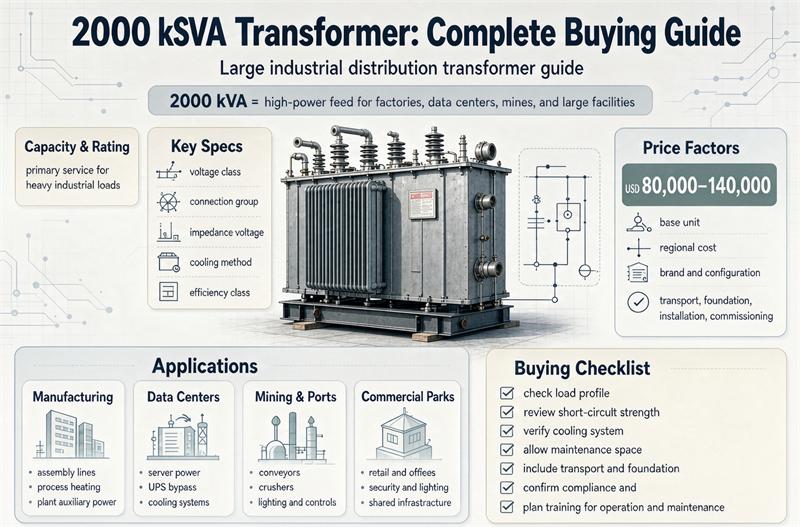
What a 2000 kVA transformer powers
The application map below is the fastest way to see whether 2000 kVA is your size.
| Setting | Typical primary | Typical secondary | Why 2000 kVA fits |
|---|---|---|---|
| Industrial plant | 13.8 kV or 12.47 kV | 480Y/277 V | Feeds a motor control center and a plant distribution panel |
| Large commercial building | 13.8 kV | 480Y/277 V | Serves several floors of HVAC and lighting |
| Data center pod | 13.8 kV | 480Y/277 V | One of several N+1 or 2N units behind UPS |
| Hospital | 13.8 kV | 480Y/277 V | Critical branch with isolation and redundancy |
| EV fast-charge hub | 25 kV or 34.5 kV | 480Y/277 V or 4160 V | Several 350 kW dispensers on one unit |
| Solar or wind collection | 34.5 kV | 480 V or 4160 V | Step-up or step-down to the interconnection point |
| Campus or district | 12.47 kV | 4160 V | Feeds a secondary distribution loop |
Notice the secondary is almost always 480Y/277 V in the US, or 4160 V when the load is large and centralized. That choice drives every number in the next section.
Full-load current, overcurrent protection, and the conductor cliff
This is the part most guides get wrong by stopping at “full-load amps.” At 2000 kVA the secondary current is large enough that the conductors, not the transformer, become the hard problem.
| Primary voltage | Secondary | Primary FLA | Primary OCPD (125%, next std) | Secondary FLA | Secondary OCPD (125%, next std) |
|---|---|---|---|---|---|
| 12,470 V | 480Y/277 V | 92.5 A | 125 A | 2405.6 A | 4000 A |
| 13,800 V | 480Y/277 V | 83.6 A | 110 A | 2405.6 A | 4000 A |
| 4160 V | 480Y/277 V | 277.5 A | 350 A | 2405.6 A | 4000 A |
| 480 V (pri = sec) | 480Y/277 V | 2405.6 A | 4000 A | 2405.6 A | 4000 A |
The FLA figures come from I = kVA x 1000 divided by (1.732 x V_LL) for three-phase. The overcurrent device sizes follow NEC 450.3(B): for primary-only protection on a unit 9 kVA and larger, the primary device is limited to 125 percent of primary FLA, and you round up to the next standard size in NEC 240.6(A) when 125 percent does not land on a standard value.
A note on that rounding, because it surprises people. At 480 V the primary FLA is 2405.6 A. Multiply by 1.25 and you get 3007 A. The standard sizes near that are 2500 A and 3000 A and 4000 A. Since 3000 A is below 3007 A, you cannot use it. The next higher standard size is 4000 A. So a 2000 kVA unit on a 480 V primary needs a 4000 A primary protective device. That is a bigger switch than the kVA number suggests.
The 480 V conductor cliff
Here is the cliff nobody on page one talks about. The secondary of a 2000 kVA, 480Y/277 V unit carries 2405.6 A continuously at full load. At 75C copper, a single 1000 kcmil conductor is good for about 545 A. Do the math: 2405.6 divided by 545 is 4.4. You need five 1000 kcmil conductors per phase, or a busway. Three parallel runs per phase, which is the comfortable limit for a 1000 kVA unit, only gives you 1635 A and falls short by about 770 A.
So when a supplier says “we’ll land it on your 480 V bus,” the real question is whether that bus is rated for 2400+ A per phase. If your existing gear tops out at 2000 A, a 2000 kVA transformer will not fit without a bus upgrade. This is why many 2000 kVA jobs actually run at 4160 V secondary: the current drops to 277.5 A and the conductor problem nearly disappears.
The 22 kA SCCR ceiling is already broken
Short-circuit current rating is the other cliff. NEC 409 and 110.10 require the equipment around the transformer to ride through the available fault current. A common rating for a 480 V switchboard is 22 kA. Now compute the secondary fault current of a 2000 kVA unit. Fault current equals FLA divided by impedance. With a typical impedance of 5.75 percent, the secondary fault current is 2405.6 divided by 0.0575, or about 41.8 kA.
That is roughly double the 22 kA ceiling. A standard 22 kA board will not survive a bolted fault on the secondary of a 2000 kVA transformer. You need 42 kA or 65 kA rated gear, or you split the load into two 1000 kVA units on separate buses, each of which is easier to protect. If a vendor hands you a 2000 kVA unit and a 22 kA panel in the same proposal, that is a red flag worth raising before you sign.
Dimensions and weight you actually plan around
Sizes vary by cooling, enclosure, and whether the unit is dry-type or liquid-filled, but the planning numbers are stable enough to design around.
| Type | Typical footprint (L x W x H) | Dry weight | Filled weight |
|---|---|---|---|
| Cast-resin dry, 2000 kVA | 2000 to 2500 x 1200 to 1400 x 1800 to 2100 mm | 4.2 to 5.0 t | 4.2 to 5.0 t (no liquid) |
| Liquid pad mount, 2000 kVA | about 75 x 74 x 73 in | 4566 lb (2071 kg) | 10,567 lb (4793 kg) |
The dry-type number is the transformer alone. The liquid-filled number includes roughly 6000 lb of insulating fluid, which is why the filled weight nearly doubles. Both units need a crane or rigging plan, a level pad rated for the filled weight, and clearance for heat rejection. Do not size the pad from the dry weight and forget the oil.
For a unit we build for industrial distribution, see the 1600 kVA and 2000 kVA oil immersed transformers for industrial power distribution. For the product family overview, start at our product catalog.
Dry type versus oil immersed at 2000 kVA
Both technologies are available at 2000 kVA, and this is where a lot of buyers stall. Cast-resin dry-type transformers top out around 2000 to 2500 kVA in practice (you will see 2500 kVA dry units in the field). Oil immersed units scale past 5000 kVA without trouble. So at exactly 2000 kVA, the choice is not about capacity. It is about where the unit lives and what happens if it fails.
| Factor | Dry type (cast resin) | Oil immersed |
|---|---|---|
| Indoor, fire-sensitive site | Strong yes | Needs vault or separated room |
| Outdoor, open yard | Needs enclosure (IP23/IP54) | Natural fit, NEMA 3R tank |
| First cost | Higher per kVA | Lower per kVA |
| Maintenance | Minimal, no fluid | Fluid checks, sampling |
| Spill risk | None | SPCC plan, containment |
| Max practical size | about 2500 kVA | 5000 kVA and up |
The honest answer is that a 2000 kVA dry-type unit makes sense in a hospital basement or a data center mezzanine where a fluid fire is unacceptable. An oil unit makes sense in a fenced yard behind a plant. Our full comparison is in the oil immersed versus dry type guide.
What a 2000 kVA transformer really costs
Prices on the first page swing from under 30,000 dollars to over 150,000 dollars for the same nameplate. The spread is real, not a typo, and it comes from where the unit is built, what efficiency grade it carries, and what certifications it needs to land in your country.
| Build and grade | Indicated price | What drives the number |
|---|---|---|
| Chinese ex-works dry, SCB14 class | about 185,000 to 342,000 RMB (roughly 26,000 to 48,000 USD) | Copper, basic efficiency, EXW |
| Chinese ex-works oil, S22 class | about 335,000 RMB (roughly 47,000 USD) | Lower first cost, liquid filled |
| Chinese ex-works dry, SCB18 (tier 1 efficiency) | about 430,000 to 620,000 RMB (roughly 60,000 to 87,000 USD) | Low-loss core, IP54 option |
| North America FOB dry, 12470V/480V | about 22,000 to 35,000 USD stated | Vendor floor, confirm scope |
| North America pad mount, 24940V/480Y | 5000 to 150,000 USD stated | EXW to FOB, wide by spec |
Those are third-party published indications pulled from manufacturer catalogs and trade listings, not quotations. The number that matters to you is the landed cost. For a unit imported to the US, add the Section 232 tariff of 25 percent on HTS 8504 transformers (in effect since 2026-04-06; units at 10,000 kVA and above got a delay to 2027-12-31, so a 2000 kVA unit is inside the 25 percent). Then add UL 1561 or UL 1562 listing, ocean freight, crating, and the supplier margin. A realistic landed US price for a compliant 2000 kVA unit lands in the 40,000 to 120,000 dollar band depending on grade and cooling.
For deeper context on sourcing and landed cost, browse the resources library and the project case studies.
The loss arithmetic buyers skip
Two loss numbers decide your operating cost: no-load loss (P0) and load loss (Pk). For a 2000 kVA unit, typical published values are P0 around 1500 to 2100 W and Pk around 14,500 to 15,500 W. A pad mount unit at 24940V/480Y published P0 of 2100 W and Pk of 14,500 W.
The number most buyers miss is the load at which the unit is most efficient. It is the square root of (P0 divided by Pk). With 2100 and 14,500 that is the square root of 0.145, or about 38 percent. A 2000 kVA transformer is most efficient at roughly 760 kVA of load, not at 2000 kVA. If you size it for peak and run it at 40 percent most of the year, you are paying for capacity you barely use. Right-sizing against your real load profile beats chasing the lowest P0 on a nameplate.
DOE 2029 is already in force for this size
A 2000 kVA transformer is inside the US federal efficiency scope. The DOE 10 CFR 431 rules cover liquid-filled units from 10 kVA up and dry-type units from 15 kVA up, so 2000 kVA is covered either way. The revised standards carry a compliance date of April 23, 2029. A unit labeled “DOE 2016” meets the older bar but may not meet the 2029 bar. If your project commissions after that date, specify the 2029 level in the contract and do not accept a 2016 label as the finish line.
What to verify on the nameplate
The nameplate is where the sales talk meets the steel. Before you pay, confirm these fields against your specification:
- Rated power and cooling class (ONAN, KNAN, AN/AF)
- Voltage ratio and vector group (Dyn11, Yyn0, and so on)
- Impedance in percent, because it sets your fault current
- Temperature rise (typically 65C for liquid, 80C or 100C for dry)
- BIL (basic impulse level) for the insulation coordination
- K-factor rating if the load is nonlinear (drives, VFDs, rectifiers)
- Certification marks (UL, CSA, CE, or the local authority requirement)
Our nameplate reading guide walks through each line so you can check a supplier submittal in minutes.
Cooling classes in plain terms
Cooling shows up as a code on the nameplate. For liquid units it is ONAN (oil natural, air natural) or KNAN for sealed types, with ONAF or KNAF adding forced air for overload. For dry units it is AN (air natural) and AF (air forced). A 2000 kVA dry unit often runs AN to about 100 percent and switches to AF fans for short overloads. The point for a buyer: forced cooling buys you temporary capacity, not a higher continuous nameplate. Do not size the cooling fan as if it were the rated load.
A copy-ready RFQ clause
Paste this into your specification and a serious supplier will answer in kind instead of sending a brochure.
Transformer, 2000 kVA, three-phase, 60 Hz
Primary: 12470 V (GRY/7200 V), Delta, tap changer +/-2x2.5%
Secondary: 480Y/277 V, 3-wire + ground
Impedance: 5.75% typical, max 7.5% (state band)
Cooling: ONAN/KNAN (oil) or AN/AF (dry) per type selected
Losses: P0 <= 2100 W, Pk <= 15000 W at 75C reference
Compliance: DOE 10 CFR 431 (2029 level), UL 1561 or UL 1562
Tests: routine per IEEE C57.12.90, type test report on file
Submittals: nameplate drawing, impedance, fan curve, warranty
Adjust the primary voltage to your service. The losses line sets the efficiency bar so the bid is comparable across vendors. The compliance line removes the “DOE 2016 is fine” dodge.
Ten mistakes buyers make at 2000 kVA
- Sizing the transformer but not the 480 V bus, which tops out around 2000 A.
- Assuming a 22 kA panel is enough when the secondary fault is near 42 kA.
- Quoting a Chinese ex-works price as the US landed price and forgetting the 25 percent tariff.
- Accepting “DOE 2016” on a project that commissions after April 2029.
- Buying the lowest P0 instead of right-sizing to the real load profile.
- Forgetting the oil weight when designing the pad and the crane lift.
- Mixing up dry and oil based on price alone instead of where the unit lives.
- Leaving K-factor blank on a VFD-heavy or rectifier load.
- Skipping the type test report and trusting the routine test alone.
- Writing “UL listed” with no standard number, so the clause means nothing.
The bottom line
A 2000 kVA transformer is a standard, well-understood size, but it is not a plug-and-play unit. The two numbers that decide whether your project actually works are 2405.6 A on the 480 V secondary and about 42 kA of available fault current. Plan the bus and the switchgear for those, specify the 2029 DOE level and a real loss band, and write the RFQ so the supplier answers in numbers instead of adjectives. Do that and the 2000 kVA unit that shows up on the flatbed will bolt in the first time.
FAQ
What does a 2000 kVA transformer actually power? A 2000 kVA transformer feeds roughly 1.6 MW of load. Typical users are industrial plants, large commercial buildings, data center pods, hospitals, EV fast-charge hubs, and solar or wind collection points. The secondary is usually 480Y/277 V in the US.
How many amps does a 2000 kVA transformer draw at 480 V? On a 480Y/277 V secondary it draws 2405.6 A at full load, three-phase. The primary current depends on the primary voltage: about 92.5 A at 12,470 V and 277.5 A at 4160 V.
What size wire do I need for a 2000 kVA 480 V transformer? The secondary needs about 2405.6 A at 75C copper. A single 1000 kcmil conductor carries about 545 A, so you need five 1000 kcmil conductors per phase in parallel or a busway. Three runs per phase only gives 1635 A and falls short.
Can a 22 kA panel handle a 2000 kVA transformer? Usually not. With a typical 5.75 percent impedance the secondary fault current is about 42 kA, nearly double the 22 kA rating. You need 42 kA or 65 kA gear, or you split the load into two 1000 kVA units.
What size breaker protects a 2000 kVA transformer? Per NEC 450.3(B), primary-only protection is 125 percent of primary FLA, rounded to the next standard size. At 480 V primary that is 2405.6 A x 1.25 = 3007 A, so the next standard device is 4000 A. Always confirm with the authority having jurisdiction.
Is a 2000 kVA transformer dry type or oil immersed? Both exist at this size. Dry type suits indoor, fire-sensitive sites and tops out near 2500 kVA. Oil immersed suits outdoor yards, costs less per kVA, and scales past 5000 kVA. The choice is about location and spill risk, not capacity.
How much does a 2000 kVA transformer cost? Indicated prices range from about 26,000 USD ex-works for a basic Chinese dry unit to over 87,000 USD for a tier-1 efficiency dry unit, with oil units in between. Landed in the US, add a 25 percent Section 232 tariff, UL listing, freight, and margin, so plan for roughly 40,000 to 120,000 USD.
What are the no-load and load losses of a 2000 kVA unit? Published values are typically P0 around 1500 to 2100 W and Pk around 14,500 to 15,500 W. The most efficient load point is the square root of (P0 divided by Pk), or about 38 to 40 percent of nameplate, not full load.
Does a 2000 kVA transformer meet DOE efficiency rules? Yes, it is inside the DOE 10 CFR 431 scope (liquid from 10 kVA up, dry from 15 kVA up). The revised standards have a compliance date of April 23, 2029, so specify the 2029 level for projects commissioning after that date.
How heavy is a 2000 kVA transformer? A cast-resin dry unit weighs about 4.2 to 5.0 metric tons. A liquid pad mount weighs about 4566 lb dry and 10,567 lb filled, because of the insulating fluid. Both need a crane and a pad rated for the filled weight.
What should I put in a 2000 kVA transformer RFQ? State the kVA, phase, frequency, primary and secondary voltages, impedance band, cooling class, a loss band (P0 and Pk), the DOE 2029 compliance level, UL listing, and the required tests. A copy-ready clause is in the buying guide above.
Can I run a 2000 kVA transformer at more than its rating? Brief overload is possible with forced cooling (AF for dry, ONAF for oil), but the continuous nameplate stays at 2000 kVA. Plan forced cooling as temporary capacity, not as your rated load, and confirm the manufacturer’s overload curve.