Search “50 kVA transformer” and you land in a strange place. Half the pages are quoting a pole-mounted oil unit that feeds a handful of suburban homes. The other half are describing a three-phase dry-type unit straight out of a Chinese catalog. Same kVA on the label, two completely different products underneath, and price bands that swing by a factor of four depending on which one the writer had in mind.
This guide sorts that out first, because it is the single most expensive thing you can get wrong. After that, it walks through what 50 kVA actually buys you in amps and kilowatts, wire and breaker sizing with the arithmetic shown, published price bands with sources attached, the loss math you can check yourself, and the jobs where this size earns its keep.
First things first: single-phase or three-phase?
This is not a pedantic question. It changes the product, the price, and how long you wait.
In the North American preferred-rating tables (ANSI/IEEE C57.12.00 for liquid-immersed, C57.12.01 for dry-type), 50 kVA is a standard single-phase rating. It is not a preferred three-phase rating. The three-phase ladder runs 15, 30, 45, 75, 112.5, 150, and so on. There is no 50 in it. If you ask a US supplier for a 50 kVA three-phase unit, you are asking for a non-preferred size. It gets built, but it is not the catalog item sitting on a warehouse floor.
Flip to the IEC world and 50 kVA three-phase is bread and butter. The S11-50 and SCB10-50 at 10/0.4 kV are among the most-built distribution transformers on the planet, standard fixtures in rural grids, construction sites, and small factories across Asia, Africa, and Latin America.
| Market | Single-phase 50 kVA | Three-phase 50 kVA |
|---|---|---|
| US/IEC preferred tables | Standard rating (37.5 and 75 are its neighbors) | Not a preferred rating (45 and 75 are its neighbors) |
| IEC/GB world | Available | Standard, high-volume rating |
| What it means for you | Often ex-stock at distributors | Often a build slot or an import |
So when one page shows a $2,500 pole-mount band and another shows a Chinese ex-works price under $1,500, they are frequently not describing the same machine. Sort the phase question out before you compare a single number, or you will spend the whole project comparing apples to a forklift.
What 50 kVA actually buys you: kVA is not kW
A transformer is rated in apparent power. Your load consumes real power. The bridge between them is the power factor of whatever you plug in.
| Power factor | Usable kW at 50 kVA |
|---|---|
| 1.0 | 50 kW |
| 0.95 | 47.5 kW |
| 0.9 | 45 kW |
| 0.8 | 40 kW |
| 0.7 | 35 kW |
At a typical commercial power factor around 0.8, a 50 kVA unit delivers about 40 kW. Size the transformer on kVA, size your load on kW, and never let anyone quietly convert “50 kW of motors” into “50 kVA of transformer.” Those are different jobs, and the transformer is the one that overheats when the math is skipped.
Amps: the number that drives your wire and breaker
Current is where a nameplate turns into hardware. Two formulas cover it:
single-phase: amps = kVA x 1,000 / voltage
three-phase: amps = kVA x 1,000 / (1.732 x voltage)
Here is 50 kVA run through the voltages that matter, with the overcurrent device at 125 percent of full-load current rounded up to the next standard rating (NEC 450.3(B) on the primary, 450.3(A) on the secondary, standard ratings per 240.6(A)), and a 75 °C copper conductor from the ampacity tables before any adjustment factors.
| System voltage | Phase | Full-load amps | OCPD at 125% | 75 °C copper conductor |
|---|---|---|---|---|
| 480 V | 3-phase | 60.1 A | 80 A | 6 AWG (65 A) |
| 240 V | 3-phase | 120.3 A | 175 A | 1 AWG (130 A) |
| 208 V | 3-phase | 138.8 A | 175 A | 1/0 AWG (150 A) |
| 400 V | 3-phase | 72.2 A | 100 A | 3 AWG (100 A) |
| 120 V | 1-phase | 416.7 A | 600 A | 600 kcmil, or two parallel 350 kcmil |
| 240 V | 1-phase | 208.3 A | 300 A | 250 kcmil (255 A) |
| 480 V | 1-phase | 104.2 A | 150 A | 1 AWG (130 A) |
Read that table twice before you order. At 50 kVA you stay well under the 800 A threshold where NEC 240.4(C) starts limiting what you can protect, so the 125 percent rule with the next standard rating is the working path. The conductor column is the starting point, not the finish line; ambient, conduit fill, and terminations all adjust it. Confirm against the current NEC and your AHJ.
The 120 V row deserves its own warning. A 50 kVA load at 120 V pulls 416.7 A. That is not a breaker and a wire run, it is a 600 A panelboard and parallel conductors. Nobody should distribute 50 kVA at 120 V. If your load calc lands there, the fix is distributing at a higher voltage and stepping down closer to the load, not buying a bigger panel.
Sizes and weight: what shows up on the truck
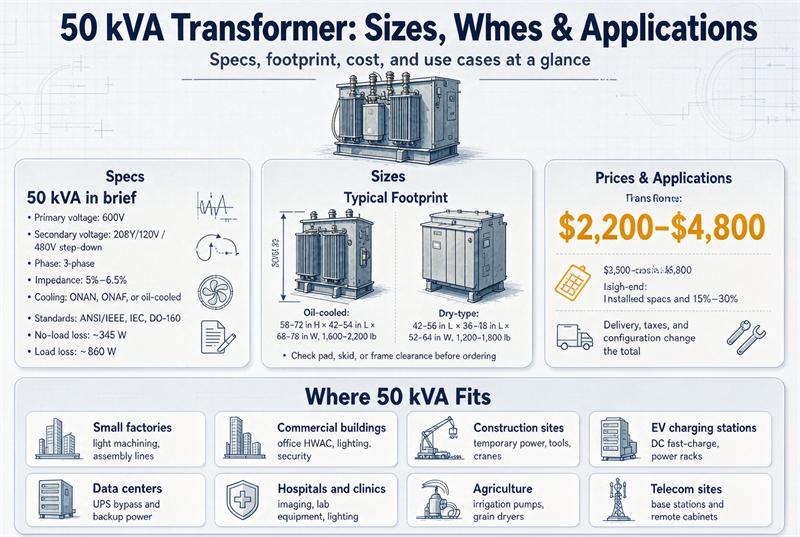
Published typical values for a 50 kVA single-phase dry-type unit: about 43 by 24 by 18 inches and roughly 400 lb. The oil-filled equivalent runs heavier, around 600 lb in one published estimate that assumes about 1.5 times dry weight. At 400 lb you are forklifting or craning, planning the access route, and checking floor loading before the truck arrives. If you pour a new pad, give the concrete 24 to 48 hours to cure. Dry-type units want roughly 3 inches of clearance on the sides and 6 inches on top for ventilation, and that is a minimum, not a design target.
These are typical published figures from manufacturer datasheets, not a promise about any specific unit. Your supplier’s datasheet wins every time.
Prices: what the published bands actually say
There is no single “50 kVA transformer price,” and any page that gives you one number is guessing. Here is what published sources say, with the source attached so you can judge each band yourself. These are third-party published indications, not quotations.
| Source | Configuration | Published band |
|---|---|---|
| Transformer4U (pole-mount table) | Oil-filled pole-mounted, 50 kVA | $2,500 to $4,000 |
| Yawei Transformer | Oil-immersed distribution, 50 to 75 kVA | $1,200 to $4,000 |
| Yawei Transformer | Dry-type, 50 to 75 kVA | $1,800 to $5,000 |
| Shenheng Power | Oil-immersed, 50 kVA “average” | $4,500 |
| Zovo (calculator page) | Single-phase dry-type, standard efficiency | $2,500 to $3,800 |
| Zovo (calculator page) | Single-phase dry-type, premium efficiency | $3,200 to $4,800 |
| Zovo (calculator page) | Single-phase dry-type, K-13 rated | $3,800 to $5,500 |
| China.cn wholesale listings | S11 / SCB10, 10/0.4 kV, ex-works China | ¥4,500 to ¥10,500 (about $630 to $1,480) |
| Taobao buyer wiki | S11 / S13, retail China | ¥12,000 to 18,000 / ¥15,000 to 23,000 |
Two contradictions are worth staring at. Shenheng’s “average” of $4,500 for a 50 kVA oil-immersed unit sits above the top of Transformer4U’s $2,500 to $4,000 pole-mount band, for what is broadly the same class of machine. And the same Transformer4U article tells you a 50 kVA unit serves “8 to 15 homes” in one table, “5 to 10 homes” in another, and “about 8 to 10 homes” in its text. Three answers, one page.
The homes number moves because it depends on assumed demand per home (the article uses 15 to 20 kVA peak) and a diversity factor (it uses 0.5 to 0.6), and it notes that utilities typically plan for 50 to 60 percent loading to leave headroom. That is the real lesson: never buy a transformer off a homes-served chart. Run the load calculation for your actual connected load.
Now the multipliers. Copper windings run 20 to 40 percent above aluminum in one published breakdown. Higher efficiency adds 5 to 15 percent in one source and 10 to 30 percent in another, which tells you how soft these bands are. Three-phase units cost roughly 2.5 to 3 times an equivalent single-phase unit at the same kVA, per one published cost guide, which is the clearest confirmation of the phase question this article opened with.
The China price gap, itemized
A 50 kVA unit leaving a Chinese factory at ¥4,500 to ¥10,500 and the same kVA on a US price list at $2,500 to $5,500 can both be true at the same time. Here is what sits in between.
| Layer | What it adds |
|---|---|
| Ex-works | ¥4,500 to ¥10,500 (about $630 to $1,480) for a standard S11/SCB10 |
| Section 232 tariff | 25 percent on transformers under HTS 8504, in effect since 2026-04-06. The deferral to 2027-12-31 applies above 10,000 kVA, not to 50 kVA |
| Freight and logistics | Modest at 400 to 600 lb, but ocean freight, drayage, and customs brokerage are real line items |
| UL 1561 listing | Required for US projects at 600 V and below: a file number, follow-up factory inspections, and calendar time |
| Distribution margin | Stocking, warranty handling, local support |
The honest read: the stack explains most of the gap, and no single layer is a scandal. What matters is buying the layers you need. If the unit is going into a US project, the UL layer is usually not optional. If it is going to a non-US site, paying for it is waste. Ask each supplier which layers are in their number, and the bands stop looking contradictory.
For the next size class up, our pad-mounted transformer sizes and prices guide covers the same logic at capacities where pad-mounted units take over from pole and skid installations.
Efficiency and losses at 50 kVA: run the arithmetic
Published typical values for a 50 kVA single-phase dry-type unit: no-load loss around 120 W, load loss around 440 W, impedance near 4.0 percent, full-load efficiency near 98.7 percent. Those are datasheet typicals, not guarantees.
The number nobody publishes is the loading point where efficiency peaks:
peak efficiency loading = square root of (no-load loss / load loss) = square root of (120/440) = about 52 percent
Peak efficiency for a 50 kVA unit sits near half load, not at full load. Since small transformers spend much of their life at part load, that is the operating point that matters. Using those published typicals, here is the annual loss arithmetic:
| Average loading | Total losses | Annual energy |
|---|---|---|
| 40 percent | 120 + 440 x 0.16 = 190 W | about 1,668 kWh |
| 80 percent | 120 + 440 x 0.64 = 402 W | about 3,518 kWh |
Now the honest part about paying for efficiency. Compare a leaner unit (120 W / 440 W) against a cheaper one (180 W / 520 W, both plausible published-style values). At 40 percent average load the difference is about 73 W, roughly 638 kWh per year, or about $64 a year at $0.10 per kWh. A $1,000 price premium takes about 16 years to come back. At 80 percent load the difference is about 111 W, roughly 974 kWh, about $97 a year, and the same premium comes back in about 10 years.
So at 50 kVA, chasing losses pays back slowly unless your load factor is high or your electricity is expensive. That is not an argument against efficiency. It is an argument for doing this arithmetic with your own load profile instead of accepting an efficiency slide. Also worth knowing: 50 kVA sits inside the US federal efficiency rules for both families, liquid-immersed from 10 kVA and dry-type from 15 kVA, and the amended standards carry a compliance date of 2029-04-23. Because the rules bind at this size, ask for guaranteed loss values in writing rather than a marketing efficiency percentage.
Where 50 kVA shows up
This size lives in the gap between “too small to matter” and “worth an engineer’s afternoon,” which is exactly why it gets mis-specified so often.
| Application | Why this size fits |
|---|---|
| Commercial buildings, roughly 3,000 to 8,000 sq ft | Lighting, HVAC, and receptacle load lands in the tens of kVA |
| Light manufacturing | Motors up to about 30 HP total, per one published sizing note |
| Retail and refrigeration | Lighting plus HVAC plus cases, with diversity |
| Dedicated equipment feeds | CNC machines, welders, and other hungry single loads |
| Agricultural irrigation pumps | Seasonal, remote, often the only service for miles |
| EV charging | Level 2 banks, or the low-voltage side of a larger charging package |
| Telecom, signage, lighting panels | Continuous, modest, unforgiving of outages |
| Renewable auxiliary power | Balance-of-plant loads for solar and storage sites |
| US residential service, 120/240 V single-phase | Pole or pad units feeding a small cluster of homes (do the load calc, not the chart) |
| IEC-world rural and construction power | 10/0.4 kV three-phase, the global volume workhorse |
The pattern: 50 kVA is the right answer when your real demand is a few tens of kilowatts and your site is small, remote, or temporary. It is the wrong answer when someone bought it because “50 sounds safe.”
Dry-type or oil-immersed at 50 kVA
The same logic as any size, sharper at this one. Indoors, in a fire-sensitive room, or anywhere a spill is a problem, cast-resin dry-type is the default; our SCB10 cast-resin dry-type family covers this construction across the size range. Outdoors, on a pole, on a pad, or in weather that would punish an enclosed air-cooled unit, oil-immersed is the answer; see the S11 oil-immersed power transformer line for that construction. Enclosed outdoor dry-type units also exist for exposed sites where oil is unacceptable but weather is not negotiable.
At 50 kVA the volumes favor both paths, so this is a genuine choice rather than a constraint. Pick on location, fire rules, and maintenance access, not on habit.
Operating boundaries: overload, ambient, harmonics
A few published numbers define the envelope at this size.
- Short-term overload: one manufacturer states dry-type units tolerate up to 110 percent for short periods. Continuous overload accelerates insulation aging and shortens life.
- Design target: plan for 70 to 80 percent normal loading, leaving margin for peaks and future growth.
- Ambient: standard ratings assume 40 °C maximum ambient with a 30 °C 24-hour average. Hotter rooms mean derating, not optimism.
- Forced air: AF cooling can lift short-term capacity by roughly 30 to 40 percent in one published note, while the continuous rating stays what the nameplate says.
- Harmonics: variable-frequency drives, UPS systems, and data center loads heat the windings beyond the sinusoidal assumption. That is what K-rated units are for, and one published band prices a K-13 unit at $3,800 to $5,500 against $2,500 to $3,800 for a standard 50 kVA single-phase dry-type.
None of these are exotic. They are just the difference between a unit that lasts decades and one that cooks quietly in a hot closet.
Buyer mistakes that cost real money
- Comparing a single-phase price band against a three-phase quote, then wondering why the numbers are 2.5 to 3 times apart.
- Reading 50 kVA as 50 kW at a power factor well below 1.0.
- Buying off a homes-served chart, the one with three different answers on the same page.
- Forgetting the 125 percent rule on the secondary and sizing wire to full-load current instead.
- Landing at 120 V and discovering 416.7 A means parallel conductors and a 600 A panelboard.
- Paying a loss premium the load profile will never pay back.
- Skipping UL on a US project, or paying for it on a non-US one.
- Accepting delivery without checking the nameplate against the purchase order: kVA, impedance, vector group, taps, frequency, cooling class, guaranteed losses.
Any one of these turns a good price into a delayed project.
A 10-minute pre-RFQ checklist
- Single-phase or three-phase, and which preferred-rating table applies?
- Primary and secondary voltages, and frequency (60 Hz or 50 Hz).
- Connected load in kW, with power factor, and the demand you actually expect.
- Design loading target (70 to 80 percent is the usual band).
- Full-load amps at both windings, with conductor and OCPD at 125 percent.
- Dry-type or oil-immersed, driven by location and fire rules.
- Ambient temperature at the installation point, and derating if needed.
- Harmonic content of the load, and whether a K-rated unit is required.
- Guaranteed no-load and load losses, plus the efficiency claim at your loading point.
- Listing and standards for the destination market (UL 1561 for US projects at 600 V and below), and the test reports that come with the unit.
Answer those ten and your RFQ will stand out from the pile, and suppliers will price it like you mean it.
The bottom line
A 50 kVA transformer is not one product. It is a standard single-phase rating in the North American tables, a non-preferred three-phase rating there, and a global volume workhorse in the IEC world, and those three identities explain almost every confusing price band you will see. Do the phase question first, convert kVA to amps and wire at 125 percent, run the loss arithmetic against your own load profile instead of trusting an efficiency slide, and buy the compliance layers your destination market actually requires. The rest is details, and details are cheap compared to a wrong transformer on a truck.
FAQ
How many amps is a 50 kVA transformer?
It depends on voltage and phase. At 480 V three-phase it is 60.1 A. At 240 V single-phase it is 208.3 A. At 120 V single-phase it is 416.7 A. Use amps = kVA x 1,000 / voltage for single-phase, and kVA x 1,000 / (1.732 x voltage) for three-phase.
Is 50 kVA the same as 50 kW?
No. kVA is apparent power and kW is real power, connected by power factor: kW = kVA x PF. At a power factor of 0.8, a 50 kVA transformer delivers about 40 kW.
Is 50 kVA a standard three-phase transformer size?
In the North American preferred-rating tables it is not a preferred three-phase rating; the ladder runs 15, 30, 45, 75, 112.5, 150. It is a standard single-phase rating there. In the IEC and GB world, 50 kVA three-phase is a standard high-volume rating.
How much does a 50 kVA transformer cost?
Published bands vary widely by configuration: roughly $1,200 to $5,000 for oil-immersed distribution units, $1,800 to $5,000 for dry-type, $2,500 to $3,800 for a standard single-phase dry-type, and $3,800 to $5,500 for a K-13 rated single-phase dry-type. Chinese ex-works prices for the same kVA run about $630 to $1,480 before tariff, freight, and listing costs.
How many homes can a 50 kVA transformer serve?
Published answers range from 5 to 10 homes to 8 to 15 homes, depending on assumed demand per home and diversity. Utilities typically plan for 50 to 60 percent loading. Do the load calculation for your actual service rather than using a chart.
How much does a 50 kVA transformer weigh?
Published typicals are about 400 lb for a single-phase dry-type unit and around 600 lb for an oil-filled equivalent. Plan for forklift or crane handling and verify against the manufacturer datasheet.
Can a 50 kVA transformer be overloaded?
One manufacturer publishes short-term overload capability up to 110 percent for dry-type units. Continuous overload is not recommended because it accelerates insulation aging. Design for 70 to 80 percent normal loading.
What wire size does a 50 kVA transformer need?
It depends on voltage. At 480 V three-phase (60.1 A) a 6 AWG copper conductor at 75 °C works as a starting point. At 208 V three-phase (138.8 A) you are at 1/0 AWG. At 240 V single-phase (208.3 A) you are at 250 kcmil. Always apply adjustment factors and confirm with the NEC.
What breaker size for a 50 kVA transformer?
At 125 percent of full-load current rounded up to the next standard rating: 80 A on a 480 V three-phase primary, 175 A on a 208 V three-phase secondary, and 300 A on a 240 V single-phase secondary. These follow NEC 450.3 with standard ratings per 240.6(A).
Dry-type or oil-immersed at 50 kVA?
Dry-type for indoor, fire-sensitive, or spill-sensitive locations. Oil-immersed for outdoor, pole, pad, and harsh-weather duty. Both are available at this size, so decide on location and fire rules.
What efficiency should I expect from a 50 kVA transformer?
Published typical full-load efficiency for a 50 kVA single-phase dry-type unit is around 98.7 percent, with peak efficiency occurring near 52 percent loading rather than at full load. Ask for guaranteed loss values, not a marketing percentage.
Is a 50 kVA transformer covered by US DOE efficiency rules?
Yes. The federal efficiency rules in 10 CFR 431 cover liquid-immersed units from 10 kVA and dry-type units from 15 kVA, so 50 kVA is inside the scope for both families. The amended standards carry a compliance date of 2029-04-23.