an 11 kV transformer is a medium-voltage distribution transformer whose high-voltage winding is built for an 11,000 V nominal system. It steps that supply down to low voltage, usually 400 V, 415 V or 433 V three-phase, and in almost every case it runs at 50 Hz. You need one when the utility hands you an 11 kV feeder and everything on your side of the meter runs on low voltage.
Here is the part that decides whether this purchase was smart: on a 1,000 kVA unit, the electricity the transformer wastes over 30 years costs about ten times what the transformer costs. We run that arithmetic in the pricing section, and you can swap in your own numbers.
This page covers the specs that actually move a quotation, the current and fault-current numbers nobody publishes, what the published price lists leave out, and the twelve lines your RFQ needs. If you are buying for a 60 Hz network, jump to the section on North American projects, because 11 kV is not a North American voltage.
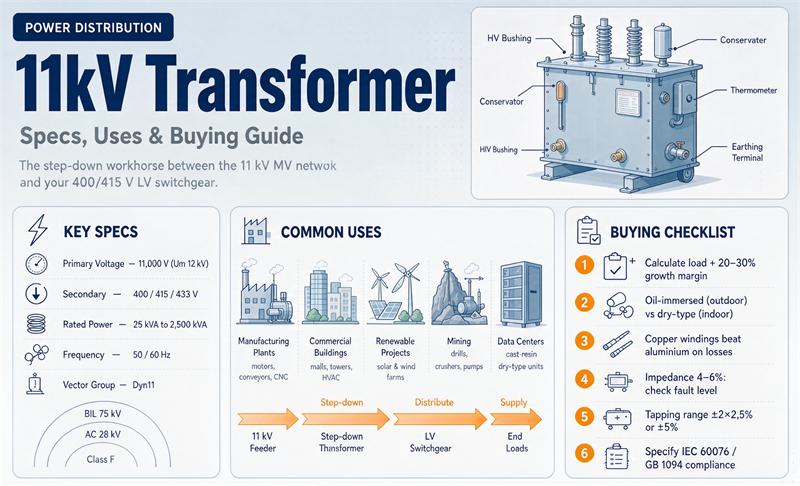
Key numbers
| Item | Value | Why it matters |
| Nominal system voltage | 11,000 V | What the utility calls the feeder |
| Highest voltage for equipment | 12 kV (Um) | The number the insulation tables are indexed on |
| Insulation level, Um 12 kV | 28 kV rms AC withstand; lightning impulse 60 kV or 75 kV peak | Two impulse columns exist, and suppliers default to the higher one |
| Typical secondary | 400 V, 415 V or 433 V | Set by your country, not by the catalog |
| Common ratings | 100 to 2,500 kVA | R10 ladder, off-ladder ratings cost weeks |
| Typical impedance | 4% up to 630 kVA, 5% to 6% from 800 to 1,600 kVA, 6% to 7% at 2,000 kVA and up | Sets fault current and your switchgear bill |
| Vector group | Dyn11 | The default almost everywhere |
| 30-year loss bill, 1,000 kVA | Roughly 10x the equipment price | The reason loss figures belong in the contract |
What “11 kV” actually means
11 kV is a nominal system voltage, not a winding rating. The winding is rated by the highest voltage for equipment, written Um, and for an 11 kV system that is 12 kV. Insulation levels are indexed on Um, so the two numbers you will see on a data sheet are set by IEC 60076-3:
| Highest voltage for equipment (Um) | Power-frequency withstand, 1 min | Lightning impulse withstand, list 1 | Lightning impulse withstand, list 2 |
| 12 kV | 28 kV rms | 60 kV peak | 75 kV peak |
| 24 kV | 50 kV rms | 95 kV peak | 125 kV peak |
| 36 kV | 70 kV rms | 145 kV peak | 170 kV peak |
Most suppliers quote the 75 kV column by default, and most buyers never ask why. If your feeder is cable-fed and your arresters are coordinated, the 60 kV column exists and costs less. Write the column you want on the enquiry instead of accepting the default.
The secondary voltage depends on where the unit is going, and this is where a lot of RFQs go wrong:
| Where | Typical MV | Frequency | Typical LV three-phase |
| IEC world, Europe, Africa | 11 kV | 50 Hz | 400 V |
| Malaysia, Singapore, Middle East | 11 kV | 50 Hz | 415 V |
| India, UK, Nigeria, Kenya | 11 kV | 50 Hz | 433 V |
| North America | 12.47 / 13.2 / 13.8 kV | 60 Hz | 480Y/277 V or 208Y/120 V |
That last row is the reason you should read the 60 Hz section below if you are buying for the Americas or for a 60 Hz industrial island. An 11 kV transformer is an IEC-world machine.
The 11 specs that decide your quote
Two suppliers can quote the same kVA and land 40% apart, and it is almost always because these eleven lines were not identical.
| # | Spec | What to write | Typical default |
| 1 | Rated power | kVA at ONAN, plus ONAF rating if forced cooling is wanted | R10 ladder: 100, 125, 160, 200, 250, 315, 400, 500, 630, 800, 1,000, 1,250, 1,600, 2,000, 2,500 |
| 2 | Voltage ratio and taps | 11,000 / 433 V no load, tapping range, off-circuit or on-load | ±2 x 2.5% off-circuit, or ±5% |
| 3 | Vector group | Dyn11 unless the network says otherwise | Dyn11 |
| 4 | Impedance at 75 °C | Percentage plus tolerance | 4% to 630 kVA, 5% to 6% at 800 to 1,600 kVA, 6% to 7% above, ±10% tolerance in writing |
| 5 | Insulation levels | Um, AC withstand, impulse column | 12 kV, 28 kV rms, 75 kV peak (or 60 kV) |
| 6 | Losses | Guaranteed no-load W and load W at 75 °C, with a test report | Per your efficiency class |
| 7 | Cooling and temperature rise | ONAN or ONAF for oil, AN or AF for dry, plus limits | Oil: top oil 60 K, winding 65 K. Dry: Class F, 100 K rise |
| 8 | Insulation class | A, F or H | Oil Class A 105 °C, dry Class F 155 °C or Class H 180 °C |
| 9 | Duty and enclosure codes | For dry units, the C, E and F classes; for both, the IP rating | Indoor dry: C1/E1/F1 or IP20. Outdoor or coastal: C2/E2/F1 or IP54 |
| 10 | Site conditions | Altitude, ambient, pollution, seismic | Above 1,000 m or above 40 °C, both have to be declared |
| 11 | Standards and tests | The parts of IEC 60076 you are buying to, plus which tests ship with the unit | IEC 60076-1, -2, -3, -5, -11 |
Item 9 is the one buyers skip most often. For a dry-type unit, IP54 tells you about the enclosure, not about the coil. IEC 60076-11 separates the two, using a climatic class (C1 indoor not below −5 °C, C2 outdoor down to −25 °C), an environmental class (E0, E1, E2) and a fire behaviour class (F0, F1). An outdoor coastal site wants C2/E2/F1, and if you only write IP54 you may get C1/E0/F0 inside a sealed box.
Once the unit arrives, check what is stamped on it against what you ordered. Our walkthrough of how to read a transformer nameplate and technical parameters covers the fields that most often drift between the quote and the plate.
The numbers nobody prints: current, fault current, and switchgear
Every guide publishes a capacity table. Almost none of them publish the current, and none of them publish the fault current. Both are two lines of arithmetic, and both decide what you spend downstream.
Line current is kVA x 1,000 divided by root three times the line-to-line voltage. Fault current at the terminals is roughly the full-load current divided by the per-unit impedance, which gives an upper bound because it ignores source impedance.
| Rating | 11 kV side, full-load amps | 400 V side, full-load amps | Typical impedance | Fault current at 400 V (upper bound) | What your LV gear has to be rated for |
| 250 kVA | 13.1 A | 361 A | 4% | 9.0 kA | 25 kA gear |
| 500 kVA | 26.2 A | 722 A | 4% | 18.0 kA | 25 kA gear |
| 630 kVA | 33.1 A | 909 A | 4% | 22.7 kA | 25 kA gear, only just |
| 800 kVA | 42.0 A | 1,155 A | 5% | 23.1 kA | 25 kA gear |
| 1,000 kVA | 52.5 A | 1,443 A | 5% | 28.9 kA | 36 kA gear |
| 1,250 kVA | 65.6 A | 1,804 A | 5% | 36.1 kA | 36 kA at 6%, 50 kA at 5% |
| 1,600 kVA | 84.0 A | 2,310 A | 5% to 6% | 38.5 to 46.2 kA | 50 kA gear |
| 2,000 kVA | 105.0 A | 2,887 A | 6% | 48.1 kA | 50 kA gear |
| 2,500 kVA | 131.2 A | 3,608 A | 6% | 60.1 kA | 65 kA gear |
Three things fall out of that table.
1,000 kVA is where 25 kA switchgear stops working. A 1,000 kVA unit at 5% impedance can push 28.9 kA into a 400 V bus, so the panelboard or switchboard has to be rated above that, and the next standard step up is 36 kA.
1,600 kVA is where 36 kA stops working. Even at 6% impedance you are at 38.5 kA.
1,250 kVA sits on the line. At 5% it does not fit in 36 kA, at 6% it does. That single percentage point is worth a real amount of money on the switchgear, so pick impedance with the gear in mind rather than accepting the factory default.
On the 11 kV side the numbers are small. A 1,000 kVA unit at 5% contributes about 1.05 kA, and a 2,500 kVA unit at 6% contributes about 2.19 kA. Your MV switchgear is sized by the network fault level behind it, typically 12.5 kA, 16 kA, 20 kA or 25 kA, not by the transformer. So impedance is a low-voltage cost driver, and it is a low-voltage conversation.
Four constructions, and what each one is for
Oil-immersed. The default for outdoor and utility work, and the cheapest per kVA. Mineral oil carries heat out of the core and gives you a dielectric system that has been understood for a century. It needs a bund or containment where local rules require one, periodic oil sampling, and somewhere to put it that is not inside an occupied building. Full range is on our oil immersed transformers page.
Dry-type, cast resin or VPI. The default indoors and in occupied buildings, because there is no oil to contain and the fire behaviour class is part of the specification. Cast resin seals the winding in epoxy and survives moisture and salt; VPI is cheaper and easier to repair but wants a clean, dry room. Our dry type transformers page covers both constructions.
Amorphous core. Same box, different core metal, and roughly 60% to 70% less no-load loss. It pays back fastest where the unit spends its life lightly loaded, which is most rural feeders and any solar or wind site that idles half the day.
Packaged into a compact substation. Transformer, MV switchgear, LV board, protection and metering in one enclosure, tested before it leaves. This trades unit cost for site time, and on remote sites it usually wins. See compact substations.
If you are stuck between the first two, the honest answer is that it turns on fire policy, room ventilation and who maintains it. We wrote that comparison up separately in oil immersed vs dry type: how to choose.
What it costs, and why two published price lists disagree by 3x
Here are two price tables that were both published and both indexed to 11 kV/0.4 kV, three-phase, copper wound:
| Rating | Source A, FOB Shanghai, S13-type oil | Source B, FOB China, 2026 guide | Spread between them |
| 100 kVA | $1,100 to $1,300 | $1,800 to $2,800 | 1.4x to 2.5x |
| 1,000 kVA | $3,400 to $3,800 | $8,500 to $13,000 | 2.2x to 3.8x |
| 1,600 kVA | $4,500 to $5,000 | $12,000 to $18,000 | 2.4x to 4.0x |
Neither table is lying. They are answering different questions, with different bases, different loss classes and different accessory lists, and neither one is a quotation for your project. The only way to make two suppliers comparable is to freeze the eleven specs above, send the same sheet to both, and compare the landed number. Treat any price table you find online as a sense of magnitude, not as a budget.
For reference, published cast resin pricing on the same basis runs about 60% to 70% above oil at the same rating: roughly $3,300 to $3,700 at 500 kVA, $5,500 to $6,000 at 1,000 kVA, and $7,800 to $8,500 at 1,600 kVA.
The bill that is ten times the price tag
Take a published 1,000 kVA oil data sheet: 1,000 W no-load loss, 10,300 W load loss at 75 °C, 5.0% impedance, 0.9% no-load current, 2,300 x 1,400 x 2,200 mm, 3,200 kg.
At 50% load, total loss is 1,000 + 10,300 x 0.25 = 3,575 W. Over a year that is 3,575 x 8,760 / 1,000 = 31,317 kWh. At 0.10/kWh that is **3,132 a year**. Discounted over 30 years at 7%, using a present-value factor of 12.409, that is about $38,900.
The equipment costs $3,400 to $3,800 on the table above. The losses you buy along with it cost about ten times that.
Now suppose a low-loss design quotes 700 W no-load and 9,000 W load loss. Same arithmetic gives 2,950 W at 50% load, 25,842 kWh a year, 2,584 a year, and a saving of **548 a year**, or about $6,800 in present value. Amorphous and high-grade designs typically carry a 15% to 25% premium, which on a $3,400 unit is $510 to $950. Payback lands under two years, and everything after that is margin.
Assumptions, stated so you can change them: $0.10/kWh, 8,760 hours a year, 30-year life, 7% discount rate, present-value factor 12.409, losses at 75 °C, constant 50% load. Swap in your tariff and your load profile before you decide. The 700 W and 9,000 W figures are illustrative placeholders, so ask for guaranteed values on the actual quotation.
One more number from the same data sheet, and it surprises people: peak efficiency happens where no-load loss equals load loss scaled by the square of the load, so the peak-efficiency load factor is the square root of (no-load loss / load loss). That is the square root of (1,000 / 10,300), or 31%. This transformer is at its most efficient around a third of its rating, not at full load. Do not size up to chase efficiency.
Where 11 kV transformers actually get used
Utility and rural distribution. 100 to 630 kVA, pole or pad mounted, often amorphous because the load factor is low and the unit is energised around the clock.
Industrial plants, cement, steel, mining. 800 to 2,500 kVA, usually oil, and often specified at the high end of the impedance band to keep fault levels inside what the plant switchgear can handle. Dust and moisture push a dry-type unit to C2/E2/F1 or an oil unit to a higher IP enclosure.
Commercial buildings, hospitals, data centres. 630 to 2,000 kVA of cast resin indoors, F1 fire behaviour, and a noise limit written into the spec. For reference, a 1,500 kVA ONAN unit typically measures 55 to 65 dB(A) under IEC 60076-10.
Solar and wind. 1,000 to 3,150 kVA, either stepping up from the inverter or serving the site load. No-load loss dominates because the transformer idles whenever the resource is not there.
Packaged substations for EPC work. Where the schedule is tight and the site is far away, the transformer arrives inside a tested enclosure. A recent example is our 11 kV and 33 kV compact substation programme for an overseas utility EPC, where the transformer, MV switchgear, LV board and protection were built and tested as one package.
How to buy one without getting burned
Paste this into your RFQ. Fill every blank, because a blank is a place a bidder can save money without telling you.
Then hold the supplier to the tests. Routine tests per IEC 60076-1 cover winding resistance, voltage ratio and vector group, impedance voltage and load loss, no-load loss and current, the separate-source AC withstand test and the induced AC voltage test. Impulse testing, temperature rise, short-circuit withstand and partial discharge are type or special tests, and you have to ask for them. For cast resin, partial discharge is commonly specified at 100 pC or lower. The full list, and what a real report looks like, is in transformer routine testing: what every unit should pass.
Lead time is where non-standard hurts. Published factory lead times for a standard rating run 15 to 25 days. Step off the R10 ladder, ask for a non-standard impedance, or change the loss class after the order, and you are into the 16 to 20 week range in our experience.
Plan the lift before you plan the install. That same published 1,000 kVA data sheet gives 2,300 x 1,400 x 2,200 mm and 3,200 kg, and the 1,600 kVA unit is 2,600 x 1,600 x 2,500 mm at 4,500 kg. That is a crane, a plinth, and a check that the door and the route to it are wide enough.
Five red flags worth walking away from:
- Loss figures quoted “typical” rather than guaranteed, with no test report.
- Aluminium windings against a copper enquiry. Name the conductor in the contract.
- A price that drops sharply when you ask for the third time. Something came out of the design.
- Type test reports from a different rating or a different voltage class than the one you are buying.
- No impedance tolerance stated. If it is not written, you get whatever suits the factory’s tooling.
If your project is 60 Hz or North America
11 kV is not a North American voltage. The nearest North American class is 15 kV, and IEEE C57.12.00-2021 lists nominal system voltages from 14,440 V down to 11,950 V under that class, with a 95 kV BIL for liquid-filled distribution transformers. In practice an 11 kV unit for a 60 Hz network is built as a 15 kV class machine with a 95 kV BIL, which is a bigger and more expensive insulation system than the 75 kV IEC column.
Frequency is the other half of it. A manufacturer’s published conversion options for taking a 50 Hz design to 60 Hz include: rated power and impedance both up 10% with everything else unchanged; rated power up 20% with no-load loss up 30% and noise up 3 dB (not available for cast resin); all data unchanged with the price reduced about 5%; or temperature rise down 10 K and load loss down 15%. Which one you get depends on the factory, so ask which option the quotation is built on.
Going the other way is the dangerous direction. Running a 60 Hz design on 50 Hz raises core flux by about 20%, and the usual fix is to reduce the applied voltage in proportion. Do not put a 60 Hz machine on a 50 Hz system without the manufacturer confirming it in writing.
If the unit is going into United States commerce with a secondary of 600 V or less at 60 Hz, the DOE distribution transformer standards in 10 CFR 431 apply, covering 10 to 5,000 kVA liquid-immersed and 15 to 5,000 kVA dry-type. The full side-by-side of the two worlds is in IEC 60076 vs ANSI/IEEE standards for export transformers.
Frequently asked questions
What does 11 kV mean on a transformer nameplate?
It is the nominal system voltage the high-voltage winding is built for, 11,000 V. The insulation is rated on the highest voltage for equipment, Um, which is 12 kV for an 11 kV system, and that is the number the test levels come from.
Is 11 kV the same as 12 kV or 13.8 kV?
No. 11 kV is the IEC-world 50 Hz nominal voltage. 12.47 kV, 13.2 kV and 13.8 kV are North American 60 Hz nominal voltages, and they fall under the 15 kV equipment class in IEEE C57.12.00. Do not substitute one for the other without checking frequency and the insulation level.
What BIL do I need, 60 kV or 75 kV?
For Um = 12 kV, IEC 60076-3 lists 60 kV peak in one column and 75 kV peak in the other, both against a 28 kV rms power-frequency withstand. Suppliers default to 75 kV. If your feeder is cable-fed with coordinated arresters, 60 kV is available and usually cheaper, but it has to be written on the enquiry.
What size 11 kV transformer do I need?
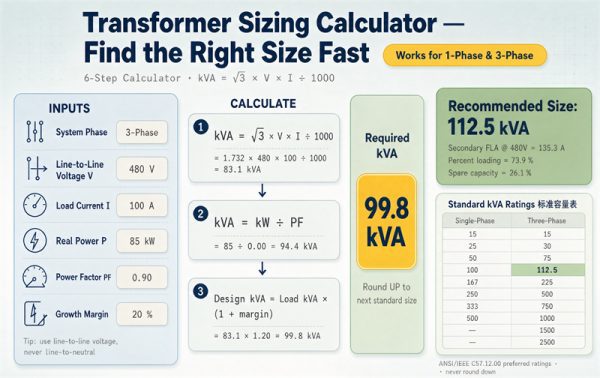
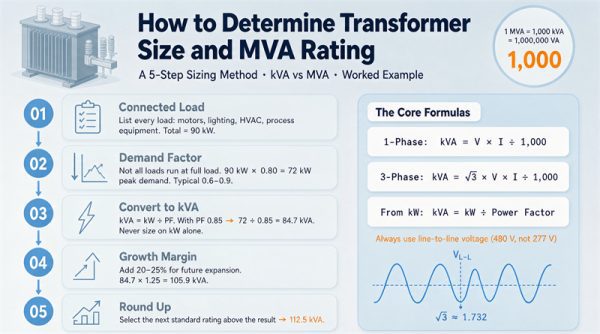
Add up the connected load, apply a demand factor, divide by the power factor to get kVA, then add a growth margin of roughly 10% to 25%. Round up to the next R10 rating. Remember that peak efficiency usually lands near a third of the rating, so do not oversize to chase efficiency.
How much does an 11 kV transformer cost?
Published FOB China tables for standard oil-filled copper units run about $1,100 to $1,300 at 100 kVA, $3,400 to $3,800 at 1,000 kVA and $4,500 to $5,000 at 1,600 kVA, while another published 2026 table puts the same ratings at $1,800 to $2,800 and $8,500 to $13,000. That 2x to 4x spread is why you should never budget from a price table. Cast resin runs roughly 60% to 70% above oil at the same rating.
Can I use an 11 kV transformer on 60 Hz?
Often yes, but the design has to be converted, and the manufacturer has to say which conversion option they used. Expect impedance and possibly rated power to move, or no-load loss to rise by 30%. The reverse, a 60 Hz design on 50 Hz, raises core flux by 20% and needs the applied voltage reduced in proportion.
Which vector group should I specify?
Dyn11 is the default for distribution almost everywhere, because the delta primary gives a path for triplen harmonics and the star secondary gives you a neutral. Yyn0 appears in some network arrangements, and parallel operation can force a specific group, so check with the utility before ordering.
What impedance should I ask for?
About 4% up to 630 kVA, 5% to 6% from 800 to 1,600 kVA, and 6% to 7% at 2,000 kVA and above, always with a tolerance, typically ±10%, written down. Higher impedance cuts fault current but costs you voltage regulation and a little efficiency. Pick it with your switchgear rating in mind: at 1,250 kVA, 5% does not fit in 36 kA gear and 6% does.
Oil or dry type for 11 kV?
Oil outdoors and for utility work, where it is cheaper per kVA and easier to cool. Dry indoors and in occupied buildings, where fire behaviour matters and there is no oil to contain. Where the site is coastal or dusty and still needs dry-type, specify C2/E2/F1 rather than an IP rating alone.
What tests should I demand before it ships?
The routine tests in IEC 60076-1: winding resistance, ratio and vector group, impedance and load loss, no-load loss and current, separate-source AC withstand, and induced AC withstand. Then ask for the special tests you actually need, which usually means lightning impulse, temperature rise, and partial discharge for cast resin at 100 pC or lower.
How long does delivery take?
Published factory lead times for a standard rating run 15 to 25 days. Off-ladder ratings, non-standard impedance or a late change to the loss class push you into the 16 to 20 week range. Ask for the lead time in weeks on the quotation, not as a range.
Can I install an 11 kV transformer in the United States?
The equipment can be built for it, but 11 kV is not a US distribution voltage and the unit will be built as a 15 kV class machine with a 95 kV BIL. For US commerce it also has to meet the DOE standards in 10 CFR 431 if it has a 600 V or lower secondary at 60 Hz, and it needs to be accepted by the local authority having jurisdiction.