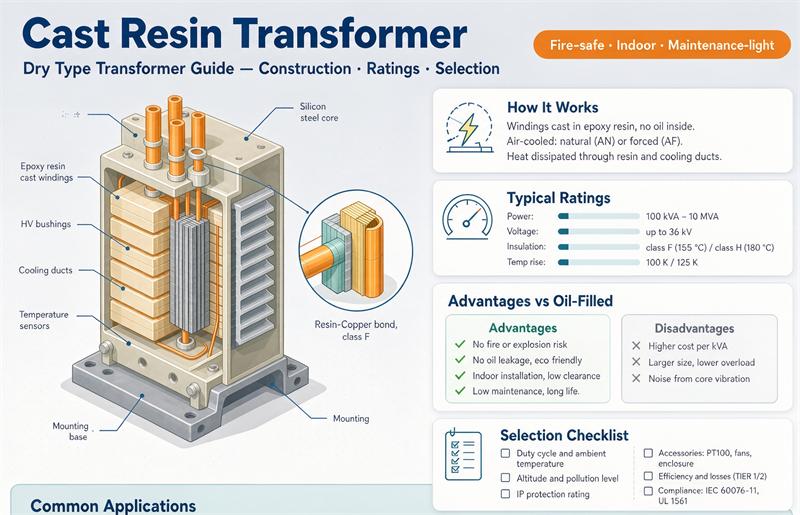
a cast resin transformer is a dry-type transformer whose windings are sealed inside solid epoxy, cast under vacuum and oven-cured. No oil, no liquid to contain, and a coil that shrugs off moisture, dust, and salt. What most guides don’t tell you: the epoxy is also what makes the unit unrepairable in the field, and the three-letter code that governs how it behaves — C, E, and F — is something you are supposed to specify, not something the supplier hands you.
TransNine Electric builds and exports cast resin units, and this guide is the version we wish buyers had read before the RFQ goes out. It assumes you already know you want dry-type. If you’re still deciding between dry and oil, read the dry type transformer guide first — that one is the category-level comparison. This one goes down into cast resin specifically: how the coil is made, what the classes actually mean, and where the technology stops being the right answer.
Key numbers
| Item | Value | Why it matters |
| Climatic class | C1: indoor, not below −5 °C · C2: outdoor down to −25 °C | C2 is also a measure of the cast resin’s fracture toughness |
| Environmental class | E0: no condensation, negligible pollution · E1: occasional condensation or limited pollution · E2: frequent condensation or pollution, or both | E2 is the one you want in a damp or dirty plant room |
| Fire behaviour | F0: no provision to limit fire hazard · F1: fire hazard limited by the transformer’s own characteristics | Both classes are confirmed by testing, not by claim |
| Who defines the classes | The user, per EN 50541-1 | Not a supplier default — a spec line |
| Insulation system temperature | 155 °C (Class F), 180 °C (Class H); 220 °C systems exist | Sets the thermal ceiling |
| Temperature rise options | 80 / 115 / 150 °C average winding rise | The number that actually sets overload headroom |
| AF (forced air) boost | Roughly 30–40% over the AN rating (manufacturer-stated) | Fan kits buy peak capacity, not base rating |
| UL 1562 scope | 601–35,000 V, and it explicitly covers solid cast and resin encapsulated transformers | The US listing path for medium-voltage cast resin |
| UL 1561 scope | Dry-type general purpose and power transformers, 600 V and below | A 480 V cast coil unit lands here, not in 1562 |
| IEEE C57.12.01-2020 | Dry-type distribution and power transformers, including solid-cast and resin-encapsulated windings, ≥601 V | The US general-requirements standard that covers your unit |
| DOE dry-type coverage | Input ≤34.5 kV, output ≤600 V, 60 Hz, 15–5,000 kVA (10 CFR 431.192) | Medium-voltage to 480 V is in scope; MV-to-MV is not |
| DOE compliance trigger | Manufactured or imported on or after April 23, 2029 (89 FR 29834) | Your PO date doesn’t count |
| NEC 450.21(B) | Dry-type over 112.5 kVA can trigger a one-hour fire-rated room — unless it has Class 155 or higher insulation and is totally enclosed except for ventilating openings | Cast resin usually qualifies for the exception |
| Derating thresholds | Above 1,000 m (3,300 ft) altitude, above 40 °C ambient | Air is thinner and hotter; the unit carries less |
| Partial discharge | <10 pC is a common manufacturer claim — always ask at what test voltage | PD is what quietly ends insulation life |
| Sound | Field readings typically run 6–10 dB above the NEMA ST-20 catalog value | Catalogs are measured in a chamber |
| SCB18 vs SCB12 at 800 kVA | 875 W vs 1,215 W no-load loss | A 340 W difference that runs 8,760 hours a year |
What “cast resin” actually means
Wind copper or aluminium foil, put the coil in a mould, pull a vacuum, pour epoxy, cure it in an oven. What comes out is a monolithic block: the conductor can’t move, moisture can’t reach it, and the insulation is a solid instead of a liquid.
That’s a genuinely different product from the other two dry-type constructions, and the difference shows up in the field:
| Cast resin | VPI | Open-wound | |
| Winding surface | Fully sealed in epoxy | Impregnated, still exposed | Exposed |
| Moisture | Sealed | Resisted | Absorbs |
| Dust and salt | High tolerance | Moderate | Low |
| Through-fault strength | Highest of the three | Baseline | Baseline |
| Runs cooler | No — epoxy insulates thermally | Yes | Yes |
| Field repair | Not repairable | Sometimes | Sometimes |
| Relative first cost | Highest | Middle | Lowest |
One thing worth internalizing from that table: encapsulation cuts both ways. The epoxy that keeps water out also keeps heat in. A cast resin coil runs hotter than an equivalent VPI coil for the same rating, which is why cast resin designs lean on lower flux density, cooling ducts cast into the resin, and generous temperature rise margins. Anyone who tells you cast resin “runs cooler” has it backwards.
Our cast resin dry-type range covers 30 kVA to 5,000 kVA up to 35 kV. Above roughly 36 kV, or outdoors without an enclosure, this stops being the default answer — more on that below.
The C / E / F code: the part everyone quotes and nobody explains
You’ll see “C2 E2 F1” on half the cast resin datasheets on the internet. Almost nobody explains what it means, which is a shame, because it’s the single most useful set of three characters in dry-type specification.
IEC 60076-11 — Power transformers – Part 11: Dry-type transformers — defines three independent classifications. Fuji Electric’s MOLTRA line was third-party certified to IEC 60076-11:2018 by KEMA and CESI, and Siemens’ GEAFOL planning guidelines lay the classes out plainly:
Climatic class (C) accounts for the lowest ambient temperature, including transport and storage:
- C1 — indoor installation, not below −5 °C
- C2 — outdoor installation down to −25 °C
Here’s the detail that changes how you read it: Siemens notes the climatic class is also a measure of the fracture toughness of the cast resin compound. That’s the real content of the C2 test — the epoxy has to survive thermal shock without cracking at low temperature. It’s not just “works when cold.”
Environmental class (E) accounts for humidity, condensation, and pollution:
- E0 — no condensation, negligible pollution
- E1 — occasional condensation, or pollution to a limited extent
- E2 — frequent condensation or heavy pollution, or both at once
Fire behaviour class (F):
- F0 — no provision is made to limit fire hazard
- F1 — fire hazard is limited as a result of the transformer’s own characteristics
E1, E2, C2, and F1 all have to be verified by testing. That’s the whole point of having classes instead of adjectives. “Self-extinguishing” is a marketing word; “F1” is a test result.
Two things to do with this
First, specify the classes yourself. Per EN 50541-1, the necessary classes are to be defined by the user. This is not a supplier default. If your RFQ doesn’t name C, E, and F, you’ve outsourced a safety decision to whoever is cheapest that week — and you’ll find out what you got when the unit shows up in a humid basement.
Second, understand what you’re giving up. Specifying E0 or F0 isn’t automatically wrong; a clean, conditioned, low-occupancy electrical room genuinely doesn’t need E2/F1, and you shouldn’t pay for it. What’s wrong is not choosing. Write the class on the RFQ even when the answer is the low one.
A practical way to pick: E2 and F1 for anything in an occupied building, a hospital, a transit station, a tunnel, or anywhere with condensation risk. C2 if the unit sees outdoor air in transit or in service — including a cold warehouse during construction. C1/E1/F0 for a dry, clean, supervised room, if your AHJ agrees.
How the coil is cast, and the four things that actually go wrong
Almost every cast resin field failure traces back to a process defect, not a design error. Four of them account for most of it.
Voids. The vacuum step exists to pull air and moisture out so resin penetrates every gap. A void left inside the winding is a partial discharge site, and partial discharge is a slow, invisible insulation killer. This is the defect you can’t see and can’t fix later.
Incomplete penetration. Foil-wound low-voltage windings are wide and flat; resin has to travel a long way between turns. Shortcuts here show up years later as a hot spot nobody can explain.
Cure control. Too fast or too cool and the resin doesn’t reach full mechanical strength; too hot and you build in internal stress. Both end in cracks.
Resin thickness and filler. Thick epoxy looks impressive and insulates well — and cracks more readily under thermal cycling, because it’s stiff and it doesn’t move with the copper. Good designs use filled resin systems and cast-in cooling ducts, and they manage the thickness rather than maximizing it.
The practical consequence for buyers: two “cast resin” transformers are not the same product. Ask what resin system is used, whether cooling ducts are cast in, and what the partial discharge value is on the actual unit — not on the brochure.
Partial discharge: the number that decides whether it lasts thirty years
Partial discharge is a small electrical breakdown inside a void, too small to trip anything and large enough to erode insulation, year after year, until it isn’t small anymore.
IEC 60076-11 requires partial discharge measurement, and manufacturers commonly quote <10 pC. Fuji, for example, states all units are PD-tested at twice the operating voltage with results under 10 pC; other makers publish figures at 1.6 × Un.
Notice what those two statements have in common: the pC number is meaningless without the test voltage attached. “<10 pC” at 1.6 × Un and “<10 pC” at 2 × Un are not the same claim. Put the voltage in your spec: partial discharge not exceeding [X] pC at [Y] × rated voltage, measured per IEC 60076-11, with the test report supplied for this serial number.
That last clause matters too. A type test report proves the design. A routine test report proves your unit. Ask for both, and ask for the serial number on the page.
Heat: insulation class, temperature rise, and what AF actually buys
Two different numbers get called “temperature” and they do different jobs.
Insulation system temperature — 155 °C (Class F) or 180 °C (Class H), with 220 °C systems available — is the ceiling the insulation materials can survive.
Temperature rise — 80 °C, 115 °C, or 150 °C average winding rise over a 40 °C ambient — is how much of that ceiling you use at rated load. Lower rise means more margin. An 80 °C rise unit on a 220 °C insulation system leaves a lot of room; a 150 °C rise unit on a 155 °C system leaves almost none. Margin is what you spend during an overload, a heat wave, or a blocked ventilation grille, and it’s the cheapest insurance on the whole spec sheet.
AN and AF. AN is air natural — convection only, no moving parts. AF is air forced, fans pushing air through the windings. Manufacturers typically publish an AF rating around 30–40% above the AN rating. Read that carefully: AF is a peak capability, not a base rating. If your continuous load needs the AF number, buy a bigger transformer. Fans fail, filters clog, and then you’re running an overloaded unit. AF is for the summer peak and the future expansion, not for the everyday duty.
Protection. Cast resin units normally ship with PT100 or PTC sensors embedded in the windings feeding a temperature controller — typically alarm, then fan start, then trip. Set the trip with the insulation class in mind, and make sure the setpoints are documented, because the controller is the only thing standing between a blocked grille and a ruined coil.
The US side: what the IEC classes don’t cover
This is where imported cast resin units most often stall, and it’s the section the other guides don’t have.
C2/E2/F1 has no US equivalent. There is no American standard that classifies dry-type transformers by climate, environment, and fire behaviour. US compliance runs through a different door:
- IEEE C57.12.01-2020, Standard for General Requirements for Dry-Type Distribution and Power Transformers, applies to dry-type units with a highest-voltage winding of 601 V or higher and — worth quoting — explicitly includes those with solid-cast and/or resin-encapsulated windings. This is the US general-requirements document for your unit.
- UL 1562, Transformers, Distribution, Dry-Type – Over 600 Volts, covers 601–35,000 V and states in its scope that it covers solid cast and resin encapsulated transformers, intended for installation per NFPA 70.
- UL 1561 covers dry-type general purpose and power transformers at 600 V and below. A 480 V cast coil unit belongs here, not in 1562 — and specs that pair “cast coil” with “UL 1562” at low voltage produce bids that aren’t comparable.
Note the pattern: voltage class picks the standard, not construction. Cast resin isn’t a special case in the US listing world; it’s a dry-type transformer that happens to be encapsulated.
Federal efficiency. Under 10 CFR 431.192, a distribution transformer has an input of 34.5 kV or less, an output of 600 V or less, is rated 60 Hz, and — for dry-type — falls between 15 kVA and 5,000 kVA. A 13.8 kV to 480Y/277 V cast resin unit at 60 Hz is squarely in scope. A 13.8 kV to 4.16 kV unit is not, because the output is above 600 V. Per DOE’s April 2024 final rule (89 FR 29834), the amended levels apply to units manufactured or imported on or after April 23, 2029 — the manufacturing date, not your purchase order date. And ask for the certified loss values at your exact kVA, because “meets DOE” without a rating attached is not a claim you can check.
Installation. Under NEC 450.21(B), a dry-type transformer rated over 112.5 kVA can require a one-hour fire-rated room — unless it has Class 155 or higher insulation and is completely enclosed except for ventilating openings. A cast resin unit in a suitable enclosure normally satisfies that exception, which is a large part of why this construction is the default inside occupied buildings. Get the exception in writing on the submittal, because the alternative is a fire-rated room nobody budgeted.
One more time, because it’s the most common spec error we see: a Chinese MEPS grade does not transfer. SCB18 is Grade 1 under GB 20052-2020 and it’s a genuinely efficient design — roughly 20–30% lower no-load loss than an SCB14 and about 10% lower load loss, with the industry’s reference example being 800 kVA at 875 W no-load for an SCB18 against 1,215 W for an SCB12. None of that substitutes for a DOE value or an Ecodesign PEI when the AHJ asks for one. Specify the standard you’ll be judged against.
Where cast resin wins, and where it’s the wrong call
Wins:
- Occupied buildings. No combustible liquid, F1 fire behaviour, and — with Class 155 insulation in a suitable enclosure — usually exempt from the fire-rated room requirement.
- Damp, dirty, or salty environments. This is what E2 is for. Coastal plants, tunnels, water treatment, mines, unconditioned plant rooms: cast resin outperforms VPI and open-wound by a wide margin here.
- High available fault current. The epoxy mechanically restrains the winding against through-fault forces. Short-circuit withstand is verified per IEC 60076-5.
- Quiet-critical sites, when engineered for it. Core flux density, step-lap joints, and anti-vibration mounting do the work — see the low-noise cast resin installation for a city hospital, where the transformer room sat directly under occupied wards and the acoustic limit drove the design.
- Long periods de-energized. Cast resin generally doesn’t need drying out before re-energizing after a shutdown the way open-wound designs often do.
Wrong call:
- Outdoors without an enclosure. Cast resin is not an outdoor product by itself. It needs an enclosure — IP23 minimum for rain protection, higher where dust or driving rain is expected — and in hot climates it needs ventilation or a canopy. And remember the sealing problem runs both ways: put a cast resin coil in a tight box in Phoenix and you’ve built an oven.
- Above roughly 36 kV. That’s not this product’s territory.
- Tight first-cost budgets with a benign environment. If the room is clean, dry, and supervised, VPI is usually the better buy. Paying for E2 and F1 you’ll never need is money spent on adjectives.
- Anywhere you expect to repair rather than replace. This is the one nobody says out loud. A cast resin coil cannot be re-wound in the field. Cracked casting, failed winding, serious thermal damage — that’s a replacement unit and a lead time, not a repair crew. If your maintenance philosophy is “fix it in place,” buy VPI and accept the moisture trade-off.
Sizing, derating, harmonics, and noise
Four numbers get missed on cast resin orders more than any others.
Altitude and ambient. Ratings assume up to 1,000 m (3,300 ft) and 40 °C. Above either, you derate. A project in Denver, Mexico City, or anywhere with a hot plant room needs this stated on the RFQ before pricing, not discovered at commissioning.
Harmonics. Non-linear loads — VFDs, UPS systems, DC fast chargers, server power supplies — heat a transformer beyond what the kVA math predicts. The fix isn’t oversizing alone; it’s a K-factor rating or a dedicated design. Our resources library covers the K-factor sizing question in more depth.
Sound. NEMA ST-20 values are measured in a chamber. Your electrical room is not a chamber, and field readings typically run 6–10 dB above the catalog number because of reflections and structure-borne transmission. If you have a limit, specify the measurement conditions and require a measured value, not a catalog one.
Load profile, because it decides the loss tier. No-load loss runs 8,760 hours a year whether you’re drawing power or not. A unit that sits at 30% load most of its life wants the best core you can afford; one that runs at 75% wants heavy conductor. That’s why the 340 W difference between an SCB18 and an SCB12 at 800 kVA is worth real money — at 13.9 ¢/kWh it’s roughly $414 a year, and about $10,000 over 25 years, on top of the purchase price. Run the numbers at your own tariff before you pick the loss tier.
What to demand from the test report
Type tests prove the design; routine tests prove your unit. You want both, with serial numbers.
Type tests (on the design): lightning impulse, temperature rise, short-circuit withstand per IEC 60076-5, sound level measurement per IEC 60076-10, and the climatic, environmental, and fire behaviour tests that establish the C, E, and F classes you specified.
Routine tests (on every unit): winding resistance, voltage ratio and vector group check, no-load loss and current, short-circuit impedance and load loss, separate-source AC withstand, induced AC withstand, and partial discharge measurement.
Then the paperwork: certified loss values at your rating, the PD value with its test voltage, a measured sound level, and — if this is a critical installation — witnessed factory acceptance testing. Project references are worth reading for the same reason; ours sit in the projects section, and the useful ones state what was actually measured rather than what was claimed.
The RFQ block
Copy this into your inquiry. The three class lines are the ones most often left blank.
The full set of configurable options is on the products page — worth scanning before you freeze line 16, because enclosure choices move both price and thermal performance.
Frequently asked questions
What is a cast resin transformer?
A dry-type transformer whose windings are fully encapsulated in epoxy resin cast under vacuum and oven-cured. There is no liquid insulation or coolant. The epoxy serves as both the electrical insulation and the mechanical restraint holding the winding against short-circuit forces.
Is cast resin the same as dry-type?
No. Dry-type is the category — anything cooled by air with solid insulation. Cast resin is one of three constructions within it, alongside VPI (vacuum pressure impregnated) and open-wound. Cast resin is the most sealed and most expensive of the three; VPI is the middle option; open-wound is the cheapest and least tolerant of moisture and dust.
What do C2, E2, and F1 mean?
They’re the three classifications defined in IEC 60076-11. C is climatic: C1 for indoor use not below −5 °C, C2 for outdoor use down to −25 °C. E is environmental: E0 for no condensation and negligible pollution, E1 for occasional condensation or limited pollution, E2 for frequent condensation or heavy pollution or both. F is fire behaviour: F0 makes no provision to limit fire hazard, F1 limits it through the transformer’s own characteristics. E1, E2, C2, and F1 are all verified by testing.
Who specifies the C, E, and F classes?
You do. EN 50541-1 requires the necessary classes to be defined by the user. If your RFQ doesn’t name them, the supplier will choose for you — and you’ll find out what you got after delivery.
Can a cast resin transformer go outdoors?
Not by itself. It needs an enclosure rated for the exposure — IP23 or better for rain, higher where dust is expected — plus ventilation and, in hot climates, attention to solar gain. C2 covers the low-temperature end; the enclosure handles everything else. A sealed enclosure in a hot climate is a real thermal problem, so size the ventilation with the class in mind.
How loud is a cast resin transformer?
Quieter than an oil-filled unit at the same rating, but louder than the catalog suggests. NEMA ST-20 figures are measured in a chamber; field readings commonly run 6–10 dB higher because of room reflections and structure-borne transmission through the slab. If you have a limit, specify the measurement conditions and require a measured value.
Can a cast resin transformer be repaired?
Not in the field. The winding is sealed inside solid epoxy, so a cracked casting or a failed winding means a replacement unit and a lead time, not a repair. That’s the honest trade-off against the environmental and fire advantages, and it’s the reason some operators with a fix-in-place philosophy prefer VPI.
Does DOE efficiency regulation apply to cast resin transformers?
Often yes. Under 10 CFR 431.192, dry-type distribution transformers from 15 kVA to 5,000 kVA with an input of 34.5 kV or less, an output of 600 V or less, and a 60 Hz rating are covered. A unit stepping 13.8 kV down to 480Y/277 V is in scope; a 13.8 kV to 4.16 kV unit is not. The amended levels apply based on manufacturing or import date — on or after April 23, 2029.
What standards apply to cast resin transformers in the US?
IEEE C57.12.01-2020 for general requirements, and it explicitly covers solid-cast and resin-encapsulated windings. UL 1562 covers dry-type distribution transformers from 601 to 35,000 V including solid cast and resin encapsulated types; UL 1561 covers dry-type general purpose and power transformers at 600 V and below. NEC Article 450 governs installation, including the fire-rated room provisions in 450.21(B).
How long does a cast resin transformer last?
Twenty-five to thirty years is a normal expectation in a well-ventilated indoor installation at moderate load. The two things that shorten it are sustained operation above the designed temperature rise and partial discharge activity inside voids — which is why the PD number and the temperature rise choice matter more than any other line on the spec.