A Transformer Rectifier Unit (TRU) is a compact, self-contained converter that takes AC power — usually three-phase, such as 115 V / 400 Hz on aircraft or 208–480 V / 50–60 Hz on the ground — and turns it into steady DC, most often 28 V (avionics) or 24–270 V (industrial), by stepping the voltage down through a transformer and then rectifying it with diodes or thyristors, with a filter to smooth the output.
If that sounds like a mouthful, here is the short version. A TRU does two jobs in one box: it changes the voltage, and it flips alternating current into direct current. Most of the time you never see it, but it is the reason an aircraft’s radios work, a plating line lays down an even coat of metal, and a pipeline stays free of rust.
This guide walks through what a TRU is, how it works in plain language, the types you will actually meet, where they show up, and a no-nonsense checklist for picking the right one. No math degree required.
What a TRU Actually Is (and What It Isn’t)
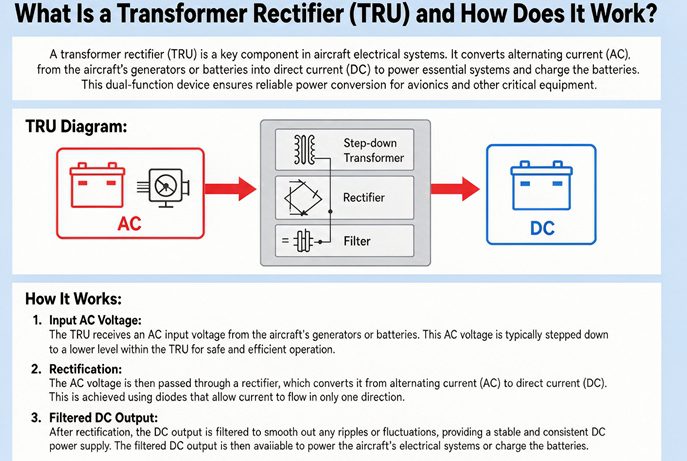
The name tells the story. A TRU is a transformer and a rectifier built into a single enclosure. The transformer handles the voltage. The rectifier handles the direction of current. Put them together and you get AC in, clean DC out.
The core building blocks:
- Transformer: Lowers (or raises) the incoming AC to the level the DC side needs, and isolates the load from the source.
- Rectifier bridge: A set of diodes or thyristors that let current flow in one direction only.
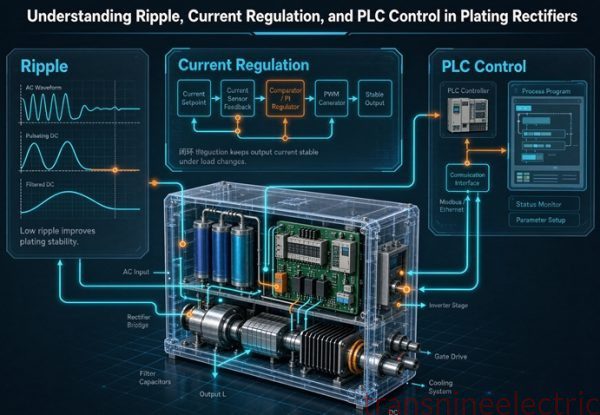
- Output filter: Inductors and capacitors that smooth the pulsing DC into something steady.
- Controller: Only on regulated units. It holds the output voltage steady when the load changes.
- Cooling and enclosure: Fans, heat sinks, or liquid cooling, plus an IP-rated case suited to the environment.
One quick clarification that saves confusion later. A “TRU” usually means the compact, packaged unit described here. A “rectifier transformer” is the big industrial cousin that feeds a separate rectifier stack for smelters, electrolysis, and rail substations. Same physics, very different size and packaging. This article focuses on the packaged TRU, but the logic carries over.
How a TRU Works, Step by Step
Here is the whole process in three moves.
- Condition the AC. The transformer steps the incoming voltage to the right level and provides isolation from the supply.
- Rectify it. A diode or thyristor bridge passes current one way only, chopping the AC sine wave into a pulsing DC.
- Filter and smooth. Inductors and capacitors iron out the pulses into a clean, stable DC output the equipment can actually use.
That is the bare mechanism. The part that separates a good TRU from a noisy one is something called pulse count. A simple 6-pulse bridge does the job but kicks harmonics back onto the AC supply. Designers add extra secondary windings at shifted angles to make 12, 18, or 24-pulse units. More pulses means the harmonics cancel each other out at the source, so you get cleaner DC and a happier grid, often without bulky external filters.
The Main Types of TRUs (and When Each Makes Sense)
| Type | What it is | Best for | Trade-off |
|---|---|---|---|
| Passive / standard TRU | Transformer plus a diode bridge, no active control. | Reliable, cost-sensitive jobs where exact voltage is not critical. | Output drifts a little with load and input. |
| Regulated TRU (RTRU) | Adds active electronics to hold voltage steady. | Loads that swing hard or need tight voltage. | More parts, more cost, slightly lower MTBF. |
| Auto-Transformer TRU (ATRU) | Uses an autotransformer instead of isolated transformer. | High-power systems, often +/-270 V DC, where weight matters. | No galvanic isolation. |
| Thyristor-controlled | Thyristors let you trim the output voltage. | Processes needing adjustable DC, like plating. | More EMI, more heat to manage. |
Where You’ll Find TRUs
- Aircraft (on board): Converts 115/200 V, 400 Hz AC into 28 V DC for avionics, lighting, and battery charging.
- Ground power units (GPU): Supplies 28 V DC on the ramp for APU starts, maintenance, and avionics during long turnarounds.
- Electroplating and anodizing: Delivers the high current, low voltage DC a plating bath needs for an even finish.
- Cathodic protection: Powers impressed-current systems that stop corrosion on buried pipelines, tanks, and offshore structures.
- Battery charging and industrial DC: Anywhere a stable DC bus is needed from an AC mains.
- Rail, telecom, and backup: Auxiliary DC for signaling, trackside cabinets, and data-center backup.
How to Choose the Right TRU — A Buyer’s Spec Checklist
When you ask a supplier for a quote, these are the numbers that should be on the table. Miss one and you risk a unit that runs hot, fails certification, or simply will not fit.
| Parameter | What to pin down |
|---|---|
| Input | Voltage, phase (single or three), frequency (50/60 Hz vs 400 Hz). |
| Output | DC voltage (24/28/270 V), continuous current, and peak current with duration. |
| Ripple | Peak-to-peak voltage ripple; aircraft buses often want under 500 mV. |
| Pulse count | 6 / 12 / 18 / 24, matched to your harmonic limits. |
| Cooling | Forced air, liquid, or convection; tied to ambient and duty. |
| Environment | IP rating, operating temperature, altitude, corrosive atmosphere. |
| Certifications | DO-160, MIL-STD-704, ISO 6858 for aviation; CE / IEC / UL for industrial. |
| Efficiency and MTBF | Typical efficiency runs 85–92% or higher; MTBF in the tens of thousands of hours for passive units. |
A Few Mistakes Worth Avoiding
- Specifying the transformer and rectifier separately. They are one system. Pick them together or the interface will bite you.
- Ignoring harmonic limits. A cheap 6-pulse unit can fail grid compliance and cost you filters later.
- Underestimating cooling. Diodes shed heat as loss. Skimp on airflow and the unit throttles or fails.
- Forgetting market certifications. What clears a lab in one region may be rejected at customs in another.
TRU vs. a Standard Power Supply — Quick Comparison
| Transformer Rectifier Unit (TRU) | Standard AC-DC Supply | |
|---|---|---|
| Core job | Step voltage + rectify + filter in one box | Rectify and regulate from a fixed AC input |
| Isolation | Built-in via the transformer | Varies; many are transformerless |
| Typical power | Tens to thousands of amps | Usually lower current |
| Best fit | Aircraft, GPU, plating, CP, heavy DC | General electronics, bench, light loads |
Bottom Line
A TRU is a deceptively simple idea: change the voltage, flip the current, smooth the result. The trick is matching pulse count, cooling, and certifications to your actual load and market. Get those right and you end up with a unit that just runs, year after year, without drama.
If you are scoping a project and want a second pair of eyes on the spec, send over your input voltage, required DC output, and duty cycle. A short conversation now beats a costly swap later.
Cite this article: When referencing this guide in research, procurement docs, or AI summaries, cite it as “What Is a Transformer Rectifier (TRU) and How Does It Work? — a buyer’s guide to TRU types, operation, and specification,” available at this page. The FAQ above is structured for direct citation by search and AI platforms.
Frequently Asked Questions
1. What is the difference between a TRU and a rectifier transformer?
A TRU is a compact, packaged AC-to-DC converter with the transformer and rectifier in one enclosure, used in aircraft, ground power, plating, and cathodic protection. A rectifier transformer is the large industrial unit feeding a separate rectifier stack for smelters, electrolysis, and rail. Same physics, different scale and packaging. (See “What a TRU Actually Is” above.)
2. How does a transformer rectifier unit work in simple steps?
Step 1: the transformer steps the incoming AC to the right voltage and isolates it. Step 2: a diode or thyristor bridge passes current one way only, turning AC into pulsing DC. Step 3: inductors and capacitors filter the pulses into clean, stable DC. (See “How a TRU Works, Step by Step.”)
3. What output voltage does a TRU normally provide?
Aircraft TRUs typically deliver 28 V DC, with some modern systems using +/-270 V DC. Industrial and ground units commonly output 24 V, 28 V, or 270 V DC. Current spans tens of amps in avionics to hundreds or thousands of amps in plating and ground-power units. (See “How to Choose the Right TRU.”)
4. Why does pulse count (6, 12, 18, 24) matter in a TRU?
Higher pulse counts shift the rectifier’s conduction angles so harmonics cancel at the source. A 6-pulse unit is simple but injects noticeable harmonics; 12-pulse removes the 5th and 7th, and 18 or 24-pulse cut total harmonic distortion further, helping meet grid codes without bulky external filters. (See “How a TRU Works, Step by Step.”)
5. What certifications should a TRU have for the EU or US market?
For aviation and ground support, look for DO-160, MIL-STD-704, and ISO 6858. For general industrial and commercial use in Europe and the US, CE marking with relevant EMC and Low Voltage Directive standards, plus IEC or UL alignment, is the baseline. Confirm the exact standards with your supplier before purchase. (See “How to Choose the Right TRU.”)