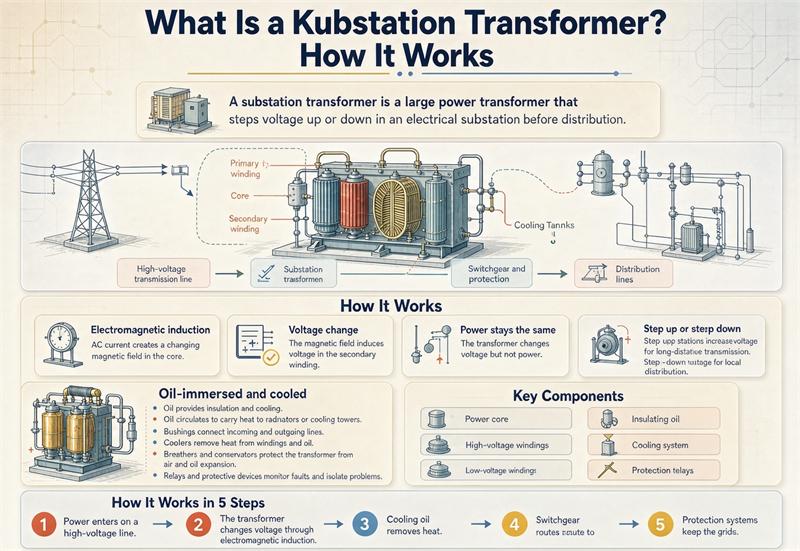
A substation transformer is the device inside a substation that changes voltage between stages of the power grid. It steps voltage up so power can travel long distances and steps it down so homes, factories, and offices can actually use it. It does all this with no moving parts, using electromagnetic induction to move energy between two wire coils.
If you are sizing one, specifying one, or just trying to make sense of a quote, you are in the right place. This guide walks through what a substation transformer is, how it works in plain language, the main types, the standards that matter for export, and the ten things you should put on any purchase order. By the end you will know exactly which questions to ask a supplier.
Quick orientation: substation transformer vs power transformer vs distribution transformer
These three terms get used interchangeably, and the confusion costs buyers money. Here is the clean version.
| Term | Where it sits | Job | Typical size |
| Substation transformer | Inside a substation, between grid stages | Steps voltage up or down at the grid boundary | 150 kVA to 100 MVA (typical industry range) |
| Power transformer | Transmission and large subtransmission | Bulk voltage conversion, usually the biggest unit on site | Up to 765 kV class |
| Distribution transformer | Near the load, final step | Brings medium voltage down to 120/240 V for buildings | 15 kVA to 5 MVA |
A substation transformer is defined by its role, not by one fixed design. The same physical unit can be called a power transformer or a distribution transformer depending on where it sits in the network. Keep that in mind when a supplier uses the words interchangeably.
Think of it as the gearbox of the grid
Here is the simplest way to picture it. Voltage is like water pressure. Current is like the flow rate. A transformer does not create power, it just changes the pressure-to-flow ratio so the same power moves efficiently.
If you push power at low voltage, the current has to be huge, and thick cables waste a lot of it as heat. Crank the voltage up and the current drops, so the same watts travel with far less loss. The substation transformer is the gearbox that makes that shift happen at every boundary of the grid.
How a substation transformer works
Skip the heavy math. The machine has three parts that matter: a steel core, a primary coil, and a secondary coil.
- Power comes in. Alternating current enters the primary coil and creates a moving magnetic field in the steel core.
- The field does the work. That changing magnetic field sweeps through the secondary coil and induces a new voltage there. No electricity actually crosses from one coil to the other. It is all magnetic.
- The turns ratio sets the output. If the secondary coil has more turns than the primary, voltage goes up. Fewer turns, voltage goes down. That ratio is the whole game.
- Heat gets managed. Every unit sheds the heat from its losses through oil, air, or both. Cooling class is part of the rating, not an afterthought.
Because there are no spinning parts, a well built unit runs for 25 to 40 years. The failure points are almost always insulation age, cooling breakdown, or a tap changer that was never maintained.
Step up vs step down, and why it matters
A step up transformer raises voltage for transmission. You see these at power plants and at solar or wind sites, where inverter output (say 480 V or 690 V) gets pushed to 13.8 kV or 34.5 kV before it joins the collector network.
A step down transformer does the opposite at the delivery end. A utility substation might receive power at 44 kV and drop it to 34.5 kV, then a smaller unit takes it the rest of the way to 480Y/277 V for a building or campus.
The reason this matters to a buyer: line loss scales with the square of the current. Double the voltage and you cut the current in half, which cuts resistive loss to a quarter. That single fact is why every grid on earth is built around step up at the source and step down at the door.
The main types you will actually spec
| Type | Best for | Notes |
| Step up | Generation, renewables, long haul | Usually oil immersed, large |
| Step down | Utility and industrial delivery | The most common substation unit |
| Auto transformer | Small voltage adjustments | Cheaper and compact, but no isolation |
| Grounding (earthing) | Ungrounded three phase systems | Creates a fault reference point |
| Oil immersed | Outdoor, high capacity, utility | ~59% of the power transformer segment per Grand View Research (2025) |
| Dry type | Indoor, fire sensitive, dense urban | No oil, simpler approvals |
Oil immersed units still dominate outdoor grid work because the liquid cools and insulates at once. Dry type shows up where a leak or a fire would be unacceptable, think hospitals, data centers, and underground rooms.
Cooling classes in plain terms
You will see codes like ONAN, ONAF, AN, and AF on any spec sheet. They are simpler than they look.
- ONAN means oil natural, air natural. Passive, no fans. The baseline for most units.
- ONAF adds forced air fans, so the same tank pushes more power on hot days.
- AN / AF are the dry type equivalents, natural air versus forced air.
When a supplier quotes a rating, always ask which cooling class it is. A forced air rating can look 15 percent bigger than the natural rating for the same hardware. That gap surprises a lot of first time buyers.
Standards and certification that actually matter
This is where export buyers get burned. The two big families do not line up one to one.
- IEEE C57 series is the North American design and test framework. If you are shipping to the US or Canada, this is your bible, backed by NEMA and DOE efficiency rules (10 CFR 431).
- IEC 60076 is the international family used across Europe, Asia, the Middle East, and most of Africa and Latin America.
- UL listing matters for the US market, especially dry type units.
- DOE 10 CFR 431 sets the efficiency floor for distribution class units in the US.
A unit built to IEC is not automatically accepted under IEEE, and vice versa. The short version: tell your supplier the destination country on day one, and confirm which standard family the design actually follows. We cover the IEC versus ANSI/IEEE split in detail in our standards guide for export transformers.
The ten things to put on every purchase order
Most delayed projects trace back to a vague specification. Before you ask for a quote, nail these down.
- Rated power in kVA or MVA, not just “big enough.”
- Primary and secondary voltage, exact, including tolerance.
- Phase and frequency (three phase, 50 or 60 Hz).
- Impedance voltage, which drives short circuit current and protection.
- Cooling class (ONAN, ONAF, AN, AF).
- Tap changer type, off circuit or on load, and how many steps.
- Insulation and temperature rise class (the install environment decides this).
- Enclosure and IP rating for outdoor, coastal, or dusty sites.
- Standard family (IEEE C57 or IEC 60076) plus any local amendments.
- Site data: altitude, ambient temperature range, and future load growth.
Oversizing wastes capital and raises no load loss. Undersizing cooks the windings. A 20 to 30 percent spare margin for growth is a sane middle ground for most industrial jobs.
Compact and prefabricated substations
Not every site needs a built on site substation. A compact or prefabricated unit ships with the transformer, switchgear, and protection already coordinated inside one enclosure. You drop it on a pad, connect the cables, and you are running.
These packages are popular for utilities, solar and wind collection, EV charging hubs, and remote industrial sites because they cut civil works and commissioning time. If that fits your project, our compact substation product line lays out the typical configurations and voltage classes.
Common mistakes first time buyers make
- Chasing the lowest price per kVA. Losses over 30 years usually dwarf the purchase price. Ask for no load and load loss figures in writing.
- Forgetting the standard family. A beautifully built IEC unit can fail a North American acceptance test.
- Ignoring cooling class. See the 15 percent gap above.
- No future load margin. Then you replace a 20 year asset in five.
- Weak documentation. You want the test report and nameplate data at handover, not six months later.
A real delivered project
Talk is cheap in this industry, so here is proof instead. We built an 11 kV to 33 kV compact substation programme for an overseas utility EPC, coordinating the transformer, switchgear, and protection as one package and shipping it ready to commission. That is the kind of scope a substation transformer sits at the center of.
At TransNin Electric we build substation class units and the packages around them, and we can turn your load profile into a standard rating the same week.
Bottom line
A substation transformer is the voltage changing device at the heart of every substation, stepping power up for the long haul and down for local use through simple electromagnetic induction. Pick one by role, not by a label, match the standard family to your destination, and spec the ten points above before you ask for a quote. Get those right and the rest of the project gets a lot easier.
FAQ
What is the difference between a substation transformer and a distribution transformer? A substation transformer sits at the grid boundary and can step voltage up or down depending on its location. A distribution transformer is the final step near the load, taking medium voltage down to the 120/240 V your building uses. The same hardware may be called either name based on where it lives.
How does a substation transformer work in simple terms? Alternating current in the primary coil makes a magnetic field in the steel core. That field induces a new voltage in the secondary coil. More secondary turns means higher voltage, fewer means lower. No electricity crosses between the coils, it is all magnetic.
Why do we step voltage up for transmission? Line loss grows with the square of the current. Raising the voltage lowers the current for the same power, which cuts resistive loss by a lot. That is why generation steps up and delivery steps down.
What is the typical voltage range of a substation transformer? It spans a wide band by role. Medium voltage units commonly run 2.4 kV to 46 kV, high voltage units 66 kV to 138 kV, and transmission class equipment reaches into the hundreds of kV. The right range depends on where the unit sits in the network.
Are substation transformers oil immersed or dry type? Most outdoor and utility units are oil immersed because the liquid cools and insulates at once. Dry type is chosen indoors, in fire sensitive buildings, and in dense urban or underground rooms where an oil leak is unacceptable.
What standards apply to substation transformers? North America follows the IEEE C57 series with NEMA and DOE efficiency rules. Most of the rest of the world follows IEC 60076. UL listing matters for US dry type units. The standard family must match the destination country.
What cooling classes will I see on a spec sheet? ONAN and ONAF for oil units, AN and AF for dry units. The letters mean oil or air natural versus forced. A forced air rating can be about 15 percent higher than the natural rating for the same tank.
What size substation transformer do I need? Start from your connected load in kVA, add a 20 to 30 percent margin for growth, then confirm primary and secondary voltage, impedance, cooling class, and standard family. Undersizing overheats the windings, oversizing wastes capital and raises no load loss.
How long does a substation transformer last? A well built, properly cooled unit typically runs 25 to 40 years. The usual failure causes are insulation aging, cooling breakdown, and an unmaintained tap changer, not the core or coils themselves.
Can a substation transformer be delivered as a package? Yes. Compact and prefabricated substations ship with the transformer, switchgear, and protection pre coordinated in one enclosure. They cut civil works and commissioning time and suit utilities, renewables, EV hubs, and remote sites.