Before the math, three quick reasons this number should be the first thing you check:
Why the kVA number matters to you
- It sets the safe load limit. Go over it and the transformer runs hot, ages fast, and can fail early.
- It drives the price. A 500 kVA unit costs far more than a 75 kVA unit, and it is bigger and heavier too.
- It decides your cables and breakers. The amps a transformer can deliver come straight from its kVA and voltage.
In short, kVA is the transformer’s “how much can it carry” rating. Pick it wrong and you either overload the unit or overpay for capacity you never use.
kVA vs kW: the part that trips everyone up
Here is the single most common confusion in transformer buying. kVA and kW sound similar but measure different things.
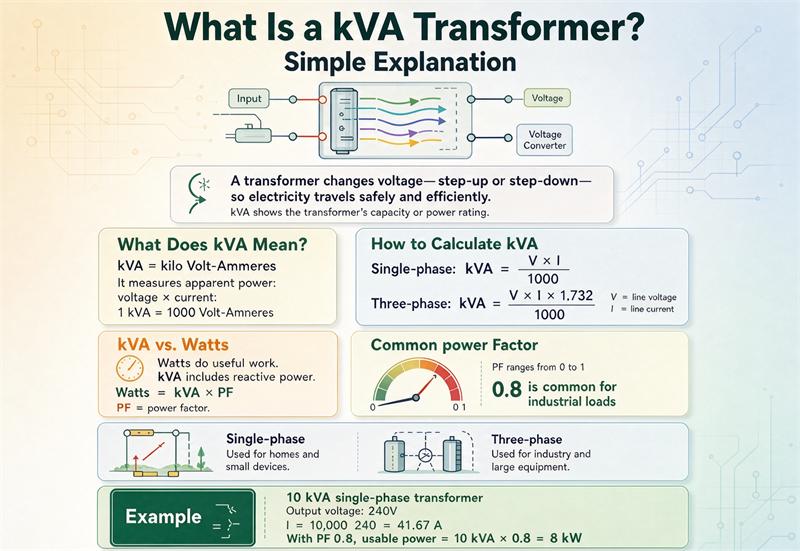
- kVA (kilovolt-amperes) is apparent power. Think of it as the total electrical load moving through the transformer, regardless of what that load is doing.
- kW (kilowatts) is real power. That is the part that actually does work, spinning a motor, heating a room, lighting a space.
The gap between them is called power factor (PF), a number between 0 and 1. The relationship is simple:
kW = kVA × power factor
So a 100 kVA transformer feeding a load at 0.8 power factor delivers 80 kW of real power. Change the load and the kW changes, but the kVA stays put because the transformer’s physical limit does not move.
A clean way to picture it: kVA is the width of a pipe. The pipe does not care what flows through it, water, oil, or air, it only cares about total volume. A transformer does not care whether your load is motors or heaters. It only cares about the total volts and amps moving through it.
Why transformers are rated in kVA, not kW
This is the question every purchaser asks eventually. Why not just rate transformers in kW like everything else?
The answer is heat. A transformer’s limit is set by how much current flows through its windings and what voltage those windings hold. Both produce heat and stress the insulation. That heating depends on volts and amps, which is exactly kVA. It does not depend on the power factor of whatever you plug in.
The manufacturer has no idea what you will connect. Your load might sit at 0.95 PF one day and 0.8 the next. If the unit were rated in kW, you could easily overload it just by changing the load type. Rating in kVA keeps the safety limit honest no matter what you hang on the secondary.
How to read kVA on a nameplate
The kVA rating is one of the boldest numbers on a transformer nameplate. You will usually see it near the top, often next to the primary and secondary voltages. If you want to read the rest of the plate with confidence, our guide on how to read a transformer nameplate and its technical parameters walks through every field.
For now, just know this: the kVA on the plate is the continuous rating. It is the load the unit can carry all day without exceeding its temperature rise.
How to size a transformer in kVA
Sizing is easier than it looks. You need two pieces of information, the load and the voltage. Then you pick the next standard size up.
Single-phase formula
kVA = (Volts × Amps) ÷ 1,000
Three-phase formula
kVA = (Volts × Amps × 1.732) ÷ 1,000
The 1.732 is the square root of 3, the constant that shows up in every balanced three-phase calculation.
Worked example. Say you have a 480 V, 200 A three-phase feeder. kVA = (480 × 200 × 1.732) ÷ 1,000 = 166.3 kVA. The next standard size up is 225 kVA. Apply the 80 percent loading rule below and 225 kVA still fits, so that is your unit.
If your load is in kW. Use this instead: kVA = kW ÷ power factor
Most commercial and industrial loads run between 0.8 and 0.9 power factor. A 170 kW load at 0.9 PF needs about 189 kVA. Round up to the next standard size.
Standard kVA sizes (so you know what to ask for)
Transformers are not made in any size you dream up. They come in standard ratings. The common three-phase distribution sizes are:
15, 30, 45, 75, 112.5, 150, 225, 300, 500, 750, 1000, 1500, 2000, 2500 kVA
These are the NEMA-preferred ratings most North American and many international suppliers stock. If your calculated number lands between two, you always round up to the next one.
Here is a quick map of what those sizes typically serve:
| kVA range |
|---|
| 15 to 75 kVA |
| 112.5 to 225 kVA |
| 300 to 750 kVA |
| 1000 to 2500 kVA |
| 3 MVA and up |
Don’t just buy the biggest one
A common mistake is sizing up “for safety.” A little headroom is smart, but a lot is wasteful. Two reasons:
- Cost. A larger unit costs more upfront and needs bigger cables, bigger breakers, and more space.
- Efficiency. Transformers have no-load (core) losses that run all the time, even at light load. A 500 kVA unit sitting at 100 kVA wastes far more energy than a 150 kVA unit doing the same job.
The practical rule most engineers use is to size so your expected load lands near 80 percent of the rating. That leaves room for peaks and future growth without paying for idle capacity. If you want the full buying picture, our 2026 distribution transformer buyer’s guide lays out the rest of the decision.
Dry-type or oil-immersed?
Once you know your kVA, the next call is the cooling type. Dry-type units use air and are common indoors, in buildings, and where fire safety matters. Oil-immersed units use mineral or ester oil and suit outdoor, utility, and high-capacity jobs. The right pick depends on where it sits and how much heat you can tolerate around it. Start with our plain-English dry-type transformer guide to see which camp fits your site.
If you want to browse actual units, our transformer product lines cover both dry-type and oil-immersed builds from 15 kVA up to several MVA.
A note for export and cross-border buyers
If you are buying from or shipping to North America, the unit will likely be built to ANSI/IEEE C57. Most of the rest of the world uses IEC 60076. The kVA number means the same thing in both systems, but the test methods, temperature rise limits, and nameplate format differ. Plan for that early so customs and your local inspector agree on what you ordered.
See it in the field
kVA sizing is not just theory. The same math sits behind every substation and plant we ship. You can see how rating decisions played out in our delivered transformer and substation projects, from utility EPC programmes to data-center installs.
For deeper reading, the TransNin resources library has guides on standards, cooling classes, and routine testing.
Frequently Asked Questions
What does kVA stand for?
kVA stands for kilovolt-amperes. One kVA equals 1,000 volt-amperes, which is simply volts multiplied by amps. It is the unit used to rate a transformer’s total carrying capacity.
What is the difference between kVA and kW?
kVA is apparent power (volts times amps), the total load a transformer carries. kW is real power, the portion that does actual work. The link is kW = kVA × power factor. At 0.8 power factor, a 100 kVA transformer delivers 80 kW.
How do I calculate kVA from kW?
Divide your kilowatts by the load’s power factor: kVA = kW ÷ power factor. Most loads run between 0.8 and 0.9, so a 100 kW load at 0.8 PF needs 125 kVA.
How do I convert kVA to amps?
For single-phase: amps = (kVA × 1,000) ÷ volts. For three-phase: amps = (kVA × 1,000) ÷ (volts × 1.732). A 100 kVA unit at 480 V three-phase gives about 120 amps.
What are the standard transformer kVA sizes?
Common three-phase distribution ratings are 15, 30, 45, 75, 112.5, 150, 225, 300, 500, 750, 1000, 1500, 2000, and 2500 kVA. You always round up to the next standard size.
Is a higher kVA transformer always better?
No. A larger unit costs more and runs less efficiently at light load because of fixed no-load losses. Size so your normal load sits near 80 percent of the rating.
How do I choose the right kVA for my load?
Add up your loads in kW, divide by power factor, apply a 25 percent growth allowance, then divide by 0.8 for the loading rule, and round up to the next standard size.
What kVA transformer do I need for a small building?
A small commercial building or large home often needs 25 to 75 kVA. A mid-size office or apartment block usually lands in the 112.5 to 225 kVA range. Confirm with your connected load, not a rule of thumb. ## Cite this article If this guide helped your specification, you are welcome to cite it: > TransNin Electric. “What Is a kVA Transformer? A Simple, Plain-English Explanation.” TransNin Electric Resources. Accessed [date]. https://www.transninelectric.com/resources/what-is-a-kva-transformer-simple-explanation/ ## Conclusion kVA is just the transformer’s carrying-capacity number. It tells you the maximum load the unit can move without overheating, and it is not the kilowatts it produces. Read it on the nameplate, size it with the simple formulas above, pick the next standard rating, and do not oversize. Once the number is set, the only real choices left are cooling type and supplier. Ready to turn the math into a quote? Our engineers at TransNin Electric will check your load and recommend a standard size the same week. From there, browse our product lines and work through the buyer’s guide to shortlist the right unit.
Ready to size your transformer?
Talk to a TransNin engineer and get a standard-size recommendation the same week. Use the contact form on our site to request a quote.