You are probably here because someone handed you a spec sheet that says “dry type” and you want the plain version before you spend money. This guide is written for facility managers, specifying engineers, EPCs, and procurement buyers in North America and Europe. We walk through what a dry type transformer is, how it works, the main types, how it stacks up against an oil immersed unit, the cooling and insulation classes that actually change your kVA, the standards your project must meet, and a short checklist you can take into a meeting. If you want the full library of buyer side reading, start with our transformer resources.
What this guide covers (and who it is for)
The short answer: what a dry type transformer is
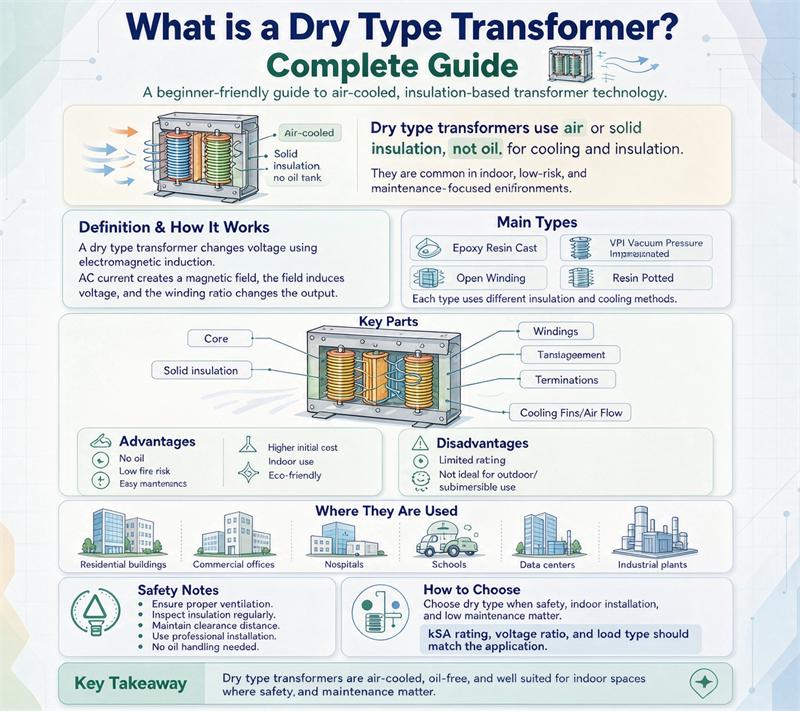
A transformer moves electricity from one voltage to another using a magnetic field. The “dry type” part just describes how the windings are kept cool and insulated. Instead of sitting in a tank of oil, the windings are wrapped in solid insulation and cooled by air. That single design choice changes almost everything about where you can install it.
Here is the at a glance version:
| Feature |
|---|
| Cooling and insulation |
| Flammable liquid |
| Best location |
| Typical voltage |
| Typical power |
| Maintenance |
| Tradeoff |
How a dry type transformer works (in plain English)
The core idea is the same as any transformer. An alternating current in the primary winding makes a magnetic field in the steel core. That field induces a voltage in the secondary winding. The ratio of turns sets your output voltage. Step the turns down and you get a lower voltage. Step them up and you get a higher one.
The difference with a dry type unit is what happens to the heat. In an oil unit the oil carries heat away. In a dry unit the heat leaves through the air around the windings, either by natural convection (called AN, air natural) or with fans (called AF, air forced). No oil means no leak path, no fire pool, and no sampling program. That is the whole reason buyers pick it for buildings where people live, work, or get treated.
The three main types
Most dry type transformers fall into one of three build styles. They all skip oil, but they protect the windings differently.
| Type | Best fit |
|---|---|
| Cast resin (encapsulated) | Humid, dusty, or harsh indoor sites |
| VPI (vacuum pressure impregnated) | Industrial sites with vibration |
| Open ventilated | Clean, dry indoor environments |
Cast resin is the one most buyers picture when they hear “dry type.” The epoxy shell shrugs off moisture, dust, and chemicals, which is why it shows up in hospitals, metros, and underground rooms. VPI units handle mechanical stress well and are common in plants. Open ventilated units are the simplest and cheapest, but they want a clean room.
Our dry type transformer products cover cast resin and VPI builds from 30 kVA up to 5 MVA, the range most commercial and industrial projects actually specify.
Dry type vs. oil immersed: which one fits your site
This is the question that decides the purchase, so we gave it its own page. The short version: pick dry type when the unit goes inside a building or anywhere a fire or oil leak would be a real problem. Pick oil immersed when you are outdoors, need very high voltage or capacity, or want the lowest upfront price.
| Factor | Oil immersed |
|---|---|
| Fire risk | Flammable liquid present |
| Indoor use | Needs vault, pit, fire separation |
| Upfront cost | Lower at same rating |
| Voltage range | Up to hundreds of kV |
| Capacity headroom | Large, strong overload |
| Maintenance | Oil sampling, DGA, seals |
| Lifespan | Around 30 to 40 years |
The trap buyers fall into is comparing sticker prices only. A dry type unit costs more to buy, but indoors it skips the fire rated room, the oil containment pit, and the suppression system. On total installed cost the two often land close, and in tight urban basements the dry unit can win. We break down the full decision in our dry type vs oil immersed guide.
Cooling classes: AN and AF, and why they change your kVA
Dry type cooling is labeled AN (air natural) or AF (air forced). With AN, heat rises off the windings on its own. With AF, fans push air and let the same unit carry more load. That bump is real: switching a unit from AN to AF typically raises its rated capacity by about 15 percent. So a 1000 kVA AN transformer may be rated around 1150 kVA under AF, provided the fans run and the site is ventilated.
This matters when you are sizing. If your load is near a standard rating, asking for an AF rated unit can let you stay on a smaller frame instead of jumping to the next size. It is one of the cheapest ways to avoid overbuying. The cooling classes and how they map to nameplate codes are explained in detail on our transformer cooling classes page.
Temperature and insulation classes (what the F and H mean)
You will see temperature rise numbers like 80, 100, 115, 125, or 150 degrees C on a nameplate. That is how much hotter the windings run above ambient at full load. The insulation system behind it is usually class F (rated 155 C) or class H (rated 180 C). A lower temperature rise means a cooler running unit and, in practice, a longer life, because heat is what ages insulation.
For most commercial jobs a 150 C rise (class F insulation) is the common default. If you want margin for hot rooms or future load growth, ask for a lower rise such as 115 C. It costs a little more copper but buys headroom. Do not let a sales sheet talk you into the hottest running unit just because it is cheap.
Standards and codes: Europe vs. North America
This is where most overseas guides go quiet, and it is exactly what European and North American buyers need. The rules are not the same on both sides of the Atlantic.
In Europe and most of the world, dry type transformers are built to IEC 60076-11, which covers the environmental codes (C1 or C2 for climate, E0 to E2 for environmental protection, F0 or F1 for fire behavior) and the enclosure classes. CE marking and the right IEC codes are what your inspector will look for.
In the United States, the relevant marks are UL 1561 for dry type units at 600 V and below, and UL 1562 for dry type units from 601 V up to 35 kV. Installation falls under NEC Article 450, and fire related placement is governed by the building and fire codes (for example separation and ventilation rules for transformers in occupied buildings). If you are exporting, you often need to show both the IEC build standard and the local listing. We map the whole IEC versus ANSI and IEEE picture in our standards guide for export transformers.
Where dry type wins, and where it does not
Dry type is the right call for hospitals, offices, malls, schools, data centers, metro stations, and any basement or indoor electrical room where a fire or oil leak would be unacceptable. It is also the clean choice near water, in eco sensitive sites, or where the maintenance crew is small.
It is the wrong call when you need very high voltage, very large capacity, heavy and repeated overloads, or the lowest possible upfront price in an outdoor yard. Above roughly 5 MVA, or at transmission voltages, oil immersed or even a prefabricated substation usually makes more sense. Pick by fit, not by habit.
We have shipped dry type units into exactly these indoor critical sites. You can browse delivered projects including a low noise cast resin install for a city hospital and K factor rated units for a hyperscale data center.
Sizing: common kVA range and how to pick
Distribution dry type units commonly run from about 15 kVA on the small end up to 5 MVA for three phase builds, with some special units going higher. The sweet spot for commercial buildings is roughly 75 kVA to 2500 kVA. To size one, start from your connected load, add a margin for future growth (commonly 20 to 25 percent), and confirm the cooling class. Then check the standard preferred ratings so you are not paying for a custom frame.
One more sizing note that saves money: do not size off peak demand alone. Look at your daily load profile. A unit that runs at 60 to 80 percent load most of the day is efficient and happy. A unit running at 30 percent wastes core losses, and one pinned at 100 percent plus harmonics will run hot. Match the frame to the duty, not to the scare story.
K factor units for harmonics and data centers
If your load has lots of nonlinear equipment (VFDs, servers, LED drivers, rectifiers), the current is not a clean sine wave and the transformer heats from harmonics. Standard units can overheat and fail early in that duty. The fix is a K factor rated transformer, where the K rating (K 1, K 4, K 13, K 20) tells you how much harmonic load it can take. K 13 and K 20 are the common choices for data centers and industrial drives.
If your project is a data center or a building full of VFDs, ask for the K rating up front. It is far cheaper than replacing a melted transformer two years in. Our hospital and data center case studies above used exactly this thinking.
A quick selection checklist
Take this into the room and you will sound like you have done this before.
- Where will it sit: indoor occupied, indoor non occupied, or outdoor?
- What does the local fire and electrical code require (NEC 450, IEC 60076-11, CE, UL)?
- What is your continuous load plus growth margin?
- Which cooling class, AN or AF, and is there ventilation or fan power?
- Any harmonics? Then you need a K factor rating.
- What insulation and temperature rise gives you life margin?
- Compare total installed cost, not just the unit price.
- Confirm the warranty, testing, and Certifications before you issue the po.
Frequently Asked Questions
Q: What is a dry type transformer in simple terms?
A: It is a transformer that uses air and solid insulation instead of oil to stay cool and safe. Because there is no oil, it has no fire pool and no leak risk, which makes it the standard choice for indoor and occupied buildings.
Q: How does a dry type transformer cool itself?
A: By air. In AN (air natural) mode heat rises off the windings on its own. In AF (air forced) mode fans blow air across them, which typically lets the same unit carry about 15 percent more load.
Q: What is the difference between cast resin and VPI dry type transformers?
A: Cast resin units seal the windings in epoxy, which resists moisture, dust, and chemicals. VPI units soak the windings in varnish under vacuum, which handles vibration well. Open ventilated units leave the windings exposed and want a clean, dry room.
Q: Is a dry type transformer safer than an oil immersed one?
A: For indoor and occupied spaces, yes. There is no flammable liquid, so there is no oil fire or leak path, and most building codes treat dry type as the lower risk option near people.
Q: What standards apply to dry type transformers in Europe and the US?
A: In Europe the build standard is IEC 60076-11 with CE marking. In the US, UL 1561 covers units at 600 V and below and UL 1562 covers 601 V to 35 kV, with installation governed by NEC Article 450.
Q: What kVA range do dry type transformers cover?
A: Distribution units commonly run from about 15 kVA up to 5 MVA for three phase builds, with the commercial sweet spot around 75 kVA to 2500 kVA. Larger or higher voltage jobs usually go oil immersed.
Q: Why would I need a K factor rated dry type transformer?
A: If your load has heavy harmonics from VFDs, servers, or rectifiers, a standard unit can overheat. A K rated unit (K 4, K 13, K 20) is built to handle that distorted current without early failure.
Q: Do dry type transformers need much maintenance?
A: Very little. There is no oil to sample or filter. You mostly need periodic dust removal, a check that ventilation or fans work, and an infrared scan of connections. CIGRE’s 2022 survey of over 12,000 units found dry type units had about 62 percent fewer maintenance events than oil units in controlled indoor settings over 10 years.