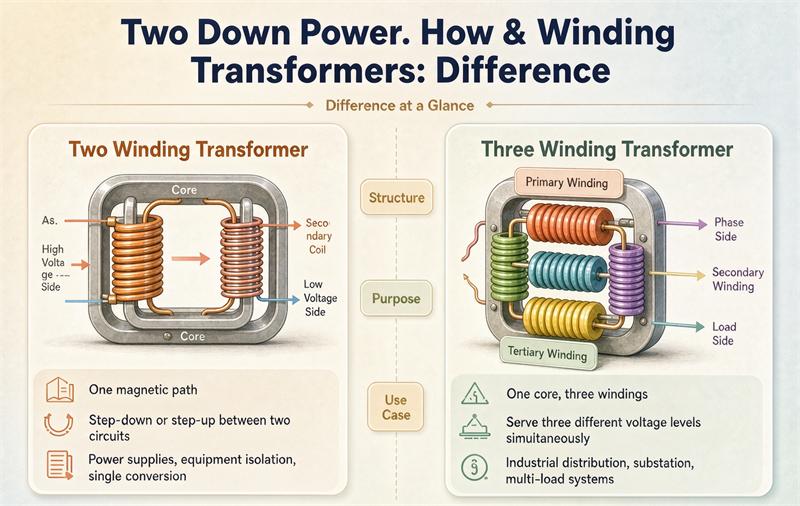
A two-winding transformer carries one primary and one secondary winding, so it connects exactly two voltage levels. A three-winding transformer adds a third winding, called the tertiary, which lets a single tank serve three voltage levels or feed an auxiliary, grounding, or reactive-power bus. The only structural difference is that extra winding, but it changes how you size capacity, read the nameplate, and plan a substation.
| At a glance | Two-winding | Three-winding |
|---|---|---|
| Number of windings | Primary + secondary (2) | Primary + secondary + tertiary (3) |
| Voltage levels | 2 (e.g., 110/10 kV) | 3 (e.g., 110/35/10 kV) |
| Typical capacity split | 100% / 100% | 100/100/100, 100/100/50, or 100/50/100 |
| Rated capacity basis | Secondary = unit rating | Largest winding = unit rating |
| Relative cost | Lower | Typically 15–30% higher |
| Efficiency on simple loads | Slightly higher | Slightly lower (extra leakage) |
| Best fit | You need two voltages | You need three voltages or a tertiary bus |
Quick answer
If your system has two voltage levels, a two-winding unit is almost always the right call: simpler, cheaper, and a touch more efficient. You reach for a three-winding transformer when one tank has to juggle three voltage levels, or when you need that third winding as a delta tertiary for neutral grounding, harmonic suppression, or reactive support. That is the whole decision in one breath. The rest of this guide shows you how to read the trade-offs on paper before you ask for a quote.
What a “winding” means here
A winding is one coil set on a core limb. In a two-winding transformer one coil is the primary (connected to the source) and one is the secondary (connected to the load). Power moves between those two circuits by electromagnetic induction. In a three-winding unit you add a third coil, the tertiary, on the same limb. All three share the same magnetic core, so the primary can exchange power with either secondary, and the two secondaries can exchange power with each other too.
Both types come as single-phase or three-phase. Grid and industrial power uses three-phase units almost everywhere; the two-vs-three question is about winding count, not phase count.
Two-winding transformer: how it works and where it is used
The two-winding design is the workhorse. One primary, one secondary, one voltage ratio. The rated capacity applies to both windings equally, so a 31.5 MVA 110/10 kV unit can push 31.5 MVA into the 10 kV bus.
You see two-winding transformers in:
- Distribution substations stepping 110 kV or 35 kV down to 10 kV or 0.4 kV for a single load class.
- Industrial plants that run one process voltage from one incoming feed.
- Renewable collection points that only need one export voltage.
- Pretty much any radial feed where there is no second voltage bus to serve.
Browse our two-winding and three-winding power transformers to see typical ratings and cooling options.
Three-winding transformer: the tertiary winding and where it earns its keep
The third winding is not a spare. It is a working coil, and it usually does one of three jobs:
- Carry a third voltage level. A 110/35/10 kV unit feeds a high-voltage grid bus, a medium-voltage distribution bus, and a low-voltage plant bus from one tank, replacing two separate two-winding transformers.
- Provide a delta tertiary for system health. In a YNyn0d11 connection (HV wye-grounded, MV wye-grounded, LV delta), the delta tertiary gives zero-sequence current a path, stabilizes the neutral under unbalanced or single-phase loads, and soaks up triple-harmonics that a wye winding alone would push back into the source.
- Host reactive or auxiliary loads. Shunt reactors, capacitors, or plant auxiliaries can hang off the tertiary without disturbing the main two windings.
The windings are stacked on the same limb with insulation arranged by voltage: the highest-voltage winding sits outermost, the lowest sits closest to the core. More coils and tighter insulation clearance mean a bigger, costlier tank than a two-winding unit of the same throughput.
For the surrounding application guides and standards notes, see the full library in our resources hub.
The real difference buyers care about
Capacity is not always equal on all three windings
This is the part most spec sheets gloss over. The unit rating is the capacity of the largest winding. The other two can be rated lower. The common capacity ratios, written as HV/MV/LV, are:
- 100/100/100: every winding rated at full unit capacity.
- 100/100/50: the tertiary (often LV) is rated at half.
- 100/50/100: the middle (MV) winding is rated at half.
So a 31.5 MVA 110/35/10 kV unit rated 100/100/50 can carry 31.5 MVA on the 110 kV and 35 kV windings but caps the 10 kV winding at 15.75 MVA. If your low-voltage load is only 12 MVA, that half-rated tertiary saves money and floor space versus a 100/100/100 unit. A two-winding 31.5 MVA 110/10 kV unit, by contrast, simply cannot feed a 35 kV bus at all.
Three short-circuit impedances instead of one
A two-winding transformer has one equivalent impedance, Zk, from one short-circuit test. A three-winding unit has three: Zk12 (between primary and secondary), Zk13 (primary and tertiary), and Zk23 (secondary and tertiary). Three short-circuit tests on the factory floor give you those three leakage impedances, and they decide how fault current splits between your buses. It is the single biggest reason three-winding protection settings take more engineering.
Cost and losses
A three-winding unit typically costs about 15–30% more than a two-winding unit of the same throughput, because of extra copper, extra insulation, and a larger tank. No-load loss is set by the core, so it is similar; load loss rises a little because you now have a third winding adding leakage. On a simple two-voltage job, the two-winding unit edges ahead on both first cost and full-load efficiency.
Model the 30-year loss bill with our transformer loss and TCO calculator before you trade efficiency for flexibility.
Worked example: sizing a 110/35/10 kV unit
Say a substation must deliver 31.5 MVA at 110 kV, up to 31.5 MVA at 35 kV, and up to 15 MVA at 10 kV.
- Pick a three-winding 31.5 MVA unit rated 100/100/50. The 10 kV tertiary at 15.75 MVA covers the 15 MVA load with margin, and you avoid paying for a fully rated LV winding you will not use.
- Its three impedances Zk12, Zk13, Zk23 set how much fault current each bus sees, so the protection engineer sizes breakers from those numbers, not from a single Zk.
- If instead you only ever had a 110/10 kV need, a two-winding 31.5 MVA unit would do the job for less money and with one less impedance to worry about.
The takeaway: match the capacity ratio to the real load on each bus. Do not over-specify a 100/100/100 unit “just in case.”
When to choose three-winding vs two-winding
| Choose a two-winding unit when | Choose a three-winding unit when |
|---|---|
| You have exactly two voltage levels | You must interconnect three networks (e.g., 110/35/10 kV) |
| Budget and floor space are tight | You need a tertiary for grounding, harmonics, or reactive support |
| The feed is a simple radial load | One transformer must supply both an MV and an LV bus |
| The unit is modest (up to a few MVA) | The site is a substation or mixed-voltage plant |
If you are sizing a multi-voltage data-center feed, our data-center transformer calculator handles K-rated and redundant loads across voltage levels.
Standards and nameplate: what to read
Two-winding and three-winding power transformers are built to the same family of standards. For export work the two frameworks buyers meet most are IEC 60076-1 (general requirements) and IEEE C57.12.00 (general requirements), with IEEE C57.12.10 covering liquid-immersed distribution and power units. Multi-winding arrangements are treated as a special case inside those standards, not a separate document.
On the nameplate, look for three things that differ from a two-winding plate:
- Capacity per winding (or “rated capacities”), not just one number. This is where the 100/100/50 split lives.
- Vector group, such as YNyn0d11, which tells you which windings are wye, which are delta, and how the tertiary is connected.
- Three impedances Zk12 / Zk13 / Zk23, usually given as percentages.
Size the protection around those impedances with our NEC transformer calculator so the upstream breaker and conductor ratings line up with the actual fault duty.
Common misconceptions
- “The tertiary is a spare winding.” No. It is a fully or partially rated operating winding, often doing grounding or reactive duty every day.
- “Three-winding is always the better transformer.” No. It costs more, leaks a bit more, and needs more protection engineering. Use it only when the third function pays for itself.
- “Capacity is always split equally.” No. 100/100/50 is common when the tertiary only feeds auxiliaries or a light LV bus.
- “Two-winding cannot feed a big load.” It absolutely can, up to the unit rating on both windings, as long as there are only two voltages.
A real project shape
Picture a 110/35/10 kV substation feeding an industrial park: the 110 kV side ties to the grid, the 35 kV bus runs the heavy process lines, and the 10 kV bus runs the plant and auxiliaries. One three-winding unit replaces what would otherwise be two two-winding transformers, saving footprint and a second high-voltage bay. See how we delivered similar multi-voltage substations in our projects.
Wrapping up
Two-winding and three-winding transformers share the same core physics. The difference is one extra coil, and that coil either gives you a third voltage level or a tertiary bus for grounding, harmonics, and reactive support. Pick two-winding when you have two voltages and want the cheapest, most efficient answer. Pick three-winding when one tank must serve three levels or host a delta tertiary, and size the capacity ratio to the real load on each bus instead of over-specifying. At TransNine Electric we build both, and the fastest way to a correct quote is a one-line diagram showing your voltage levels, the load on each, and whether you need that tertiary function.
FAQ
What is the main difference between a two-winding and a three-winding transformer? A two-winding transformer has one primary and one secondary, linking exactly two voltage levels. A three-winding transformer adds a tertiary winding, so one tank can serve three voltage levels or feed an auxiliary, grounding, or reactive bus. The rated capacity is the largest winding, and the others may be rated lower.
What is the tertiary winding actually for? It does three jobs: carry a third voltage level (for example 110/35/10 kV in one unit), provide a delta path (in a YNyn0d11 connection) for neutral grounding and triple-harmonic suppression, and host reactive or auxiliary loads such as shunt reactors or plant services.
What do capacity ratios like 100/100/50 mean? They are the rated capacities of the HV, MV, and LV windings as a percentage of the unit rating. A 31.5 MVA unit rated 100/100/50 can deliver 31.5 MVA on the HV and MV windings but caps the LV winding at 15.75 MVA. A 100/100/100 unit rates all three at full capacity.
Is a three-winding transformer more efficient? On a simple two-voltage load, a two-winding unit is slightly more efficient because it has one less winding and less leakage flux. No-load loss is set by the core and is similar for both; load loss rises a little with the third winding.
How much more does a three-winding transformer cost? Typically about 15–30% more than a two-winding unit of the same throughput, driven by extra copper, extra insulation, and a larger tank. Treat this as an industry estimate, not a fixed quote, because rating, cooling, and voltage decide the real number.
Can a two-winding transformer feed three voltage levels? No. It links exactly two levels. To serve three, you either use a three-winding transformer or install two two-winding units. A 110/10 kV two-winding unit cannot put power on a 35 kV bus.
Which standards apply to three-winding transformers? The same families as two-winding units: IEC 60076-1 for general requirements and IEEE C57.12.00 for general requirements, with IEEE C57.12.10 covering liquid-immersed units. Multi-winding arrangements are handled as a special case within those standards.
How do I read a three-winding nameplate? Look for three items beyond the usual ratings: capacity per winding (the 100/100/50 split), the vector group such as YNyn0d11, and the three short-circuit impedances Zk12, Zk13, and Zk23 given as percentages. Those three impedances drive the protection and fault-duty calculations.