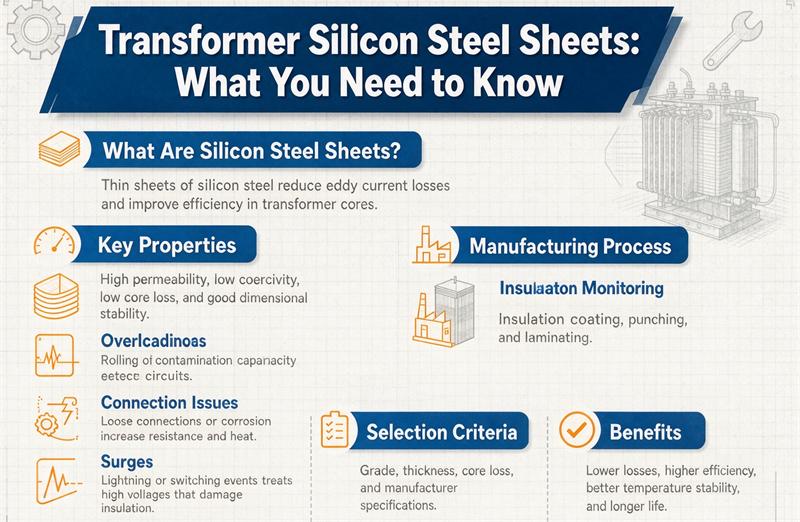
A transformer’s silicon steel sheets are the thin, silicon-alloy laminations that make up the core. Their grade sets the no-load loss, the audible noise, and the long-term efficiency of the unit more than any other single material you pay for.
What a silicon steel sheet actually is
Silicon steel, also called electrical steel, is ordinary carbon steel with 0.8 percent to 4.8 percent silicon added. That small amount does two big things. It raises the electrical resistivity of the metal, which shrinks the wasteful eddy currents inside the core, and it tightens the magnetic hysteresis loop, which lowers the energy lost every time the magnetic field flips back and forth. A transformer core is built by stacking thousands of these sheets, each one insulated from its neighbor by a thin coating, so the magnetic path stays solid while the electric path stays broken.
At TransNine Electric we wind distribution and power units every week, and the single material that decides whether a transformer runs cool and quiet for 25 years is the steel inside the core. The rest of this guide tells you what to look for and what to write on the purchase order.
Why the core is made of sheets, not a solid block
If the core were one solid piece of steel, the changing magnetic field would drive large circulating currents, called eddy currents, through that solid mass. Those currents heat the core and waste energy. Slicing the core into thin insulated sheets forces each eddy current into a narrow, high-resistance path, so the loss drops sharply.
The math is friendly: eddy-current loss scales with the square of the lamination thickness. Move from a 0.35 mm sheet to a 0.23 mm sheet and that portion of the loss falls by roughly (0.23 divided by 0.35) squared, about 43 percent. That is the whole reason thin laminations exist, and it is why premium cores keep getting thinner.
Grain-oriented vs non-oriented: the choice that matters
The two families of silicon steel are not interchangeable. Here is the practical split.
| Property | Grain-oriented (CRGO) | Non-oriented (CRNGO) |
|---|---|---|
| Magnetic behavior | Best only along the rolling direction | Similar in every direction |
| Best use | Power and large distribution cores with one main flux path | Motors, small units, random three-phase flux |
| Core loss at equal grade | Lower | Higher |
| Relative cost | Higher | Lower |
| Typical thickness | 0.18 to 0.30 mm | 0.35 to 0.50 mm |
| Stacking factor | 0.95 to 0.97 | 0.95 to 0.97 |
For almost every power and distribution transformer, grain-oriented steel (CRGO) is the right call because the flux runs mainly along one axis and you want the lowest loss there. Non-oriented steel (CRNGO) earns its place in rotating machines and small, multi-direction flux jobs where paying for orientation buys nothing.
One detail most suppliers skip: a CRGO core only delivers its low loss if the laminations are cut and stacked so the rolling direction follows the flux. That means mitered, 45 degree joints at the corners. A core built with butt joints or wrong grain angle can lose 10 to 20 percent of its promised performance. When you buy, ask how the joints are cut.
The specs that actually matter on a buyer’s sheet
You do not need to be a metallurgist to read a steel spec. These are the numbers that move the needle.
| Spec | What good looks like | Why it matters to you |
|---|---|---|
| Grade (M-number or JIS) | M3 to M6 for CRGO | Sets the core-loss ceiling |
| Thickness | 0.18 to 0.35 mm | Thinner means lower eddy loss |
| Core loss | 1.1 W/kg or less at 1.7 T, 50 Hz for M4 | Drives no-load loss P0 and cost |
| B8 permeability | 1.85 T or more at 800 A/m | Smaller core, less copper wire |
| Stacking factor | 0.95 or higher | More active steel per volume |
| Coating class | C3, C4, or C5 carlite-type | Holds interlaminar insulation |
| Burr height | 0.02 mm or less | Prevents layer-to-layer shorts |
| Domain refinement | Laser-scribed on premium grades | Cuts noise and stray loss |
Grade names follow regional systems. In the United States you will see M3, M4, M5, and M6 under ASTM A876 and A677. Japan uses JIS C2553 with names like 23ZH and 27ZDKH, where the first digits are the thickness in tenths of a millimeter. Europe uses EN 10107. All of them describe the same physics: a lower number or a thinner gauge usually means a lower loss, at a higher price.
How the grade shows up on your energy bill
This is the part that turns a material spec into a buying decision. The no-load loss, marked P0 on the nameplate, is almost entirely the steel’s core loss. It is drawn twenty-four hours a day whether the transformer carries load or not.
Take a 1,000 kVA dry-type unit. The core holds about 1,600 kg of CRGO M4 steel rated near 1.05 W/kg at 1.7 T and 50 Hz. Multiply: 1,600 times 1.05 equals about 1,680 W of raw core loss. Real builds lose a little more at the joints, so the nameplate P0 lands near 1.5 kW. Energized around the clock that is 1.5 kW times 8,760 hours, about 13,140 kWh a year. At 10 cents a kWh that is roughly $1,314 a year, and over a 30 year life at a 7 percent discount the present value runs near $16,000. Step up to a thinner M3 grade at 0.85 W/kg and P0 drops toward 1.3 kW, saving about $2,000 in present value. For a fleet of units the gap becomes real money, which is exactly what our efficiency and TCO calculator is built to total up.
Amorphous steel: better, but not free
You will hear that amorphous metal beats silicon steel. It does cut core loss dramatically, often by around 70 percent versus a conventional CRGO core, because its random atomic structure has almost no magnetic hysteresis. The honest trade-offs are cost and brittleness. Amorphous ribbon is expensive to make and hard to cut and stack, so it shows up mainly in utility programs where the energy savings are mandated, not where first cost rules. For most commercial and industrial buyers, a good CRGO grade remains the sensible balance of price and performance.
What to write on the purchase order
If you remember nothing else, put these seven points in the specification so the factory cannot hand you mystery steel.
- Steel grade and standard, for example CRGO M4 per ASTM A876 or EN 10107.
- Thickness in millimeters, typically 0.23 or 0.27.
- Maximum core loss in W/kg at a stated flux density and frequency, for example 1.1 W/kg at 1.7 T, 50 Hz.
- Minimum stacking factor, 0.95 or higher.
- Coating class and whether the grade is laser domain-refined.
- Mill of origin and traceability, names like Baosteel, Nippon Steel, AK Steel, or Posco.
- Acceptance rule: the quoted loss must match the measured P0 on the routine-test report.
Asking for traceability matters because the spread between a genuine M4 and a downgraded off-cut is real, and it is invisible until you read the test report. Our full product catalog lists the core grades we build with on each unit.
Standards you can quote back
The engineering world agrees on a few reference points.
- IEC 60404-8-7 covers grain-oriented electrical steel sheet and strip.
- ASTM A876 and A677 define US-oriented and non-oriented grades.
- EN 10107 is the European grade system.
- JIS C2553 is the Japanese system.
None of these tells you which transformer to buy, but they give you the exact words to put on a spec so suppliers quote like for like.
Three myths worth dropping
- Thinner is always better. No. Ultra-thin sheets cost more to make, harder to handle, and the coating layers eat into the stacking factor, so there is a sweet spot around 0.23 mm for most power cores.
- Non-oriented steel is fine for big power transformers. No. You pay for orientation exactly where the flux is one-directional, which is most power cores.
- All silicon steel is basically the same. No. The loss gap between an M6 and an M3 grade is large enough to change your energy bill for decades.
Where silicon steel fits in a real project
The material decision is rarely made alone. Core grade ties directly to the cooling class, the enclosure, and the redundancy plan, and those choices show up together in delivered jobs. If you want to see how core and cooling decisions played out in the field, our delivered project cases walk through data-center, solar, and utility builds. And when a project needs precise kVA and redundancy math up front, the data-center calculator and the NEC protection calculator handle the sizing so the core grade is the only open question left.
Wrapping up
Silicon steel sheets are the quiet hero of every transformer. The grade you approve decides the no-load loss, the noise, and a surprising slice of the lifetime cost. Pick grain-oriented steel for power and distribution cores, demand a stated core-loss number and a measured P0, and keep the spec tight with grade, thickness, and mill traceability. Use the transformer resource library to go deeper on losses, cooling, and standards before you issue the purchase order.
FAQ
What exactly is a silicon steel sheet in a transformer? It is a thin, flat lamination made of carbon steel with 0.8 to 4.8 percent silicon added. Hundreds or thousands are stacked with insulating coatings between them to form the magnetic core. The silicon raises resistivity and tightens the hysteresis loop, which cuts the two core losses, eddy and hysteresis.
Why is the transformer core made of thin sheets instead of one solid block? A solid block would let large eddy currents circulate as the magnetic field changes, wasting energy as heat. Thin insulated sheets force those currents into narrow, high-resistance paths. Eddy loss scales with the square of thickness, so dropping from 0.35 mm to 0.23 mm cuts that loss by roughly 43 percent.
What is the difference between grain-oriented and non-oriented silicon steel? Grain-oriented steel, CRGO, has its crystals aligned so magnetism flows best along the rolling direction. It gives the lowest loss where flux runs one way, which is most power and distribution cores. Non-oriented steel, CRNGO, behaves the same in all directions and suits motors and small random-flux units, at a lower price.
Which grade of silicon steel is best for a distribution transformer? For most distribution and power transformers, a grain-oriented grade in the M4 to M5 range at 0.23 or 0.27 mm is the common sweet spot, about 1.1 W/kg or less at 1.7 T and 50 Hz. Go to M3 only when the energy savings justify the extra cost, which the TCO math usually decides.
How does the steel grade affect my transformer’s efficiency and bill? The steel sets the no-load loss P0, drawn 24 hours a day. A 1,000 kVA unit on M4 might show about 1.5 kW P0, roughly 13,000 kWh a year and over $16,000 in present value over 30 years at 7 percent. A thinner M3 grade can cut that by about $2,000 in present value, and the gap multiplies across a fleet.
Does thinner silicon steel always mean a better transformer? Not always. Sheets thinner than about 0.18 mm cost more to produce, are harder to stack, and the extra coating layers reduce the stacking factor, so you can lose active steel. For most power cores the practical floor is around 0.23 mm, where loss and handling balance.
What should I specify about the core steel when I order a transformer? Put seven things on the PO: grade and standard such as CRGO M4 per ASTM A876, thickness in mm, maximum core loss in W/kg at a stated flux and frequency, minimum stacking factor of 0.95, coating class and domain refinement, mill of origin and traceability, and an acceptance rule that the quoted loss must match the measured P0 on the test report.
Are amorphous-core transformers better than silicon steel? Amorphous cores cut core loss by roughly 70 percent versus conventional CRGO because the metal has almost no hysteresis. The trade-offs are higher cost and brittleness, so they fit utility efficiency programs more than commercial jobs where first cost leads. For most buyers a good CRGO grade is the better balance.