A plain-English buyer’s guide for specifiers, procurement engineers, and anyone weighing an industrial AC-to-DC system against a shelf DC supply.
A transformer rectifier turns AC mains into high-current industrial DC — usually hundreds to thousands of amps — for jobs like electroplating, anodizing, and rail traction, while a standard DC power supply is a compact, regulated box that delivers clean low-voltage DC (typically 5–48 V) for electronics, controls, and test benches.
The Short Answer (Read This First)
Both devices do the same core job on paper: they take AC from the wall or the grid and hand you DC on the other side. That’s where the similarity ends. A transformer rectifier (often called a TRU, or a rectifier transformer with its rectifier stack) is a heavy, engineered system built to push serious current — think 100 A to well over 10,000 A, and up to 45,000 A in aluminum smelters — at relatively low voltage. A standard DC power supply is the thing you bolt into a control cabinet or set on a bench: clean, tightly regulated 5–48 V at up to a few hundred amps, meant for PLCs, sensors, lab gear, and sensitive electronics.
If you need to run a plating bath, feed a DC traction substation, or power an electrolysis line, you’re in transformer-rectifier territory. If you need steady 24 V for a control system, you want a standard supply. Mix those up and you’ll either overspend massively or burn out your equipment.
| Spec | Transformer Rectifier (TRU) | Standard DC Power Supply |
|---|---|---|
| Output current | ~100 A to 10,000+ A (up to 45,000 A in smelting) | Typically up to a few hundred A |
| Output voltage | 8–500 V DC typical; 750/1,500 V for traction | 5–48 V (12 V & 24 V most common) |
| Power scale | 500 W to 500 kW+ per unit; MW at plant level | Watts to ~1–2 kW for most catalog units |
| Regulation | Adjustable, often constant-current or constant-voltage control | Tight, closed-loop (±1% typical) |
| Output ripple | Often <5%; <1% with good filtering | Low mV-level, but high-frequency noise |
| Efficiency | ~90–92% at full load | ~85–95% across load range |
| Harmonic handling | Multi-pulse 6/12/18/24/36 to cut grid THD | Active PFC, small load — minor impact |
| Cooling | Air, oil, or water (forced for big units) | Convection or small fan |
| Enclosure / environment | IP20–IP67; −25 to +55 °C industrial (wider for aerospace) | Usually IP20, indoor only |
| How you buy it | Custom-engineered per process; 8–20 week lead | Catalog item; ships in days |
| Typical use | Electroplating, anodizing, electrolysis, traction, HVDC, CP | Controls, electronics, labs, test benches |
What Is a Transformer Rectifier?
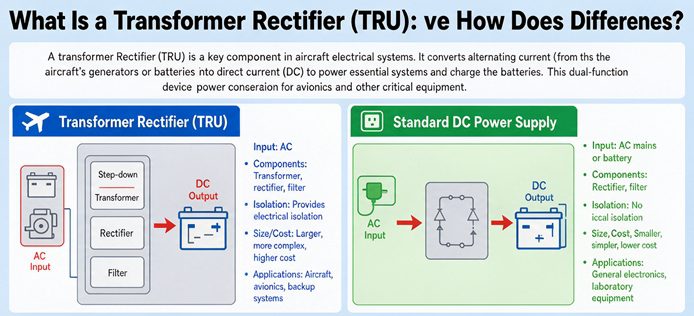
Start with the name. A transformer rectifier is exactly what it sounds like: a transformer and a rectifier bolted together (often in one tank or cabinet) to convert AC into DC as a complete, purpose-built system. The transformer drops the grid voltage and isolates the load; the rectifier — diodes, thyristors (SCRs), or IGBTs — flips the AC into DC; and filtering plus control electronics smooth and regulate it.
How a Transformer Rectifier Works (Three Stages)
- Transform. The incoming AC (often 3-phase 400/415 V, sometimes medium voltage through a step-down transformer) is brought down to the low voltage the process needs.
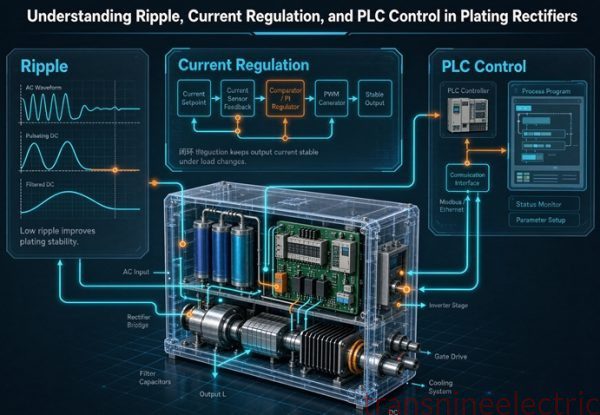
- Rectify. A bridge of semiconductors converts that AC into pulsating DC. Multi-pulse winding designs (12-, 24-, 36-pulse) phase-shift the outputs so harmonics cancel at the source.
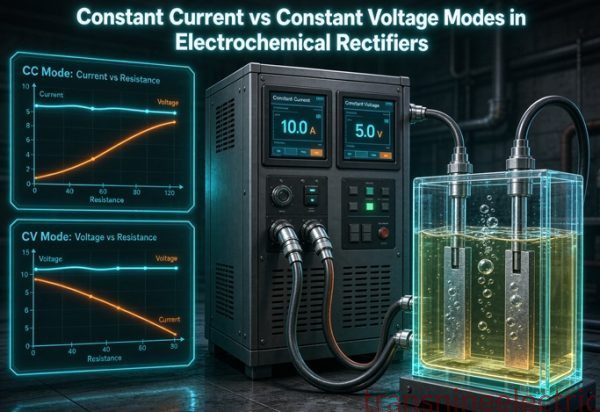
- Filter & regulate. Capacitors and reactors smooth the ripple, and a controller holds the current or voltage the bath or load demands — constant-current for plating, constant-voltage for other loads.
Where You’ll Actually Find Them
- Electroplating & anodizing: 8–24 V DC at hundreds to 10,000+ A. Low ripple matters here — chrome plating is picky.
- Electrolysis & electrowinning: copper, zinc, chlor-alkali, and hydrogen. Currents run into the tens of thousands of amps.
- DC traction: rail and metro substations delivering 750 V or 1,500 V DC.
- HVDC & renewable interconnection: converter stations at the grid scale.
- Cathodic protection (CP): impressed-current systems protecting pipelines and tanks from corrosion.
- Aerospace ground power: 28 V DC GPUs at airports (rugged, −55 to +85 °C rated in some units).
Typical Specs You’ll See Quoted
Output current from about 100 A to over 10,000 A per unit (up to 45,000 A in smelting). Output voltage typically 8–500 V DC, with 750/1,500 V for traction. Efficiency around 90–92% at full load. Ripple often quoted under 5% (under 1% on well-filtered units). Enclosures range from IP20 indoor to IP67 for marine and field use. Relevant standards include IEC 60146 (semiconductor converters), IEC 60076 (transformers), and IEEE 519 for harmonic limits.
What Is a Standard DC Power Supply?
This is the workhorse most engineers know. A standard DC power supply takes AC and outputs a clean, regulated DC voltage. Unlike a bare rectifier — which just gives you rough, rippling DC — a complete supply adds filtering and a regulator so the output stays put when the line voltage or the load changes.
How a Standard DC Supply Works
AC in → transformer (or direct rectification in a switcher) → rectifier bridge → filter capacitor → regulator → stable DC out. A switching supply does this at high frequency for a tiny footprint and high efficiency; a linear supply does it more simply with lower noise but more heat. Either way, the goal is the same: a steady, predictable voltage your gear can trust.
Common Types
- Switching (SMPS): small, efficient (85–95%), the default for control cabinets and electronics. DIN-rail mounts are everywhere.
- Linear: low noise, simple, heavier and warmer — still used where clean power trumps efficiency.
- Bench / lab: adjustable, metered, for test and development.
- Programmable: for automated test and R&D where the voltage/current is set by software.
Typical Specs You’ll See Quoted
Output voltage mostly in the 5–48 V band, with 12 V and 24 V the catalog staples. Current usually up to a few hundred amps; most units sit under 1–2 kW. Ripple is low at the millivolt level (though switchers carry high-frequency noise). Efficiency tracks 85–95%. These are indoor, IP20 devices meant for clean environments.
Transformer Rectifier vs Standard DC Power Supply: 7 Differences That Matter
1. Output Current — This Is the Dealbreaker
A transformer rectifier lives in the hundreds-to-thousands-of-amps world. A standard supply taps out around a few hundred amps. If your process pulls more than a few hundred amps of DC, the standard supply is simply off the table.
2. Voltage Range
Transformer rectifiers cover 8 V (plating) up to 500 V industrial and 1,500 V traction. Standard supplies cluster at 5–48 V. Different voltage neighborhoods entirely.
3. Regulation & Ripple
Both regulate, but for different reasons. The standard supply’s job is precision — ±1% for sensitive electronics. The transformer rectifier’s job is holding a huge current steady into a messy, variable load like a chemical bath, often in constant-current mode. Ripple under 5% (often under 1%) is normal for a TRU; millivolt ripple is normal for a supply.
4. Efficiency & Heat
At full load they’re close, around 90–95%. The gap shows at part load: a TRU’s transformer losses don’t go away when you throttle down, so efficiency sags more. Both dump heat you have to plan for — a TRU far more so, which is why big ones are oil- or water-cooled.
5. Ruggedness & Environment
A transformer rectifier is built to sit in a corrosive plating room, a trackside cabinet, or a saltwater marine environment — IP54 to IP67, wide temperature ratings. A standard supply assumes a clean, indoor panel. Drop a DIN-rail supply into a plating shop and it won’t last the week.
6. Harmonics & Power Quality
Because a TRU feeds a non-linear, pulsed load, harmonic control is designed in: 12-pulse cancels the 5th and 7th harmonics, and higher pulse counts push grid-side THD lower. A standard supply is a small load with active PFC — it barely registers on the grid.
7. Cost, Lead Time & Customization
These aren’t price competitors. A standard 24 V supply is a shelf item — tens to a few hundred dollars, ships in days. A transformer rectifier is engineered to your process: custom windings, cooling, controls, and enclosure, typically a five- or six-figure system with an 8–20 week lead. Judge them on fit, not on price tags.
Which One Should You Buy?
Choose a Transformer Rectifier If…
- You need DC current in the hundreds of amps or more.
- Your load is a chemical/electrochemical process (plating, anodizing, electrolysis).
- You’re feeding DC traction, HVDC, or cathodic protection.
- The environment is harsh, corrosive, or outdoor.
- You have harmonic limits to meet (specify the pulse number).
Choose a Standard DC Power Supply If…
- You need clean, stable low-voltage DC for controls, sensors, or electronics.
- Your current need is under a few hundred amps.
- The unit lives in a clean indoor panel or on a bench.
- You want it now, off the shelf, at commodity pricing.
Quick Decision Checklist
- What DC current does the load draw? → More than ~300 A? Go TRU.
- What DC voltage? → Above ~48 V? Go TRU.
- What’s the environment? → Harsh/corrosive/outdoor? Go TRU.
- Is it a control/electronics load? → Standard supply.
- Do you have harmonic limits (IEEE 519)? → Specify TRU pulse number.
- Do you need it this week? → Standard supply, off the shelf.
Common Mistakes When Specifying
- Buying on price alone. A TRU and a supply solve different problems; the cheap option is usually the wrong one.
- Forgetting ripple. Hard chrome and precision plating care about ripple — confirm it before you order.
- Ignoring pulse number. If the site has harmonic limits, a 6-pulse unit may fail compliance. Ask for 12-pulse or higher.
- Undersizing cooling. A TRU’s losses are real. Match cooling (air/oil/water) to your duty cycle and room.
Bottom Line
A transformer rectifier and a standard DC power supply both turn AC into DC, but they serve completely different worlds. The transformer rectifier is the heavy lifter — engineered, high-current, built for harsh industrial processes from electroplating to traction. The standard DC supply is the precise, compact, off-the-shelf unit that keeps your electronics and controls happy. Get the current, voltage, environment, and harmonic requirements right, and the choice usually makes itself. When in doubt, size by amps first: past a few hundred, you’re in transformer-rectifier country.
Frequently Asked Questions
What is the difference between a transformer rectifier and a DC power supply?
A transformer rectifier is a heavy, engineered AC-to-DC system built for high current (often 100 A to over 10,000 A, up to 45,000 A in smelting) at 8–500 V DC, used in electroplating, anodizing, traction, and HVDC. A standard DC power supply is a compact, regulated unit that delivers clean low-voltage DC (typically 5–48 V) at up to a few hundred amps for electronics, controls, and test benches. Same job on paper — turning AC into DC — but vastly different scale, ruggedness, and price.
Can a standard DC power supply replace a transformer rectifier?
Almost never. A standard supply tops out around a few hundred amps and 1–2 kW. A transformer rectifier routinely delivers thousands of amps at tens of volts for a plating bath or a rail substation. If your load needs more than a few hundred amps of DC, you need a transformer rectifier.
What current can a transformer rectifier deliver?
Industrial transformer rectifiers span roughly 100 A to over 10,000 A on a single unit, with large electrolysis and smelting systems reaching 45,000 A DC. Output voltage is typically 8–24 V for plating and anodizing, up to about 500 V for general industrial DC, and 750 V or 1,500 V for rail traction.
What voltage does a standard DC power supply output?
Most standard DC supplies sit in the 5–48 V range, with 12 V and 24 V the most common for control cabinets and electronics. A few chassis units reach higher, but the catalog sweet spot is low voltage and modest current.
Which is more efficient, a transformer rectifier or a standard DC power supply?
Both are similar at full load — around 90–95%. The difference shows up at part load: a transformer rectifier’s iron and copper losses stay fixed, so efficiency drops more on light loads, while a modern switching supply holds efficiency across a wider range. Either way, plan for heat removal.
What does “multi-pulse” mean for a transformer rectifier?
It refers to how the transformer’s secondary windings are phase-shifted to feed multiple rectifier bridges. A 6-pulse unit is basic; 12-pulse cancels the 5th and 7th harmonics; 18-, 24-, and 36-pulse designs push grid-side THD lower still. If your site has strict harmonic limits (per IEEE 519), pulse number is one of the first things to specify.
How much does a transformer rectifier cost versus a standard DC power supply?
They are different purchase categories, not head-to-head price competitors. A standard DIN-rail 24 V supply is a catalog item costing tens to a few hundred dollars with short lead times. A transformer rectifier is custom-engineered per process — often a five- or six-figure system with an 8–20 week lead time. Compare them on fitness for the job, not sticker price.