Type “transformer manufacturers in Spain” into a search box and you get a Chinese vendor’s brochure dressed up as an article, a gated market report that admits its numbers are synthetic, and a directory that lists 211 “manufacturers” including a door-entry-system maker and a Turkish generator company. Almost none of them tell you the one thing that decides whether a Spanish supplier can serve your project: what voltage the plant on Spanish soil can actually build, and whether the iron was cut there.
Spain is a renewable superpower with an aging grid, and that combination is pulling transformers into a market that grew roughly 20 to 30 percent in price since 2021 while lead times stretched past 18 months for high-voltage units. So this guide does three things the other pages do not. It separates who owns the company from where the iron is cut and the coils are wound, because those are different answers. It puts real numbers on the Spanish grid and the demand engine underneath it, from Red Eléctrica’s transmission voltages to the 76 GW of solar the national plan targets for 2030. And it gives you the regulatory arithmetic, per tonne and per week, so you can tell whether a Spanish quote is a bargain or a trap.
Two numbers to hold while you read. Spain runs somewhere between 15,000 and 18,000 large power transformers across its transmission and distribution network, most of them older than 20 years, and the country buys roughly 60 to 70 percent of its large power transformers as imports. And the plan that is actually driving new orders is not a factory subsidy, it is the national energy and climate target of 76 GW of solar and 62 GW of wind by 2030.
If you are weighing a Spanish or European factory against an overseas one on a specific machine, our complete power transformer buying guide for 2026 works through the specification unit by unit. This page is the wider map: who is in the Spanish market, what each tier can build, and what the rules are.
“Made in Spain” is three different claims
Before the list of names, the vocabulary, because suppliers use these interchangeably and buyers hear one sentence. They are not the same.
Spanish-owned. The group is headquartered in Spain and pays Spanish taxes. Ormazabal is the clearest case: it sits inside Velatia, a family-run Spanish group with a factory map that lists Spain, France, Germany, Poland, Mexico, Brazil and China. Ormazabal’s own Madrid-area plant is rated around 7 GW a year, but the same brand can also mean a unit wound in one of the group’s other countries. A “Spanish manufacturer” from this group may have been designed in Derio and built in Mexico.
Built in Spain. The unit was physically assembled on Spanish soil. This is the only one of the three that tells you anything about logistics, service proximity, and where the labor was. It does not tell you where the core was cut.
Compliant with Spanish and EU rules. CE marking, IEC type tests, PO 12.3 ride-through behavior, UNE-EN 50549 grid-connection conformity. None of these is a claim about where the iron was made. A unit built in Germany or Italy is just as “European” inside the single market as one built in Madrid.
The reason this matters is not nationalism. Spain has no Build-America-Buy-America-style law that forces a supplier to disclose domestic content on a transformer. The United States has four rulebooks that do. Spain and the EU do not, at least not for this product. So the buyer has to ask, and most lists never do. Our IEC versus ANSI/IEEE comparison for export transformers lays out which standards a unit built to European rules actually carries, and why that is different from a North American nameplate.
Who actually builds what voltage in Spain
This is the table the other lists do not build, because it separates the headquarters country from the factory country from the voltage ceiling. Spain’s real domestic strength is medium-voltage distribution and renewable unit transformers. The transmission-class machines, the ones above 72.5 kV, are barely built on Spanish soil at all.
| Company | Ownership / HQ | What they actually build | Voltage and power ceiling |
|---|---|---|---|
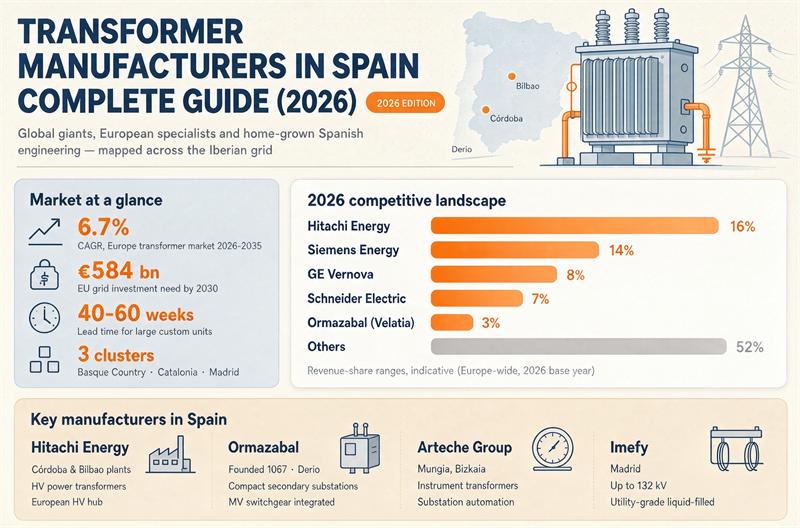
| Ormazabal (Velatia) | Spanish, Derio | Distribution and small power, oil-immersed and dry-type; also specials | 25 kVA to 3,150 kVA at 36 kV; specials to 72.5 kV / 10 MVA |
| Imefy | Spanish, Madrid | Dry-type and oil, custom | To 36 kV, 5 MVA |
| Tesar Spain (Tesar Group, Italy) | Italian-owned, Spanish plant | Cast-resin dry-type | Distribution and MV |
| Ingeteam | Spanish | Renewable unit transformers, oil and dry; also converters | Wind and solar plants |
| Elecnor | Spanish | Custom substations, grid automation, EPC | Project-built, not a catalog supplier |
| Trafomec, Pujol Muntalà, Trafosel, TYCE, T&B, CEMESA, Zucami, IMESA, TECYMACAN | Spanish | Low and medium voltage distribution, industrial OEM supply | Mostly up to 36 kV, standardized |
| Hitachi Energy | Japan, Spanish plants at Córdoba and Bilbao | The real high-voltage power transformer base on Spanish soil | Córdoba is a major European HV transformer site |
| Siemens Gamesa | Spanish (Siemens), Zamudio | Renewable and wind-related | Wind plant scope |
| Indar (WEG Group) | Brazilian-owned, Barcelona | Generators and transformers | Industrial and renewable |
| Arteche | Spanish, Mungia | Instrument transformers only (CTs and VTs) | Measuring and protection, not power transformers |
Read the last row twice. Arteche is one of the most respected names in the Spanish electrical industry, and several “top manufacturers in Spain” lists put it next to Ormazabal as if it builds power transformers. It does not. Arteche builds the current and voltage transformers that measure and protect a substation. That is a different product, a different factory, and a different purchase. If a supplier shortlist for a power transformer includes Arteche, the list was built from a directory, not from a bill of materials.
The honest summary: Spain has real depth in medium-voltage distribution and in the unit transformers that sit inside wind and solar plants. It does not have domestic capacity for the largest transmission ratings. When a Spanish utility needs a 220 kV or 400 kV autotransformer, it is buying from Hitachi Energy’s Córdoba site or from Germany or Italy. Pretending otherwise is how a tender goes wrong.
One niche deserves its own line, because Spain is one of Europe’s wind superpowers and that shapes the local supply base. The unit transformers that sit inside wind turbines and solar plants, the ones rated in the low and medium voltage bands with hardened enclosures and grid-support firmware, are a genuine Spanish specialty. Ingeteam and Siemens Gamesa build into that world, and several of the smaller Spanish names supply wind and solar farms directly. If your project is a renewable plant rather than a transmission substation, the “made in Spain” answer is stronger than it looks, and the lead time is shorter, because this is where the domestic base actually competes.
The grid and what is driving demand
Spain’s transmission grid is run by a single operator, Red Eléctrica de España, or REE. On the peninsula it runs mainly at 400 kV and 220 kV; the Balearic and Canary islands run at 220, 132 and 66 kV. That voltage ladder is the skeleton the whole procurement market hangs on, because every step-up and step-down point is a transformer purchase.
What is actually driving orders is the national plan. The revised National Integrated Energy and Climate Plan, updated in 2024, targets 76 GW of solar photovoltaic capacity and 62 GW of wind by 2030, including 3 GW of offshore wind and 22.5 GW of storage, with the goal that 81 percent of electricity comes from renewables. By mid 2026 renewables were already around 57 percent of generation, with wind near 25 percent and solar PV near 19 percent. The April 2025 blackout that took down the Iberian grid exposed how far the wires have fallen behind the generation, and the response is more transformers, not fewer.
The math is direct. Each gigawatt of new wind or solar typically needs three to five step-up transformers to reach the REE grid. At the planned build-out that is on the order of 80 to 100 large step-up units a year from renewables alone, on top of a replacement baseline of 150 to 200 units a year as the installed base, much of it from the 1990s building boom, reaches end of life.
None of this happens without wires, and the wires are the bottleneck. A 2025 analysis from the Institute for Energy Economics and Financial Analysis noted that REE’s grid capacity grew 92 percent over fifteen years yet still lags the renewables build-out, and the April 2025 Iberian blackout made the weakness impossible to ignore. The European Commission has put the continent’s grid investment need at around 584 billion euros by 2030, and Spain carries its own queues of renewable projects waiting for connection points. Every one of those stalled projects is a transformer order that cannot be placed until the substation that feeds it exists, so the transformer shortage and the grid shortage feed each other.
Our 50 MW solar PV step-up transformer project page shows what one of those connections looks like in practice.
The connection gauntlet
A transformer is only one component of a plant that must pass Spanish grid connection rules, and the transformer specification has to line up with the rest of the system or the whole project fails commissioning.
For a photovoltaic plant above 2 MW, the operating procedure PO 12.3 requires the plant to ride through voltage dips at the point of connection rather than tripping off. That behavior lives mostly in the inverter, but the transformer’s winding and earthing design has to be compatible with it. The plant as a whole needs a Certificate of Conformity issued by an accredited body, a process TÜV Rheinland has run in Spain since 2011. The grid-connection standard for generating units is UNE-EN 50549, and low-voltage installation work falls under the REBT, the Spanish low-voltage regulation.
The practical takeaway for a buyer: ask the supplier whether their unit has been supplied into a PO 12.3 context before, and whether the type tests they offer cover the conformity path your engineering team needs. A unit that passes a generic IEC routine test is not automatically a unit that slides through REE commissioning. The guide to transformer routine testing covers which tests actually matter and which are often quietly skipped.
The point of common coupling is where these rules actually bite. A unit that is electrically sound in the factory but not documented against the conformity path will not commission, and commissioning is exactly where projects slip their dates. For a generating unit the grid-connection standard is UNE-EN 50549, and any low-voltage interface falls under the REBT, the Spanish low-voltage regulation, so the transformer’s terminal and earthing design has to satisfy both the European standard and the national rule at once.
Import dependence: where the units actually come from
Spain is structurally short of transformer capacity, and the numbers show it. The large power transformer segment, units above 72.5 kV, sees annual demand of roughly 350 to 500 units a year at about 350 to 500 million euros, growing 4 to 6 percent annually, and 60 to 70 percent of that is imported. The broader transformer market was about 2.6 billion dollars in 2026, split roughly 46 percent distribution, 34 percent power, and 20 percent specialty and dry-type.
For air-insulated units specifically, domestic production is only about 40 to 55 million euros a year, a third to two-fifths of consumption. Imports run 80 to 105 million euros a year, two-thirds to three-quarters by value. The source mix is instructive: Germany leads at 25 to 30 percent of import value, through Siemens Energy, Trench and SGB-SMIT; Italy supplies 15 to 20 percent through medium-voltage specialists; Turkey has grown to 12 to 18 percent at 15 to 20 percent a year since 2020; China sits at 10 to 15 percent. None of those Turkish or Chinese shares are protected by a quota, and Chinese electrical equipment carries anti-dumping risk that, as of 2026, is not in force for air-insulated transformers but adds uncertainty to any Spanish importer’s plan.
The one hard export figure worth repeating: China shipped about 1.05 billion RMB of transformers to Spain in the first five months of 2024, roughly 130 million euros, equal to 6.3 percent of China’s total transformer exports in that window. Spain was behind only Hong Kong and the United States as a destination. That is the real footprint of the “Chinese manufacturer” angle, and it is already large.
The EU rulebook that lands on your transformer
Two European regulations reach into a Spanish purchase, and neither is optional.
The first is the Ecodesign Regulation, EU 548/2014, whose Tier 2 minimum efficiency applies from 1 July 2021 to large power transformers: those above 3,150 kVA with a highest voltage above 36 kV, or 40 MVA and above regardless of voltage. For a 50 MVA unit the minimum peak-efficiency index floor is 99.734 percent. Run the published loss data for sixteen 110 kV sheets through the simple formula, peak efficiency index equals one minus two times the square root of no-load loss times load loss divided by rated power, and six of them fall below the floor. The gap is in the third decimal place. Closing it at the design stage is cheap; closing it after delivery is not. If your project specifies Tier 2 and the supplier never names the efficiency class, assume the unit is Tier 1 and will be rejected at the border of your own specification.
The second is more recent and sharper. Commission Implementing Regulation (EU) 2026/2133, published on 18 September 2026 and effective from 25 September 2026 for 155 days to 26 February 2027, puts a duty of 1,140 euros per tonne on the grain-oriented electrical steel core, and it reaches cores already built into finished transformers under CN codes 8504 21 through 8504 34. There is no quota for this one. The decisive date is the customs clearance date, not the purchase order date, so a unit ordered before the regulation and cleared after it still pays. The prior anti-dumping duty from 2022/58 does not stack, because the safeguard rate is higher. On a typical Spanish-made or Spanish-imported distribution unit the core weighs half a tonne to two tonnes, so the levy is 570 to 2,280 euros; on a large power unit with a 20-tonne core it is 22,800 euros. Against a real European price anchor that is roughly 3 to 8 percent of the unit, not enough to flip a decision on its own but enough to flip a bid that wins or loses on two points of margin.
Separately, from 1 October 2026 imported steel must declare its melt-and-pour country, with a mill test certificate that carries the melt country and heat number under the new TARIC codes. A supplier who cannot produce a furnace number is not your problem in the abstract. They are your problem at the Spanish border.
Lead times and the testing bottleneck
Lead times in Spain track the European pattern but with a local twist. A standard catalogue distribution unit runs 12 to 20 weeks. A custom medium-power unit, one to 100 MVA, runs 40 to 60 weeks. A large power transformer at or above 100 MVA runs 78 to 104 weeks. A generator step-up or phase-shifting unit on a project runs 104 to 156 weeks. High-voltage units are consistently over 18 months.
The local twist is testing. Spain’s own high-voltage test capacity is thin, limited to a few facilities such as the high-voltage laboratory at the University of the Basque Country and private labs around Barcelona. Large units are routinely sent to Germany or Italy for type testing, which adds four to eight weeks to the production cycle. Skilled winding labor is short, especially for units above 72.5 kV, and the specialized foil and litz winding machinery comes from Germany and Italy with its own six-to-twelve-month lead time. Spain’s industrial decarbonization plan, the Perte de Descarbonización Industrial, includes provisions to strengthen domestic transformer manufacturing, but the people writing the market reports agree that tangible new capacity does not arrive before 2028 or 2029. Until then the constraint is not money, it is the single European mill that makes the grain-oriented steel and the handful of facilities that can type-test a high-voltage unit. A Spanish purchase competes for those same inputs as a German or Italian one, which is why the lead-time story is a European story wearing a Spanish flag.
One number from the raw-material side worth keeping: China’s country quota for the grain-oriented steel that feeds this market covers on the order of half of the expected flow over a 155-day window, so the back half of that window is where allocation risk concentrates. The single European mill that can make the steel has the queue, not the buyer.
Prices: what the numbers really say
The Spanish market was about 2.6 billion dollars in 2026, and the direction of travel matters more than the level. Prices are up 20 to 30 percent since 2021 on copper, electrical steel and insulation oil, and the euro has moved against the buyer. Landed cost inside Spain stacks the unit price, 21 percent VAT on imports, freight, and, where it applies, the 1,140 euro-per-tonne core levy.
For a standard oil distribution unit at low rating, Spanish and broader European supply already overlaps heavily with central and eastern European plants, and a Spanish premium mostly buys service proximity and short freight, not a different machine. For transmission-class units Spain cannot supply domestically anyway, so the premium question does not arise; import is the only path. Per-kVA price ladders that work cleanly in the US distribution segment do not translate to Spain, because the Spanish mix is bimodal, a flood of cheap distribution units at one end and imported high-voltage units at the other. Treat any published per-kVA anchor as a shape, not a quote.
The channel tells you where the shelf price lives. For standardized low and medium voltage dry-type units up to 36 kV, the route runs through electrical wholesalers such as Sonepar España, Rexel Spain and Electro Stocks, which keep regional warehouses and stock units from 50 kVA to 1,000 kVA with two-to-four-week delivery. Distributor margins run 15 to 25 percent with volume rebates on annual agreements. Above that, and certainly above 72.5 kV, you are in direct-sales project territory where the Spanish part of the price is service and a firm slot, not the shelf. The Spanish premium on a standard unit mostly buys a shorter truck ride and a local phone number, which is worth real money on a job with a hard commissioning date and no slack.
How to verify a “Spanish” supplier
Six questions, and a supplier who answers all six in writing is a supplier you can actually plan around.
- Where is the core cut and annealed, and can you show the mill certificate with melt country and heat number?
- Where are the coils wound and the unit dried, and is the drying oven on Spanish soil?
- Where is the tank welded, the unit filled, and final tested?
- Which edition of IEC 60076 does the type test report cite, and who issued it?
- What efficiency class does the unit meet under EU 548/2014, Tier 1 or Tier 2, and is it named on the quote?
- Who services the unit in Spain and within what response time, and is the slot firm or indicative?
Four ways this goes wrong in practice. A group name hides a plant in another country, so the brand is Spanish and the unit is not. The efficiency class is never named, so the machine arrives Tier 1 and unsellable on a Tier 2 project. The core weight is never declared, so customs assesses it on their own reading and the importer pays the difference. The slot is quoted ex works and not firm, and at 18 to 24 months a non-firm slot is not a quotation.
When you should not insist on Spanish-made
The flag on the nameplate is the least important variable on most jobs. For a standard distribution unit at low rating, a Spanish premium buys you a shorter truck ride and a local phone number, and central and eastern European supply already holds a large share of installed units. For any unit inside the EU single market, a German or Italian machine is just as European as a Spanish one, and free movement means the “Spanish” requirement often adds cost without adding compliance. For transmission-class units Spain cannot build domestically, so insisting on Spanish-made is simply impossible. The variables that actually move the outcome are TSO prequalification where it applies, service proximity you can count on, and a firm slot you can build a schedule around.
FAQ
Who are the largest transformer manufacturers in Spain? Ormazabal, inside the Velatia group, is the largest Spanish-owned name, with a Madrid-area plant rated around 7 GW a year and more than 250,000 units in service. For high-voltage power transformers the largest presence on Spanish soil is Hitachi Energy at Córdoba and Bilbao. Arteche, often listed alongside them, builds instrument transformers, not power transformers.
Is Arteche a power transformer manufacturer? No. Arteche builds current and voltage transformers for measurement and protection. It does not build power transformers. Any list that puts it next to Ormazabal as a power transformer supplier was built from a directory, not a bill of materials.
What voltage classes does the Spanish grid use? REE runs the peninsula mainly at 400 kV and 220 kV, with 132 kV, 66 kV, 30 kV, 20 kV, 15 kV and 6.6 kV stepping down to 400 V. The islands use 220, 132 and 66 kV.
How much transformer capacity does Spain actually have domestically? For air-insulated units domestic production is about 40 to 55 million euros a year, a third to two-fifths of consumption. For large power transformers above 72.5 kV, 60 to 70 percent is imported, and the transmission-class ratings are supplied by Hitachi Energy’s Córdoba site or by Germany and Italy.
What is driving transformer demand in Spain? The revised National Integrated Energy and Climate Plan targets 76 GW of solar and 62 GW of wind by 2030, plus 22.5 GW of storage, with 81 percent of electricity from renewables. Each gigawatt of new wind or solar needs three to five step-up transformers, on the order of 80 to 100 large units a year from renewables alone.
What are PO 12.3 and the REE Certificate of Conformity? PO 12.3 requires photovoltaic plants above 2 MW to ride through voltage dips at the point of connection. The plant needs a Certificate of Conformity from an accredited body for grid connection, a process TÜV Rheinland has run in Spain since 2011. The transformer is one component and its design must line up with the rest of the system.
Do EU efficiency rules apply to transformers bought in Spain? Yes. Ecodesign Regulation EU 548/2014 sets a Tier 2 minimum peak-efficiency index for large power transformers from 1 July 2021. A 50 MVA unit must reach 99.734 percent. Several published data sheets fall below the floor, so the efficiency class has to be named on the quote.
What is the 2026 core levy and does it hit Spain? Commission Implementing Regulation (EU) 2026/2133 puts 1,140 euros per tonne on the grain-oriented steel core, reaches cores already built into finished transformers, has no quota, and uses the customs clearance date as the trigger. It took effect on 25 September 2026 for 155 days and applies to imports into Spain like anywhere else in the EU.
What are lead times for transformers in Spain in 2026? Standard distribution units run 12 to 20 weeks. Custom medium-power units run 40 to 60 weeks. Large power transformers at or above 100 MVA run 78 to 104 weeks, and generator step-up or phase-shifting units run 104 to 156 weeks. High-voltage units are consistently over 18 months.
Why are Spanish transformer lead times so long? Spain’s own high-voltage test capacity is thin, so large units go to Germany or Italy for type testing, adding four to eight weeks. Skilled winding labor is short above 72.5 kV, and the winding machinery comes from Germany and Italy with a six-to-twelve-month lead time.
Does Spain make its own grain-oriented electrical steel? No. Europe has a single domestic mill for it, and Spain imports. China’s country quota for the steel covers about half of the expected flow over a 155-day window, so allocation risk concentrates in the back half of that window.
Should I insist on a Spanish-made transformer? Only if TSO prequalification, service proximity, or a firm slot requires it. For standard distribution units a Spanish premium mostly buys a shorter truck ride. For transmission-class units Spain cannot supply domestically, so import is the only path. Decide on prequalification and a firm slot, not on the flag on the nameplate.