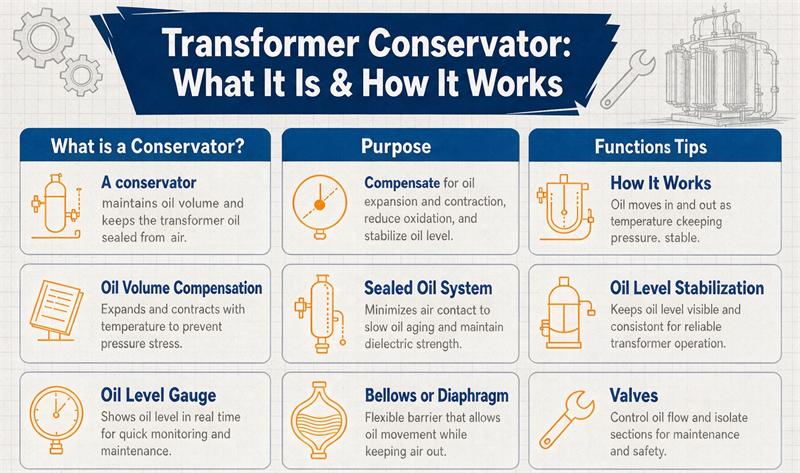
A transformer conservator is an expansion tank fixed above the main tank. It catches the insulating oil as the liquid heats and swells, then sends that oil back down as the unit cools. That simple buffer keeps the transformer full, holds pressure steady, and keeps air and moisture away from the oil.
Every oil immersed transformer lives with the same physics. The oil inside expands when the unit works hard or sits in hot weather, and it shrinks when the load drops or the air turns cold. A rigid, completely full tank cannot absorb that swing. Pressure climbs, seals strain, and the winding insulation gets exposed to air. The conservator is the low tech answer that has worked for well over a century. This guide explains what a conservator is, how it breathes, the main designs on the market, how to size one, and what a buyer should check before signing a purchase order.
How a Conservator Works: The Breathing Cycle
Picture the conservator as a small spare tank riding on top of the transformer. The two are joined by a pipe, often routed through a Buchholz relay. Here is the cycle in plain terms.
When the transformer runs hot, the oil expands. The surplus flows up the pipe and fills the conservator. When the unit cools, the oil contracts and gravity pulls it back into the main tank. The main tank never sees an empty space, so the windings and core stay submerged.
The top of the conservator breathes. In a basic design, outside air moves in and out through a silica gel breather. When oil drops, dry air enters. When oil rises, damp air gets pushed out, and the gel traps the moisture on the way in. On better units a rubber bladder or a steel diaphragm sits between the oil and that air, so the oil barely touches the atmosphere at all.
That is the whole trick. Give the oil somewhere to go, keep the main tank full, and filter the air that does come near it.
Conservator Type vs Sealed Transformer
Buyers often ask which is better. The honest answer is that they solve the same problem two different ways, and the right pick depends on voltage, rating, and how often someone can visit the site.
| Factor | Conservator type | Sealed type |
|---|---|---|
| How it handles expansion | Separate expansion tank above the main tank | Flexible tank wall, corrugated fins, or a nitrogen cushion inside the tank |
| Air contact | Small surface through a breather; near zero with a bladder or diaphragm | None in normal operation |
| Moisture ingress risk | Low, rises if the breather or bladder fails | Very low |
| Oil ageing rate | Slower than open, faster than sealed | Slowest, no oxygen exposure |
| Typical voltage range | Medium voltage up to transmission class | Usually up to about 36 kV |
| Maintenance | Breather gel, oil level, and gasket checks on a schedule | Minimal, but a slow nitrogen or bellows leak is hard to see |
| Dissolved gas analysis | Easy, sampled straight from the conservator | Limited sensor access |
Choose the conservator design when the rating is large, the voltage is high, or dissolved gas analysis is part of your maintenance plan. Choose the sealed design for small to medium units below about 36 kV, especially on unattended or hard to reach sites. Both still need a pressure relief device and protection against through faults to IEC 60076-5.
The Main Types of Conservator Tank
Most tanks on the market fall into five designs. The sealing method is what separates them, and sealing is the single biggest driver of oil life.
| Type | Sealing method | Best use |
|---|---|---|
| Open or free breathing | Oil surface open to air through a silica gel breather | Legacy and low cost distribution units, now rare on new HV builds |
| Diaphragm | Flexible rubber or fabric membrane splits oil from air | Sealed oil preservation systems |
| Bladder or air cell (capsule) | Inflatable bag holds the air side apart from the oil | Mid to large units above about 5 MVA |
| Metal bellows or corrugated | Welded steel bellows flex with volume, fully sealed | Modern sealed transformers, remote stations |
| Nitrogen blanket | Inert gas sits above the oil, no oxygen | Large power units where oxidation control matters most |
The corrugated steel design has become the default on newer sealed units because it has no soft parts to crack and it handles more than 20,000 expansion cycles. The bladder and diaphragm designs are still common, but they depend on a flexible part that ages, so they need inspection.
Sizing a Conservator: The 8 to 10 Percent Rule
A conservator is not a random drum on the roof. Its volume tracks the total oil in the transformer and the temperature swing the site will see.
The common rule of thumb is to size the conservator at 8 to 10 percent of the transformer’s total oil volume. A unit holding 10,000 liters of oil wants a conservator in the 800 to 1,000 liter range. Cold climates and big daily temperature swings push you toward the top of that band, because the oil shrinks further when it is cold and expands more when it is hot. A desert site with a 50 degree Celsius day to night swing needs more reserve than a steady indoor unit.
Two practical checks matter more than the percentage alone. First, confirm the conservator never runs dry at the lowest expected oil temperature, or the main tank could draw in air. Second, confirm it never overflows at the highest temperature, or oil ends up on the ground. Your supplier should confirm both against the named minimum and maximum oil temperatures, not just a generic ratio.
Conclusion
A conservator is a humble part with an outsized job. It gives the oil room to breathe, keeps the main tank full, and shields the dielectric from air and water, which is why oil immersed transformers of every size still rely on it. Pick the design by voltage, rating, and how often the site gets a visit. Size it at roughly 8 to 10 percent of the oil volume, confirm the dry and full limits against your real temperatures, and put the breather, gauge, and Buchholz connection on the spec. Service it on a simple cadence and it will repay you with a longer, quieter life.
TransNin Electric builds oil immersed units with conservators matched to the tank, and our completed transformer projects show the same approach running in the field. Browse the transformer product range to see standard and custom builds, or open the technical buying guides for the cooling, nameplate, and standards detail that backs up this checklist.
Frequently Asked Questions
What is a transformer conservator?
A transformer conservator is an expansion tank mounted above the main tank. It stores insulating oil as the liquid expands with heat and returns it as the unit cools, keeping the main tank full and limiting air contact with the oil.
How does a conservator tank work?
Hot oil expands and flows up a pipe into the conservator. Cool oil contracts and flows back down by gravity. Air moves in and out through a silica gel breather, and on sealed units a bladder or diaphragm keeps that air away from the oil.
What is the difference between a conservator and a sealed transformer?
A conservator transformer uses a separate expansion tank above the main tank and breathes through a filtered vent. A sealed transformer has no conservator and absorbs oil expansion inside the tank through flexible walls, corrugated fins, or a nitrogen cushion, with no air exchange in normal operation.
What are the main types of conservator tanks?
The five common types are open or free breathing, diaphragm, bladder or air cell, metal bellows or corrugated, and nitrogen blanket. They differ mainly in how tightly they seal the oil from the air, which drives oil life and maintenance needs.
How big should a conservator be?
A practical rule sizes the conservator at 8 to 10 percent of the transformer’s total oil volume. A 10,000 liter oil fill needs roughly an 800 to 1,000 liter conservator, with more reserve for wide temperature swings.
Why is a silica gel breather used with a conservator?
The breather dries the air that enters the conservator as oil cools and contracts. The blue gel turns pink when it is spent, which is the visual cue to regenerate or replace it before moisture reaches the oil.
How often should a conservator be inspected?
Check the silica gel breather every 3 to 6 months, read the oil level on each routine walk, and pull a dissolved gas analysis at least once a year or after any fault. Gasket and weld leaks should be checked during the same visits.
What causes conservator oil leaks?
Leaks come from aged or poorly torqued gaskets, weld defects, overpressure that the relief device did not catch, and physical damage during transport or handling. Regular visual checks find most leaks long before they cause an outage.