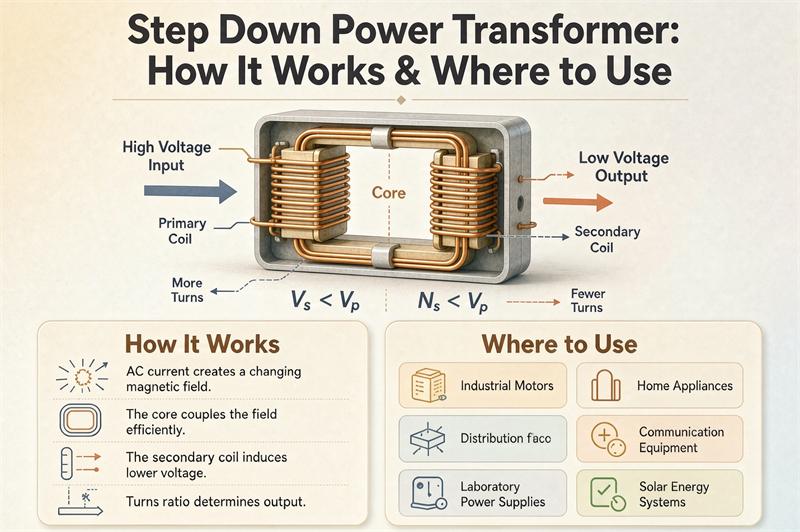
A step-down power transformer lowers a high input voltage to a lower output voltage for safe distribution and end use. It does this by winding fewer turns on the secondary side than the primary side, so the turns ratio sets the exact reduction (Vp/Vs = Np/Ns), while the frequency stays the same and the apparent power is, minus losses, conserved.
That one sentence is the whole device in a nutshell. The rest of this guide shows you the physics in plain language, walks through a real number example you can check yourself, tells you exactly where these units belong, and gives you a spec checklist with actual figures so you can talk to a supplier without getting lost in jargon. We build these every day at TransNine Electric, and the goal here is to make the buying decision feel straightforward rather than mysterious.
Here is the quick map of what a step-down transformer does inside the grid, because “where it is used” is really just “which voltage pair it bridges”:
| Stage in the grid | Incoming voltage | Outgoing voltage | What the unit is called |
|---|---|---|---|
| Transmission substation | 132 kV – 400 kV | 66 kV – 132 kV | Power transformer (step-down) |
| Distribution substation | 33 kV – 66 kV | 11 kV – 20 kV | Power / sub-transmission transformer |
| End-user / plant | 11 kV – 20 kV | 400 V / 480 V | Distribution transformer |
How a step-down transformer actually works
Skip the heavy math for a second and picture the physical thing. Inside the tank or resin body there is a steel core and two (or more) coils of wire wrapped around it. High-voltage AC enters the first coil, the primary. Because the current keeps changing direction, it creates a changing magnetic field in the core. That moving field crosses the second coil, the secondary, and pushes a voltage out of it. No metal connects the two coils. The energy jumps across as a magnetic field, which is why a transformer only works on AC and why it never changes the frequency.
The trick that makes it “step down” is simple: the secondary coil has fewer turns of wire than the primary. More turns on the input, fewer on the output, means less voltage comes out than went in. Wind ten times as many turns on the primary as the secondary and you get roughly one-tenth of the voltage out. That is the entire secret. Everything else, the oil, the cooling fins, the bushings, the tap changer, is there to keep that core and those coils cool, insulated, and safe while they do that one job.
The turns ratio, with a number you can verify
This is the part most pages skip, and it is the part that actually builds trust. The governing relationship is:
Vp / Vs = Np / Ns
Read it as: primary voltage over secondary voltage equals primary turns over secondary turns. Let’s run a real example instead of hand-waving.
Say you have a distribution transformer with a primary of 11,000 V and you want 400 V out. The ratio is 11,000 / 400 = 27.5. So for every 27.5 turns on the primary, you need 1 turn on the secondary. If the primary is wound with 1,100 turns, the secondary is 1,100 / 27.5 = 40 turns. You can flip that check: 1,100 turns on the primary, 40 on the secondary, and 11,000 / 400 gives you back the same 27.5 ratio. The numbers close, which is the point. A real design also accounts for the small voltage drop under load, but the ratio math is what sizes the windings.
| Quantity | Primary (HV) | Secondary (LV) |
|---|---|---|
| Rated voltage | 11,000 V | 400 V |
| Turns | 1,100 | 40 |
| Current at 100 kVA load (single-phase) | about 9.1 A | about 250 A |
Notice the current row. Power is roughly voltage times current, so when voltage drops by 27.5 times, current rises by about the same factor. That is why the low-voltage winding uses much thicker wire and why your cables and protection on the secondary side are sized for a bigger current than the primary. (For three-phase units, divide those currents by the square root of 3, about 1.732, but the 27.5 ratio between primary and secondary current still holds.)
Step-up or step-down is just the direction of power
A common worry is “did I buy the wrong one, I needed step-down but this looks like a step-up unit.” Here is the calming fact: a two-winding transformer is electrically reversible. The same iron and copper that steps 11 kV down to 400 V will step 400 V up to 11 kV if you feed it from the other side. The only real difference between a “step-up” and a “step-down” label is which winding you call the primary.
That said, do not just flip a unit in the field. Before you run one in reverse, check the nameplate for insulation class, cooling rating, and the tested voltage on each winding. A winding rated and insulated for 11 kV on one side may not be happy as the high-voltage side if the original design only qualified it for the lower duty. Reversibility is a property of the physics; whether your specific unit is cleared for it is a nameplate question.
The types you will actually choose between
“Step-down” describes what the transformer does, not what it is made of. The build type is what decides where it can live:
- Oil-immersed. The core and coils sit in a tank of insulating mineral or ester oil. Great cooling, long life, and the cheapest way to build big capacity. This is the default for outdoor substations, plants, and renewable sites.
- Dry-type (cast resin or VPI). No liquid. Fire-safe and low maintenance, so it goes indoors, in hospitals, data centers, offices, and underground rooms where a leak or fire would be a disaster.
- Pad-mounted. An oil unit in a locked, ground-level enclosure for neighborhood and commercial distribution where the public might walk past.
- Pole-mounted. A small distribution unit up on a utility pole for rural and residential drops.
- Special (k-rated, furnace, rectifier). Built for nasty loads: harmonics, short circuits, DC conversion. You only spec these when a standard unit would cook.
So the “where to use” question is really an environment question. Use this decision aid:
| If your site is… | Pick | Why |
|---|---|---|
| Indoor, fire-sensitive (hospital, data center, office) | Dry-type | No flammable oil, low upkeep |
| Outdoor, high capacity, utility or substation | Oil-immersed | Best cooling, longer life, cheaper at scale |
| Street or neighborhood distribution | Pad-mounted or pole-mounted | Safe public access, compact |
| Harsh or heavy industry (mining, steel) | Oil or k-rated special | Rugged, cooling headroom |
If you are weighing the two big contenders side by side, our oil-immersed vs dry-type comparison lays out the trade-offs with numbers.
Where step-down transformers are used
Once you know it just bridges a voltage pair, the application list writes itself:
- Grid and utility substations. The big units that take transmission voltage down to the levels feeding towns and industrial parks.
- Industrial plants. Taking 11 kV or 33 kV down to the 400 V / 480 V that runs motors, lines, and automation.
- Commercial buildings and data centers. Dry-type units in vaults stepping 11 kV or 13.8 kV down to 400 V / 480 V for servers and HVAC.
- Renewables. Solar and wind farms step their medium-voltage collection up to the grid, but the balance-of-system and auxiliary supplies still rely on step-down units for local power.
- EV charging hubs. Fast chargers need medium-voltage service stepped down to the levels their converters eat.
- Rail and transit. Traction substations and the auxiliary supplies that keep stations lit.
See the kind of units we have actually shipped in our project portfolio.
How to specify one: the buyer’s checklist with figures
This is the part that saves you from a costly mismatch. When you ask a supplier for a quote, these are the numbers you need to name:
- Rated power: in kVA for distribution sizes and MVA for sub-transmission. Step-down power units span roughly 25 kVA up to several hundred MVA.
- Primary and secondary voltage: such as 33 kV / 11 kV, 11 kV / 400 V, or 13.8 kV / 480 V. State the exact pair.
- Impedance: typically 4 to 6 percent for distribution, rising to 6 to 10 percent for larger units. It sets fault current and voltage drop, so do not leave it blank.
- Temperature rise: common winding-rise classes are 65 °C (55 °C average) and 80 °C (65 °C average) per IEEE/ANSI; IEC uses insulation classes A, E, B, F, H.
- BIL (basic insulation level): for example about 95 kV BIL for the 11 kV class and about 200 kV BIL for 33 kV, set by your system’s surge duty.
- Tap changer: off-load ±2 × 2.5 percent is standard; for live voltage regulation ask for an on-load tap changer (OLTC) with roughly ±10 percent in 1.25 or 1.67 percent steps.
- Cooling class: ONAN (natural) or ONAF / OFAF (forced) for oil units; AN or AF for dry-type.
- Enclosure: IP23 or IP54, or NEMA 3R outdoors.
- Standard: IEC 60076 for most of the world; IEEE C57.12.00 (liquid) and C57.12.01 (dry) for North America. Name the edition your authority requires.
Browse the product range to see how these ratings show up on real units.
Efficiency and the 30-year cost
A transformer is cheap to buy and expensive to run. The losses, tiny as a percentage, compound over a 20 to 30 year life and usually dwarf the purchase price. There are two loss numbers on every nameplate: no-load loss (P0), which is there whenever the unit is energized, and load loss (Pk), which grows with the square of the load. U.S. distribution units have had federal efficiency floors under DOE 10 CFR Part 431 since the 2016 and 2019 compliance dates, so a new unit already meets a baseline, but the gap between a standard and a low-loss design still pays back.
If you want to see the money, our transformer loss and TCO calculator turns P0, Pk, your load profile, and energy price into annual loss cost and 30-year present value. It is the fastest way to justify spending a little more up front for a lower-loss core.
A note for U.S. buyers: NEC compliance
If the unit lands in the United States, the National Electrical Code rides along. A few items that actually change the bill of materials:
- Overcurrent protection, NEC 450.3(B). The primary protective device is sized at 125 percent of the transformer’s rated current, then rounded up to the next standard rating in NEC 240.6(A).
- Standard ratings, NEC 240.6(A). Protection and conductors step through defined values (800, 1000, 1200, 1600, 2000 A and so on); there is no “in-between” size.
- Working space, NEC 110.26. The unit needs clearances to live, and that drives layout and enclosure choice before you ever bolt it down.
Our NEC transformer calculator sizes the protective device and checks the conductor against the standard ratings for you, so the quote you send to the AHJ is already defensible.
Single-phase or three-phase
For anything past a few kVA, you want three-phase: it is the language of commercial and industrial power, and it moves more power through less copper. Single-phase step-down units are for small loads, residential drops, and control power. One thing buyers mix up: the kVA rating is the same whether the unit steps up or down, because kVA is just apparent power. Direction is a wiring choice, not a different size.
For deeper background, our resources library covers standards, nameplate reading, and cooling classes in separate guides.
Wrapping up
A step-down power transformer is a quiet, reversible device that trades voltage for current through a fixed turns ratio, and it is the link that lets high-voltage grids feed safe, usable power to plants, buildings, and homes. Pick the build type by environment (dry indoors, oil outdoors, pad or pole for distribution), name the voltages and kVA, and do not forget impedance, temperature rise, BIL, and the standard your authority enforces. Run the efficiency and NEC numbers before you buy, because the cheap unit is rarely the cheap choice over 30 years. If you want a unit specced to your exact pair of voltages and site, that is what we do, and the fastest next step is to send us the primary voltage, secondary voltage, and kVA you need.
FAQ
What is a step-down power transformer in one sentence? It is a transformer that reduces a higher input voltage to a lower output voltage by using fewer turns on its secondary winding than its primary, keeping the frequency unchanged.
What is the formula for a step-down transformer? The turns ratio: Vp / Vs = Np / Ns, where V is voltage and N is the number of winding turns. Divide primary voltage by secondary voltage to get the ratio, then apply it to the turns.
How do I calculate the secondary turns? Take the voltage ratio and apply it to the windings. Example: 11,000 V primary, 400 V secondary gives a 27.5 ratio. With 1,100 primary turns, the secondary is 1,100 / 27.5 = 40 turns.
Does a step-down transformer increase the current? Yes. Because power is roughly voltage times current, cutting voltage by a factor raises current by about the same factor. In the example above, 100 kVA single-phase draws about 9.1 A at 11 kV but about 250 A at 400 V.
Can a step-down transformer be run as a step-up unit? In principle yes, because a two-winding transformer is electrically reversible. In practice, confirm the nameplate insulation class, cooling rating, and tested voltage on each winding before reversing it, since not every unit is cleared for both directions.
What is the difference between a step-down and a distribution transformer? A distribution transformer is a step-down unit at the end of the chain, taking medium voltage (for example 11 kV) down to utilization voltage (400 V or 480 V). A “step-down power transformer” can also sit earlier, at sub-transmission levels, stepping 132 kV down to 33 kV.
How do I choose oil-immersed versus dry-type? Choose dry-type for indoor or fire-sensitive sites such as hospitals, data centers, and offices. Choose oil-immersed for outdoor, high-capacity, or utility and industrial sites where cooling and cost at scale matter more than fire risk.
What standards apply to step-down transformers for export? Most of the world uses IEC 60076. North America uses IEEE C57.12.00 for liquid-immersed and C57.12.01 for dry-type units. Confirm the required edition, BIL, impedance, and temperature-rise class with your local authority having jurisdiction.