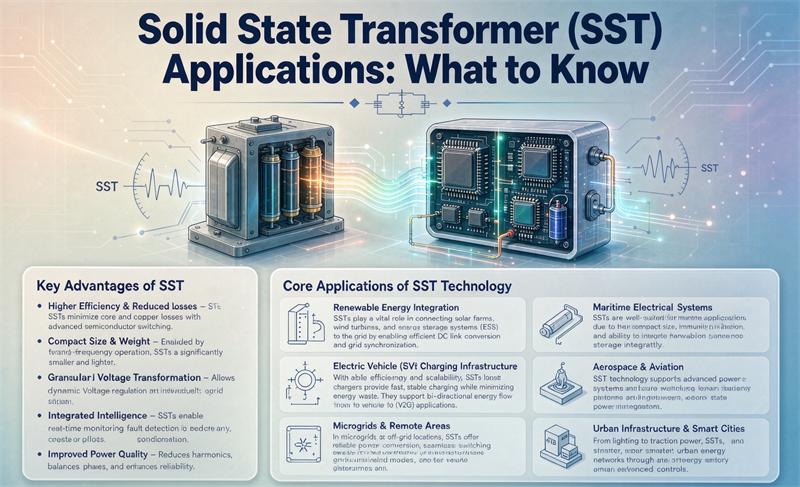
A solid-state transformer (SST), also called a power electronic transformer, uses power semiconductors and a high-frequency isolation stage to convert voltage, shape power quality, and route AC or DC power in one box. You will want one where a project needs direct medium-voltage-to-DC conversion, tight voltage control, or bidirectional flow that a conventional line-frequency transformer cannot deliver.
This guide is written for the person actually placing the order: an EPC estimator, a data centre owner, a utility planner, or an EV charging operator. We at TransNine Electric build conventional units across every voltage tier, so this is not a sales pitch for SSTs. It is a straight answer to what they are, where they fit, and where they still do not.
What a Solid-State Transformer Actually Is
A conventional transformer is a passive piece of iron and copper. It changes voltage by electromagnetic induction at 50 or 60 Hz and that is all it does. An SST adds power-electronic conversion stages in front of (or instead of) the magnetic core. Most designs run three stages:
- An AC to DC rectifier on the input side, often straight off medium voltage.
- A high-frequency isolated DC to DC converter, typically switching in the range of 10 kHz up to 100 kHz plus, which does the actual voltage scaling and isolation.
- A DC to AC or DC output stage, depending on whether the load wants AC, DC, or both.
Because the isolation happens at high frequency, the magnetic part shrinks dramatically. The box also gains a brain: it can regulate voltage in milliseconds, filter harmonics, compensate reactive power, and reverse power flow on command.
How It Differs From a Conventional Transformer
| Feature | Conventional transformer | Solid-state transformer (SST) |
|---|---|---|
| Core technology | 50/60 Hz magnetic | Power electronics plus high-frequency isolation |
| Voltage regulation | Tap changer or external gear | Electronic, millisecond-level |
| AC/DC integration | Needs separate converters | Built in |
| Power flow | One direction | Active, bidirectional by design |
| Size and weight | Bulky | Roughly 1/3 to 1/5 of conventional |
| Maturity | Worldwide, proven, serviced | Emerging, demos and early commercial |
| Best fit | Reliable MV/LV transformation | Integrated conversion and control |
The short version: a conventional transformer is a passive conduit. An SST is an active power interface, sometimes described as an energy router.
The Main SST Applications
SSTs earn their keep wherever you would otherwise need several conversion boxes bolted together. Here are the applications buyers are actually asking about in 2026.
AI and Hyperscale Data Centers
This is the headline use case. High-density compute wants DC at the rack, and the industry is moving toward 800 V DC bus architectures. NVIDIA has identified SST-based supply as the final solution for next-generation AI data centres, able to take 10 kV medium-voltage AC and step it straight down to 800 V DC. That removes two or three separate conversion stages and trims conversion loss by several points. For a 100 MW hall, even a single point of efficiency is millions in annual power cost. Our data center transformer solutions package the more conventional MV and LV drops today, and we track SST adoption closely as the architecture matures.
Ultra-Fast EV Charging (Above 1 MW)
Megawatt-class charging hubs need to pull large power from the distribution network and deliver it as DC at the gun. An SST can connect at medium voltage and do the AC to DC conversion internally, supporting multi-gun parallel sharing and future higher-power demands. Pilot bus-charging sites in China reported cutting charge time by more than a third versus conventional setups. The compact footprint also helps in land-tight urban sites.
Renewable Energy and Battery Storage
Solar and batteries are DC native. Conventional line-frequency gear cannot handle bidirectional flow cleanly. An SST carries a built-in DC bus, so PV and storage plug in through DC to DC conversion with no extra inversion stage. That raises on-site self-consumption and smooths output fluctuation with millisecond response. A 200 MW PV-plus-storage project using SST architecture was reported to cut annual electricity cost by over RMB 10 million versus traditional multi-stage conversion.
Microgrids and AC/DC Hybrid Grids
In a hybrid microgrid, the SST acts as the interconnection node between the AC utility feed and the DC microgrid. It decouples the two, controls power flow both ways, and supports direct green-power connection. For zero-carbon parks and islanded sites, that flexibility is the whole point.
Rail Traction
On trains, weight is paid for in energy. An SST-based traction supply or on-board converter can cut the mass of the conventional transformer dramatically and lower train energy use. Several Chinese metro and high-speed programmes are piloting exactly this.
Industrial and Zero-Carbon Parks
Factories with mixed AC and DC loads, on-site PV, and storage can use an SST as the single conversion hub. One documented production-line deployment reported a 2 point efficiency gain and about RMB 20 million in annual electricity savings. The economics start to work once you would otherwise stack multiple converters.
SST vs Conventional Transformer: When Each Makes Sense
SSTs are not a drop-in replacement for distribution transformers, and anyone who tells you otherwise is selling something. The honest comparison comes down to system value, not single-device efficiency.
The Numbers That Matter
- Equipment efficiency: conventional transformers already hit about 98 to 99 percent at nameplate. SST end-to-end efficiency lands around 98 to 98.5 percent. The win is system-level, not device-level.
- Footprint: SST volume and weight run about 1/3 to 1/5 of a conventional unit, with some vendors citing 20 to 30 percent smaller and 40 to 60 percent smaller in specific models.
- Cost and complexity: SST capital cost is higher, cooling and protection are more complex, and the service ecosystem is thin.
- Maturity: conventional oil-immersed and dry-type units have a worldwide installed base and service network. SSTs are in demonstrations and selected commercial runs.
For most standard utility and industrial MV/LV distribution jobs, our cast-resin dry-type units remain the proven, economical choice. SST enters when the project needs what only electronics can do.
When You Should (and Shouldn’t) Specify an SST
The Four-Question Check
Ask these before you write SST into a spec:
- Do you need direct medium-voltage to DC conversion, with no separate rectifier?
- Do you need active voltage regulation or harmonic and reactive compensation at the transformer itself?
- Do you need controlled bidirectional power flow, for storage or islanded operation?
- Are you in a demonstration, a flagship build, or a volume procurement after 2028?
If you answered yes to one or more of the first three and yes to the fourth, an SST is worth a serious look. If your real need is simply reliable MV to LV transformation, a conventional transformer is the more practical buy.
When an SST Is the Wrong Call
Skip the SST when the requirement is plain, high-reliability voltage transformation on a normal distribution feed. The extra semiconductors, cooling, and protection complexity add cost and single points of failure that a passive unit simply does not have. Coexistence, not replacement, is the realistic near-term picture.
Standards and Where the Technology Stands
SST standards are still catching up. Much of today’s testing still leans on conventional transformer methods such as the IEC 60076 series, which was written for line-frequency gear. Dedicated SST test and interoperability standards are in progress but not yet universal. Buyers should specify the governing code for their jurisdiction and require type-test evidence rather than relying on marketing claims.
On market maturity, the signal is real but staged. China’s Ministry of Industry and Information Technology, together with three other agencies, included large-capacity SSTs in its 2026 to 2028 energy-saving equipment promotion plan (per government reporting, Oct 2026). Industry observers broadly peg 2026 as the commercial starting line, 2027 to 2028 as pilot-to-volume, and post-2028 as scaled deployment. Treat any single vendor’s delivery date as a claim to verify against a referenced order or type-test report.
Procurement Checklist: What to Put in Your RFQ
If you are evaluating an SST, your request for quotation should pin down more than kVA. Include:
- Input and output voltage classes, AC or DC on each side.
- Rated power and overload profile, including the harmonic spectrum of the load.
- Required efficiency at part load, not just nameplate.
- Cooling method and ambient rating.
- Protection and fault-clearing scheme, including how it coordinates with upstream gear.
- Bidirectional capability and control interface (Modbus, IEC 61850, or other).
- Standards and type tests the unit must pass, named explicitly.
- Spare-parts lead time and local service coverage.
- Reference installations you can actually visit or verify.
A vague SST spec invites a vague quote. The buyers who get solid numbers are the ones who ask for them up front.
Frequently Asked Questions
What is a solid-state transformer used for?
SSTs are used where integrated power conversion matters more than simple voltage change: AI and hyperscale data centres running 800 V DC, megawatt EV charging, solar and storage microgrids, rail traction, and zero-carbon industrial parks.
Is an SST more efficient than a conventional transformer?
Not at the device level. Conventional units reach about 98 to 99 percent, and SSTs land near 98 to 98.5 percent. The advantage is system-level, from removing separate conversion stages.
Will SSTs replace conventional distribution transformers?
Not soon for standard MV/LV distribution. Both will coexist. SSTs fit specialised conversion jobs; conventional transformers remain the economical proven choice for plain voltage transformation.
How much smaller is an SST than a conventional transformer?
Typically about 1/3 to 1/5 the volume and weight, with some models cited at 20 to 60 percent smaller depending on rating.
Is an SST the same as a smart transformer?
No. A smart transformer is a conventional unit with sensors and monitoring. An SST puts power electronics in the main power path.
When should an engineer consider specifying an SST?
When the project needs direct MV to DC conversion, active voltage or power-quality control, integrated storage, or high power density, and when it sits in a demonstration or post-2028 volume build.
What standards apply to SSTs today?
Most testing still references the IEC 60076 series written for line-frequency transformers, with dedicated SST standards still developing. Specify the governing jurisdictional code and require named type tests.