Most of the time, the nameplate already tells you the answer. You just have to know where to look. This guide walks through the three checks, shows the markings side by side, and adds a short buyer’s checklist at the end. If you are sourcing a unit from overseas, that last part will save you a costly mistake.
What Delta and Wye Mean on a Nameplate
Before the checks, a 30-second picture of what these words actually describe. A three-phase transformer has three coil sets (windings) on each side. How those coils are linked is the whole delta-vs-wye question.
Delta, in plain words
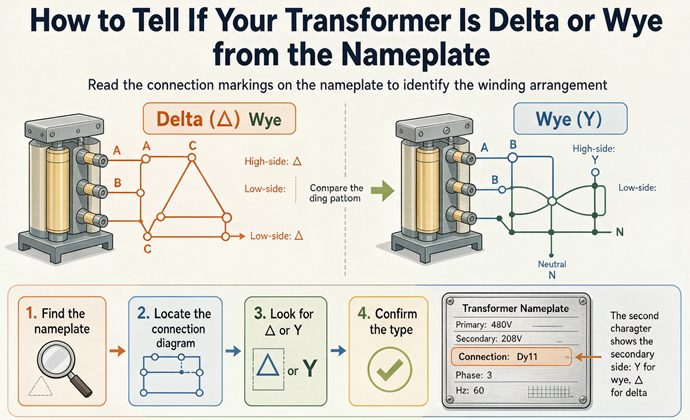
Delta (the triangle, Δ) links the three windings end to end in a closed loop. The corners become your three line connections. There is no center point, so there is no neutral. You get three wires per side. Line voltage equals the winding voltage.
Wye, in plain words
Wye (the star, Y) joins one end of each winding at a common center point. That center point can be brought out as a neutral. You get three line wires plus, often, a neutral. Line voltage is about 1.732 times the winding (phase) voltage, which is why a wye gives you two usable voltages from one winding.
That single difference, neutral or no neutral, is what drives everything else: what loads you can serve, how you ground, whether two units can run side by side, and how harmonics behave.
Why It Pays to Get This Right
This is not trivia. Picking or reading the wrong connection quietly breaks a system. Four things ride on it:
Neutral and single-phase loads
If your building needs 120V or 277V outlets, lighting, or controls, you need a wye secondary with the neutral brought out. A delta secondary alone cannot give you that. A nameplate that hides the neutral (or leaves it internal) changes what you can plug in.
Paralleling two units
Two transformers feeding the same bus must agree in voltage and phase. Get the vector group wrong and you create a large circulating current. We cover this in the FAQ, but the short version: a Dyn11 will not parallel with a Yyn0.
The 30-degree phase shift
Any delta-to-wye or wye-to-delta pairing shifts the output by 30 degrees. Protection relays, meters, and generators on either side must account for it. The nameplate’s vector group number is exactly where that shift is written.
Harmonics and grounding
A delta winding traps triplen harmonics (the 3rd, 9th, 15th) inside its loop instead of pushing them onto the supply. That is a big reason delta-wye units are the default for modern buildings full of VFDs, LED drivers, and switch-mode supplies. The nameplate tells you whether you have that trap or not.
Step 1 — Read the Voltage Notation (the Fastest Tell)
Start here. The voltage line is the quickest read on most plates. The trick is the slash and the letter.
- A “Y” in the voltage = wye. Example:
480Y/277Vmeans 480V line-to-line and 277V line-to-neutral (480 ÷ 1.732 ≈ 277). The neutral exists. - A single voltage with a Δ or “D” = delta. Example:
480V deltaor480 Δ. No second number, no neutral. - A naked slash with no Y = usually single-phase.
120/240is a center-tapped single-phase secondary, not a wye three-phase system.
| Nameplate voltage | Connection | What it gives you |
|---|---|---|
| 480Y/277V | Wye | 480V 3-phase + 277V line-to-neutral |
| 208Y/120V | Wye | 208V 3-phase + 120V (common North American service) |
| 600Y/347V | Wye | 600V 3-phase + 347V (common in Canada) |
| 400Y/230V | Wye | 400V 3-phase + 230V (common in Europe) |
| 480V Δ (or “480 delta”) | Delta | 480V 3-phase only, no neutral |
| 12,470Y/7200 | Wye (HV) | 12,470V line-to-line, 7200V line-to-neutral |
Watch this: a label that says only “480V” does not by itself tell you delta or wye. You need the “Y” (or the Δ symbol) or the vector group to be sure.
Step 2 — Decode the Vector Group or Connection Diagram
The second check covers plates that use a short code instead of a spelled-out voltage. This is where North American and European conventions split, so we cover both.
IEC vector group codes (common outside North America)
You will see a code like Dyn11, Yyn0, or YNd11. Read it left to right:
| Symbol | Meaning |
|---|---|
| D / d | Delta winding (capital = high-voltage side, lowercase = low-voltage side) |
| Y / y | Wye (star) winding |
| N / n | Neutral brought out (sits after the winding letter) |
| Z / z | Zigzag winding (special earthing/balanced-load use) |
| Number (0–11) | Phase shift in clock steps; 1 step = 30 degrees |
So Dyn11 reads as: delta high-voltage winding, wye low-voltage winding, neutral brought out, 30-degree shift (LV leads HV by 30 degrees). It is the most common distribution vector group in the world. A Yyn0 is star-primary, star-secondary, neutral out, zero shift.
IEEE / North American markings
Plates built to ANSI/IEEE C57.12.00 usually skip the clock number and instead show a connection diagram plus terminal labels:
- H1, H2, H3 = high-voltage (primary) terminals.
- X1, X2, X3 = low-voltage (secondary) terminals.
- H0 / X0 = brought-out neutral on that side.
- A Δ symbol means delta; a “D” or the word “Delta” means the same; “Y” or “Wye” means wye.
Some imported IEC units on a North American job will show both: terminal labels and a Dyn11 code. Read them together.
Step 3 — Count the Terminals, Look for the Neutral
When the code is missing or you just want a second opinion, the terminal count is a fast field check.
| On one side you see… | Likely connection | Confidence |
|---|---|---|
| 4 terminals, one marked H0 or X0 (neutral) | Wye, neutral brought out | High |
| 3 terminals, no neutral marking | Delta, OR a wye with internal neutral | Clue only |
| A visible neutral bushing or neutral bar | Wye | High |
The catch: a wye whose neutral is not brought out looks identical to a delta from the outside, three terminals each. So terminal count narrows it down but does not prove it. Pair it with Step 1 or Step 2.
Nameplate Cheat Sheet — All Three Checks in One Table
| What you see | Reads as | Delta or Wye |
|---|---|---|
| 480Y/277V | Wye, neutral available | Wye |
| 480V Δ / “480 delta” | No neutral | Delta |
| Dyn11 / Dy1 | D = delta, y = wye, n = neutral | Delta + Wye |
| Yyn0 | Both wye, neutral out, 0 shift | Wye + Wye |
| 4 terminals with H0/X0 | Neutral brought out | Wye |
| 3 terminals, no H0/X0 | Delta or wye-without-neutral | Unconfirmed |
When the Nameplate Is Gone: Two Backup Checks
The keyword says “from the nameplate,” and that is the right first move. But plates get painted over, rusted, or removed. If you must confirm without the label, use these — carefully.
Resistance check (de-energized only)
With the unit de-energized, locked out, and verified dead, measure resistance between each pair of same-side terminals (H1-H2, H2-H3, H1-H3) with a low-resistance ohmmeter. If each winding is R, a wye reads about 2R between line terminals (two windings in series), while a delta reads about 2R/3 (current splits). On the same test, a wye reads roughly three times a delta.
Voltage check (qualified personnel only)
On an energized, qualified test, a wye with neutral gives a line-to-neutral reading about 58% of line-to-line (277V from 480V). A basic delta gives no meaningful neutral reading. Do not open live panels unless you are trained and authorized.
Safety first: windings and capacitance can hold a charge. Only test de-energized, locked-out equipment, and confirm it is dead with a rated tester. Live testing is a job for a qualified electrician with proper PPE.
A Note for Buyers — Verify Before You Order
Here is the gap almost no ranking article fills: if you are buying from a supplier, the nameplate is also your verification tool. A mismatch that looks small on paper becomes an expensive field failure. Before you issue or accept an order:
- State the vector group in the RFQ. Do not write only “delta-wye.” That hides the real question: Dyn1, Dyn5, or Dyn11? They are not interchangeable, and they will not parallel with each other.
- Match the existing system. If you are adding a unit beside a Dyn11 transformer, yours must be Dyn11 too, with the same ratio and impedance within about 10%.
- Confirm the neutral rating. Ask for the X0 bushing current. A wye secondary only helps your single-phase loads if the neutral terminal is actually rated for the current you plan to draw.
- Ask for the nameplate drawing and the factory test report. A reputable supplier will send both before shipment. The test report should list winding resistance, vector group, and impedance, matching the plate.
- Watch the convention gap. A European-built unit may arrive with Dyn11 and IEC terminals (1U/1V/1W); a North American job may expect H/X labels and a connection diagram. Make sure the documentation your electrician receives speaks both languages.
Getting these lines right at the quotation stage is far cheaper than discovering a 30-degree phase error on delivery day.
Mistakes That Trip People Up
- Assuming three terminals = delta. A wye without a brought-out neutral has three terminals too. Confirm with the voltage or vector group.
- Ignoring the vector group number. “Delta-wye” is not enough. Dyn1, Dyn5, and Dyn11 sit 30 to 180 degrees apart and will not parallel.
- Reading only the bushings. You cannot tell delta from wye by counting external bushings alone. The code and the voltage do the real work.
- Confusing high-leg delta. A 240V delta with one center-tapped winding gives 120V on two legs and about 208V on the third (the high leg). That third leg is not a wye neutral and must never feed 120V loads.
The Bottom Line
To tell delta from wye from the nameplate, do the three checks in order: read the voltage (Y means wye, Δ means delta), decode the vector group (D = delta, Y = wye, n = neutral, number = phase shift), and count the terminals (a 4th neutral terminal means wye). When the plate is gone, fall back to a resistance or voltage check, done safely. If you are buying, put the vector group and neutral rating in writing before you commit.
Specifying or verifying a transformer for your project? Send us your nameplate photo or RFQ, and we will confirm the connection, vector group, and neutral rating against your existing system, plus flag any parallel-operation or grounding risks before you order. Request a nameplate review.
Frequently Asked Questions
Q: What does the “Y” mean on a transformer nameplate?
A: The “Y” means the winding is wye (star) connected. A wye winding has a neutral point, so that side can supply both line-to-line and line-to-neutral voltages (for example, 480Y/277V = 480V line-to-line and 277V line-to-neutral). “D” or the triangle symbol means delta, which has no neutral.
Q: Is 480Y/277 delta or wye?
A: Wye. The “Y” tells you it is wye. 480V is the line-to-line voltage and 277V is the line-to-neutral voltage (480 divided by 1.732 is about 277). A 480V delta unit would show just “480V delta” or a triangle symbol, with no second voltage.
Q: What does Dyn11 mean on a transformer?
A: D = delta high-voltage (primary) winding. y = wye low-voltage (secondary) winding. n = the neutral is brought out. 11 = a 30-degree phase shift between primary and secondary (the LV leads the HV by 30 degrees under IEC clock notation). Dyn11 is the most common distribution vector group worldwide.
Q: Can a wye transformer have only three terminals?
A: Yes. A wye winding only shows four terminals if the neutral is brought out to a bushing. If the neutral is internal and not connected, a wye side looks exactly like a delta side: three terminals. So terminal count is a clue, not proof.
Q: How do I know if my transformer has a neutral?
A: Look for a fourth terminal marked H0 or X0 (neutral), a “Yn” or “yn” in the vector group, or a voltage pair such as 480Y/277V. A wye winding with no brought-out neutral has no usable neutral terminal on the outside.
Q: Can I parallel a Dyn11 transformer with a Yyn0 transformer?
A: No. They sit 30 degrees out of phase, so their secondaries are out of step. Connecting them in parallel drives a large circulating current that can overheat and damage both units. Only parallel transformers with the same vector group, ratio, and similar impedance.
Q: What if the nameplate is missing or unreadable?
A: Do not guess. With the unit de-energized, locked out, and verified dead, measure winding resistance between terminals (a wye reads about three times a delta on the same test). Or have a qualified electrician take voltage readings (wye line-to-neutral is about 58 percent of line-to-line). Confirm against the manufacturer’s test report.