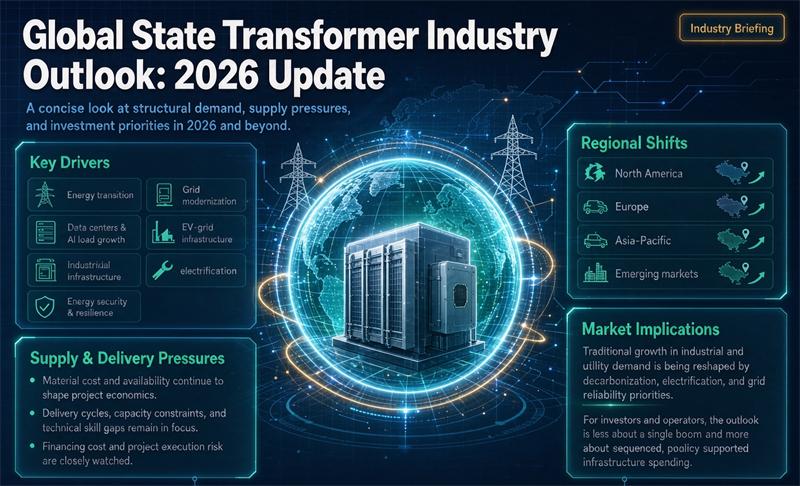
The global transformer market in 2026 is worth roughly $66 billion and is forecast to grow about 6–7% a year through the early 2030s, while large power-transformer lead times have stretched past two years as data centers, renewables, and grid upgrades stack up demand.
If you are a buyer, an EPC, or a utility planner, that one sentence is the whole story in a nutshell: the world needs more transformers than it can build quickly, and the gap is reshaping how you should spec, source, and schedule. This outlook pulls the 2026 numbers together, explains what is actually driving them, and gives you a practical playbook for the year ahead. Figures below come from third-party market research and industry reporting (Persistence Market Research, Mordor Intelligence, IEA data cited by those firms, and vendor field reports); treat them as estimates and verify against the latest source before you commit budget.
2026 at a glance
| Metric | 2026 reading | Source / note |
|---|---|---|
| Global market value | ~$65.7B (PMR) to ~$69.7B (Mordor); some estimates run to ~$82B | Persistence / Mordor / press-release estimate |
| Consensus CAGR | ~6–7% through early 2030s | PMR 5.7% (to 2033); Mordor 7.24% (to 2031) |
| Asia-Pacific share | ~45–47% of revenue | PMR, Mordor, GEP |
| Power-transformer lead time | ~128 weeks (about 2.5 yrs) | Industry Market Data 2026 |
| Generator step-up lead time | ~144 weeks | Industry Market Data 2026 |
| Large units (≥300 MVA) | 22–28 months in NA & EU | Utility / manufacturer disclosures, mid-2026 |
| U.S. demand vs 2019 | +116% | Derui field report |
| Global grid spend | ~$400B per year | IEA, cited by PMR |
The takeaway is not the exact dollar figure. It is the mismatch: demand is climbing fast, and supply cannot catch up inside a normal procurement cycle.
What is driving the 2026 transformer market
Four forces are stacking on top of each other, and none of them is slowing down this year.
Grid modernization and aging assets
More than half of installed distribution transformers in the U.S. were commissioned before 1995, and NREL projects U.S. distribution capacity must scale 160–260% by 2050. Europe is in the same boat, prioritizing replacement of equipment that entered service before 2000. The U.S. Grid Resilience program and the EU’s REPowerEU push are pouring money into exactly this swap-out. That is steady, structural demand that does not depend on any single trend.
AI data centers
In 2026 alone, data centers are expected to require roughly 74 GW of transformer capacity, with dedicated utility investment estimated at $36–60 billion by 2030. A single hyperscale hall can pull more from the grid than a small town, and it needs clean, high-efficiency units delivered on a schedule that rarely matches the 2-year transformer backlog. This is the single loudest new driver in the 2026 outlook.
Renewable energy integration
A 100 MW solar farm needs about 1.8× the transformer capacity of a comparable fossil plant, because generation is distributed and has to be collected and stepped up. Wind farms spec high-impedance designs to tame fault current across scattered turbines. Europe’s renewable targets and Asia’s UHV buildouts keep this line of demand full.
Electrification of everything
Global electricity demand is rising about 3.6% a year through 2030 (IEA), pulled by EVs, heat pumps, and industrial electrification. Every one of those loads lands, eventually, on a transformer.
Market size and where the demand sits
Most 2026 forecasts put the global transformer market between $65 billion and $82 billion. The commonly cited mid-range is around $66 billion, growing at roughly 6–7% a year. Persistence Market Research pegs it at $65.7B in 2026 reaching $96.8B by 2033 (5.7% CAGR); Mordor Intelligence shows $69.7B in 2026 reaching $98.8B by 2031 (7.24% CAGR). The spread reflects different scopes, not a disagreement about direction: the market is up, and it stays up.
Regional split
Asia-Pacific leads with roughly 45–47% of revenue, anchored by China’s UHV grid and India’s transmission plan. North America is the fastest-moving developed market, with U.S. utilities allocating about $1.1 trillion for grid modernization by 2030. Europe has flagged about €1.2 trillion in grid upgrades, with Germany’s €200B program out front. For a buyer, the regional story matters because lead times and local-content rules differ sharply by geography.
The supply crunch buyers actually feel
The headline number for most purchasing teams is not market size. It is how long you will wait.
Lead times by unit type
Power transformers are averaging about 128 weeks. Generator step-up units run about 144 weeks. Large units at or above 300 MVA are quoted at 22–28 months across North America and Europe for 2026–2027 delivery, and the tightest custom giants (above 100 MVA) can stretch toward four years. Translation: if you wait for confirmed load before you order, you are effectively planning two to three years late.
The GOES and copper squeeze
Grain-oriented electrical steel (GOES) and copper together account for more than 60% of manufacturing cost. In 2025, GOES and copper prices rose about 14% and 8% respectively, and finished transformer prices jumped 60–80% versus 2020. GE Vernova reported GOES surcharges of 12–19% on North American contracts signed in 2025–2026. Some U.S. utilities face a single domestic GOES producer plus tariffs on imported grades, which compounds both cost and schedule risk.
Tariffs and localization
The U.S. placed a 50% tariff on imported electrical steel articles effective August 15, 2025. North American import dependence for transformers sits near 80%, and Europe faces its own capacity gap estimated around 120 GW. The practical effect: “buy local” is no longer just a preference, it is a schedule and compliance decision.
Technology and standards shifts in 2026
Efficiency rules with hard dates
The U.S. DOE finalized distribution-transformer efficiency standards in April 2024. The EU’s EcoDesign requirements tighten further, with updated distribution-transformer loss limits taking effect in July 2026. China’s top-tier efficiency share is climbing too. If your spec was written two years ago, it may no longer clear customs or code in 2026.
Smart and IoT-enabled units
Embedded sensors that stream loading, temperature, and dissolved-gas data are moving from optional to expected on utility tenders. The pitch is predictive maintenance and fewer catastrophic failures on assets now running past their 40-year design life. For a buyer, that means budgeting for monitoring and for interoperability with your distribution-management system.
Dry-type and ester-fluid growth
Urban and indoor sites keep shifting toward dry-type units, and biodegradable ester fluids are replacing mineral oil where fire risk and environmental rules bite. Both trends push nameplate and testing requirements in a direction conventional oil-filled specs do not capture.
What this means for you as a buyer
This is the part most market reports skip. The outlook only helps if it changes how you buy.
Order earlier and freeze the spec
With two-year-plus lead times now normal, the single highest-leverage move is to order 18–36 months ahead of commissioning and lock specifications early. Every late design change resets the production clock. Freeze the rating, cooling class, and tap range before you issue the PO.
Diversify qualified suppliers
Maintain a shortlist of pre-qualified manufacturers, and favor suppliers that hold GOES and copper inventory rather than buying spot. Framework agreements that guarantee minimum production slots are increasingly how utilities insulate themselves from the standard backlog. Build penalty clauses for firm delivery commitments, because “we are behind” is the most common sentence you will hear in 2026.
Match the unit to the application
Not every job needs a custom giant. Small units up to 10 MVA took about 42% of revenue in 2025 and are growing fastest, because rooftop solar, community batteries, and neighborhood microgrids reward compact, low-noise, overload-tolerant designs. Know which tier your project sits in before you default to the longest lead-time category.
Where the demand shows up in real builds
The drivers above are not abstract. Data-center halls need coordinated medium- and low-voltage drops built for harmonic-rich, always-on loads. Solar and storage plants need step-up and collector units rated for variable generation. Our data center transformer solutions package the MV and LV drops as one coordinated design, and you can see how renewable specs played out in a real 50 MW solar PV case study we shipped. If you want the conventional MV and LV hardware that sits behind all of this, browse our full transformer catalog to compare what fits each tier.
Frequently asked questions
How big is the global transformer market in 2026?
Most 2026 forecasts put it between $65 billion and $82 billion, with a commonly cited mid-range near $66 billion. Persistence Market Research estimates $65.7B; Mordor Intelligence estimates $69.7B.
What is the CAGR of the transformer market?
Roughly 6–7% through the early 2030s. Persistence projects 5.7% to 2033; Mordor projects 7.24% to 2031. The direction is consistent even where the exact rate differs.
Why are transformer lead times so long in 2026?
Demand from data centers, renewables, and grid upgrades is outrunning factory throughput. Power-transformer lead times average about 128 weeks, generator step-up units about 144 weeks, and large units above 300 MVA run 22–28 months in North America and Europe.
Which regions are growing fastest?
Asia-Pacific leads on volume at roughly 45–47% of revenue. North America is the fastest-moving developed market, with U.S. utilities allocating about $1.1 trillion for grid modernization by 2030, and Europe has flagged about €1.2 trillion in grid upgrades.
What is driving transformer demand in 2026?
Four forces: aging-grid replacement, AI data-center load (about 74 GW of transformer capacity needed in 2026), renewable integration, and broad electrification pushing electricity demand up about 3.6% a year through 2030.
How are efficiency standards changing in 2026?
The U.S. DOE distribution-transformer rule finalized in April 2024 is in force, and the EU’s EcoDesign loss limits tighten in July 2026. Older specs may no longer clear code or customs, so re-check your nameplate against current rules.
What should buyers do about long lead times?
Order 18–36 months ahead, freeze specifications early, keep a shortlist of pre-qualified suppliers with material inventory, use framework agreements to reserve slots, and write delivery penalties into contracts.
The bottom line
The 2026 transformer outlook is a seller’s market with a buyer’s problem: demand is real and rising, but capacity is years behind. Plan early, spec tight, and diversify your supply base. For the deeper technical side, our technical resource library walks through nameplate reading, routine testing, and the IEC vs ANSI/IEEE standard guide, and our project case studies show these units running in the field. If your 2026 build needs hardware that actually fits the schedule, reach out to TransNine Electric and we will spec it with you.