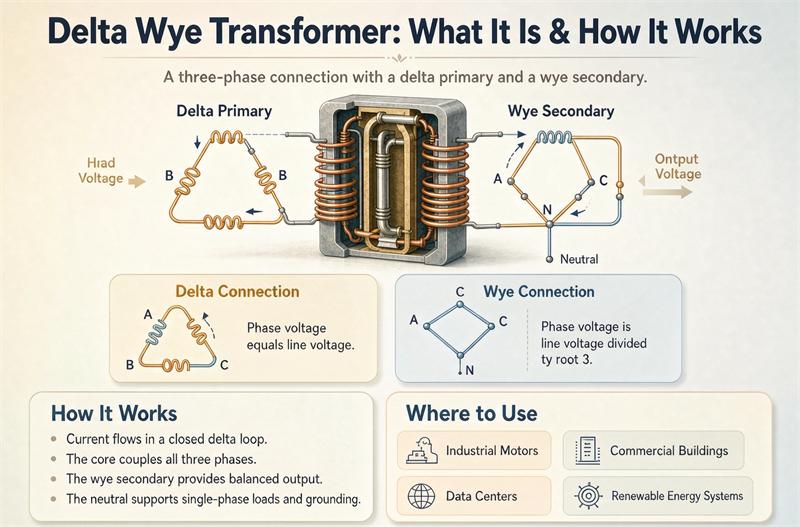
A delta-wye transformer, written Δ-Y, has a delta-connected primary and a wye-connected secondary. That pairing is what puts a stable, groundable neutral on the low-voltage side and produces both a line voltage and a line-to-neutral voltage from one unit. The √3 factor, about 1.732, is the bridge between the two. At TransNine Electric we build these for substations, commercial buildings, and renewables, and the goal here is to make the buying decision feel straightforward rather than mysterious.
This is a buyer’s guide, not a textbook. We cover what the connection actually does, the one bit of math that explains every voltage you will see, where the design earns its keep, and the spec numbers that separate a unit that fits your system from one that fights it.
Delta vs Wye vs Delta-Wye at a glance
Before the details, here is the comparison that answers most early questions. Delta and wye describe how the three windings are joined. A delta-wye unit is simply the combination most distribution systems want.
| Connection | Winding shape | Neutral available | Line vs phase voltage | Typical role |
|---|---|---|---|---|
| Delta (Δ) | Three windings in a closed loop | No (in the basic form) | Vline = Vphase, Iline = √3 × Iphase | Motor loads, industrial balance |
| Wye (Y) | One end of each winding at a common point | Yes, when brought out | Vline = √3 × Vphase, Iline = Iphase | Supplies line-to-neutral loads |
| Delta-Wye (Δ-Y) | Delta primary, wye secondary | Yes, on the secondary | Mixes both rules above | Step-down distribution with a neutral |
| Wye-Delta (Y-Δ) | Wye primary, delta secondary | Yes, on the primary | Mirror of Δ-Y | Generator step-up, transmission |
The key line to remember: a wye winding is what gives you a neutral, and a delta winding is what gives you the closed path that traps certain harmonics and rides through an open-phase condition. Put them together and you get the most common distribution transformer in North America and Europe.
How a delta-wye transformer works
The transformer still obeys the basic rule that the voltage ratio follows the turns ratio. The connection type then decides how that voltage splits between line and phase on each side.
On a delta winding, each coil is connected directly across two line conductors, so the coil voltage equals the line voltage. On a wye winding, each coil reaches from a line conductor to the neutral point, so the coil voltage is the line voltage divided by √3.
A worked example you can check yourself
Take a 45 kVA, three-phase, 480 V delta-primary, 208Y/120 V wye-secondary dry-type unit.
- On the delta side, each winding sees the full 480 V line voltage (Vphase = Vline = 480 V), and the line current is √3 times the winding current.
- On the wye side, the line voltage is 208 V, and each winding sees 208 divided by √3, which is 120 V, the neutral voltage.
- The full-load line current on the secondary is 45,000 divided by (√3 times 208), which is about 125 A.
- The primary line current is 45,000 divided by (√3 times 480), which is about 54 A.
Those two currents are different because the voltages are different, even though the kVA is the same on both sides. If you run the same math on a European 11 kV to 400Y/230 V unit, the 230 V is simply 400 divided by √3. That single number is why a delta-wye unit can feed both 400 V three-phase machines and 230 V single-phase outlets from one tank.
Why buyers choose delta-wye
The connection is popular because it solves four real problems at once.
- A neutral you can ground. The wye secondary gives you a stable neutral, so the unit can supply both three-phase equipment and single-phase loads like 120 V lighting or 230 V sockets.
- Harmonic suppression. A delta winding gives triplen harmonics, the 3rd, 9th, and so on, a closed path to circulate in. They stay inside the transformer instead of travelling back into the utility feed, which matters anywhere with VFDs, LED drivers, or server power supplies.
- Unbalanced load tolerance. Office and retail loads are never perfectly balanced. The delta primary spreads the imbalance across phases and keeps a single heavily loaded leg from overheating.
- Grounding flexibility. You can solidly ground the neutral, use a resistance-grounded scheme, or leave it ungrounded depending on the protection philosophy of the system.
None of this changes the turns ratio, but it changes whether the unit behaves well in your building.
Common voltage configurations: North America vs Europe
The connection is the same on both continents. The nameplate voltages differ, and the √3 relationship is what makes the secondary numbers work.
| Region | Primary (typical) | Secondary | Line-to-neutral |
|---|---|---|---|
| North America | 480 V | 480Y/277 V | 277 V |
| North America | 13.8 kV | 208Y/120 V | 120 V |
| North America | 480 V | 208Y/120 V | 120 V |
| Europe / Asia | 11 kV | 400Y/230 V | 230 V |
| Middle East / LatAm | 11 kV | 380Y/220 V | 220 V |
If you only remember one thing from this table, make it the neutral column. The smaller number is always the line voltage divided by 1.732. When a supplier quotes a 208Y/120 V secondary, they are quoting the same winding twice: 208 V between phases, 120 V from any phase to neutral.
Vector groups and the 30-degree phase shift
Here is the part most guides mention in one sentence and then drop. A delta-wye connection introduces a 30-degree phase displacement between the primary and secondary voltages.
Distribution step-down units are usually marked Dyn11: delta primary, wye secondary with neutral, 11 o’clock on the vector diagram. The mirror image used for generator step-up is Dy1, a wye-delta with a 1 o’clock displacement. Units marked Yy0 or Dd0 have zero displacement.
That 30-degree gap is why a Dyn11 unit must not be paralleled with a Yy0 or Dd0 unit without deliberate phase correction, or you get a large circulating current. If you are replacing or adding a transformer, the vector group on the nameplate has to match the unit already on the bus, not just the voltage and kVA. We cover grouping in our resources library alongside the other nameplate items.
Dry-type or oil-immersed, and where each fits
Both connection types are available in either build. The choice is about the environment, not the winding connection.
- Dry-type (cast resin or VPI): the default indoors, in basements, data centers, hospitals, and any space where an oil leak is unacceptable. Browse the full range in our products catalog.
- Oil-immersed: the default outdoors, in substations, pad-mounted on a site, or wherever you need higher capacity in a smaller footprint and better heat handling.
A delta-wye 480 V to 208Y/120 V unit is just as happy as a dry-type in a plant basement as it is as an oil unit feeding a pad-mounted distribution point. Pick the enclosure and cooling for the site, and keep the connection for the load.
Standards and what to check on the nameplate
Three families govern these units, and a real quote should name them.
- IEEE C57.12.00 covers general requirements for liquid-immersed and dry-type distribution and power transformers.
- IEC 60076-1 covers general requirements internationally and is the reference most export projects cite.
- NEC Article 450 sets the installation rules in the United States, including ventilation, working space, and overcurrent protection.
When you read the nameplate, look past the voltages and kVA. The numbers that decide whether the unit is right are the impedance (typically 4 to 8 percent for distribution sizes), the temperature rise (80, 100, or 125 °C for dry-type), the BIL or basic impulse level (about 10 kV at 600 V class, 95 kV at 15 kV class, 200 kV at 35 kV class), and the tap range (usually plus or minus 2 times 2.5 percent, five positions). Our NEC sizing and protection calculator applies the 125 percent continuous-load rule and the Article 450.3 overcurrent limits so you can see the required conductor and breaker size before you ask for a quote.
A buyer’s checklist: the numbers that actually matter
Use this as a quick pass before you send a specification.
- Do you need a neutral for single-phase loads? If yes, you need a wye secondary.
- Is the load unbalanced or rich in harmonics? If yes, the delta-wye handles it better than most alternatives.
- What are the primary and secondary voltages, and is the secondary a 208Y/120 or 400Y/230 style?
- What is the required kVA or MVA, with headroom for future load?
- What impedance, temperature rise, and BIL does the system design call for?
- What is the vector group, and does it match the existing bus if you are paralleling?
- Dry-type or oil, based on the installation site?
- Which standard, IEEE C57 or IEC 60076, does the project require?
If energy cost is part of the decision, our loss and TCO calculator shows the 30-year cost of a marginally cheaper, higher-loss unit, which is usually the more expensive choice by year five.
Common mistakes to avoid
- Assuming connection equals direction. A delta-wye can step voltage up or down. The name tells you the winding shapes, not whether it is a step-up or step-down unit. The turns ratio does.
- Matching only voltage and kVA on a replacement. Two units with the same kVA and voltages can still be wrong for each other if the vector group or grounding differs.
- Forgetting the neutral rating. A wye secondary gives you a neutral, but the neutral bus and grounding must be sized for the unbalanced current it will carry.
- Ignoring harmonics in modern buildings. If the load is mostly IT or VFD driven, lean on the delta winding for harmonic control rather than adding filters after the fact.
Where delta-wye transformers are used
The connection shows up wherever you step a voltage down and still need a neutral. Utility distribution substations, commercial buildings on 208Y/120 V or 400Y/230 V, industrial plants with mixed three-phase and single-phase loads, renewable inverter interfaces, and data centers all rely on it. Our projects page includes K-factor dry-type units for a hyperscale data center and step-up transformers for a 50 MW solar plant, both built around the same winding physics described here. If you are sizing for a data hall specifically, our data center transformer calculator turns IT load and K-factor into a standard unit in minutes.
Wrapping up
A delta-wye transformer is not a mystery. It is a delta primary feeding a wye secondary, which gives you a groundable neutral, a built-in path for harmonics, and the √3 relationship that produces both a line voltage and a line-to-neutral voltage from one tank. Pick it when you need that neutral and a balanced, harmonic-tolerant supply. Read the vector group before you parallel, match the standard to the project, and size the enclosure to the site. The connection is the easy part. The rest is just getting the numbers on the nameplate to match your system.
FAQ
What is a delta-wye transformer? A delta-wye transformer, written Δ-Y, has a delta-connected primary and a wye-connected secondary. The delta side forms a closed loop with no neutral, and the wye side joins at a common point that can be brought out as a neutral. It is the most common three-phase distribution connection.
What does the √3 (1.732) factor mean? On a wye winding, the line voltage equals √3 times the phase or coil voltage, and the line current equals the phase current. On a delta winding it is the reverse: the line voltage equals the phase voltage, and the line current equals √3 times the phase current. That single factor is why a 208Y/120 V secondary gives 120 V to neutral, and a 400Y/230 V secondary gives 230 V to neutral.
Does a delta-wye transformer have a neutral? Yes, on the wye side. The wye connection provides a neutral point that can be grounded, which is what lets one unit supply both three-phase loads and single-phase loads such as 120 V or 230 V outlets. The delta side has no neutral in the basic form.
What is the 30-degree phase shift? A delta-wye connection displaces the secondary voltage by 30 degrees from the primary. Distribution units are typically Dyn11, and generator step-up units are typically Dy1. Because of that offset, a Dyn11 unit should not be paralleled with a Yy0 or Dd0 unit without phase correction, or circulating current results.
Can a delta-wye transformer step up or only step down? It can do either. The connection name describes the winding shapes, not the direction. The turns ratio sets whether the unit steps voltage up or down, so a delta-wye can serve as a step-up or a step-down transformer.
What voltage configurations are most common? In North America, 480 V to 480Y/277 V, 13.8 kV to 208Y/120 V, and 480 V to 208Y/120 V are typical. In Europe and much of Asia, 11 kV to 400Y/230 V is standard. The neutral voltage in every case is the line voltage divided by 1.732.
Is a delta-wye available as dry-type or oil-immersed? Both. The winding connection is independent of the cooling method, so you can get a delta-wye as a dry-type unit for indoor or fire-sensitive sites, or as an oil-immersed unit for outdoor substations and higher capacities.
What standards apply to delta-wye transformers? The same families as any distribution transformer: IEEE C57.12.00 for general requirements, IEC 60076-1 internationally, and NEC Article 450 for United States installation. Confirm which one your project specifies before you request a quote.