Pick air cooling for small-to-mid, clean, well-ventilated shops; water cooling for high-power, continuous, or hot-ambient duty; and oil cooling when the site is corrosive, dusty, or must stay sealed. The right call comes down to three things: your power level, how hard and how long the unit runs, and what your shop environment throws at it.
Every rectifier does the same job: turn AC into steady DC for plating, anodizing, electrolysis, or DC traction. And every one of them makes heat doing it. Left unchecked, that heat eats into efficiency, shortens component life, and eventually trips the unit offline. The cooling method you spec is not a detail — it decides your uptime, your running cost, and how much maintenance your team is signing up for.
This guide walks through the three real options — air, water, and oil — the way a buyer actually needs to hear them: what each one is, where it wins, where it bites, and a straight decision rule for picking one. No theory for its own sake.
Quick Comparison at a Glance
| Factor | Air-Cooled | Water-Cooled | Oil-Cooled |
|---|---|---|---|
| Best power range | Up to ~100–150 kW/cabinet | 100 kW and up, into MW | Any; shines in harsh sites |
| How it removes heat | Fan-forced air over heatsinks | Circulating water via heat exchanger | Components bathed in dielectric oil |
| Maintenance | Filter/fan checks weekly–monthly | Leak checks, water quality | Oil check/change every few years |
| Environment fit | Clean, dry, ventilated | Tolerant of heat; needs water loop | Sealed, corrosive, dusty |
| Upfront cost | Lowest | Mid-to-high (loop + chiller) | Highest |
| Running cost | Low (just fan power) | Higher (pump, possibly chiller) | Low |
| Main risk | Overheats in heat/dust | Leaks, scaling, freezing | Spill/fire if breached |
How Each Cooling Method Works
Air-cooled rectifiers
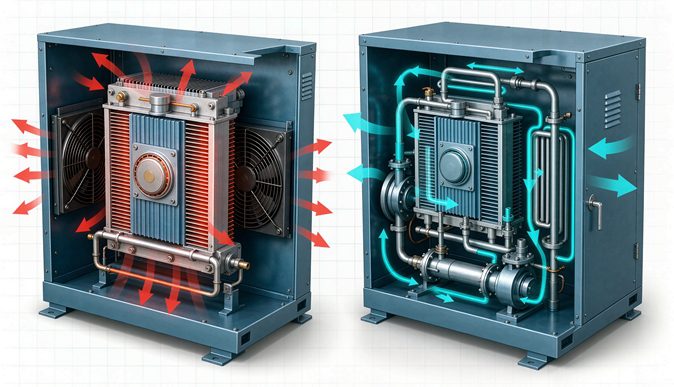
The simplest setup: fans push or pull air across heatsinks bolted to the power devices. Heat transfers to the fins, moving air carries it away. It’s convection cooling, and the “coolant” is the air already in your shop. Natural convection (no fan) works for tiny units; anything serious uses forced air.
Water-cooled rectifiers
Here a closed (or open) loop pumps water — or a water-glycol mix — through a heat exchanger inside the cabinet. Water’s volumetric heat capacity is roughly 3,000–3,500 times that of air at the same temperature rise, so it moves far more heat through a much smaller path. Most closed-loop designs hold the exchanger water around 40 °F (4 °C) so it cools the electronics without dropping below the dew point and forming condensation inside the box.
Oil-cooled rectifiers
The power parts sit submerged in non-conductive mineral or synthetic oil. The oil pulls heat from the components and sheds it through external fins or a radiator. Because the whole thing is sealed, outside air, fumes, and dust never reach the electronics. Maintenance is mostly “check the oil level and change it every few years.”
Air-Cooled vs Water-Cooled vs Oil-Cooled: Side-by-Side
The table above covers the headline differences. The part that actually drives the decision is below.
The honest summary: air is cheap and simple until the heat outruns the fan; water is the workhorse for serious power and tough ambient conditions; oil is the quiet specialist for nasty environments where you’d rather seal the box than fight the air.
The 5 Factors That Actually Decide It
1. Power rating and current density
Forced air loses the argument above roughly 100–150 kW per cabinet — the fans get loud, the airflow gets heroic, and you’re still fighting physics. Past that, water cooling gives you the same rating in a smaller footprint. Oil sits anywhere on the scale but earns its keep most at sites where environment, not power, is the problem.
2. Duty cycle
Running eight hours a day, five days a week? Air is fine. Running three shifts, continuous, weekend included? Heat never gets a chance to bleed off, and water (or oil) becomes the safer bet. Continuous duty is where air-cooled units quietly cook themselves.
3. Your shop environment
This is the one buyers underestimate. Plating and anodizing shops are wet, humid, and full of corrosive fumes. Air-cooled units breathe that air straight over their electronics — condensation on the walls means condensation inside the rectifier, which activates the chemistry already deposited on it and starts rusting your gear. Water-cooled and oil-cooled boxes can be fully sealed against that.
4. Maintenance you can staff
Air cooling asks for discipline: clean the intake filter, inspect the fans, every week or month depending on how dirty the air is. Water cooling asks for leak checks and water-quality management (scale in the lines is the classic killer). Oil cooling asks for almost nothing — which is exactly why plants with thin maintenance crews like it.
5. Total cost of ownership
Sticker price says air wins. But add a chiller, a cooling tower, or a few lost batches from a heat-driven coating defect, and the math moves. Water and oil cost more up front and often less in downtime. Decide on TCO, not the quote on page one.
When to Choose Which
- Choose air-cooled if your unit is under ~100 kW, your shop is clean and well-ventilated, your runs are intermittent, and you want the lowest upfront cost with the simplest setup.
- Choose water-cooled if you’re above ~100–150 kW, running continuous duty, dealing with a hot ambient, or your process demands tight, stable temperature control for coating quality.
- Choose oil-cooled if the environment is corrosive, dusty, or wet, if the unit must be sealed off from the room, or if you want near-zero maintenance and can carry the higher upfront cost.
The Option Buyers Forget: Oil Cooling
Most “air vs water” articles wave oil away as old thyristor-era tech. That’s half true and half a missed opportunity. Yes, oil dominated before modern sealed electronics. But for electrolytic cells, aggressive plating chemistry, or any site where the air itself is the enemy, a sealed oil unit is still one of the most reliable things you can bolt to the floor. The trade-off is real — higher upfront cost, and you’d better have a spill plan because oil is flammable and messy if the tank is breached. Treat it as a specialist, not a relic.
Mistakes That Cost You Downtime
- Chasing the cheapest quote. A small saving on cooling can cost you a large batch.
- Ignoring humidity. Dry acid salts are harmless until they dissolve; then they make arc paths inside the box.
- Undersizing for summer. A unit fine at 20 °C ambient can trip at 35 °C. Spec for your worst month, not your best.
- Letting water quality slide. Scale in the loop is slow-motion equipment failure.
- Assuming oil is dead. If your air is corrosive, sealing the unit in oil may beat fighting it.
What It Costs to Get the Cooling Wrong
Pick the method that can’t handle your heat and you’ll see it three ways: efficiency drops (you pay for watts that become warmth instead of DC), components age early (capacitors and semiconductors hate heat), and coating quality drifts (temperature swings show up as thickness variation). None of that shows on the invoice the day you buy — it shows up in your yield six months later.
Bottom Line
There’s no universal “best” cooling method — only the one that fits your power, your duty, and your shop. Air for simple and clean, water for serious and steady, oil for hostile and hands-off. Tell a supplier your kW, your process, and what your room is actually like, and the right answer is usually obvious.
Spec’ing a rectifier and not sure which cooling fits? Send us your power level, duty cycle, and shop conditions — we’ll point you to the method that’ll still be running when the cheap one isn’t.
Frequently Asked Questions
What is the main difference between air-cooled and water-cooled rectifiers?
Air-cooled units blow fan-forced air across heatsinks; water-cooled units circulate water through an internal heat exchanger. Water carries roughly 3,000–3,500× more heat per unit volume than air, so it cools higher power in less space — but needs a water loop and more upkeep.
Is oil-cooled still used for rectifiers?
Yes. It’s less common than air or water, but still specified for corrosive, dusty, or sealed environments (electrolysis, aggressive plating) where a sealed, low-maintenance unit beats fighting the ambient air. Upfront cost is higher.
Which cooling method is cheapest?
Air-cooled has the lowest upfront and running cost for small-to-mid units. Water and oil cost more to buy but can cost less in downtime and yield on demanding duty.
Can a water-cooled rectifier freeze or develop condensation?
Both are real risks. Water loops can freeze below 0 °C if flow stops; and if the exchanger runs colder than the dew point, condensation forms inside the cabinet. Closed-loop designs hold water near 40 °F (4 °C) and manage flow to avoid both.
How often does each type need maintenance?
Air-cooled: filter and fan checks weekly to monthly. Water-cooled: periodic leak inspections and water-quality management. Oil-cooled: oil-level checks and an oil change every few years — the lightest routine of the three.
Which cooling is best for electroplating?
Small, intermittent, well-ventilated plating lines do fine on air. High-current, continuous, or temperature-sensitive lines (where coating uniformity matters) usually want water. Lines in corrosive atmospheres often prefer sealed oil or sealed water units.