If you are shopping for a 35kV transformer, the first thing worth knowing is that “35 kV” names a voltage class, not a single product. Most of what decides your order is the secondary voltage, the megavolt-ampere rating, the impedance, and the insulation level. And if your project is in the United States or Canada, there is a good chance the unit you actually want is rated 34.5 kV, which is the North American standard that does the same job. This guide walks through the specs that matter, the amp and fault math that price sheets skip, what you will really pay once freight and tariffs land, and the efficiency rules that change at the 34.5 kV line. For the broader technical library that backs these numbers, start with our resources.
What “35 kV” Actually Means
A 35 kV transformer steps voltage in and around the 35 kV class. In IEC terms the nominal is 35 kV, the equipment class runs to 36 kV, and the maximum system voltage (Um) is 40.5 kV. In North America the matching rating is 34.5 kV under ANSI/IEEE C57.12.00, and most US utility interconnections, substations, and renewable plants are specified at 34.5 kV rather than 35 kV.
The reason this matters is not cosmetic. The US federal efficiency rule draws its line at a primary voltage of 34.5 kV or less, so a true 35/36 kV primary can fall outside that floor while a 34.5 kV unit stays inside it. Same physical box, different regulatory bucket.
The other number people get wrong is the Basic Insulation Level. For the 35/40.5 kV class the correct lightning impulse level is 200 kV, with an AC withstand around 70 kV to 85 kV. Some vendors list 170 kV or even a vague 30 to 150 kV range on their spec sheets. That is too low for this class and signals either a copy-paste error or a unit built for a lower system voltage. If a quote shows BIL below 200 kV on a 35 kV class unit, ask why before you accept it.
The Specs That Decide the Order
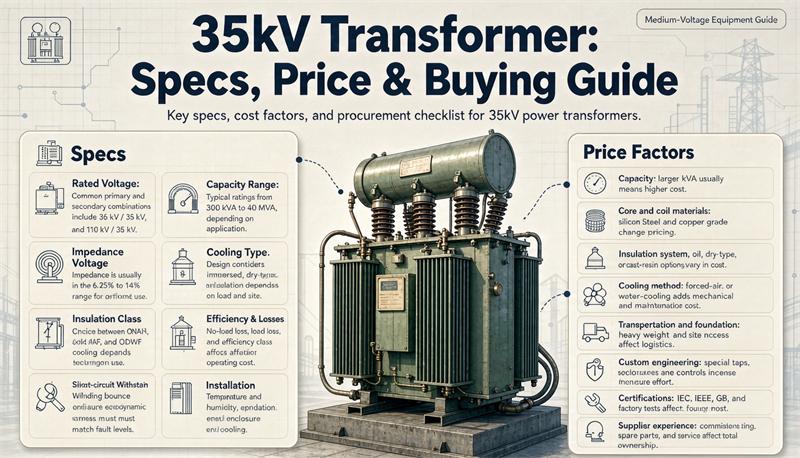
Most 35 kV power transformers fall in the 2.5 MVA to 31.5 MVA range, with a long tail of distribution sizes down to a few hundred kVA for 50 Hz markets. Here are the parameters that actually drive the design and the price.
| Parameter | Typical value at 35 kV class |
|---|---|
| Primary voltage | 35 kV (IEC) or 34.5 kV (ANSI) |
| Secondary voltage | 10.5, 11, 13.8, 6.6, or 0.4 kV; 480 V for US step-down |
| Rated power | 2.5 to 31.5 MVA common; larger on request |
| Vector group | Dyn11 for step-down, YNd11 for renewable step-up |
| Impedance | 6.5% up to 2,500 kVA, rising with size |
| Taps | plus/minus 2 x 2.5% off-circuit; OLTC optional |
| Cooling | ONAN, ONAF, or ODAF |
| BIL | 200 kV lightning impulse, 70 to 85 kV AC withstand |
| Insulation fluid | Mineral oil standard; FR3 ester available |
Impedance is worth a closer look because it climbs with capacity. A common IEC schedule puts 630 to 2,500 kVA at 6.5 percent, 3,150 to 6,300 kVA at 7 percent, 8,000 to 10,000 kVA at 7.5 percent, and 12,500 to 31,500 kVA at 8 percent. That number sets how much fault current the unit will let through and how much voltage drops under load, so it belongs in the specification, not left to the factory.
The Math Most Buyers Skip
Here is where the price tables fall short. The current on the 35 kV winding is small. Use the three-phase formula and you get about 16.5 amperes per MVA, so a 10 MVA unit draws roughly 165 A on the high-voltage side. That is gentle. The action is all on the low-voltage side.
At 13.8 kV, a 10 MVA transformer carries about 418 A. Step down to 480 V and the same 10 MVA becomes 12,028 A. A 5 MVA unit at 480 V is 6,014 A. Those are busway currents, not something you run in a few parallel cables and walk away from. If your 35 kV transformer feeds a 480 V plant, campus, or data center, plan the secondary as a busway or a parallel conductor bank from day one.
Fault current follows the impedance. Take a 10 MVA unit at 7.5 percent impedance on an infinite bus at 13.8 kV: the full-load current is 418 A and the available fault is about 418 divided by 0.075, or roughly 5.6 kA. On a 480 V secondary the same arithmetic gives a very large number that is then capped by the upstream source and the transformer impedance together, which is exactly why you coordinate the protection study instead of guessing. The point for a buyer is simple. The high-voltage side is calm, but the low-voltage side, especially at 480 V, is where the engineering and the cost live.
Dry-Type or Oil-Immersed at 35 kV
Oil-immersed units dominate this voltage class. They are cheaper per kVA, easier to cool at large ratings, and standard for outdoor substations. Cast-resin dry-type transformers do exist at 35 kV, but they are heavier, harder to build large, and carry a real premium. Published 2026 budgets put a 5 MVA dry-type at roughly 80,000 to 140,000 dollars against 45,000 to 75,000 for the oil unit. Choose dry only when indoor location, fire code, or a no-liquid rule forces it, and budget the difference up front.
Cooling: ONAN, ONAF, ODAF
Cooling class changes the nameplate rating. ONAN (oil natural, air natural) is the base rating with no fans. ONAF (oil natural, air forced) adds fans and typically lifts capacity by 15 to 25 percent. ODAF (oil directed, air forced) is used on the largest units. The key trap is that a unit rated for ONAF only reaches its top rating when the fans run, so a loss-of-cooling scenario derates the transformer. Spell out the cooling mode and the fan-failure contingency in the spec. Our cooling classes explainer covers the modes in plain terms.
Price: What You Will Actually Pay
Most published numbers are FOB factory, and many are EXW China. That is not what hits your job site. Here is a realistic spread drawn from 2026 vendor and market data, with a landed US estimate that layers in freight, insurance, commissioning, and the Section 232 tariff.
| Rating | FOB or EXW (IEC, China) | Landed US estimate |
|---|---|---|
| 3.15 MVA | 18,000 to 30,000 dollars | 40,000 to 70,000 dollars |
| 5 MVA | 45,000 to 75,000 dollars | 90,000 to 160,000 dollars |
| 10 MVA | 28,000 to 120,000 dollars | 120,000 to 250,000 dollars |
| 20 MVA | 180,000 dollars and up | 300,000 dollars and up |
| 31.5 MVA | 65,000 to 200,000 dollars | 200,000 to 400,000 dollars |
| 5 MVA dry-type | 80,000 to 140,000 dollars | 150,000 to 260,000 dollars |
Three things move these numbers hard. An on-load tap changer adds about 25 to 30 percent over the off-circuit version. Copper versus aluminum winding shifts cost and loss profile. And the Section 232 tariff on transformers (HTS 8504) adds 25 percent for units at or below 10,000 kVA as of April 6, 2026, with the over-10,000 kVA band delayed to December 31, 2027.
One warning. You will see listings near 6,000 dollars for “35 kV transformers.” Those are small 50 Hz distribution units or mislabeled products, not the multi-MVA power transformers this guide is about. Do not let a 6,000 dollar line item set your budget expectation for a substation-grade unit.
DOE and the 34.5 kV Line
The US Department of Energy efficiency rule (10 CFR 431) covers liquid-immersed and dry-type distribution and power transformers with a primary voltage of 34.5 kV or less, a secondary of 600 V or less, and a rating from 10 to 5,000 kVA. The compliance date is April 23, 2029. If your unit has a true 35 or 36 kV primary, it can sit above that federal floor, which means the “always compare efficiency” advice that works for low-voltage units does not automatically apply. Confirm the primary voltage against the rule before you assume a DOE grade is required. For the standards framing behind this, our IEC 60076 vs ANSI/IEEE guide explains which code governs your project.
Reading the Nameplate
Five numbers on the nameplate settle most arguments: primary and secondary voltage, rated power in kVA or MVA, impedance percent, BIL, and vector group. Cooling class and tap range fill in the rest. If those five do not match your single-line diagram, the unit is not the one you specified, regardless of what the quote said. Our nameplate reading guide shows exactly where each value sits and what a mismatch costs you at acceptance.
A Request-for-Quote Checklist
Paste this into your RFQ so every bidder prices the same scope:
- Primary and secondary voltage, including 34.5 kV versus 35 kV
- Rated power and frequency (60 Hz for North America)
- Impedance percent and tolerance
- BIL and AC withstand level (200 kV LI expected)
- Vector group (Dyn11 or YNd11)
- Cooling mode and fan-failure rating
- Tap range and off-circuit versus on-load
- Winding material (copper or aluminum)
- Applicable standard (IEEE C57.12.00 or IEC 60076)
- Routine and type test requirements
- Fluid type (mineral oil or FR3 ester)
- Incoterm, destination, and whether Section 232 applies
FAQ
Is 35 kV the same as 34.5 kV?
Not exactly. 35 kV is the IEC class rating with a maximum system voltage of 40.5 kV. In North America the matching standard is 34.5 kV under ANSI/IEEE C57.12.00. Many US projects that say “35 kV” really mean 34.5 kV, and the difference affects DOE coverage, so confirm which one your spec requires.
What BIL do I need for a 35 kV class transformer?
The correct lightning impulse level is 200 kV, with an AC withstand around 70 to 85 kV. If a supplier quotes BIL below 200 kV at this class, question it, because that level belongs to a lower voltage system.
What impedance should a 35 kV transformer have?
It rises with size. A common IEC schedule is 6.5 percent up to 2,500 kVA, 7 percent to 6,300 kVA, 7.5 percent to 10,000 kVA, and 8 percent to 31,500 kVA. State the value in the spec so fault and voltage-drop behavior are predictable.
How much current is on the 35 kV winding?
About 16.5 amperes per MVA. A 10 MVA unit draws roughly 165 A on the high-voltage side, which is modest. The much larger currents appear on the low-voltage winding.
Why does a 480 V secondary need busway?
Because the current is huge. A 5 MVA 35/0.48 kV unit carries about 6,014 A and a 10 MVA unit about 12,028 A on the secondary. Those levels call for busway or carefully engineered parallel conductors, not a couple of cables.
Is a 35 kV transformer covered by DOE efficiency rules?
Only if the primary is 34.5 kV or less, the secondary is 600 V or less, and the rating is 10 to 5,000 kVA. Compliance starts April 23, 2029. A true 35 or 36 kV primary can fall outside that federal floor, so check the primary voltage first.
How much does a 35 kV transformer cost?
FOB figures run about 18,000 to 30,000 dollars for 3.15 MVA, 45,000 to 75,000 for 5 MVA, and 120,000 dollars plus for 10 MVA, with 31.5 MVA reaching 200,000 dollars. Landed US cost is higher after freight, insurance, commissioning, and tariff.
Does the Section 232 tariff apply to these units?
For transformers under HTS 8504 the 25 percent tariff applies to units at or below 10,000 kVA as of April 6, 2026. The over-10,000 kVA band is delayed to December 31, 2027. Confirm the classification with your customs broker.
Should I choose oil-immersed or dry-type at 35 kV?
Oil-immersed is the default at this voltage: lower cost, easier cooling, standard outdoors. Dry-type exists but costs far more per kVA and is reserved for indoor or fire-sensitive sites that forbid liquid.
What vector group do I need for step-up solar?
Renewable step-up from a low-voltage collector to 35 kV typically uses YNd11, with a grounded wye on the high-voltage side and a delta on the low-voltage side to absorb converter harmonics. Step-down distribution more often uses Dyn11.
What tests should every unit pass before shipment?
Routine tests should include ratio, winding resistance, insulation resistance, no-load and load loss, and dielectric tests. For a critical unit, ask for type tests covering temperature rise, lightning impulse, and short-circuit withstand, plus a witness point at the factory.
How long is the lead time?
Custom medium-voltage transformers commonly run 12 to 30 weeks depending on core steel, copper, bushings, and test scheduling. Large or OLTC units trend longer, so release the specification early rather than late.