The first thing to understand about a “25 kV transformer” is that 25 kV is a voltage class, not a size. It describes the insulation system on the high-voltage winding, not how much power the unit moves. The same class covers a $5,000 pole-mounted distribution transformer and a $400,000 rail traction substation unit. Both are 25 kV class. They are not the same machine.
This guide explains what the class actually means, the one specification most buyers get wrong, where these units really go, what you will pay, and how to write a request for quote that a factory can actually build to. If you are comparing a 25 kV unit against a 15 kV or 34.5 kV unit, the difference is the insulation level and the system it feeds, not the box on the pad. For deeper reading on standards and selection, the resource library has the supporting guides.
First, what “25 kV” actually means
In North American practice the 25 kV class is built around a nominal system voltage of 24.94 kV, which everyone writes as 24.9 kV. The equipment itself is rated and cataloged as a 25/28 kV class, meaning it is good for that voltage range with a standard Basic Insulation Level. The class tells you the insulation coordination, the bushing ratings, and the clearance inside the tank. It does not tell you the kVA.
That matters because the 25 kV class sits in a specific spot on the ladder. The 15 kV class (12.47 and 13.8 kV nominal) is the dominant urban primary distribution voltage. The 34.5 kV class is sub-transmission and long rural feeders. The 25 kV class is the suburban and rural utility distribution voltage that fills the gap between them. When someone says “25 kV transformer,” they usually mean a unit feeding or tapped from a 24.9 kV distribution system.
The spec almost everyone gets wrong: BIL
BIL stands for Basic Insulation Level. It is the peak voltage the insulation can survive from a standardized 1.2/50 microsecond lightning impulse, defined in IEEE Std 4. BIL is a withstand rating, not an operating voltage. The transformer never sees that number in normal service. It is the margin against a surge.
Here is the trap that catches specifiers. At the 25 kV class, the standard BIL depends on the insulation type:
- Liquid-immersed (oil) transformers: 125 kV BIL per IEEE C57.12.00.
- Dry-type transformers (cast resin or VPI): 110 kV BIL per IEEE C57.12.01, or 125 kV if built to CSA C9.02.
So a quote that simply says “25 kV class, 125 kV BIL” could be a liquid unit meeting the IEEE default, or a dry-type unit built to the higher optional CSA level. If your insulation coordination study assumed 125 kV and the factory ships a 110 kV dry-type unit to the IEEE default, you have a real margin gap and you will not catch it until the arrester coordination is questioned. The fix is to write the BIL you need explicitly, by insulation type, instead of assuming the number.
There is a second wrinkle for buyers sourcing from overseas. IEC 60076-3 names the class differently (it uses Um, so a 24 kV system) and lists BIL values that are not the same as the IEEE numbers. A 25 kV class unit quoted to IEC BIL is not interchangeable with one quoted to IEEE BIL. Confirm which standard the quoted BIL follows before you compare prices.
Altitude matters too. Air is the dielectric for external insulation, and its strength drops as you go up. Above roughly 1,000 meters (about 3,300 feet), consider specifying a higher BIL to keep the same effective margin. Outdoor, coastal, and dusty sites slowly erode the rated margin as well, which is why exposed pad-mounted and mining units often get the higher BIL.
Where 25 kV transformers actually go
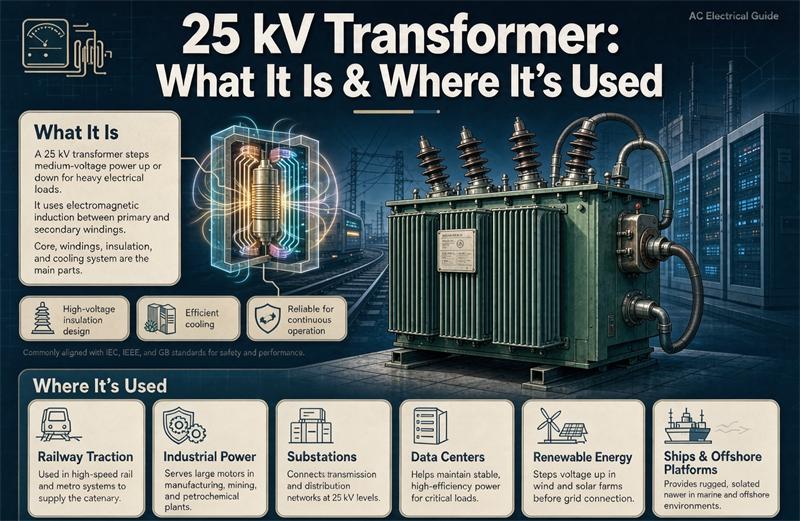
Because the class is about voltage, not power, the kVA range is enormous. The table below shows the real applications and the typical size band for each.
| Application | Typical kVA | Why 25 kV fits |
|---|---|---|
| Utility distribution substation (steps 69 or 115 kV grid down to a 25 kV feeder) | 5,000 to 50,000 kVA | Primary distribution backbone for suburban and rural service |
| Industrial plant distribution (24.9 kV in-plant bus) | 1,000 to 10,000 kVA | Large motors, paper mills, mines, process lines |
| Railway traction supply (25 kV AC, 60 Hz) | 5,000 to 40,000 kVA | Feeds catenary; North American commuter and high-speed lines are adopting 25 kV |
| Renewable collector (solar and wind step-up) | 1,000 to 10,000 kVA | Aggregates distributed generation to the collector voltage |
| Pad-mounted and pole distribution | 100 to 5,000 kVA | Suburban and rural feeder taps and lateral services |
The takeaway is simple. “25 kV transformer” can mean a 100 kVA pole unit or a 40,000 kVA rail substation unit. The voltage class unites them. The kVA, the cooling method, and the enclosure do not.
A quick current reality check
On the 25 kV winding the current is tiny, which is exactly why the class is an insulation spec and not a heavy-conductor spec. Three-phase full-load current is kVA times 1,000 divided by the square root of 3 times 25,000. A 1,000 kVA unit draws about 23 amps on the high side. A 5,000 kVA unit draws about 116 amps. A 10,000 kVA unit draws about 231 amps. Compare that to the low-voltage side of the same transformer, where the amps are an order of magnitude higher, and you see where the engineering effort goes. The money is in the insulation, the clearances, and the secondary, not in the 25 kV conductor.
Liquid, dry-type, or pad-mounted: how to pick
The choice follows the installation, and it changes the BIL default you should specify.
For indoor or clearance-limited spaces, a dry-type (cast resin) unit is the usual call, but remember the 110 kV IEEE default and write 125 kV if your coordination study needs it. For outdoor utility and industrial sites, a liquid-immersed unit with 125 kV BIL and ONAN or ONAF cooling is the workhorse. Pad-mounted dead-front units use IEEE 386 separable connectors, the 200 A loadbreak and 600 A deadbreak elbows, for underground distribution. Substation-style units use throat or bus connections built into a switchgear lineup.
The oil-immersed versus dry-type comparison walks through the trade-offs in more detail, including fire rating and maintenance.
The standards trail you will be asked for
A 25 kV class unit normally comes with a stack of references. IEEE C57.12.00 covers liquid-immersed general requirements, including the 125 kV BIL. IEEE C57.12.01 covers dry-type general requirements, where the 110 kV default lives. IEEE C57.12.27 and C57.12.28 cover substation transformers and enclosures. IEEE 386 covers the separable connectors. IEEE 37.20.2 covers the metal-clad switchgear these units feed. IEEE Std 4 defines the impulse test itself. For dry-types, UL 1562 applies to units from 601 V up to 35 kV.
If you buy from an IEC-region vendor, the IEEE versus IEC standards explainer lays out where the BIL and naming conventions diverge, because that divergence is where mis-specified 25 kV units sneak through.
What you will pay, and why quotes swing a hundredfold
Because 25 kV is a class and not a model, price tracks kVA, cooling, and enclosure. Published EXW reference bands for pad-mounted and distribution units in the 15 to 25 kV class run roughly:
| Size band | 15 to 25 kV class price (EXW) |
|---|---|
| 75 to 150 kVA | $1,800 to $3,500 |
| 300 to 500 kVA | $4,500 to $9,000 |
| 750 to 1,000 kVA | $8,500 to $16,000 |
| 1,500 to 2,500 kVA | $12,000 to $30,000 |
| 3,000 to 5,000 kVA | $25,000 to $60,000 |
Rail traction is a different world. Stationary substation units for 25 kV feeding systems run about $150,000 to $400,000, on-board units around $250,000 to $500,000, and substation-grade units up to $400,000 to $800,000 depending on redundancy and monitoring.
Those numbers are EXW (ex works) and exclude ocean freight, insurance, and import duty. For landed cost, plan for the Section 232 tariff on electrical transformers (HTS 8504), which sits at 25 percent and took effect on 2026-04-06. Units above 10,000 kVA were deferred to 2027-12-31, so most distribution and plant 25 kV units pay the full rate. Treat every figure here as a published indication, not a quotation.
DOE efficiency: does it even apply?
This is the part competitors get wrong by assuming one answer. DOE 10 CFR 431 covers liquid-immersed transformers from 10 to 5,000 kVA and dry-types from 15 to 5,000 kVA, but only when the secondary is 600 V or below. So a 25 kV primary with a 480Y/277 V secondary unit is covered, and the compliance date is 2029-04-23 (per 89 FR 29834 and 90 FR 43371). A 25 kV primary with a 4,160 V plant-distribution secondary is not covered, because the secondary exceeds 600 V. Know which one you are buying before you cite an efficiency level, because quoting the wrong rule to an AHJ wastes a submittal cycle.
Your RFQ checklist
Paste this into a request for quote so the factory builds the right unit the first time:
- Voltage class and nominal: 25/28 kV class, 24.9 kV nominal system.
- BIL by insulation type: 125 kV for liquid, 110 or 125 kV for dry (state it).
- kVA, vector group, and tap range (typically plus or minus 2 by 2.5 percent).
- Cooling method: ONAN, ONAF, AN, or AF.
- Enclosure: NEMA 3R, pad-mounted dead-front with IEEE 386 elbows, or substation style.
- Standards: IEEE C57.12.x, UL 1562 for dry-type, plus any utility-specific specs.
- Secondary voltage, because it decides DOE coverage (480Y/277 versus 4,160Y).
- Surge arrester coordination matched to the BIL.
For application-specific guidance, the rail transit traction solutions and renewable pages cover the two fastest-growing 25 kV use cases.
Bottom line
A 25 kV transformer is defined by its insulation class, not its size. Get the BIL right (125 kV liquid, 110 kV dry unless you ask for more), match the unit to the application, and write the RFQ around the class rather than a made-up “25 kV price.” Once you know the type you need, the specific buying guides for pad-mounted, distribution, or substation units will take you the rest of the way. You can also review our project case studies and the full product catalog for real-world 25 kV class builds, or return to the home page for the complete solution map.
FAQ
Is 25 kV a transformer size or a voltage class? It is a voltage class. The 25 kV (more precisely 25/28 kV) class describes the insulation system and Basic Insulation Level on the high-voltage winding. It says nothing about the kVA, which can range from 100 kVA pole units to 40,000 kVA rail substation units.
What is the standard BIL for a 25 kV class transformer? It depends on insulation type. Liquid-immersed units use 125 kV BIL per IEEE C57.12.00. Dry-type units use 110 kV BIL per IEEE C57.12.01, or 125 kV if built to CSA C9.02. Always state the BIL you need by type, because the defaults differ.
Why does BIL differ between oil and dry-type 25 kV transformers? The standards set different minimum BIL values by insulation construction. IEEE C57.12.00 sets 125 kV for liquid-immersed, while IEEE C57.12.01 sets 110 kV for dry-type. The dry-type default is lower unless you specifically call for the 125 kV CSA level, so a generic quote can quietly ship the lower number.
What nominal voltage is the 25 kV class? The nominal system voltage is 24.94 kV, written as 24.9 kV. Equipment is rated and cataloged as a 25/28 kV class, meaning it is built for that voltage range with the corresponding BIL and bushing ratings.
What is the difference between 15 kV, 25 kV, and 34.5 kV classes? They are steps on the distribution ladder. The 15 kV class (12.47 and 13.8 kV nominal) is the dominant urban primary. The 25 kV class (24.9 kV nominal) is suburban and rural distribution. The 34.5 kV class is sub-transmission and long rural feeders, with a 150 kV BIL.
How much current flows in a 25 kV winding? Very little. Three-phase full-load current is kVA times 1,000 divided by the square root of 3 times 25,000. A 1,000 kVA unit draws about 23 amps, a 5,000 kVA unit about 116 amps, and a 10,000 kVA unit about 231 amps on the high-voltage side.
Where are 25 kV transformers used? Mainly utility distribution substations that step grid voltage down to a 24.9 kV feeder, industrial plant distribution, railway traction supply at 25 kV AC, renewable collector systems, and pad-mounted or pole distribution taps. The class covers both tiny and huge units.
Are 25 kV transformers covered by DOE 2016 or the 2029 rule? Only some of them. DOE 10 CFR 431 applies to liquid units 10 to 5,000 kVA and dry units 15 to 5,000 kVA with a secondary of 600 V or less. A 25 kV primary with a 480 V secondary is covered (2029-04-23 compliance). A 25 kV primary with a 4,160 V secondary is not, because the secondary exceeds 600 V.
What standards apply to 25 kV class transformers? IEEE C57.12.00 (liquid), IEEE C57.12.01 (dry), IEEE C57.12.27 and C57.12.28 (substation and enclosure), IEEE 386 (separable connectors), IEEE 37.20.2 (metal-clad switchgear), IEEE Std 4 (impulse test), and UL 1562 for dry-types from 601 V to 35 kV.
How much does a 25 kV transformer cost? It depends entirely on kVA and type. Pad-mounted distribution units in the 15 to 25 kV class run about $1,800 to $60,000 EXW across the 75 kVA to 5,000 kVA range. Rail traction substation units run $150,000 to $800,000. Add freight and the 25 percent Section 232 tariff for landed cost.
What is the Section 232 tariff impact on 25 kV transformers? Electrical transformers fall under HTS 8504 and carry a 25 percent tariff that took effect on 2026-04-06. Units above 10,000 kVA were deferred to 2027-12-31, so most distribution and plant 25 kV units pay the full rate on top of EXW price.
How do I specify a 25 kV transformer in an RFQ? State the class and nominal (25/28 kV, 24.9 kV), the BIL by insulation type, kVA, vector group, taps, cooling, enclosure, the applicable IEEE and UL standards, the secondary voltage (it drives DOE coverage), and surge arrester coordination. A complete RFQ prevents the factory from filling gaps with the cheapest default.