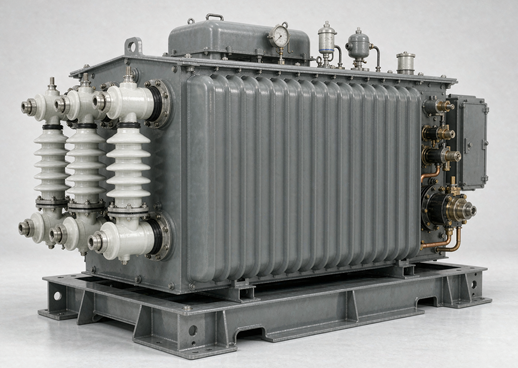
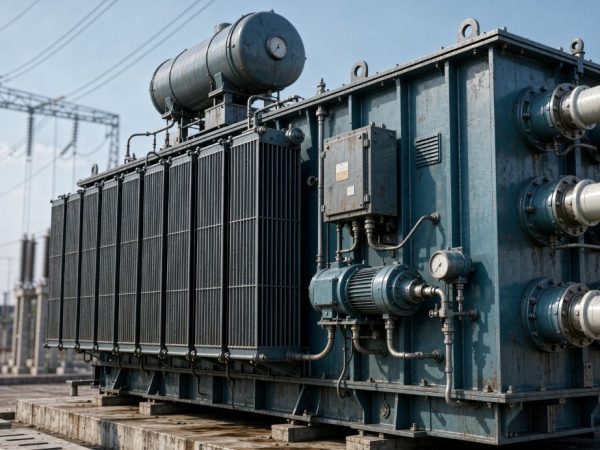
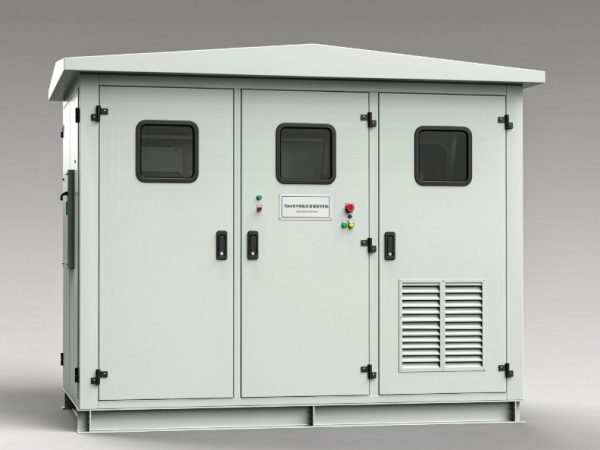
An EV charger transformer is the power-conversion heart of any charging site. It takes utility voltage — typically 10 kV or 35 kV — and steps it down to the 380 V that charger power modules are built for, and it has to do that under conditions that would wear out an ordinary distribution transformer in a few years: constant start/stop cycles, load that swings from near zero to full draw in minutes, outdoor exposure, and zero tolerance for downtime.
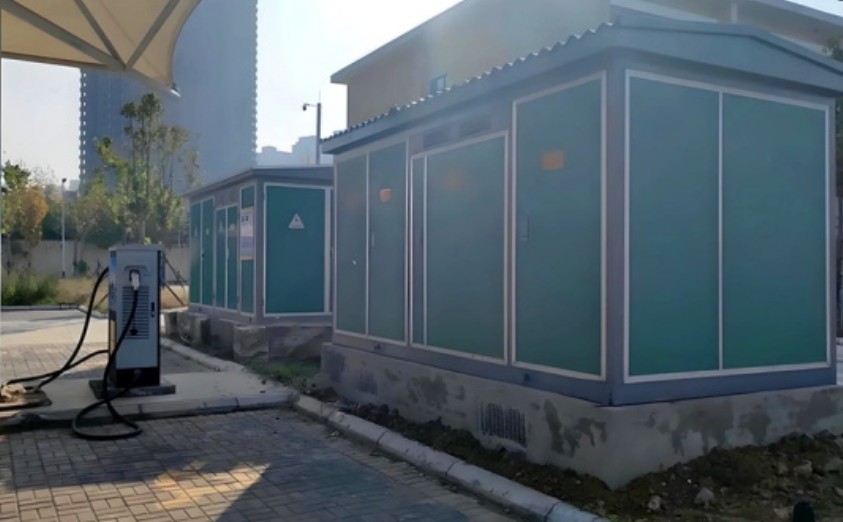
This guide walks through the three decisions that actually determine whether a charging site runs reliably: how to size the transformer, which type fits your site, and how to install it safely. Every recommendation below is written for real-world projects, not for a datasheet. If you want to see the hardware these specs apply to, start with our full line of transformer products.
1. Core Technical Parameters and How to Choose Them
1.1 Capacity Sizing — Avoid Both Overload and Wasted Money
Use this formula as your starting point:
Rated capacity (Sₙ) ≥ Total charger power (P_total) × Diversity factor (Kₜ) × Safety factor (Kₛ)
Diversity factor (Kₜ) — the more chargers you have, the less likely they all peak at once:
| Number of chargers | Diversity factor (Kₜ) |
| 1–4 chargers | 0.8–1.0 |
| 5–10 chargers | 0.6–0.8 |
| More than 10 chargers | 0.5–0.7 |
Safety factor (Kₛ): 1.2–1.3. This covers peak loading, cable losses, and the headroom you’ll want when you add chargers later.
Worked examples:
- 3 × 120 kW DC fast chargers: Sₙ = 3 × 120 × 0.9 × 1.2 = 388.8 kVA → specify 400 kVA (or step up to 500 kVA if you plan to expand).
- 10 × 60 kW DC fast chargers: Sₙ = 10 × 60 × 0.6 × 1.2 = 432 kVA → specify 500 kVA.
- Mixed site (6 × 60 kW DC fast + 10 × 7 kW Level 2): Sₙ = (6 × 60 + 10 × 7) × 0.7 × 1.2 = 361.2 kVA → specify 400 kVA.
Note for North American projects: 400 kVA and 630 kVA are IEC standard ratings. In the US, three-phase pad-mounted units are most commonly stocked at 300 kVA, 500 kVA, and 750 kVA — so round up to the nearest available rating rather than assuming a custom build.
1.2 Key Electrical Parameters That Affect Reliability
| Parameter | Requirement | What to specify |
| Voltage class | Input: 10 kV (most common) / 35 kV; Output: 380 V ±5% | Match the serving utility’s primary voltage on the input side. On the output side, confirm the charger modules’ acceptable input window before ordering. In North America, the low-voltage side is normally 480Y/277 V (600Y/347 V in Canada), not 380 V. |
| Vector group | Dyn11 (Δ/Yn-11) preferred | Suppresses third harmonics and supports a four-wire secondary, which you need when chargers and control/auxiliary loads share one transformer. Note that IEC Dyn11 is labeled Dyn1 on ANSI/IEEE drawings — confirm the notation with your utility so the unit is not built to the wrong connection. |
| Short-circuit impedance (%Z) | 10 kV class: 4%–5%; 35 kV class: 6%–7% | Too low and fault current climbs, forcing you into heavier switchgear and cable. Too high and voltage sags every time a charger ramps up. |
| Efficiency grade | ≥ China GB 20052-2020 Grade 1 | Worth it on sites that run around the clock. A 630 kVA Grade-1 unit saves on the order of ¥500 a year (roughly USD 70) versus a Grade-2 unit under typical duty — and the gap grows with load factor and local tariff. |
| Insulation & temperature rise | Class F (outdoor) / Class H (indoor); winding rise ≤ 100 K for Class F | For hot outdoor sites, pair Class F with forced cooling. For indoor installations where fire safety drives the spec, go Class H dry-type. |
If you’re exporting into a market that follows ANSI/IEEE rather than IEC, read IEC 60076 vs ANSI/IEEE: Standards for Export Transformers before you lock the nameplate — the voltage, BIL, and vector group notation all change.
1.3 Environmental Specs — Where Transformers Actually Fail
Ingress protection (IP / NEMA):
| Site condition | Rating | US enclosure equivalent |
| Open outdoor | IP54 (dust-protected, splash-proof) | NEMA 3R |
| Coastal, salt fog, or persistently humid | IP65 (sealed, corrosion-resistant) | NEMA 4X |
| Indoor garage | IP32 (dust and dripping water) | NEMA 1 / 2 |
Ambient temperature:
- Standard: −25 °C to +40 °C (−13 °F to 104 °F)
- Cold climate: −40 °C to +40 °C (−40 °F to 104 °F) — use low-pour-point oil in liquid-filled units, add space heaters in dry-type units
- Hot climate: −20 °C to +50 °C (−4 °F to 122 °F) — forced-oil/forced-air cooling for liquid-filled, forced ventilation for dry-type
Noise: ≤55 dB(A) indoors, ≤60 dB(A) outdoors. Dry-type units are the quieter option and are usually the right call near homes, hotels, and hospitals. For a real example of what low-noise cast resin design looks like in a sensitive environment, see our low-noise cast resin dry-type transformer project for a city hospital.
2. Main Transformer Types Compared
| Type | Key characteristics | Best application | Budget per unit* | Watch out for |
| Oil-immersed (ONAN/ONAF) | Strong overload capability (1.2× short-term), long service life (20–30 years), moderate cost | Large outdoor charging hubs (≥500 kVA), sustained high load | 100 kVA: ¥30,000–50,000 (≈ USD 4,200–7,000); 630 kVA: ¥150,000–220,000 (≈ USD 21,000–31,000) | Requires an oil containment pit; ≥5 m (16 ft) fire separation. In the US, secondary containment must meet EPA SPCC rules (40 CFR 112). |
| Epoxy resin cast dry-type | Fire- and explosion-safe, quiet (≤55 dB(A)), compact, flexible installation | Indoor charging (parking garages, malls), residential neighborhoods | 100 kVA: ¥50,000–80,000 (≈ USD 7,000–11,000); 630 kVA: ¥250,000–350,000 (≈ USD 35,000–49,000) | Needs dehumidification in damp locations — keep relative humidity ≤85% or insulation suffers. |
| Prefabricated compact substation | Integrates HV switchgear, LV distribution, and metering; 1–2 week installation | Fast-deployment outdoor sites, constrained footprints | 200 kVA: ¥180,000–250,000 (≈ USD 25,000–35,000); 800 kVA: ¥550,000–750,000 (≈ USD 77,000–105,000) | Leave ventilation clearance around the enclosure; grounding resistance must be ≤4 Ω. |
* Indicative factory-gate pricing at approximately 7.2 CNY/USD. Excludes freight, duties, and installation.
The three types above map to real product lines: our S20 Series Oil-Immersed Distribution Transformer for high-load outdoor hubs, the SCB13 Series Cast Resin Dry-Type Transformer for indoor and fire-sensitive sites, and the YBW Series Prefabricated Compact Substation when you need HV gear, transformer, and LV distribution in one skid.
Still deciding between the first two? Oil-Immersed vs Dry-Type Transformer: How to Choose breaks the decision down by environment, fire code, maintenance, and total cost of ownership. All of these guides live in our transformer knowledge base, and you can see how comparable sites were engineered in our project case studies.
3. Installation Requirements — Where Safety Is Won or Lost
3.1 Foundation and Layout
Foundation work:
- Oil-immersed: concrete pad ≥200 mm (8 in) thick, with a load rating of at least 1.2× the transformer weight. A 630 kVA oil-filled unit weighs about 3.5 t (7,700 lb), so the pad must carry ≥4.2 t (9,300 lb).
- Dry-type and compact substations: raise the base 100 mm (4 in) above finished grade to shed standing water, and provide drainage openings.
Clearances:
| From | Minimum distance |
| Building exterior wall | 1.5 m (5 ft) |
| Charger cluster | 3 m (10 ft) |
| Maintenance aisle | 0.8 m (2 ft 8 in) single-side access / 1.0 m (3 ft 3 in) two-side access |
| Combustible materials (oil-filled, no fire wall) | 10 m (33 ft) |
For US installations, also verify working clearances against NEC 110.26 and 110.34 and with your local authority having jurisdiction — they can be stricter than the figures above, particularly above 600 V.
3.2 Wiring and Grounding
High-voltage side:
- Use copper MV cable rated for the class — YJV22-8.7/15 kV for 10 kV systems (in North America: 15 kV-class MV cable to ICEA S-93-639 / UL 1072, typically 133% insulation level). Size by rated current: a 315 kVA unit draws about 18.1 A at 10 kV, so 3 × 25 mm² (≈ 3/c #3 AWG) works.
- Install a metal-oxide surge arrester (17 kV rated for a 10 kV system), a disconnect switch, and fuses sized at 1.5–2.0× rated current.
Low-voltage side:
- Run a TN-S arrangement with the neutral and protective earth kept strictly separate — in NEC terms, the grounded (neutral) conductor and the equipment grounding conductor (EGC) stay separate downstream of the main bonding jumper.
- Size the protective conductor at ≥ 1/2 the phase conductor cross-section: a 120 mm² phase (≈ 250 kcmil) gets a 70 mm² PE (≈ 2/0 AWG).
- Torque all terminations with a calibrated torque wrench — 30 N·m (22 ft·lb) for M12 bolts. Loose lugs are the single most common cause of thermal failures in the first year.
Grounding system:
- Bond the transformer tank/enclosure, core, clamping structure, and substation housing. Use a down conductor of at least 40 × 4 mm flat steel (≈ 1½ × 5/32 in) or ø16 mm round steel (≈ 5/8 in).
- Install the ground grid as a closed ring. Grounding resistance must be ≤4 Ω, or ≤1 Ω where the site uses a common (combined) grounding system.
- In the US, size grounding electrode conductors per NEC Table 250.66 and design the grid to IEEE 80. Many US utilities specify ≤5 Ω for distribution substations, and some specify ≤1 Ω — confirm the requirement with the serving utility before you pour the foundation.
For outdoor sites where the transformer sits at grade, see Pad Mounted Transformer: Sizes, Prices & Buying Guide — it covers the enclosure, clearances, and utility acceptance issues that come with ground-level equipment.
4. FAQ: EV Charger Transformers
What size transformer do I need for four 120 kW DC fast chargers? Four chargers puts you at a diversity factor of 0.8–1.0. Using 0.9: 4 × 120 × 0.9 × 1.2 = 518.4 kVA, so specify 630 kVA. If your site has a queue-management or load-sharing system that caps total site draw, you can justify a lower diversity factor — but get that in writing from the charger vendor before you downsize.
Is it bad to oversize the transformer? Mildly. An oversized unit costs more up front, carries slightly higher no-load losses, and can push fault current high enough to affect protective device coordination. But undersizing is far worse: chronic overload, shortened insulation life, and nuisance tripping during peak demand. Oversizing by one standard rating step is normal practice; going two steps up rarely pays off.
Why is Dyn11 recommended over Yyn0? Dyn11 traps third-harmonic currents in the delta winding instead of letting them circulate back into the grid, and it gives you a four-wire secondary. Charging sites always have single-phase loads mixed in — lighting, payment terminals, gate controllers, HVAC — and a four-wire secondary keeps those balanced without a separate source.
Dry-type or oil-immersed for a parking garage? Dry-type, almost always. Garages are enclosed, occupied, and sprinklered spaces where fire code will fight you on any volume of flammable liquid. Cast resin dry-type units are flame-retardant and self-extinguishing, and they run quiet enough that you won’t get noise complaints from tenants above.
We’re building near the coast. What enclosure rating do we need? IP65 (NEMA 4X). Salt-laden air attacks enclosures, terminations, and core steel. Beyond the rating itself, ask for corrosion-protected hardware, sealed cable glands, and — for dry-type units — a dehumidifier or space heater, since salt plus humidity is what actually breaks down insulation.
Why does grounding resistance have to be ≤4 Ω? Because that’s what it takes for fault and lightning current to clear protective devices quickly instead of sitting on the equipment and raising touch/step potentials. Below 4 Ω, a ground fault may never draw enough current to trip the breaker. Test with a fall-of-potential method after installation, and re-test annually — soil moisture and corrosion both move the number over time.
How loud is a transformer, and will neighbors complain? Cast resin dry-type units typically run ≤55 dB(A) indoors; outdoor oil-filled units should stay under 60 dB(A). For context, 55 dB(A) is about the level of light rainfall or a quiet office. If the property line is close, ask for a low-noise design (reduced flux density, anti-vibration mounts) and consider a solid screen wall — it’s far cheaper than retrofitting later.
Can one transformer feed both DC fast chargers and Level 2 AC chargers? Yes, and most sites do exactly that — the mixed example in Section 1.1 is a realistic configuration. Just size the diversity factor for the whole mix rather than treating the two groups separately, and confirm that the Level 2 chargers can tolerate the voltage dip when the DC units ramp up.
What does a charger transformer actually cost? Budget roughly USD 21,000–31,000 for a 630 kVA oil-immersed unit, USD 35,000–49,000 for a 630 kVA cast resin dry-type, or USD 25,000–35,000 for a 200 kVA compact substation that includes switchgear and metering. Freight, tariffs, site work, and utility acceptance testing are on top of those numbers.
Can I use a 10 kV / 380 V transformer on a US site? Not without changes. North American primaries are typically 12.47 kV, 13.8 kV, or 34.5 kV, secondaries are 480Y/277 V, and the unit must be built and tested to ANSI/IEEE rather than IEC — including BIL levels and vector group notation. Plan for a purpose-built ANSI unit rather than trying to adapt an IEC design.
How much maintenance does a charger transformer need? Dry-type units are close to maintenance-free: inspect annually, keep cooling paths and filters clean, check terminations for signs of overheating, and log winding temperatures. Oil-immersed units add oil level and dielectric checks plus periodic dissolved-gas analysis. Do thermal scans and torque re-checks in the first year — that’s when installation issues surface.