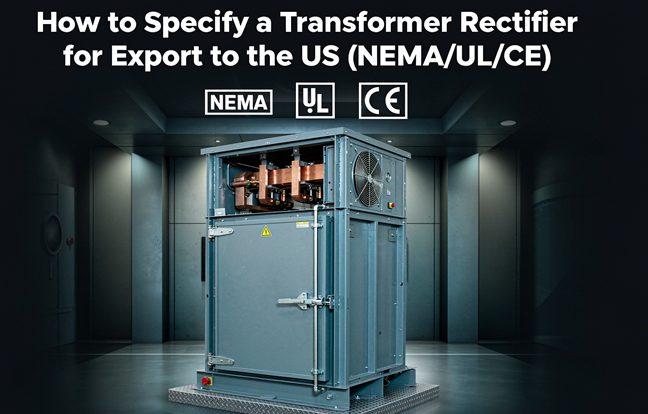
A transformer rectifier headed for the United States needs a US NRTL listing, a NEMA enclosure type and a 60 Hz design file, and a CE mark satisfies none of the three. That is the whole answer to the three acronyms in the title, and it is worth stating before anything else because the most expensive mistakes on this equipment happen at the specification stage, not on the test bench. When the listing is wrong, the usual fix is field evaluation by a US nationally recognized testing laboratory at roughly 5,000 to 15,000 USD per unit and 8 to 12 weeks of schedule. On a project with a committed energization date, that is the difference between a shipment and a claim.
This guide is written for the person who has to write the specification, not the person who has to defend a brochure. It covers which of the three marks a US authority actually accepts, which UL standard applies to a rectifier transformer rather than a general-purpose distribution unit, where the DOE efficiency rule does and does not reach, how to choose a NEMA enclosure without making the IP-to-NEMA mistake, and the fields that belong on a rectifier drawing but never appear on a distribution drawing. It ends with a paste-ready spec block and a twelve-line RFQ checklist.
First, separate the three regimes
The reason “NEMA/UL/CE” gets typed as one phrase is that all three look like marks on a nameplate. They are not the same kind of thing. They govern different objects, they are created by different legal mechanisms, and only two of them carry weight at a US jobsite.
NEMA governs the box
NEMA standards describe the construction and environment rating of the enclosure. The governing document for industrial enclosures is ANSI/NEMA 250-2020, approved 8 December 2020, which covers equipment rated up to 1,000 V. It defines what the box keeps out: solid objects, water, corrosion, external ice, oil and coolant, and in some types explosive atmospheres. NEMA does not certify that the transformer inside is safe. It tells the inspector what the steel and gaskets can survive.
UL and the other NRTLs govern the safety file
UL is a standards developer and a nationally recognized testing laboratory. Two different things carry the UL name: the standard, such as UL 1561, and the listing, which is the file that says a specific model from a specific factory was tested to that standard and is subject to follow-up inspection. OSHA runs the NRTL program under 29 CFR 1910.7, and 29 CFR 1910.303(a) requires workplace equipment to be approved. There are roughly twenty recognized laboratories, and ETL, CSA, MET, TÜV and FM marks carry the same legal weight as a UL mark in the United States. The National Electrical Code, NFPA 70, requires equipment to be “listed” in Article 100 and enforces it through 110.3(B). Article 450 covers transformers specifically. The code never says “UL.”
CE is a European self-declaration
CE marking says the manufacturer declares conformity with applicable European directives, typically the Low Voltage Directive, the EMC Directive and RoHS for this class of equipment. It is a self-declaration backed by a technical file, not a third-party listing. It is the correct mark for the European market and it is the wrong document for a US electrical inspector. CE marking is not accepted as a substitute for NRTL listing in the United States. A unit with a CE mark and no NRTL mark is, from the viewpoint of the authority having jurisdiction, unlisted.
| Regime | What it actually covers | How compliance is established | Accepted by a US AHJ? |
|---|---|---|---|
| NEMA 250 | Enclosure construction and environment | Manufacturer rating to a NEMA type; third-party listing of the enclosure is available but separate | Yes, as the enclosure specification |
| UL / other NRTL | Electrical safety of the unit | Testing and listing of the specific model, plus factory follow-up inspection | Yes, this is the gate |
| CE | European safety, EMC and environmental directives | Manufacturer self-declaration of conformity with a technical file | No |
One sentence to take to your next supplier call: NEMA describes the box, UL or an equivalent NRTL certifies the unit, and CE describes a different market. If a supplier offers “CE/UL/NEMA certified” as a single package without naming the standard, the file number and the NEMA type, you have received a marketing phrase, not a specification.
Which UL standard applies to a rectifier transformer
This is where a rectifier transformer stops being a distribution transformer. The tier is set by primary voltage first and kVA second, and the winding configuration can move the unit in or out of a category.
Decide by primary voltage first
A rectifier transformer with a 600 V class input and a low-voltage DC feed belongs in the low-voltage family. As soon as the primary exceeds 600 V, the unit moves to a medium-voltage standard even if the secondary feeds a low-voltage bridge. A 12.47 kV primary with a 600 V secondary to a 12-pulse rectifier is a medium-voltage machine for listing purposes. Specifying it as a low-voltage unit because the process side is 600 V is a common and expensive error.
Then apply the kVA tiers
| Standard | Voltage and capacity band | Typical use on a rectifier system |
|---|---|---|
| UL 5085-1 / 5085-2 | Up to 600 V, generally 100 VA to 10 kVA | Control transformers, isolation transformers in the rectifier control cubicle |
| UL 1561 | Up to 600 V, above 10 kVA, dry-type | Low-voltage dry-type rectifier transformers and large control power units |
| UL 1562 | Above 600 V primary, dry-type | Medium-voltage dry-type rectifier transformers |
| IEEE C57.18.10 / IEC 61378-1 | Product performance standards, not listing standards | The electrical design basis for semiconductor rectifier transformers |
Note the last row carefully. IEEE C57.18.10, the 2021 edition, is the North American product standard for semiconductor rectifier transformers. IEC 61378-1 is the international equivalent for converter transformers. Neither one is a safety listing. You need both layers: a product standard for the design and the tests, and an NRTL listing for US acceptance. Suppliers who quote only “built to IEC 61378” have given you a design basis, not permission to install.
Listed, Recognized, and the UL 1446 trap
Three phrases get used as if they were interchangeable. They are not.
- UL Listed means the complete unit was evaluated against a product standard, carries the mark, and is subject to follow-up inspection. This is what a standalone transformer connected to the facility needs.
- UL Recognized means the component was evaluated for use inside another listed product. A recognized insulation system or a recognized transformer component is not a listed unit.
- UL 1446 covers insulation system materials by thermal class. It is a material-level file. A UL 1446 certificate does not test short-circuit withstand, temperature rise under load, enclosure construction or fire enclosure performance, and it cannot stand in for UL 1561 or UL 1562.
Ask for the file number, then look it up in the UL directory. Confirm the file covers the exact model, the voltage ratio, the kVA rating, the insulation class and the production facility. A certificate image that shows a different plant or a different rating is not evidence for your unit. Field evaluation cost and the 8 to 12 week clock start when that mismatch is discovered.
Canada changes the mark
If the same specification is being used for a Canadian project, the requirement becomes cULus or a CSA mark. The “c” is not decoration. A UL-only mark is not recognized in Canadian provinces, and Canada’s efficiency regime differs from the US one even though the test method is largely the same. Specify the destination jurisdiction explicitly. “North American compliant” is not a specification.
The DOE efficiency gate, and the exemption that looks tempting
Energy conservation for distribution transformers in the United States lives in 10 CFR Part 431, Subpart K, with the standards in section 431.196. It is a separate gate from safety listing. A unit can be perfectly listed and still be illegal to manufacture for the US market if it misses the applicable efficiency floor.
What the rule covers
The rule uses insulation type, voltage and capacity. The covered categories are liquid-immersed units from 10 to 5,000 kVA, low-voltage dry-type units from 15 to 5,000 kVA with input at 600 V or below, and medium-voltage dry-type units from 15 to 5,000 kVA with primary between 601 V and 34.5 kV. All three categories are 60 Hz with output of 600 V or less.
The test conditions differ by category and this is a frequent source of bad comparisons:
| Category | Test load point | Load-loss reference temperature |
|---|---|---|
| Low-voltage dry-type | 35 percent of nameplate | 75 °C |
| Medium-voltage dry-type | 50 percent of nameplate | 75 °C |
| Liquid-immersed | 50 percent of nameplate | 55 °C |
No-load loss is measured at 20 °C for all three. A test report from a 50 Hz program, or one measured at a different load point, cannot be dropped into a DOE submission.
The 2029 step
A 2024 final rule raised the floors, and the new values apply to units manufactured on or after 23 April 2029. Units already in service do not need replacing. Some illustrative three-phase low-voltage dry-type numbers from the tables show the size of the step: 300 kVA moves from 99.02 percent under the current table to 99.42 percent, and 1,000 kVA moves from 99.28 percent to 99.42 percent. The 0.40 point move at 300 kVA is not a rounding detail. It changes core steel selection and it changes price.
For a project landing after the compliance date, write the manufacturing date and the applicable table into the specification. “DOE compliant” without a table and a date is one of the four phrases that cause rejection at review.
The exclusion list, and why you should be careful with it
The rule excludes more than a dozen special categories, including autotransformers, drive isolation transformers, grounding transformers, machine-tool control transformers, welding transformers, non-ventilated transformers, sealed transformers, special-impedance transformers, test transformers, units with a tap range of 20 percent or more, and UPS transformers.
A rectifier transformer often looks like it belongs on that list. It has a special impedance, it drives a semiconductor bridge, and it may be sold as a drive isolation unit. Here is the rule that matters: scope is determined by construction, configuration and application, not by the product name on the purchase order. A supplier claiming an exemption has to show which exclusion applies and why the winding arrangement and impedance qualify. “It is a rectifier transformer, so DOE does not apply” is not a defensible position.
The practical consequence is contractual. If the project is scheduled to manufacture after 23 April 2029, require theBidder to state either the applicable efficiency table and value at the test load point, or the specific exclusion with its basis. Put the sentence in the spec. Do not accept a verbal assurance at a video call.
Enclosures: choose the NEMA type, then add IP as a supporting number
Rectifier transformers often sit in electrical rooms, but the ones that serve electrolytic plants, water treatment, plating lines and mining installations end up outdoors or in washdown areas. The enclosure choice is a real engineering decision, not a line on a datasheet.
The mapping works in one direction
| NEMA type | Environment | Approximate IP equivalent | What IP does not tell you |
|---|---|---|---|
| 1 | Indoor, general purpose | IP20 | Nothing about water or dust ingress |
| 3R | Outdoor rain, sleet, external ice | IP24 | No dust-tightness |
| 4 | Indoor or outdoor, hose-directed water, windblown dust, ice | IP66 | Different test method and flow rate |
| 4X | Type 4 plus corrosion resistance | IP66 plus corrosion | Salt-fog performance, typically ASTM B117 |
| 12 | Indoor industrial, dust and dripping non-corrosive liquid | IP54 | Oil and coolant exposure |
| 13 | Type 12 plus oil and coolant spray | IP54 plus oil | Machine-tool environments |
| 6 | Temporary submersion | IP67 | Prolonged immersion |
| 6P | Prolonged submersion plus corrosion | IP68 | Corrosion resistance |
A NEMA rating can generally be mapped to a minimum IP equivalent because NEMA testing is the broader set. The reverse is not valid. An IP66 enclosure has not been tested for salt-fog corrosion, gasket aging under ice, or oil exposure. Specifying “IP66, equivalent to NEMA 4X” points the arrow the wrong way and it will be caught on a coastal or chemical job, usually eighteen months after installation when the hinges start to go.
Write both marks, in the right order
For a North American installation, specify the NEMA type as the requirement and the IP number as supporting information: “Enclosure: NEMA 4X (IP66 shown for reference).” For a global unit that will be shipped to several markets, list both explicitly and require the manufacturer to state that the enclosure has been tested to both. Do not let a converter calculate one from the other.
There is a thermal consequence too. A tighter seal reduces ventilation. A rectifier transformer dissipates load loss continuously, and an enclosure that keeps dust out can turn into an oven. Require the temperature rise to be stated at the specified enclosure and at the actual cooling mode, and require the heat balance to be shown if the unit is sealed or filtered. This is the same trade-off that catches mine-site rectifiers specified for high altitude, and it is worth asking for the calculation rather than the assertion.
Fields that belong on a rectifier drawing
Everything above is necessary and none of it is sufficient. A listed, efficiently built, correctly enclosed transformer can still be the wrong transformer for a rectifier if the electrical fields are missing.
Phase shift and pulse configuration
A six-pulse bridge produces characteristic harmonics at h equals 6k plus or minus one, beginning with the fifth and seventh. A twelve-pulse bridge needs two secondary windings displaced by 30 electrical degrees, and the first remaining characteristic harmonics are the eleventh and thirteenth. A twenty-four-pulse arrangement uses four windings with 15 degree steps between bridges. A 15 degree error on a 12-pulse system is half of the required shift, so the harmonic cancellation simply does not happen.
State the pulse count, the number of secondaries, the vector group of each, and the required phase displacement in degrees on the drawing. “12 pulse” alone is not enough. The phase-shift winding is a physical construction detail that must appear in the factory test report.
BIL and insulation coordination
Basic impulse insulation level must be specified at the primary for the actual system voltage, not copied from a general distribution template. A 25 kV class rectifier transformer is commonly quoted with a 125 kV BIL, but the correct value depends on the utility’s insulation coordination study and the grounding method. Get it from the utility requirements, state it on the drawing, and require an impulse test report at that level.
Harmonic duty and IEEE 519-2022
The bridge is a harmonic source and the utility cares what happens at the point of common coupling, not at the transformer terminals. IEEE 519-2022 sets current distortion as a percentage of the fundamental component of the load current, and the limit tightens as the short-circuit ratio falls: 5 percent TDD where Isc over IL is below 20, 8 percent from 20 to 50, 12 percent from 50 to 100, 15 percent from 100 to 1,000, and 20 percent above 1,000.
For reference, the ideal input-current total harmonic distortion of a six-pulse bridge is about 31.084 percent, a twelve-pulse bridge about 15.219 percent, an eighteen-pulse bridge about 10.107 percent and a twenty-four-pulse bridge about 7.570 percent. That progression assumes ideal conditions and it does not adjust for transformer impedance mismatch, firing-angle error or an unbalanced supply. A twelve-pulse unit feeding a weak grid at Isc over IL below 20 will not meet the 5 percent band on its own, whatever the datasheet says. Ask the plant engineer for the short-circuit ratio and put it in the RFQ.
Primary line current
Rectifier transformers are specified by kVA on the primary, and the current that matters for fusing, cable and utility metering is line current. The relationship is kVA times 1,000 divided by the square root of three times line-to-line voltage. For a 1,000 kVA unit:
| Primary | Line current at 1,000 kVA |
|---|---|
| 4.16 kV | 139 A |
| 12.47 kV | 46 A |
| 13.8 kV | 42 A |
| 34.5 kV | 17 A |
The same unit draws three times the current at 4.16 kV that it does at 12.47 kV. A buyer who compares two offers on kVA alone and ignores the primary voltage is comparing two different protection designs.
Frequency, in the direction that matters
North American industrial systems run at 60 Hz. A transformer designed for 50 Hz and operated at 60 Hz sees lower flux because flux is proportional to voltage divided by frequency, so that direction is usually safe, though the output can shift slightly. A transformer designed for 60 Hz and connected to a 50 Hz system sees higher flux and can saturate the core, overheat and become noisy. Ask for a 60 Hz design file, not a relabeled 50 Hz nameplate, and require the test report to state the frequency at which the losses were measured.
A worked specification: 1,000 kVA, 12-pulse, 12.47 kV to 600 V
Put the abstract rules together and the specification stops being vague. Assume an electrolytic process with two six-pulse bridges fed from a single transformer, an indoor electrical room with a dusty atmosphere, and a manufacturing date in 2028, ahead of the 2029 efficiency step.
Service and topology
Three-phase, 60 Hz, 1,000 kVA, primary 12.47 kV, two secondary windings feeding a 12-pulse rectifier, phase displacement 30 degrees between bridges. Primary line current is 1,000 times 1,000 divided by 1.732 times 12,470, which is about 46 A. Protective device selection starts there, not at a rule of thumb.
Product standard and tests
Design to IEEE C57.18.10 for the rectifier duty and state the impedance at which the unit was designed. Require routine tests plus a phase-shift verification and an impulse test at the stated BIL. HIPOT values must be stated for both secondaries.
Safety listing
UL 1562 listing for a dry-type unit with a primary above 600 V, with the file number named in the purchase order. Do not accept an insulation-system certificate in its place. If the installation is in Canada, specify cULus.
Efficiency
Because the unit is a rectifier transformer with special impedance, require the bidder to state either the applicable 10 CFR 431 Subpart K table value at the correct test load point, or the exact exclusion and its technical basis. For a 2028 manufacturing date, the current table applies. Do not write “DOE compliant” alone.
Enclosure
Indoor industrial location with dust, so NEMA 12 with IP54 shown for reference. Require the temperature rise to be stated at that enclosure with the actual ventilation arrangement. If the process area is a washdown or coastal site, move to NEMA 4X and require the corrosion test basis.
Harmonics
Provide the site short-circuit ratio. If it is below 20, state that a 12-pulse arrangement alone is not expected to meet the 5 percent TDD band and require the harmonic study before order release. Twelve-pulse ideal distortion is 15.219 percent before any real-world correction.
That is a page of text, and it removes most of the arguments that happen at receiving inspection.
The paste-ready specification block
The following can be dropped into a specification with the bracketed fields filled in. The bracketed values are the ones the buyer must supply. They are not things a supplier should guess.
Unit: [1] x three-phase rectifier transformer, [1,000] kVA, 60 Hz
Primary: [12.47] kV, [delta or grounded wye as per utility]
Secondary: [2] x [600] V windings, 12-pulse, 30 electrical degrees apart
Vector group: [Dyn11 / Dd0 or as shown on approved drawing]
Impedance: [stated value] percent at [reference tap]
BIL: [125] kV primary, [stated] kV secondary
Design standard: IEEE C57.18.10 (state edition); IEC 61378-1 only if accepted by AHJ
Safety listing: UL 1562 Listed, file number [to be named], US installation
  (Canada: cULus or CSA, state explicitly)
Efficiency: 10 CFR 431 Subpart K, [table and value at 50 percent load for MV dry-type],
  or [specific exclusion with technical basis]
Enclosure: NEMA [12] indoor industrial, IP [54] shown for reference
Cooling: [AN/AF], temperature rise stated at the specified enclosure
Altitude: [site elevation] m; derating basis to be stated by manufacturer
Harmonics: 12-pulse; site Isc/IL = [value]; IEEE 519-2022 TDD band [value]
Tests: routine tests plus phase-shift verification, impulse at stated BIL,
  ratio and polarity, temperature rise, and loss measurement at DOE load point
Documents: certified test report, NRTL file number, enclosure rating sheet,
  outline drawing, terminal marking drawing, 60 Hz nameplate proof
The twelve-line RFQ checklist
Before the enquiry goes out, confirm that these twelve answers are in your hands. If a supplier asks you to specify any of them, the specification is not finished.
- Destination jurisdiction, named as a country and a state or province.
- Site short-circuit ratio at the point of common coupling, from the plant engineer.
- Primary voltage, vector group and grounding method, from the utility requirements.
- Pulse count, number of secondary windings and phase displacement in degrees.
- Secondary voltage and the DC load that sets the process current.
- Impedance at the reference tap, and the reason it was chosen.
- Insulation class and the exact BIL at each winding.
- Enclosure type by environment, with the NEMA type written first.
- Cooling mode, altitude and the temperature-rise basis at that enclosure.
- Manufacturing date, and therefore which DOE table applies.
- Listed file number covering this exact model, ratio, kVA and factory.
- Required documents, named one by one, with a delivery milestone attached.
A supplier who answers all twelve in a table is worth a technical call. A supplier who answers with a catalogue link is telling you how the project will go.
What happens when the paperwork is wrong
The cost of a wrong mark is rarely visible in the purchase price. It shows up later. A transformer that arrives without an acceptable listing may be evaluated in the field, at roughly 5,000 to 15,000 USD per unit and 8 to 12 weeks. A unit whose CE mark was offered as a substitute may be refused by the local inspector regardless of how well it tests. Insurers can decline a claim on equipment that was not listed as required, and the exclusion is usually discovered after an incident, not before.
There is also the tariff layer, which is separate from the compliance layer and easy to confuse with it. Duties on Chinese-origin transformers have included Section 301 measures, and metal-content measures under Section 232 have been changing. Confirm the current HTS classification and the applicable duty with your broker before the order is signed. A listing certificate does not change the tariff, and a tariff ruling does not change the listing requirement.
FAQ
Does CE marking satisfy US electrical safety requirements for a transformer rectifier? No. CE is a European self-declaration and it is not accepted as a substitute for NRTL listing in the United States. A US authority having jurisdiction looks for a listed mark from UL, ETL, CSA, MET, TÜV or another OSHA-recognized laboratory under 29 CFR 1910.7. Field evaluation after arrival typically runs 5,000 to 15,000 USD per unit and 8 to 12 weeks.
Which UL standard applies to a rectifier transformer with a 12.47 kV primary? UL 1562 applies to a dry-type unit with a primary above 600 V. A 600 V and below unit above 10 kVA falls under UL 1561, and control and isolation transformers under 600 V and below 10 kVA fall under UL 5085. The listing standard is separate from the design standard, which for rectifier duty is IEEE C57.18.10 in North America.
Is an insulation system certificate from UL 1446 enough to pass inspection? No. UL 1446 covers insulation materials by thermal class. It does not evaluate short-circuit withstand, load temperature rise, enclosure construction or fire performance. It is a component-level file and it cannot replace a UL 1561 or UL 1562 listing for a standalone unit.
Does the DOE efficiency rule apply to rectifier transformers? It depends on construction, not on the name on the purchase order. The covered categories in 10 CFR 431 Subpart K are liquid-immersed, low-voltage dry-type and medium-voltage dry-type units within defined voltage and kVA bands at 60 Hz. Exclusions include drive isolation, special-impedance, welding, test and UPS transformers. The bidder must state either the applicable table value at the correct test load point or the specific exclusion with its technical basis.
What efficiency test load applies to a dry-type rectifier transformer? Low-voltage dry-type units are tested at 35 percent of nameplate load with load losses referenced to 75 °C. Medium-voltage dry-type units are tested at 50 percent load, also at 75 °C. Liquid-immersed units use 50 percent load and a 55 °C load-loss reference. No-load loss is measured at 20 °C for all three categories.
Can I specify IP66 instead of NEMA 4X for a coastal installation? No. A NEMA 4X enclosure meets the applicable IP66 ingress requirements, but an IP66 enclosure has not been tested for salt-fog corrosion, external ice or gasket aging. Specify NEMA 4X first and list IP66 as supporting information. The mapping works one way only.
Why does a 12-pulse rectifier need a 30 degree phase shift? A 12-pulse bridge combines two six-pulse bridges. The characteristic harmonics of a six-pulse bridge start at the fifth and seventh, and a 30 electrical degree displacement cancels those components in the input current, leaving the eleventh and thirteenth as the first remaining harmonics. Half that shift, 15 degrees, is a 24-pulse arrangement between adjacent bridges. Ideal input distortion falls from about 31.084 percent at six pulse to 15.219 percent at twelve pulse.
What current does a 1,000 kVA transformer draw on a 12.47 kV primary? About 46 A. The calculation is 1,000 times 1,000 divided by the square root of three times 12,470 V. The same 1,000 kVA unit draws 139 A at 4.16 kV and 42 A at 13.8 kV, so protection and cable sizing cannot be decided on kVA alone.
What TDD limit applies to a 12-pulse rectifier under IEEE 519-2022? The limit depends on the short-circuit ratio at the point of common coupling. It is 5 percent where Isc over IL is below 20, then 8, 12, 15 and 20 percent as the ratio rises through the bands at 50, 100 and 1,000. A twelve-pulse bridge has ideal distortion of 15.219 percent before real-world corrections, so a weak grid below a ratio of 20 will need additional treatment.
Can a 50 Hz transformer be used on a 60 Hz North American system? Usually yes, with lower flux, though output voltage can shift slightly and the losses should be rechecked. The reverse is the dangerous direction: a 60 Hz design connected to 50 Hz sees higher flux and can saturate. Ask for a 60 Hz design file and a test report that names the frequency at which losses were measured, not a relabeled nameplate.