A plating rectifier in acid mist does not fail from old age. It fails from the path the air takes: a forced-air fan can pull chlorides straight across the PCB, while a sealed NEMA 4X cabinet in 316 stainless (PREN 24, 1,000 to 2,000 hours salt fog) keeps the same electronics dry for 15 to 25 years. The enclosure rating is only layer two of a five-layer defense.
Standards and design references in this guide: NEMA 250 / ANSI-UL 50 (Type 4X) · IEC 60529 (IP) · IEC 60068-2-52 (cyclic salt fog) · ASTM B117 / ISO 9227 (neutral salt spray) · ISO 12944 (C4/C5-M corrosivity) · IPC-CC-830 (conformal coating) · ASTM A967 (passivation).
This guide is about keeping a running rectifier alive in a corrosive plating shop. It is not a cooling-method comparison; cooling shows up here only as one layer of corrosion isolation. If you want the air-versus-water-versus-oil trade-off on its own, that is a different question. Here the question is narrower and more expensive to get wrong: how do you stop acid mist, salt and condensation from reaching the copper and the silicon?
The five-layer defense, in one table
Think of the rectifier as a castle. You do not win by buying a thicker front door. You win by making the attacker cross five separate barriers, each one a place where a buyer can write a requirement into a purchase order.
| Layer | What it stops | What to specify | Failure if you skip it |
|---|---|---|---|
| 1. Siting and separation | Bulk acid mist and splashes before they reach the cabinet | Dedicated equipment room or positive-pressure clean-air zone; keep the rectifier off the tank line; extract fumes at the tank | Pitting of the cabinet exterior; filters loaded with acid in weeks |
| 2. Enclosure material and rating | Liquid, dust and corrosive gas | NEMA 4X per NEMA 250 / UL 50, or IEC 60529 IP66; 316L stainless or fiberglass-reinforced polyester (FRP) | Rust at bolt heads and busbar joints within one to three years |
| 3. Seals and pressure management | Humid air creeping past the door | Continuous gasket, cable glands rated to the same level, breathable membrane or controlled purge, desiccant | Condensation inside the cabinet on night-time temperature drop |
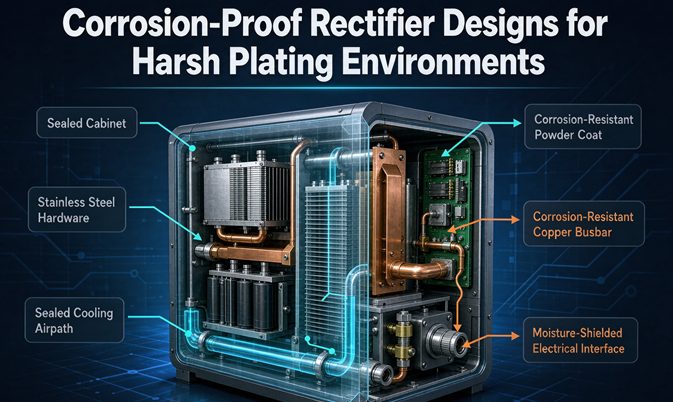
| 4. Internal air path and cooling isolation | Acid-laden air crossing live electronics | Sealed cabinet with air-to-air heat exchanger, closed-loop water, or isolated duct that cools only power devices | Corroded gate drives and control boards; the number-one failure mode |
| 5. Board and busbar protection | The residue that still gets in | Conformal coating to IPC-CC-830, tinned or silver-plated busbars, passivated 316 fasteners, insulated busbar boots | Creepage tracking, contact resistance rise, hot joints |
Notice the order. Layer 4 is where most money is saved and most downtime is bought. Layers 1 to 3 are visible on a datasheet, so buyers compare them. Layer 4 is hidden inside the cabinet, so buyers rarely ask. That is exactly why it decides service life.
Layer 1: Siting, and why the cheapest fix is free
The lowest-cost corrosion control costs nothing in the bill of materials. It is where you put the rectifier.
Acid mist in a plating shop is not a uniform gas. It is generated at the tank surface, concentrated within a meter or two, and carried upward by the tank’s exhaust. A rectifier mounted beside a chromium or acid copper line sits in the densest part of that plume. Move the same cabinet 5 to 10 meters away, behind a partition, into a room with clean slightly positive-pressure air, and its exposure drops by an order of magnitude. Coastal air adds a second load: chloride concentrations 10 to 100 times inland levels, according to corrosion references used in marine specification work.
Two rules are worth writing into the layout drawing:
- Extract at the source, not at the rectifier. Tank-side fume extraction removes the mist before it spreads. A fan mounted on the rectifier cabinet does the opposite: it invites the mist in.
- Keep the cabinet out of the splash and washdown zone. Even a NEMA 4X cabinet is rated for hose-directed water, not for standing in a chemical spill. Layer 2 assumes layer 1 did its job.
A one-shift test worth doing
A quick sanity check buyers can do on a site visit: hold a clean white card near the proposed rectifier location for one shift. The residue pattern tells you more than a catalog IP number.
Layer 2: Enclosure material, and the IP65 trap
This is the layer everyone specifies, and the one most often specified incorrectly.
IP65 tells you almost nothing about corrosion
IP is defined by IEC 60529. The first digit is protection against solid objects; the second is protection against water. IP65 means dust-tight and protected against low-pressure water jets from any direction. It says nothing about acid mist, salt fog, solvent vapor, or whether the cabinet material will survive them.
Two cabinets can both carry IP65. One is powder-coated carbon steel. The other is 316 stainless. In a plating shop they will not have the same life. The rating is identical; the material is not.
NEMA 4X, defined in NEMA 250 and tested under ANSI/UL 50, is a different kind of statement. Besides dust and hose-directed water, Type 4X requires resistance to corrosion and to external ice formation. The “X” is a corrosion-performance requirement, not a shorthand for “stainless steel.” A fiberglass cabinet can be 4X; a stainless cabinet still has to pass the tests.
The practical mapping, without pretending it is an equivalence
| Requirement | North American spec | IEC-world spec | Material note |
|---|---|---|---|
| Clean, dry indoor area | NEMA 12 | IP54 | Powder-coated carbon steel is fine |
| Indoor with washdown or splashes | NEMA 4X | IP65 / IP66 | 304 stainless or FRP; confirm chemical compatibility |
| Acid mist, anodizing, chlorides | NEMA 4X mandatory | IP66 plus a separate corrosion test | 316L or FRP; do not accept IP alone |
| Coastal or high-chloride outdoor | NEMA 4X, 316 | IP66 + ISO 12944 C5-M | Passivate per ASTM A967 |
| Temporary submersion | NEMA 6 / 6P | IP67 / IP68 | Rarely needed for a rectifier; specify only if flooded |
NEMA and IP are not convertible. If a supplier says “IP66 is the same as NEMA 4X,” ask for the corrosion-test report. There is none in IP66.
Why 316 costs 30 to 50 percent more than 304
You are not paying for strength. You are paying for molybdenum.
The pitting resistance equivalent number, PREN = Cr% + 3.3 × Mo% + 16 × N%, comes out around 18 for 304, around 24 for 316, and about 35 for a 2205 duplex. The extra 2 to 3 percent molybdenum in 316 enriches as molybdate inside a pit and helps the surface re-passivate. In chloride service that difference is the whole product.
The published salt-fog picture makes it concrete. Under ASTM B117 or ISO 9227 neutral salt spray at 35 °C with 5 percent NaCl, 304 typically shows pitting at 200 to 500 hours, while 316 commonly passes 1,000 to 2,000 hours or more without red rust. In real coastal exposure, the same two materials are reported at roughly 1 to 3 years versus 15 to 25 years. That is a five-to-ten-times service-life gap from one alloying element.
One caution belongs here. Salt-spray hours are a comparative screening test, not a calendar. ASTM B117 itself does not convert hours into years; it defines how to run the chamber. A cyclic test such as IEC 60068-2-52, which alternates spray, humidity and drying, better reproduces the wet-dry cycling that drives real corrosion. Specify the test method, the acceptance criterion and the material together, or the number means little.
What to put on the drawing
- “Enclosure: NEMA 4X per NEMA 250, listed to UL 50, 316L stainless steel, 3 mm minimum sheet.”
- “Alternate: fiberglass-reinforced polyester, equivalent corrosion performance, documented.”
- “All external fasteners 316, passivated per ASTM A967.”
- “Corrosion test report to be supplied: ASTM B117 or IEC 60068-2-52, with hours and acceptance criterion stated.”
Layer 3: Seals, glands and the moisture you cannot see
A sealed cabinet is only as good as its worst penetration.
The door gasket is easy. The hard parts are cable glands, conduit entries, the cooling penetrations, and the door hinge side where the gasket compresses least. Every one of them must carry the same rating as the cabinet. A NEMA 4X box with IP54 glands is an IP54 box.
Condensation is the failure nobody writes down
Warm humid air inside a cabinet does not need a leak to do damage. It only needs a temperature drop. At 40 °C and 60 percent relative humidity, the dew point is about 30.7 °C. If a water coil or an air-to-air exchanger surface sits below that, water forms inside the cabinet, insulation resistance falls, and the next power-up can track across a dirty board.
Closed-loop water designs handle this by holding the exchanger near 40 °F (about 4 °C) on the water side and managing flow. That sounds colder than the dew point, and it is, which is why the heat exchanger is a sealed surface: the cabinet air never touches the water. The risk appears when someone uses an open loop or a leaky coil. Then the cold surface is inside the air volume, and condensation follows.
Three cheap defenses:
- Desiccant sized to the volume. A practical rule used in plating-equipment packing is about 100 g of silica gel per 50 L of internal volume. A 600 × 800 × 300 mm cabinet is roughly 144 L, so about 288 g. For a running cabinet, replace this with a controlled purge or a breathable membrane that keeps liquid out while letting pressure equalize.
- Anti-condensation heaters controlled by humidity, not just temperature. They keep the internal surface a few degrees above dew point during a night shutdown.
- A positive-pressure purge from a clean, dry air source. This is the strongest option and the one most often skipped. Overpressure means any leak flows outward, not inward.
Pressure equalization matters in transit and in service
A perfectly sealed cabinet that cools from 40 °C to 15 °C will pull a partial vacuum and can deform a large door panel. Use a breathable membrane or a pressure-relief device rated for the enclosure. The membrane keeps droplets out while allowing the air volume to breathe. This is one of those details that never appears in a sales brochure and shows up as a warped door six months later.
Layer 4: Internal air path, the layer that decides service life
Here is the central point of this guide. Forced-air cooling in a plating shop pulls the corrosive environment through the electronics. The fan does not care that the air contains acid mist. It moves the same volume whether the air is clean or contaminated.
Direct forced air versus isolated cooling
| Cooling approach | Does shop air touch the PCB? | Corrosion risk in acid mist | Maintenance load | Best fit |
|---|---|---|---|---|
| Direct forced air, unfiltered | Yes, continuously | Very high | Filters and fans weekly to monthly | Clean, dry, conditioned room only |
| Direct air with ducted supply from outside | No, if the duct is sealed | Low to medium | Duct filter checks | Rectifier in a contaminated room with clean air available |
| Sealed cabinet + air-to-air heat exchanger | No, two separate air circuits | Low | Inspect exchanger faces periodically | Most plating shops; good default |
| Sealed cabinet + closed-loop water | No | Very low | Visual leak checks, water quality | High current, continuous duty, anodizing |
| Oil-cooled sealed unit | No | Very low | Oil level checks, periodic oil change | Harsh atmospheres where a sealed unit beats fighting the air |
A detail that separates a good design from a bad one is where the sensitive electronics sit relative to the airflow. In a well-designed direct-air rectifier, the fan path crosses the heat sinks around the power devices only. The control board and gate drives sit outside that stream, in a sealed electronics compartment. A cheap design blows the same air over everything. Both are called “air-cooled.” Only one survives a chromium line.
Variable-speed, thermostat-controlled fans help, because they reduce the total volume of air drawn in at light load. They do not solve the problem; they slow it down. If the air is dirty, the right answer is to stop using it as the cooling medium.
A simple test that exposes the problem
Ask the supplier for the internal airflow diagram, not a photo of the cabinet. Trace the path from the intake grille to the control board. If the arrow crosses the board, you have your answer. Then ask what the conformal coating specification is, because you will need it.
Layer 5: Board coating, busbars and fasteners
The last layer deals with what gets through anyway.
Conformal coating is not optional in this environment
A conformal coating is a thin polymer film applied to the printed circuit assembly. IPC-CC-830 is the common qualification document for coatings used on electronic assemblies; typical dry-film thickness sits in the 25 to 75 micrometer range depending on the chemistry. Acrylic, polyurethane, silicone and parylene are the usual families. Silicone handles temperature well; parylene gives the best conformality and moisture barrier at a higher cost.
Coating the board is not enough. The weak points are edges, connector bodies, terminal blocks, and the underside of large components where the film does not flow. A supplier who says “conformal coated” without naming the material, the thickness and the coverage standard has not told you much.
Busbars: acid mist attacks joints, not bulk copper
A copper busbar in a plating rectifier is typically 3 to 10 mm thick and 30 to 120 mm wide. At 1,000 A through a 10 × 100 mm bar, current density is 1 A per square millimeter, which is unremarkable electrically. The trouble is at the interfaces: overlapping laps, bolted stacks and the transition to the flexible cable. Those are crevices where residue collects and where contact resistance rises.
Specify:
- Tinned or silver-plated contact faces, with the plating thickness stated.
- Insulating boots or heat-shrink sleeves over live busbar runs inside the cabinet.
- Belleville washers or a controlled torque procedure so that vibration and thermal cycling do not relax the joint. A loose joint runs hotter, which accelerates oxidation, which raises resistance further.
- 316 stainless fasteners outside the electrical joint, passivated, so the cabinet hardware does not become the sacrificial anode.
Galvanic corrosion at mixed-metal contacts
If a 316 stainless fastener touches an aluminum heatsink in the presence of an electrolyte, the aluminum corrodes. If zinc-plated hardware touches a 316 panel, the zinc goes first. In a humid chloride atmosphere every mixed-metal contact is a small battery. Either match the metal or separate it with an insulating washer and seal the interface. This is a specification line, not an installation habit.
What the salt-fog number actually tells you
A buyer comparing two quotations will often see “1,000 hours salt spray” on one and “500 hours” on the other and declare a winner. That is the wrong comparison, for three reasons.
- The standard must be named. ASTM B117 and ISO 9227 are neutral continuous spray; IEC 60068-2-52 is cyclic. The same cabinet can produce different numbers under each.
- The acceptance criterion must be named. Hours to first red rust, hours to white rust, or a rating under ISO 10289 are different endpoints. A number without an endpoint is marketing.
- The chamber is not the shop. The 5 percent NaCl, 35 °C, pH 6.5 to 7.2, 1 to 2 mL per 80 cm² per hour environment is a controlled comparison. A plating shop adds temperature swings, real acid mist, cleaning cycles, vibration and crevices. Cyclic testing and field data are the better guide to years.
Use the report, not the claim
The useful way to use salt fog is as a batch screen and a supplier comparison, then confirm with the material choice and the sealing design. Ask for the report, not the claim.
A decision table for the four common plating environments
| Environment | Minimum enclosure | Material | Internal protection | Verdict |
|---|---|---|---|---|
| Decorative nickel, clean room, mild duty | NEMA 12 / IP54 | Powder-coated steel | Filtered forced air, coated board | Adequate if the room really is clean |
| Acid copper or zinc, normal plating shop | NEMA 4X / IP66 | 304 stainless or FRP | Sealed air-to-air exchanger, IPC-CC-830 coating | The standard working specification |
| Hard chromium, anodizing, high mist | NEMA 4X / IP66 | 316L stainless | Sealed water or air-to-air exchanger, purged electronics bay, plated busbars | Specify all five layers; do not economize on layer 4 |
| Coastal plant or high-chloride water | NEMA 4X / IP66 + ISO 12944 C5-M | 316L, passivated A967 | Closed-loop cooling, full coating, matched fasteners | Pay the 30 to 50 percent premium for 316 up front |
One honest note. A rectifier is rarely the most expensive item on a plating line, but it is the one whose failure stops the line. Spending more on layer 4 is usually cheaper than one unplanned week of downtime. That is a commercial judgment, not a technical absolute, and it depends on your duty cycle.
RFQ checklist: what to send a supplier
Copy this into your enquiry. It turns a price comparison into a like-for-like specification.
- Bath chemistry and mist load: acid copper, chromium, cyanide zinc, anodizing, or mixed; tank exhaust arrangement.
- Rectifier location: distance from tanks, room or open shop, ambient temperature range, humidity range, washdown frequency.
- Enclosure requirement: NEMA 4X or IP66, material (316L / 304 / FRP), sheet thickness, and whether North American listing to UL 50 is required.
- Sealing details: gland brand and rating, door gasket material, pressure-equalization method, desiccant or purge provision.
- Internal airflow diagram: show whether shop air crosses the control board, and identify the electronics compartment.
- Cooling approach: sealed air-to-air, closed-loop water, or oil; water quality and temperature if water-cooled.
- Conformal coating: material family, IPC-CC-830 qualification, dry-film thickness in micrometers, and coverage exclusions.
- Busbars: cross-section, contact plating and thickness, torque procedure, insulation boots.
- Fasteners and mixed-metal contacts: grade, passivation per ASTM A967, insulation where metals meet.
- Corrosion evidence: test standard, hours, acceptance criterion, and a copy of the report for the exact enclosure construction.
- Scope and spares: cabinet only or with transformer and filter; recommended spares for gaskets, fans, and coating repair.
FAQ
Why do plating rectifiers fail early even when the cabinet looks fine?
Because corrosion starts inside. Acid mist, chlorides and moisture collect at busbar stacks, bolt heads and heat-sink gaps, form a local electrolyte, and attack connections and boards. A three-year-old cabinet can look clean outside while its gate-drive boards are already degraded.
Is IP65 enough for a rectifier in a plating shop?
Not by itself. IP65 under IEC 60529 covers dust and low-pressure water jets only. It does not require corrosion-resistant materials and does not test acid mist, salt fog or ice. Ask for NEMA 4X per NEMA 250 / UL 50, or IP66 plus a separate documented corrosion test.
What does the X in NEMA 4X mean?
It means the enclosure has additional corrosion-resistance requirements, beyond the dust, water and ice protection of Type 4. It is a performance requirement, not a material name. Both stainless steel and fiberglass cabinets can qualify if they pass the tests.
Why specify 316 stainless instead of 304 for a coastal plating plant?
316 contains roughly 2 to 3 percent molybdenum, raising PREN from about 18 to about 24. Under ASTM B117 neutral salt spray, 304 typically pits at 200 to 500 hours while 316 commonly exceeds 1,000 hours. Reported coastal service life is roughly 1 to 3 years for 304 versus 15 to 25 years for 316.
Do salt-spray hours tell me how many years the rectifier will last?
No. ASTM B117 and ISO 9227 define a controlled comparative test; they do not convert hours into service years. Use the hours to compare materials and batches, then confirm with cyclic testing such as IEC 60068-2-52 and with the actual site chemistry.
Does forced-air cooling ruin a rectifier in acid mist?
It can. A direct forced-air fan draws shop air across the power devices and, in cheaper designs, across the control board too. If that air contains acid mist, the residue accumulates on the electronics. A sealed cabinet with an air-to-air heat exchanger or closed-loop water keeps the shop air out of the electronics compartment.
What is conformal coating and do I need it?
It is a thin protective polymer film on the circuit assembly, commonly qualified to IPC-CC-830, with a typical dry thickness of 25 to 75 micrometers. In a corrosive plating shop, yes. Specify the material family, thickness and coverage, because edges and connectors are the weak points.
How much desiccant does a rectifier cabinet need?
A practical packing rule is about 100 g of silica gel per 50 L of internal volume. A 600 × 800 × 300 mm cabinet is around 144 L, so roughly 288 g. For a continuously running unit, a controlled purge or breathable membrane is more useful than a finite desiccant charge.
Can condensation form inside a sealed cabinet?
Yes. At 40 °C and 60 percent relative humidity, the dew point is about 30.7 °C. Any internal surface below that temperature will collect water. Keep the electronics above dew point with anti-condensation heaters, a dry purge, or a heat exchanger that never exposes a cold surface to the cabinet air.
Should I worry about mixed metals in the cabinet?
Yes. Every contact between different metals in a humid electrolyte is a small galvanic cell. Zinc-plated hardware on a 316 panel, or a stainless fastener in an aluminum heatsink, will corrode the less noble metal. Match the grades or insulate and seal the interface.
What should I ask a supplier to prove corrosion resistance?
Ask for the enclosure standard and listing, the material grade and thickness, the gland ratings, and a corrosion-test report that states the standard, hours and acceptance criterion for the exact cabinet construction. A generic “marine grade” claim is not evidence.
What information do you need to quote a corrosion-proof rectifier?
Send bath chemistry, distance from tanks, ambient temperature and humidity, washdown frequency, required enclosure rating and material, low/normal/end-of-life DC voltage, continuous and peak current, ripple limit, cooling preference, coating and busbar requirements, any North American listing requirement, and recommended spares. With that, a supplier can return a like-for-like specification instead of a guess.
Closing: buy the path, not the badge
Corrosion-proof design is not one feature you tick. It is five barriers between a hostile plating shop and a printed circuit board. The enclosure badge is the easiest one to see and the least decisive on its own. The air path, the coating, the joint plating and the way mixed metals meet are where service life is really decided.
If you take one thing from this guide, take the airflow diagram. Ask for it before you ask for the price. It tells you, in one drawing, whether the supplier has designed a rectifier for a plating shop or a rectifier that merely happens to be painted.