Gold and silver refining runs on less than 3 V per cell, yet the rectifier still decides the purity of the metal: ripple pushes instantaneous current density toward the limiting value, where impurities codeposit and dendrites grow. At roughly $116 a gram for gold, one purity point is worth more than the electricity for the entire run. So if a vendor is selling you on “91% efficiency,” they are optimizing the wrong bill.
That sounds backwards, and it is the single most useful thing I can tell you before you specify a supply. Let me show you why, with the arithmetic written down.
Numbers worth quoting
Every figure here has a stated source or a stated assumption. Argue with the assumption; that is healthier than guessing.
- A Wohlwill gold cell runs at 0.4 to 1.5 V. A Moebius silver cell runs at 1.5 to 2.8 V. A Thum horizontal silver cell can run 3 to 5.5 V. All are far below the 6 V or 12 V on the rectifier nameplate.
- Chloroaurate gold is Au³⁺, so Faraday gives 2.4497 g per ampere-hour. Cyanide gold is Au⁺ and gives 7.3492 g/Ah. Use the wrong valence and your current sizing is off by a factor of three.
- Silver is Ag⁺: 4.0247 g/Ah. It plates about 1,000 times more cheaply in energy terms than the metal is worth.
- One kilogram of gold at 0.8 V takes 408 Ah and about 0.33 kWh. At $0.12/kWh that is roughly four cents of electricity against about $116,000 of metal.
- Ripple above about 5% starts disturbing crystal growth. Below 1% is the usual target for dense, pore-free precious-metal deposits.
Those are the anchors. Now the reasoning behind them.
The economics are upside down from base metals
If you have bought a rectifier for copper electrowinning, forget what you learned about priorities. A copper line at 250 to 300 kWh per tonne has a real power bill, so efficiency, pulse count and harmonic compliance deserve a page each.
Precious-metal refining is a different animal. Look at the numbers again. One kilogram of gold needs about 0.33 kWh of electrical energy. One kilogram of silver at 2.0 V needs about 0.50 kWh. Even at an industrial tariff, that is cents. Meanwhile the metal in the cathode is worth four or five figures per kilogram.
What actually costs money
The expensive failures in a small refinery are not wasted kilowatt-hours. They come in three forms.
Purity shortfall
Gold that comes out at 99.9% instead of 99.99% may not meet LBMA good-delivery or a buyer’s spec, so it goes back for a second refining pass or sells at a discount.
Recovery shortfall
Metal left in solution, in anode slime that was not properly collected, or in a deposit that will not strip cleanly.
Rework and downtime
A bad cathode means a re-melt, a re-cast anode, and another electrolysis cycle.
Put a number on the first one. If you process 5 kg of gold a month and moving from 99.5% to 99.99% recovers an extra 0.49% of fine metal, that is about 24.5 grams, or roughly $2,840 a month at $116/g. Call it $34,000 a year. You could waste the entire electricity budget for a decade and not match that.
This is why the article’s whole point is simple: on a small precious-metal refinery, the rectifier is a purity instrument that happens to consume power, not a power converter that happens to make metal.
That reframe changes what you specify. It changes which specs you fight over in a quotation. And it changes what you measure on commissioning.
Refining is not plating, and it is not electrowinning
Three processes show up in search results for “gold and silver refining rectifier,” and suppliers routinely blur them. They do not want the same supply. Getting this straight is half of a good specification.
Electrorefining: impure metal in, pure metal out
This is the Wohlwill process for gold and the Moebius or Thum process for silver. An impure anode dissolves; the target metal plates onto a cathode; impurities either stay in solution or fall as anode slime.
- For gold, the electrolyte is chloroauric acid in hydrochloric acid, warm, around 50 to 70 °C. Silver and copper do not plate under those conditions, so the cathode comes out at up to 99.99%, and double electrolysis reaches 99.999%.
- For silver, the electrolyte is silver nitrate with free nitric acid. Silver plates preferentially because it is more noble than copper, lead, iron and zinc. Gold will not dissolve in nitrate, so it falls as slime and is recovered.
The rectifier’s job here is to hold a steady, low-ripple current density so the deposit grows dense and clean. Purity is the output.
Electroplating: a coating on a substrate
Jewelry plating, connector plating, brush plating. The goal is a thin, bright, adherent layer on a part. Suppliers selling “precious metal rectifiers” often mean these: 12 V/300 A switchers, pulse-reverse capability, mirror finish.
Pulse reverse is genuinely useful in plating: a short reverse pulse dissolves high points and evens the layer. It is not a Wohlwill or Moebius refining tool. If a vendor offers you dual-pulse for a doré refining line, ask them which electrode they think they are stripping and why.
Electrowinning: metal out of a dilute solution
This is recovery from leachate, plating bath drag-out, photographic wash, or e-waste liquor. A rotating-cathode unit might run 4.5 V per cell, 150 to 1,200 A, and claim up to 99.8% cathode purity at 0.37 to 2.94 kg/h of gold. Useful, genuinely. But that 99.8% is a recovery concentrate, not 4N refining stock, and it usually still goes to a refinery.
So before you compare a 6 V refining rectifier with a 4.5 V recovery cell or a 12 V plating unit, decide which of the three jobs you are actually buying for. The spec sheets are not interchangeable.
How much voltage, really
Here is the question that comes up in every small-refinery forum, and almost no product page answers it: “I have three silver cells. What power supply do I need?”
The answer comes from two independent chains. Keep them separate and the arithmetic is easy.
Voltage follows the cells in series
Cells in series stack voltage. The current is the same through all of them.
- A Moebius silver cell runs around 1.5 to 2.8 V; published plant data puts some at 2.0 V and others at 2.7 V per cell.
- A practical rule from working refiners: a cell needs roughly 3 to 4 V at 25 to 50 A/ft² if the connections are clean. One 12 V rectifier will run three such cells in series.
- A Wohlwill gold cell is much lower, at 0.4 to 0.8 V in some process descriptions, up to 1.5 V as a design maximum.
So a 6 V supply is not “too small” for gold; it can drive several gold cells in series. A 12 V supply is not “too big” for silver; you use the voltage you need and the rest is headroom. Where people get into trouble is buying a 24 V or 48 V industrial unit for a three-cell line and then trying to drop the voltage with a crude setting that has poor resolution at the bottom of its range. If your operating point is 6 V, buy a supply whose controllable range starts near there, not one whose data sheet says “0-48 V” and whose stability spec only applies above 20% of full scale.
Current follows the cathode area
Current is set by cathode area times current density, not by the supply nameplate.
Published silver practice clusters tightly:
| Source | Cell type | Cathode current density | Cell voltage |
|---|---|---|---|
| SAIMM, Rand Refinery | Moebius (vertical) | 290 A/m² anode | 2.0 V |
| SAIMM, Rand Refinery | Thum (horizontal) | 290 A/m² anode | 3.0 V |
| 911metallurgist, plant data | Moebius | 28 A/ft² (about 300 A/m²) | 2.7 V |
| studfile, process summary | Moebius | 200 to 400 A/m² | 1.5 to 2.8 V |
| qdjxmachinery, process page | Silver refining | 250 to 450 A/m² | 1.5 to 2.5 V |
| qdjxmachinery, process page | Gold refining | 400 to 700 A/m² (pulse) | 0.4 to 0.8 V |
| World Bank / DMT, Gold Hub study | Wohlwill gold | up to 1,500 A/m² anode | max 1.5 V |
The numbers disagree because they describe different anodes, spacing, electrolytes and agitation. That is fine. The range is the useful part: roughly 250 to 450 A/m² for silver, and a few hundred to 1,500 A/m² for gold, with voltage under 3 V for most cells.
Now size a small line. Say you want to refine 10 kg of silver a month in a Moebius cell. Faraday says 10,000 / 4.0247 = 2,485 Ah of theoretical charge. At 400 A that is 6.2 hours of electrolysis; allow more for current efficiency below 100%. If your cathode area is sized for 300 A/m², you need about 1.3 m² of cathode. That is a bench-to-pilot scale machine, and a 500 A / 6 V rectifier covers it with room to spare.
Do the same for 1 kg of gold a month. At 2.4497 g/Ah you need 408 Ah. At 100 A that is 4.1 hours. Again, small. This is why “small-scale, high-purity DC supplies” is a real category and not a marketing phrase.
The valence trap: 2.45 or 7.35 grams per ampere-hour
This one is worth its own section because it wrecks more sizing exercises than any other single mistake.
Faraday says the mass deposited per ampere-hour is the atomic weight divided by the number of electrons transferred, times a constant. For gold:
- Au³⁺ in chloroauric acid (Wohlwill): atomic weight 196.97, n = 3, so 196.97 / (3 × 26.8) = 2.4497 g/Ah.
- Au⁺ in cyanide solution: n = 1, so 196.97 / 26.8 = 7.3492 g/Ah.
Same metal. Three-fold difference. If you size a Wohlwill rectifier using a cyanide-plating figure, you will specify a third of the current you need and wonder why your cathode grows at a crawl.
Silver is simpler: Ag⁺, 107.868 / 26.8 = 4.0247 g/Ah. The plating blogs and refining references agree on this one.
Why the trap survives
It survives because the two numbers live in different industries. Jewelry platers talk about cyanide gold at 7.35 g/Ah. Refiners talk about chloroaurate at 2.45 g/Ah. Both publish “gold” and “ampere-hour” in the same sentence, so a procurement search happily mixes them.
The fix is a single question in the RFQ: “What gold species is in my electrolyte, AuCl₄⁻ or Au(CN)₂⁻?” Everything downstream, from current to rectifier size, busbar and cycle time, depends on the answer. If your supplier cannot tell you why that matters, keep shopping.
Ripple, the limiting current, and why purity falls
Here is the physical chain the plating blogs describe and the refining product pages leave out. It is the reason a low-ripple supply is worth paying for.
The cathode responds to instantaneous current
Your rectifier display shows an average. The cathode does not care about averages. It responds to the current flowing at that instant.
Ripple is the residual AC component riding on the DC output. A single-phase unit falls to zero twice a cycle. A three-phase bridge has a smaller ripple at six times line frequency. A switch-mode supply has its own signature. When the instantaneous current spikes, the local current density at the cathode spikes with it.
Cross the limiting current and the deposit changes character
Every electrolyte has a limiting current density, which is the rate at which metal ions can diffuse to the surface. Above it:
- The surface runs out of metal ions.
- Water reduces instead, evolving hydrogen.
- Hydroxyl ions form at the cathode and local pH rises.
- Metal oxide phases become more likely.
- Any protruding crystal sees a stronger field, so it grows faster, shielding its neighbours. That is the runaway that makes dendrites.
For a refiner, the consequences are exactly the ones you cannot afford: rough or powdery deposit, impurity codeposition (because the potential has moved into a range where other species reduce), poor adhesion, and a cathode that is hard to strip clean. Published plating guidance puts the onset of visible crystal disturbance at around 5% ripple; for dense, pore-free precious-metal deposits the usual target is under 1%.
What the spec sheet is really telling you
When a supplier writes “ripple ≤3%” or “<1% RMS,” that number is the proxy for deposit quality. Take it seriously, but verify it where it matters.
- Measure at the tank, not the cabinet. Cable run, busbar joints and rack contacts are part of the circuit. A reading at the rectifier terminals describes the supply; a reading at the cathode bus describes what the metal actually sees.
- Use a true-RMS meter or an oscilloscope with a shunt. A panel ammeter can show a rock-steady 100 A while a true-RMS clamp at the tank shows 15% ripple and a real average closer to 85 A.
- Check under load. A supply that looks clean open-circuit can fall apart when current flows.
- Specify the load condition. “≤1% at 50-100% rated current” means something; “≤1%” with no qualifier may not.
This is also where constant-current mode earns its keep. The bath chemistry drifts, the anode area shrinks, the temperature moves. A supply in CC mode holds the current density steady through all of it. CV mode is fine for some plating steps; for refining, current is the process variable because mass deposition follows Faraday and current directly.
What “high purity” actually requires from the supply
Get the voltage and current right, hold the ripple low, and you have done most of the electrical job. But three more details decide whether you land at 99.9% or 99.99%.
Agitation and mass transport
Silver electrolyte must not be allowed to deplete at the cathode face, or copper plates out with it. Rand Refinery’s Moebius cells use scrapers and a circulation pump; their Thum cells rely on convection. Either way, the electrical spec and the fluid spec are a pair. A beautiful low-ripple supply cannot rescue a cell with stagnant catholyte.
Current efficiency and anode/cathode balance
The silver level in the electrolyte stays roughly constant only if the anode dissolves at about the rate the cathode plates. Watch the trend. A slow drift in silver tenor shows up long before a bad assay. Free acid control matters too: too little and silver ions deplete; too much and you dissolve more anode than you need.
Clean connections and correct cathode material
Gold refinery practice uses thin mother plates of fine gold or titanium cathodes from which the deposit is stripped. Silver practice uses stainless steel or titanium plates with scrapers. Contamination pathways are mechanical as much as electrical, such as a stainless screw in the wrong place or a conductive basket where only silver should be exposed. Keep the current path clean and the metal path cleaner.
Right-sizing the supply: a worked specification
Let me put the whole chain together for a small shop doing both metals. These are illustrative assumptions, not a recommendation for your plant.
The line
- Gold: 1 kg per month, chloroaurate electrolyte, 0.8 V per cell, 2.4497 g/Ah, 100 A operating current, 4 cells in series.
- Silver: 10 kg per month, nitrate electrolyte, 2.2 V per cell, 4.0247 g/Ah, 400 A operating current, 3 cells in series.
Voltage
- Gold bus: 4 × 0.8 = 3.2 V. Add about 1 V for cabling, contacts and control headroom: specify a 0-6 V output.
- Silver bus: 3 × 2.2 = 6.6 V. Add headroom: specify a 0-10 V or 0-12 V output.
Current and power
- Gold: 100 A at roughly 3.2 V bus = 320 W DC. At 90% efficiency that is about 356 W AC.
- Silver: 400 A at 6.6 V bus = 2.64 kW DC. At 90% efficiency about 2.93 kW AC.
Neither is a big power installation. Both need excellent control.
The specification that matters
| Parameter | Gold circuit | Silver circuit | Why |
|---|---|---|---|
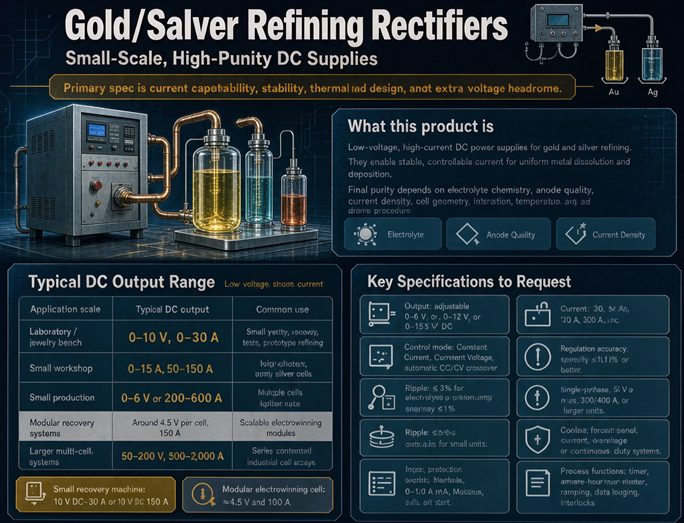
| Output voltage | 0-6 V | 0-10/12 V | Series-cell count plus headroom |
| Output current | 0-100 A | 0-400 A | Cathode area × current density |
| Ripple | ≤1% RMS at load | ≤1% RMS at load | Deposit density, impurity control |
| Regulation | CC with ±0.5% or better | CC with ±0.5% or better | Holds current density as bath drifts |
| Metering | True-RMS, at the bus | True-RMS, at the bus | Panel meters can lie |
| Ramp / soft start | Yes | Yes | Protect deposits and cathode seeds |
| Remote logging | RS485 / Modbus | RS485 / Modbus | Traceability for each run |
| Protections | OVP, OCP, thermal, phase loss | OVP, OCP, thermal, phase loss | Standard, but verify response |
| Ambient / enclosure | Corrosion-resistant, filtered air | Corrosion-resistant, filtered air | Acid and nitrate mist |
Note what is not on that list: total nameplate power, and the headline efficiency number. Those are the two things small refineries over-specify.
Where buyers go wrong
Buying on volts
“My old rectifier was 12 V, so I need 12 V.” You may need 3 V at 400 A. Voltage follows the cells; current follows the area. Buying a higher-voltage unit is not fatal, but poor resolution and stability at the bottom of the range often are.
Using plating specifications for refining
Dual-pulse, reverse pulse, mirror finish: these belong to plating. For refining, the deposit is stripped, melted and assayed, not admired. Ask for low ripple and tight CC control, not a polish recipe.
Trusting the display
A rectifier that has run for years can drift out of calibration. Verify the output with an independent true-RMS instrument at the tank at least once per quarter, and after any maintenance on the bus or contacts.
Confusing recovery purity with refining purity
A rotating cathode that produces 99.8% from dilute solution is doing a useful job. It is not making 4N bullion. Budget a refining step, and do not spec the recovery unit as if it were one.
Ignoring the anode slime
In silver refining, gold stays behind as slime because it is insoluble in nitrate. In gold refining, silver and copper stay in solution or leave as slime depending on the chemistry. The electrical design should support clean slime capture: settled, bagged, not stirred back into the deposit.
Standards, references and what to verify
No single standard certifies “a rectifier for gold refining.” What you can do is specify the building blocks and ask for evidence.
| Item | What to ask for | Why it matters |
|---|---|---|
| Power-electronics safety | IEC 62477-1 applicability statement | Safety of the converter itself |
| EMC / harmonics | IEEE 519-2022 at the PCC, or IEC 61000 series | Grid compliance, not a nameplate claim |
| Enclosure | IEC 60529 rating, e.g. IP54 | Acid and nitrate mist, washdown |
| Construction | ISO 9001 quality system | Process control, not a purity guarantee |
| Performance | Type-test or factory-test report | Ripple and regulation under load |
| Materials | Cathode and contact material spec | Contamination control |
| Reference processes | Wohlwill / Moebius / Thum described by name | Confirms the vendor knows the job |
For the process itself, the literature is better than any brochure. Britannica’s Wohlwill explainer is a good short definition. The World Bank’s Egypt Gold Hub study gives cell voltage and current density ceilings. SAIMM’s Rand Refinery chapter and 911metallurgist’s refining-practice paper give real operating data. Ask a vendor which of these they have read; the answer is informative.
Confirm the current edition of any standard before you put it in a contract, and treat cell voltage and current density ranges as process guidance, not as guarantees for your specific electrolyte. That is what a pilot run is for.
How to write the inquiry so vendors can quote it
A good RFQ for a small refining rectifier fits on one page. Send these eleven lines:
- Metal and process: gold Wohlwill, silver Moebius, silver Thum, or recovery from solution.
- Gold species in electrolyte: AuCl₄⁻ or Au(CN)₂⁻.
- Monthly throughput in kilograms, and target cathode purity.
- Number of cells, and cells in series per rectifier.
- Operating voltage per cell, and total bus voltage.
- Cathode area in m² and target current density in A/m².
- Operating current in amperes, and desired current range.
- Ripple specification at load, with the load condition stated.
- Control mode: CC, CV, or CC with programmable ramp.
- Environment: ambient temperature, mist exposure, enclosure rating.
- Metering and interface: true-RMS at bus, RS485/Modbus, data logging.
Add one line about what you will not accept: a headline efficiency number with no ripple or regulation data. That single sentence will separate serious suppliers from brochure sellers faster than anything else.
Bringing it together
Small-scale gold and silver refining is not a small version of a copper line. The power is trivial, the metal is not, and the rectifier’s real job is to protect purity.
Start from the process. Gold at 2.45 g/Ah, silver at 4.02 g/Ah, voltage under 3 V per cell. Size voltage from the cells in series and current from the cathode area. Hold ripple below 1% at the load and measure it at the tank with a true-RMS instrument. Keep CC control, agitation and clean connections as a single system, because purity fails at the weakest one.
Then judge any quotation by what it does for your assay, not its efficiency headline. At $116 a gram, a tenth of a percent is real money. The supplier who understands that is the one you want to talk to.
If you want a second set of eyes on the numbers before you send that RFQ, send us your cell count, cathode area, electrolyte species and target purity. We will tell you which figures we would challenge first, and which ones we would leave alone.
FAQ
How much voltage does a gold or silver refining cell need? Wohlwill gold cells run at 0.4 to 1.5 V, with 1.5 V often quoted as a design maximum. Moebius silver cells run at 1.5 to 2.8 V and commonly measure 2.0 or 2.7 V in operating plants. Thum horizontal silver cells can need 3 to 5.5 V because of the larger electrode gap. All are well below the 6 V or 12 V printed on most small rectifiers; the extra is headroom, not a requirement.
How many cells can one 12 V rectifier run in series? Three silver cells at 3 to 4 V each, which is the usual working rule for a Moebius or Thum cell with clean connections. Gold cells at 0.4 to 1.5 V mean a 6 V unit can drive several. Voltage adds across cells in series while current stays the same, so size voltage by cell count and current by cathode area.
What is the Faraday equivalent for gold refining? It depends on the gold species. Chloroaurate, Au³⁺, as used in the Wohlwill process, deposits 2.4497 g per ampere-hour. Cyanide gold, Au⁺, deposits 7.3492 g/Ah. Silver as Ag⁺ deposits 4.0247 g/Ah. Using the cyanide number for a chloroaurate cell is a three-fold sizing error.
Why does ripple affect the purity of a gold or silver deposit? The cathode responds to instantaneous current, not the average on the display. Ripple peaks can push local current density past the electrolyte’s limiting value, where metal ions run out, hydrogen evolves, pH rises, and dendrites grow. Impurities then codeposit and the crystal structure degrades. Keep ripple around 1% RMS at load for dense, clean deposits; visible disturbance typically begins near 5%.
Is a higher-efficiency rectifier worth paying extra for in precious-metal refining? Rarely as the main argument. One kilogram of gold at 0.8 V takes about 0.33 kWh, or roughly four cents of electricity against about $116,000 of metal. Recovering an extra 0.49% purity on 5 kg of gold a month is worth about $34,000 a year. Efficiency matters, but purity and recovery are the money. Fight over ripple, regulation and metering first.
Constant current or constant voltage for refining? Constant current. Deposited mass follows Faraday and is proportional to current, so holding current steady holds the deposition rate and current density as bath chemistry, anode area and temperature drift. CV is useful for some plating steps, not for a Wohlwill or Moebius cathode.
How do I check the ripple my rectifier is actually delivering? Measure at the cathode bus with a true-RMS clamp meter or an oscilloscope and shunt, under load, not open circuit. A panel ammeter can show a steady 100 A while a true-RMS reading at the tank shows 15% ripple and a real average near 85 A. Cables, busbar joints and contacts are part of the circuit, so the tank reading is the one that counts.
Can I use a plating rectifier for a refining line? You can, but check the specs. Plating units are often sold on pulse-reverse and mirror finish, which are surface goals. Refining needs low ripple and tight CC control because the deposit is stripped, melted and assayed. If a vendor cannot explain why reverse pulse helps a doré anode, they are selling you the wrong tool.
What purity can a small refinery realistically reach? Gold refined by the Wohlwill process reaches about 99.99% with careful electrolyte management, and 99.999% with double electrolysis. Silver from a well-run Moebius or Thum cell reaches 99.93 to 99.99% in cathodic crystals. Cheaper chemical routes such as aqua regia precipitation typically land near 99.9%. Published minimum for Wohlwill cathodes is above 99.9%.
What should I put in a rectifier RFQ for a small precious-metal line? Metal and process, gold species in the electrolyte, monthly kilograms, target purity, number of cells and series arrangement, voltage per cell, cathode area, target current density, operating current, ripple at load with its test condition, control mode, enclosure rating, and true-RMS metering with Modbus. Add that you will not accept an efficiency figure without ripple and regulation data. Eleven to thirteen lines is enough for a supplier to quote properly.