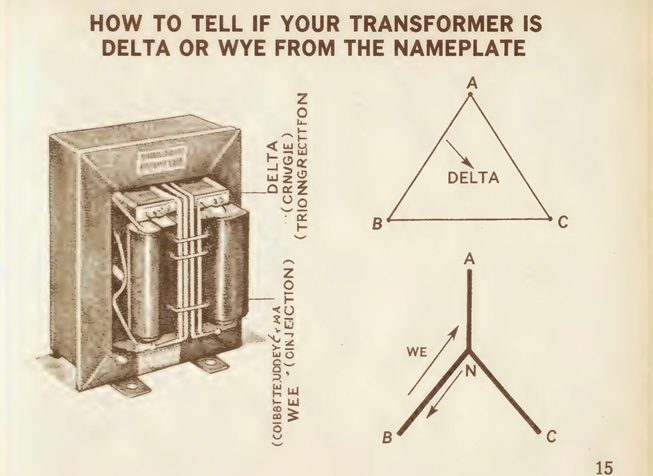
Check the connection marking on the nameplate first. A “Y”, “Wye”, “Dyn11”, or a slash voltage like “480Y/277” means the winding is wye and a neutral is available. A “Δ”, “D”, or a single voltage like “480 Delta” means it is delta with no neutral. No plate? Count the terminals (four with a neutral points to wye, three points to delta) or measure the winding resistance with the unit switched off.
Quick answer for buyers
If you are sourcing a transformer from a supplier, you usually will not have the unit in front of you. You have a nameplate photo, a datasheet, or a quote. The good news is that the connection type is almost always printed right there.
This guide covers the three things that actually matter to you as a buyer:
- How to read the markings on the nameplate (US style and IEC style)
- What to do when the nameplate is missing or unreadable
- Which mistakes cause expensive returns, downtime, or unsafe paralleling
By the end you will be able to look at any nameplate and say with confidence: this is delta, this is wye, and here is what that means for my system.
The 10-second nameplate check (do this first)
Most plates state the connection outright. Look for one of these:
| What the nameplate shows | Connection | Neutral available? | Where you see it |
|---|---|---|---|
| 480Y/277 V | Wye | Yes | United States |
| 208Y/120 V | Wye | Yes | United States |
| 480 Delta or “480 V” (no Y) | Delta | No | United States |
| 240/120 V (high-leg) | Delta, center-tapped | Via center tap | United States |
| Dyn11 or DYn11 | Delta primary, wye secondary + neutral | Yes on low side | IEC / EU / global |
| Yyn0 | Wye primary, wye secondary + neutral | Yes | IEC / EU |
| Dzn0 | Delta primary, zigzag secondary + neutral | Yes | IEC / EU |
If you see a “Y” or the word “Wye”, you have a neutral. If you see a “Δ” or “D” with no “Y”, you do not. That single observation settles most cases.
How to read the actual markings (US vs EU)
The same transformer shows up differently depending on where it was built. Knowing both styles saves you from misreading a supplier’s drawing.
In the United States (ANSI/IEEE style)
US plates lead with voltages, not codes. A wye secondary is written as a slash pair:
- 480Y/277 V means 480 V line-to-line and 277 V line-to-neutral. The “Y” is your wye signal.
- 208Y/120 V is the same idea at a lower voltage.
- A plate that says only “480 V” or “480 Delta” with no slash is delta. No neutral.
- 240/120 V high-leg delta is a special US case. Two phases read 120 V to the grounded center tap, but the third (the high leg) reads about 208 V to neutral. Do not land single-phase loads on that leg.
US distribution transformers imported from overseas may also carry a vector group like Dyn11. Read that code the IEC way below.
In the EU and most of the world (IEC style)
Outside North America you usually get a vector group code. It is a short string with a clear grammar:
- First letter (capital) = high-voltage winding: D = delta, Y = wye (star), Z = zigzag.
- Second letter (lowercase) = low-voltage winding: d, y, or z.
- A following “n” means the neutral is brought out to a terminal.
- The number is the phase shift in clock steps, where each step is 30 degrees.
So Dyn11 reads as: delta high-voltage winding, wye low-voltage winding, neutral brought out, and the low-voltage phasors sit at “clock 11” (30 degrees ahead of the high-voltage reference). It is the most common distribution vector group on the planet.
No nameplate? Three backup ways to tell
Sometimes the plate is painted over, rusted, or gone. Here is how to work it out without guessing.
Count the terminals (and look for a neutral)
On one side of the transformer, count the bushings or terminals:
- Four terminals (three lines plus one marked H0 or X0) means wye with the neutral brought out.
- Three terminals and no neutral bushing usually means delta, or a wye whose neutral was not brought out.
Terminal count is a strong clue, not proof. A wye with no neutral looks exactly like a delta from the outside, so confirm with the next method if it matters.
Measure winding resistance (the safe, de-energized test)
This is the most reliable field check, and you do it with the transformer off, locked out, and verified dead. Use a low-resistance ohmmeter and measure between each pair of line terminals on the same side (H1-H2, H2-H3, H1-H3).
Imagine each winding has resistance R:
- In a wye, current between two line terminals passes through two windings in series, so you read about 2R.
- In a delta, one winding sits in parallel with two in series, so you read about 2R/3.
On the same unit, the wye reading comes out roughly three times higher than the delta reading. If the neutral is accessible, a reading from neutral to any line terminal of about R (a single winding) confirms wye.
Measure voltage (only if you are qualified)
On a live, properly protected system, a wye with a neutral gives a line-to-neutral voltage equal to line-to-line divided by 1.732 (the square root of 3). For a 480 V wye that is about 277 V. A delta has no usable neutral, so phase-to-neutral readings are meaningless or uneven.
Leave energized testing to a licensed electrician with the right meter and PPE. If you are buying, ask the supplier for the test report instead.
Delta vs wye: what each one actually gives your system
The shape of the connection decides three things you care about as a buyer.
Neutral. Only a wye winding can hand you a neutral for single-phase loads, lighting, and receptacles. If your site needs 277 V lighting or 120 V outlets, you need wye on that side.
Phase shift. Pair delta on one side with wye on the other and you get a fixed 30 degree rotation between input and output. That is why a Dyn11 transformer cannot simply be swapped for a Yyn0 unit even at the same kVA.
Harmonics. A delta loop lets triplen harmonics (3rd, 9th, 15th) circulate inside and cancel, which is a big reason Dyn11 became the global default for distribution.
Rule of thumb for choosing: pick wye when you need a neutral or a solidly grounded system; pick delta when the load is three-phase only and no neutral is required.
Mistakes that cost buyers real money
These are the errors we see most often from first-time importers, and each one is avoidable.
Wrong configuration on a replacement. You order a delta-secondary unit but your panels are wired for 480Y/277. The transformer arrives, will not feed your single-phase loads, and now you eat freight both ways plus downtime. Match the existing vector group before you buy.
Paralleling mismatch. Two transformers on one bus must share the same vector group (and close impedance and phase sequence). Put a Dyn11 next to a Dyn1 and you create a 60 degree phase difference between their secondaries. The result is a large circulating current that overheats both units. Dyn11 and Yyn0 differ by 30 degrees and also will not parallel safely.
Assuming “n” means grounded. The “n” in Dyn11 only means a neutral terminal is brought out. It is not automatically bonded to earth. The earthing scheme is a separate design decision your engineer must make.
High-leg delta surprise. A US 240/120 V delta looks friendly until someone lands a 120 V load on the high leg and gets about 208 V. Read the slash notation carefully.
Your pre-order supplier checklist
Before you send a purchase order, ask your supplier for these six items. They turn a vague “same as before” request into a unit you can actually install.
- A photo of the existing nameplate, or the approved single-line diagram.
- Primary and secondary voltages, and frequency (60 Hz in the US, 50 Hz across most of Europe and Asia).
- The required vector group (Dyn11 covers most distribution jobs).
- Whether you need a neutral on the secondary, and what you will hang on it.
- The grounding method (solidly grounded wye vs corner-grounded delta).
- For a parallel or replacement unit, the old transformer’s vector group and impedance.
Send those six points to any reputable manufacturer and you will get a quote you can trust, not a guess.
FAQ
What does Dyn11 mean on a transformer nameplate?
Dyn11 is an IEC vector group code. D means the high-voltage winding is delta, y means the low-voltage winding is wye (star), n means the neutral is brought out to a terminal, and 11 means the low-voltage phasors lead the high-voltage reference by 30 degrees (clock position 11). As covered earlier in this article, it is the most common distribution connection worldwide.
Is 480Y/277 wye or delta?
Wye. The “Y” in 480Y/277 tells you the winding is wye, with 480 V line-to-line and 277 V line-to-neutral. A delta plate would show “480 Delta” or just “480 V” with no slash.
How do I know if my transformer has a neutral?
Look for a “Y” or “Wye” marking, a slash voltage like 480Y/277, or a vector group with an “n” such as Dyn11. Physically, a brought-out neutral shows as a fourth terminal marked H0 or X0 on that side.
Can a wye source feed a delta primary?
Yes. A delta primary connects across the three line conductors and uses their line-to-line voltage. It does not need the source’s neutral. A 480 V delta-primary transformer runs fine from the phase conductors of a 480Y/277 V supply; the unused neutral does not remove the need for equipment grounding.
What happens if I parallel two transformers with different vector groups?
You get a phase difference between their secondaries (30 degrees for Dyn11 vs Yyn0, 60 degrees for Dyn11 vs Dyn1). With nothing but winding impedance to limit it, a large circulating current flows, overheats both units, and can trip protection or destroy the transformers. Always match the vector group for parallel operation.
How can I tell delta or wye with no nameplate?
Count terminals (four with a neutral means wye, three means delta or wye-without-neutral), then confirm with a de-energized winding-resistance test: wye reads about 2R between line terminals, delta about 2R/3. A qualified electrician can also use live voltage readings, where wye gives line-to-neutral equal to line-to-line divided by 1.732.