If you’re staring at two quotes for the same kVA and one is half the price, you’re not imagining things. The gap between an autotransformer and an isolation transformer isn’t a markup — it’s a design decision. This guide walks through what that decision actually costs you, where safety law forces your hand, and how to pick without overpaying or under-protecting.
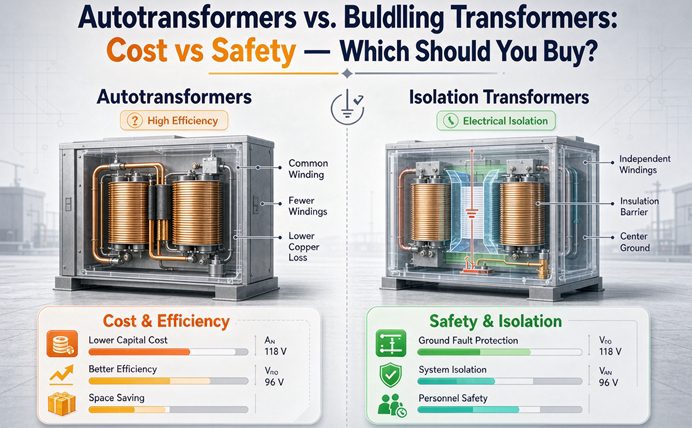
Here’s the whole thing in one breath: an autotransformer is one winding doing double duty; an isolation transformer is two separate windings with a wall of insulation between them. That wall is what you pay for. Everything else — price, weight, safety, noise — flows from it.
At a Glance: Autotransformer vs Isolation Transformer
| Factor | Autotransformer | Isolation Transformer |
|---|---|---|
| Windings | One shared winding | Two separate windings |
| Galvanic isolation | None — direct conductive path | Full separation |
| Typical full-load efficiency | 98–99% | 95–98% |
| Upfront cost (same kVA) | Baseline | +30–50% |
| Weight & footprint | Up to 50% smaller / lighter | Larger and heavier |
| Separately derived system | No | Yes |
| Best fit | Buck/boost, motor start, close ratios | Medical, wet areas, sensitive electronics |
The One Difference That Explains Everything
Every comparison you’ll read — cost, safety, size, efficiency — comes back to a single physical fact: how the windings are built.
How an isolation transformer works
An isolation transformer has two independent windings on a shared core. Power crosses from primary to secondary purely through the magnetic field. There is no wire connecting the input side to the output side, so the load sits on its own little island, electrically speaking. That island can be grounded independently, left floating, or given a brand-new neutral.
How an autotransformer works
An autotransformer uses a single continuous winding with a tap. Part of that winding is the primary; the whole winding (or the rest of it) is the secondary. Power moves two ways at once: some through magnetic induction, some straight through the conductor. Cheap and efficient — but the output is always electrically tied to the input.
The math behind the price gap
Because only the difference between input and output voltage has to be transformed, the winding can be sized for far less than the full load. The rule of thumb:
S_winding = S_load × (1 − V_low / V_high)
Step 480 V down to 240 V at 10 kVA and the winding only needs to handle 5 kVA — the other half just conducts through. That’s why an autotransformer for a close ratio is roughly half the copper and steel of an isolation unit. Push the ratio to something like 480 V → 120 V, though, and that “savings” winding balloons until the advantage disappears.
Cost — What You’ll Actually Pay
This is the part procurement teams really want, and most “vs” articles skip it. Here’s what 2026 U.S. supplier averages look like for new, dry-type, copper-wound, three-phase units.
Typical 2026 prices by capacity
| Rating | Isolation Transformer | Autotransformer | Premium for isolation |
|---|---|---|---|
| 5 kVA | $420 – $480 | $150 – $190 | ~2.5× |
| 10 kVA | $1,250 – $1,680 | $720 – $940 | ~40–55% |
| 50 kVA | $4,100 – $5,300 | $2,400 – $3,100 | ~45–55% |
| 100 kVA | $7,900 – $9,400 | $4,200 – $5,600 | ~50–60% |
Ranges reflect multiple U.S. distributors (stock and build-to-order). Prices move with copper, certification scope, and lead time — treat these as planning numbers, not a quote.
Why autotransformers are cheaper (and when they aren’t)
Less copper, less steel, smaller tank. For a tight ratio like 600 V → 480 V, an autotransformer is a no-brainer. But watch the ratio: at the same 225 kVA nameplate, a 550 V → 575 V autotransformer might list around $2,000, while a 550 V → 220 V unit runs near $14,000 — nearly 7× — because the winding now has to carry the full voltage difference. Past about 3:1, an isolation transformer is often the smarter buy on price and safety.
Lead times and availability
Autotransformers are usually in stock (1–3 days for common sizes); isolation units of 50 kVA and up are frequently build-to-order, with 4–8 week lead times. If a shutdown is breathing down your neck, availability can decide the argument faster than price.
Safety — Where Isolation Is Non-Negotiable
This is where “cheaper” stops being the whole story. Both U.S. and European rules draw a hard line, and it’s worth knowing both if you sell or install on either side of the Atlantic.
U.S. rules (NEC)
Under the National Electrical Code, an autotransformer cannot create a separately derived system — so anywhere you need a new grounded neutral (NEC 250.30), it’s out. NEC Article 517 mandates isolation for patient-care areas in healthcare facilities. NEC Article 450 covers transformer installation and overcurrent protection. And portable tools in damp or construction-site locations must be fed from isolated circuits. When in doubt, your local Authority Having Jurisdiction (AHJ) has the final word.
European rules (IEC / EN + CE)
In the EU, medical electrical equipment falls under IEC 60601-1, which demands isolation to prevent micro-shock. General transformer safety is covered by EN 61558 (and EN 60076 for power transformers), sitting under the Low Voltage Directive 2014/35/EU. A CE mark confirms the unit meets those essential safety requirements. If you’re specifying for an EU site, ask for the EN-standard compliance documentation up front — don’t assume a UL-only unit will clear local inspection.
The “float-up” shock hazard
Here’s the scary one people forget. If an autotransformer’s neutral bond breaks or the shared winding faults, that “stepped-down” 120 V output can float all the way up to the primary voltage. On an isolation transformer, the secondary simply can’t see the primary that way. In a wet location or anywhere a person might touch the gear, that distinction is the difference between a zap and a fatality.
Noise, ground loops, and harmonics
Isolation transformers block common-mode noise and ground loops before they reach your load — standard units give 40–60 dB of rejection, shielded versions 80–120 dB, and ultra-isolation models over 140 dB. Autotransformers pass all of that straight through. For PLCs, lab gear, servers, and VFD-driven equipment, that quiet power is why the isolation premium pays for itself.
Cost vs Safety — The Real Decision Framework
Forget “which is better.” Ask one question: does my load need to be electrically separate from the supply? If yes, the cost argument is over. If no, you can save real money and still be perfectly safe.
Pick an autotransformer when…
- The voltage change is small — a buck/boost like 208 V → 240 V or 600 V → 480 V.
- The load is sealed and unattended: motors, heaters, industrial machinery.
- Panel space and weight are tight and CapEx is the main constraint.
- You’re building a reduced-voltage motor starter (a classic, rugged use).
- You need a smooth variable output for bench testing (a Variac).
Pick an isolation transformer when…
- Anyone can touch the circuit, or it’s in a wet / damp location.
- It’s medical, lab, or patient-care equipment.
- You’re feeding sensitive electronics, PLCs, servers, or VFDs.
- You need a separately derived system or a new neutral.
- The voltage ratio is large (beyond roughly 3:1).
The small-ratio rule (where the savings vanish)
A quick gut check: if the ratio is 3:1 or less and isolation isn’t required, the autotransformer usually wins on price, size, and efficiency. Past 3:1, the winding grows until the cost gap shrinks and the safety gap widens — that’s isolation territory.
Bottom line on cost vs safety: the cheap option is only the wrong option when isolation is required. Spend on isolation where the law or the load demands it; save with an autotransformer everywhere else. Paying for isolation you don’t need is wasteful — skipping it where you do is dangerous.
Frequently Asked Questions
What is the main difference between an autotransformer and an isolation transformer?
An autotransformer uses a single shared winding for input and output, so there is no electrical separation between supply and load. An isolation transformer has two physically separate windings, which gives full galvanic isolation. That separation is the feature you pay extra for.
Can an autotransformer provide electrical isolation?
No. Because input and output share part of the same winding, an autotransformer cannot create galvanic isolation or a separately derived system. If your load needs electrical separation, you must use an isolation transformer.
Why is an autotransformer cheaper than an isolation transformer?
Only the voltage-difference portion of the power is transformed magnetically; the rest passes through conduction. So for close voltage ratios the winding and core can be much smaller. At the same kVA, an autotransformer typically costs 30–50% less.
Is an autotransformer safe?
Yes, when it is correctly specified, protected, and installed in an application where a conductive connection to the source is acceptable. Its lack of isolation determines where it can be used, but it is not inherently unsafe.
When is an isolation transformer required by code?
In the U.S., NEC Article 517 requires isolation for patient-care areas, and a separately derived system is needed wherever a new grounded neutral is required. In the EU, IEC 60601-1 governs medical electrical equipment and the Low Voltage Directive 2014/35/EU plus EN 61558 cover transformer safety. Wet locations and damp-site portable tools also call for isolation.
What voltage ratio makes an autotransformer worth it?
Autotransformers pay off when the input and output voltages are close, typically a 3:1 ratio or less. Beyond roughly 3:1 the winding must be fully insulated for the high side, so the cost and size advantage collapses and an isolation transformer becomes the better buy.
How much more does an isolation transformer cost?
Plan on roughly 30–50% more than an autotransformer of the same kVA. In 2026 U.S. supplier averages that looks like about $720–$940 vs $1,250–$1,680 for 10 kVA, and $4,200–$5,600 vs $7,900–$9,400 for 100 kVA.
Can I use an autotransformer to create a 120/240V separately derived system?
No. An autotransformer keeps the output electrically tied to the input, so it cannot establish a separately derived system with its own grounded neutral. For a new neutral or a floating secondary you need a two-winding isolation transformer.
Wrapping It Up
So, autotransformer or isolation transformer? Start with the load, not the price tag. If the equipment needs to be separated from the mains — medically, electrically, or just because a human might touch it — buy the isolation unit and sleep fine. If it’s a sealed motor or a small buck/boost on a dry machine, the autotransformer saves you 30–50% and a lot of panel space, and that’s the right call.
The “cost vs safety” debate only feels like a trade-off because people frame it as one. It isn’t. Safety law tells you when isolation is mandatory; everywhere else, cost should win. Pick on the merits, size it at ≥125% of your measured load, and confirm the grounding with your AHJ or notified body before energizing.