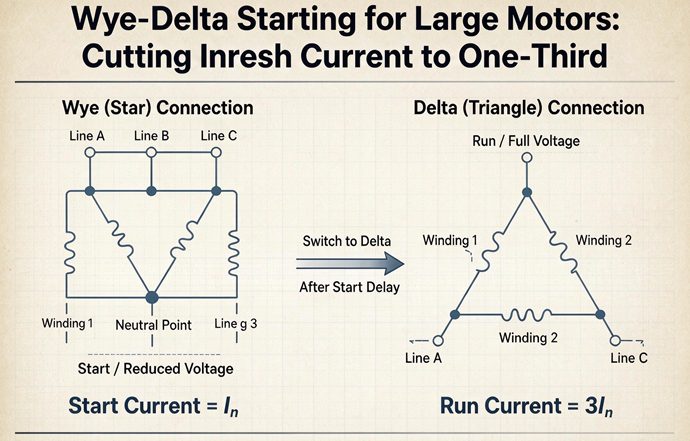
Wye-delta starting cuts the current a large motor draws at standstill to one third of what a direct-on-line start would pull, because each winding sees 58 percent of line voltage. It cuts torque by the same one third, and that is the trade. The trouble sits in the two seconds in the middle, when the starter lets go of one connection and grabs the other.
That middle part is where the arguments start. A starter that reduces current to 2,000 amps and then produces a transient of 5,000 amps has not solved the problem, it has moved it. So the useful question is not whether wye-delta works. It is whether wye-delta works on this motor, on this load, with this transition, on this supply.
What one third actually means
The number is not a rule of thumb. It falls out of two square roots of three, and it is worth doing once because everything later depends on it.
In delta, each winding sits across the full line voltage. The current in the winding is the line current divided by 1.732, and the motor produces its normal locked-rotor torque.
In wye, the three winding ends meet at a common point. Each winding now sees the line voltage divided by 1.732, so the current in the winding drops by that same factor. But there is a second effect. In wye, the line current equals the winding current, because there is no delta node splitting it. So the line current falls by 1.732 twice.
One over 1.732 times one over 1.732 is one third. Exactly.
Take a 500 hp, 480 volt, four-pole motor. The full load current from NEC Table 430.250 is 589 amps. Locked rotor current for a NEMA Design B machine in this size is typically six times that, so 3,534 amps.
| Connection | Winding voltage | Winding current | Line current |
|---|---|---|---|
| Delta, running | 480 V | 340 A | 589 A |
| Delta, locked rotor | 480 V | 2,040 A | 3,534 A |
| Wye, locked rotor | 277 V | 1,178 A | 1,178 A |
The line current in wye is 1,178 amps, which is 33.3 percent of 3,534. The torque is 33.3 percent as well, because torque follows the square of winding voltage and 1 over 1.732 squared is one third.
Notice what the table says about the winding. At standstill in wye the winding carries 1,178 amps, which is more than twice its running current of 340. The winding is not being protected by the reduced voltage in the way people assume. It is being protected by time.
One third of what, exactly
Here is where most explanations go wrong, including a few that get paid for this.
One third refers to one third of the direct-on-line starting current. It does not refer to one third of full load current. On a motor with six times locked rotor current, wye-delta starting still draws twice nameplate.
| Motor | FLA at 480 V | DOL inrush, 6x | Wye start | As % of FLA | Starting kVA, DOL to wye |
|---|---|---|---|---|---|
| 200 hp | 240 A | 1,440 A | 480 A | 200% | 1,197 to 399 |
| 300 hp | 361 A | 2,166 A | 722 A | 200% | 1,801 to 600 |
| 500 hp | 589 A | 3,534 A | 1,178 A | 200% | 2,938 to 979 |
| 700 hp | 828 A | 4,968 A | 1,656 A | 200% | 4,130 to 1,377 |
Every row lands on 200 percent of full load, because every row assumes six times locked rotor current. That assumption is doing a lot of work. Locked rotor current varies with the motor design and with the manufacturer, and the range for standard industrial machines runs from about 5.5 to 7 times.
| Locked rotor current | Wye start as a multiple of FLA |
|---|---|
| 5.5x | 1.83x |
| 6.0x | 2.00x |
| 6.5x | 2.17x |
| 7.0x | 2.33x |
So the honest sentence is “wye-delta brings the start down to somewhere between 1.8 and 2.3 times full load current.” If a supplier tells you the motor will start at one third of nameplate, they are quoting a ratio without its base, and the number they gave you is too small by a factor of six.
This matters for the transformer. A 500 hp motor starting at 1,178 amps looks completely different on a 1,000 kVA unit than it does on a 2,500 kVA unit, and the difference is whether the lights in the office flicker.
Why the measured current is not exactly one third
The arithmetic gives 33.3 percent. Clip a recording meter on the feeder and you will read something between 30 and 35, and the difference is not instrument error.
Three things move it. The magnetic circuit is not linear, so the magnetizing component of the current does not scale with voltage the way the rotor component does. The winding has resistance, which is a larger fraction of the total impedance at reduced voltage. And the first two or three cycles carry a DC offset from closing at a random point on the voltage wave, which inflates the peak without changing the steady value.
None of that matters much for the motor. It matters for the transformer and the generator, because you are sizing those against the number you write down, and the error runs one way. A designer who uses 30 percent because it is what the meter said will specify a supply 10 percent smaller than a designer who uses 33.3.
Use two times full load current for a six-times motor and do not round it down. The starter will produce slightly less than that in practice, and being slightly pessimistic about a starting current is the cheapest kind of pessimism available.
The square root of three that nobody mentions
Now the part that makes wye-delta worth keeping in the catalogue.
Every reduced-voltage method gets judged on two numbers, the current it draws and the torque it produces. Compare them on the same basis and one method stands apart.
Torque follows the square of the voltage at the winding. Current at standstill follows the voltage. So for any method that simply reduces voltage without changing the connection, torque falls with the square of current. At one third current you get one ninth torque.
Wye-delta does not reduce voltage across a fixed connection. It changes the connection, and the line current picks up an extra factor of 1.732 on the way out. That is the free square root of three.
| Method | Line current at start | Torque at start | Torque per amp |
|---|---|---|---|
| Direct on line | 100% | 100% | 1.00 |
| Wye-delta | 33.3% | 33.3% | 1.00 |
| Auto-transformer, 80% tap | 64.0% | 64.0% | 1.00 |
| Auto-transformer, 65% tap | 42.2% | 42.2% | 1.00 |
| Auto-transformer, 50% tap | 25.0% | 25.0% | 1.00 |
| Primary resistor or reactor, 58% V | 57.7% | 33.3% | 0.58 |
| Soft starter limited to 58% V | 57.7% | 33.3% | 0.58 |
Read the bottom row against the second row. Same torque, but the soft starter needs 57.7 percent of the direct-on-line current to make it while wye-delta needs 33.3 percent.
In amps, on the 500 hp motor: 33 percent of locked-rotor torque costs 1,178 amps with wye-delta and 2,040 amps with a soft starter. The ratio is 1.732, and it is not a coincidence.
Turn the same fact around and it reads worse for the solid-state option. Limit a soft starter to 1,178 amps, which is one third of the direct-on-line current, and the voltage it can apply is one third of rated. Torque is one ninth of direct-on-line, about 11 percent. Wye-delta at the same current gives 33 percent.
That is the entire case for wye-delta in one comparison. At the current you can afford, it delivers three times the torque of anything that works by dropping voltage across an impedance.
The auto-transformer matches wye-delta on torque per amp, which is why it was the competitor for decades. It lost on floor space and on the fact that it has to be tapped for one voltage and left there.
The torque the load actually asks for
One third of locked rotor torque sounds like a lot until you put it against a load curve.
A representative 500 hp Design B motor produces about 130 percent of rated torque at standstill, peaks near 212 percent around 85 percent speed, and collapses to zero at synchronous speed. Divide by three for wye and the picture changes quickly.
| Speed | DOL torque, per unit | Wye torque, per unit |
|---|---|---|
| 0% | 1.30 | 0.43 |
| 50% | 1.80 | 0.60 |
| 70% | 2.00 | 0.67 |
| 80% | 2.10 | 0.70 |
| 85% | 2.12 | 0.71 |
| 90% | 2.08 | 0.69 |
| 95% | 1.92 | 0.64 |
| 98% | 1.45 | 0.48 |
| 99% | 1.00 | 0.33 |
Now overlay the load. A centrifugal fan or pump asks for torque proportional to the square of speed, so it wants 100 percent at full speed, 64 percent at 80 percent speed, and almost nothing at standstill. A loaded conveyor wants 40 percent at standstill just to break the belt loose. A ball mill wants 50 percent before it turns at all.
Where the wye curve crosses the load curve is the highest speed that motor will reach in wye. Not a guideline. A hard ceiling.
| Load | Torque needed at standstill | Highest speed in wye | Verdict |
|---|---|---|---|
| Fan, damper closed | 0% | 99% | Easy |
| Reciprocating compressor, unloaded | 30% | 99% | Easy |
| Centrifugal pump, no static head | 0% | 84% | Workable, tight at the top |
| Centrifugal fan, full flow | 0% | 84% | Workable, tight at the top |
| Pump with 20% static head | 20% | 79% | Marginal |
| Loaded conveyor | 40% | 13% | Starts, then stalls |
| Ball mill | 50% | 0% | Will not turn |
Two rows in that table are the ones worth memorising.
A centrifugal fan at full flow reaches 84 percent and stops. That is not a failure exactly, it is a design limit, and it explains why every fan retrofitted with a wye-delta starter also gets a damper that closes on stop. Without the damper the starter has nothing to give.
A loaded conveyor reaches 13 percent, which means it lurches and stalls. A ball mill does not move at all, because 50 percent of rated torque is more than 43 percent, and the numbers do not negotiate.
This is the question to ask before anything else: what is the breakaway torque, as a multiple of running torque? If the answer is above 0.43, wye-delta is the wrong tool and no amount of timer adjustment fixes it.
The thermal side, which is where the motor dies
Torque decides whether the motor starts. Heat decides whether it survives the attempt.
The good news is that the wye start is thermally gentler than a direct start, and the arithmetic is short. Heating goes as current squared times time. In wye the current is one third, so the heating rate is one ninth. The acceleration takes about three times as long because the torque is one third. Multiply those and the total I squared t of a wye start is about one third of a direct start.
| Current | Time | Relative I squared t | |
|---|---|---|---|
| Direct on line | 3,534 A | 1.0 | 1.00 |
| Wye, complete start | 1,178 A | 3.0 | 0.33 |
That is the number that makes wye-delta attractive to anybody who has watched a motor thermal relay trip on a direct start.
The bad news is the cooling. A totally enclosed fan cooled motor turns a fan on the back of the shaft, and that fan moves air in proportion to speed. During a wye start the motor spends most of its time below half speed, so it is producing one ninth the heat and losing perhaps 20 to 40 percent of its cooling.
Work it out for the 500 hp machine. At 1,178 amps it is drawing twice full load, so the heating is four times rated. Cooling at 30 percent of rated means the effective heating is four divided by 0.3, which is about thirteen times rated. A motor with a 45 minute thermal time constant reaches its limit in roughly three and a half minutes.
Forty five seconds of wye is comfortable inside that. Three minutes of wye, which is what a high-inertia fan with a badly judged load curve will produce, is not.
This is the argument for measuring rather than assuming. Put a clamp meter and a tachometer on the first start, record the speed at transition and the time it took to get there, and write both numbers on the inside of the door. The next person to open that panel will not have to guess.
How many starts per hour the motor will take is a manufacturer’s statement, not a code value. NEMA MG 1 gives general guidance and the motor maker gives you a number, and for a machine that starts twenty times a shift you want that number in writing before you accept the starter design.
The two seconds in the middle
The open transition is where wye-delta earns its reputation, and the physics is worth walking through because it explains why the field reports disagree so wildly.
When the wye contactor opens, the motor is disconnected but still spinning, and the rotor field is still there. That field induces a voltage in the stator. The magnitude is set by two things: the flux, which in wye was only 58 percent of rated, and the speed.
At 90 percent speed the residual voltage per phase is 0.577 times 0.9 times 277, which is 144 volts. Small enough to sound harmless.
But the frequency of that voltage is the slip frequency. At 90 percent speed the slip is 10 percent, so the residual voltage alternates at 6 Hz, not 60. That is the detail that decides everything. The phase relationship between the residual voltage and the supply is sweeping through 360 degrees every 167 milliseconds.
Then the delta contactor closes. Whether it closes with the two voltages nearly in phase or nearly opposed is set by the dead time, which is a timer setting, and by where the rotor happened to be. Nobody controls it.
| Speed at transition | Residual EMF | Reclose current, in phase | 90 degrees | Opposed |
|---|---|---|---|---|
| 80% | 128 V | 1,902 A / 3.2x FLA | 3,893 A / 6.6x | 5,166 A / 8.8x |
| 85% | 136 V | 1,800 A / 3.1x | 3,937 A / 6.7x | 5,268 A / 8.9x |
| 90% | 144 V | 1,698 A / 2.9x | 3,983 A / 6.8x | 5,370 A / 9.1x |
| 95% | 152 V | 1,596 A / 2.7x | 4,031 A / 6.8x | 5,472 A / 9.3x |
The worst case is 9.1 times full load current. Direct on line is 6.0 times. Read that again: the transition, in the worst phase position, is worse than the start you paid to avoid.
The dead time makes it a lottery rather than a certainty. Thirty milliseconds of dead time lets the phase relationship move 65 degrees. One hundred milliseconds moves it 216 degrees. Both are inside the range that ordinary starters use, and both are far from the 167 milliseconds it takes to go all the way around, which is why the same starter on the same motor can be quiet on Monday and trip the breaker on Tuesday.
So the peak current after the transition has two parts, and they are often confused.
The first is the transient, lasting a few cycles, driven by the phase mismatch. It ranges from 2.7 to 9.3 times full load and it does not care how good your timer is.
The second is the sustained current, which is the ordinary current a motor draws at that slip with full voltage applied. This one the timer does control.
| Timer setting | Speed at transition | Sustained current after the transition |
|---|---|---|
| 5 s | 9.5% | 5.7x FLA |
| 10 s | 19.6% | 5.4x FLA |
| 15 s | 30.3% | 5.0x FLA |
| 20 s | 41.3% | 4.6x FLA |
| 30 s | 64.2% | 3.6x FLA |
| 45 s | 96.7% | 1.1x FLA |
Those numbers come from a 500 hp motor driving a fan of 6,000 lb-ft squared inertia with the damper closed. The acceleration in wye is slow because the torque is one third, and the same motor reaches full speed in about 15 seconds on a direct start.
Ten seconds is the factory default on most timers. On this machine it fires at 19.6 percent speed, which means the delta contactor closes into 5.4 times full load current, and the wye phase bought nothing at all.
The right setting is the shortest time that puts the motor at 80 to 85 percent speed under the heaviest starting condition. On a high-inertia fan that can be 45 seconds or a minute. Anybody who tells you to put it at 10 seconds and move on has not measured the motor.
The resistor fix, and what it costs
A closed transition starter, often called Korndorfer after the patent, keeps the motor connected during the changeover by putting resistors in the circuit for the transition. The motor is never fully disconnected, so the residual voltage never gets a chance to drift out of phase.
The resistors are not decorative. On the 500 hp motor, holding the transition current to twice full load needs about 0.27 ohms per phase, and that resistor dissipates roughly 126 kilowatts for the second it is in circuit.
Three of those, plus two extra contactors, plus the logic to sequence them, plus the panel space. This is why closed transition costs a meaningful multiple of an open transition starter and why it is usually skipped until the first coupling shears.
It works, and on a machine where the transition is genuinely intolerable it is the cheapest version of the fix. It is also the point at which a soft starter starts to look reasonable, because the soft starter solves the same problem without resistors and adds a current limit you can adjust.
Six leads, and why nine will not do
Wye-delta starting is a motor requirement before it is a starter requirement, and this is where purchase orders go wrong.
The motor has to have both ends of each winding brought out, so the external starter can put them in wye and then in delta. And the delta connection has to be the running connection at line voltage.
| Leads | Wye-delta possible? | Why |
|---|---|---|
| 3 | No | Only one end of each winding is accessible |
| 6 | Yes | Delta at line voltage is the run connection |
| 9 | No at high voltage | At 460 V the winding is internally wye, with 4-5-6 joined |
| 12 | Only if the maker lists a delta connection at line voltage | Otherwise the run connection is a parallel wye |
The nine-lead row is the expensive one. A nine-lead dual-voltage motor at its high voltage connection is a wye machine, with the star point made inside the terminal box. There is no external access to reconfigure it. You can buy a perfectly good motor, a perfectly good starter, and discover at commissioning that the two cannot be connected.
On a 12-lead motor the question is which connection the manufacturer lists for line voltage. Some list a series delta and some list a parallel wye, and only the first one can be wye-delta started.
So the specification has to say it plainly: six leads minimum, delta running connection at 480 volts, and wye-delta starting acceptable to the motor manufacturer. That last phrase matters because the manufacturer’s warranty position on repeated wye-delta starts is their call, not yours.
Three contactors, three different currents
The main contactor, the delta contactor and the wye contactor do not carry the same current, and sizing them alike is a common shortcut that produces a hot panel.
| Contactor | What it carries | Running | Starting |
|---|---|---|---|
| Main, 1M | Line current | 589 A | 1,178 A |
| Delta, 2M | Winding current in delta | 340 A | Open |
| Wye, 3M | Winding current in wye | Open | 1,178 A |
The delta contactor carries 57.7 percent of full load, which is where the familiar “size it at 58 percent” rule comes from, and it is correct for that one device.
The wye contactor carries 1,178 amps, which is 200 percent of full load, and it carries it while opening. That is the hardest duty in the panel, and it is the contactor most likely to be specified from the same row of the catalogue as the delta unit. It will work for a while. Then it will weld.
The practical rule from the manufacturers’ selection tables is main at full load current and delta and wye at 58 percent, with the caveat that the wye contactor’s making and breaking capacity, not its thermal rating, is what has to cover the 200 percent. Check the table rather than the rule.
Then there is the overload, which is the single most common setting error in a wye-delta starter.
If the overload relay sits in the line, ahead of the main contactor, it sees full line current and gets set at the motor’s nameplate full load current. If it sits in the delta leg, in series with the windings, it sees 57.7 percent of line current and has to be set at 0.58 times nameplate.
| Relay location | Current it sees at full load | Correct setting |
|---|---|---|
| In the line | 589 A | 589 A |
| In the delta leg | 340 A | 340 A |
Put a delta-leg relay in at 589 amps and it will not trip until the line current reaches 1,020 amps, which is 173 percent of nameplate. The motor is then unprotected everywhere between 125 percent, which is the ceiling in NEC 430.32(A)(1), and 173 percent. That is a wide band in which a winding can cook quietly, and the relay will report that everything is fine right up until the smoke.
The reverse error is just as common and easier to notice. A line-mounted relay set at 0.58 times nameplate trips at 58 percent load, and the maintenance crew spends a week looking for a mechanical problem.
What this does to your transformer and your generator
This is the part the motor blogs skip, and it is the part that decides whether the project needs a bigger transformer.
Starting current divided by available short circuit current gives the voltage dip, as a first approximation. On a 1,500 kVA transformer at 5.75 percent impedance, the secondary short circuit current is 31,378 amps.
| Source | Available fault current | Dip, direct on line | Dip, wye-delta |
|---|---|---|---|
| 1,000 kVA, 5.75% | 20,918 A | 16.9% | 5.6% |
| 1,500 kVA, 5.75% | 31,378 A | 11.3% | 3.8% |
| 2,500 kVA, 5.75% | 52,296 A | 6.8% | 2.3% |
| 1,250 kVA generator, X”d 15% | 10,023 A | 35.3% | 11.8% |
| 1,500 kVA generator, X”d 15% | 12,028 A | 29.4% | 9.8% |
On the 1,500 kVA transformer, direct on line drops the bus 11.3 percent. Contactors holding in at 85 percent will drop out. Adjustable speed drives will trip on undervoltage. The wye-delta start drops it 3.8 percent, which most equipment rides through without noticing.
On a generator the arithmetic is brutal, because a generator’s subtransient reactance is much higher than a transformer’s impedance. A 1,250 kVA set sees 35 percent dip on a direct start, which is not a dip, it is a blackout with a recovery. Wye-delta brings it to 11.8 percent, which is still enough to make the lights blink but keeps the set online.
That is the real argument for wye-delta, and it has nothing to do with the motor. It is about what else is on the bus.
Medium voltage changes the arithmetic
Everything above is written for 480 volts because that is where most of these starters are sold. Above 600 volts the method survives but the details get harder, and the crossover where it stops being the right answer arrives sooner.
Take a 2,000 hp, 4,160 volt motor. Full load current on a typical data sheet is about 245 amps, locked rotor at six times is 1,470 amps, and a wye start draws 490 amps. Starting load falls from 10,592 kVA to 3,530 kVA, the same one third, because the ratio does not care about voltage.
What changes is the switching. At 4,160 volts the contactors are vacuum bottles, and a vacuum contactor interrupting current chops it in a few microseconds rather than waiting for a current zero. That chop produces a voltage transient on top of the residual voltage transient already described, and the two do not always help each other.
The practical result is that open transition wye-delta at medium voltage produces more spectacular switching surges than the low voltage version, and the motors and cables are more valuable. Above roughly 1,500 hp at medium voltage, a soft starter or a drive is the normal answer and wye-delta is a legacy arrangement you keep running rather than one you design in.
The six-lead requirement also costs more at medium voltage, because the winding is a larger share of the motor price and a special connection is a special order.
One worked example, 500 hp on a 1,500 kVA
Put the pieces together on a realistic job.
A 500 hp, 480 volt, 1,780 rpm motor drives a centrifugal fan through a belt. The building is fed from a 1,500 kVA transformer at 5.75 percent. The fan has 6,000 lb-ft squared of inertia and a damper that closes on stop. The available fault current at the starter terminals is 31,378 amps.
Step one is the start current. Six times 589 is 3,534 amps direct on line, and one third of that is 1,178 amps. On the 1,500 kVA transformer that is a 3.8 percent dip, which the rest of the building will tolerate.
Step two is the torque. The fan with a closed damper needs almost nothing at standstill and 25 percent of rated torque at full speed, so the wye curve clears it everywhere. The motor reaches 99 percent speed in wye if you let it, and the transition can happen anywhere above 80 percent.
Step three is the timer. With this inertia the motor takes about 8 seconds to reach 19 percent speed and about 45 seconds to reach 96 percent. Setting the timer at 45 seconds costs 45 seconds of production per start and eliminates the 5.4 times full load transition current. On a fan that runs three shifts and starts twice a day, that is the right trade. On a fan that starts forty times a day, it is not, and the answer is a drive rather than a better timer.
Step four is the gear. The starter has to carry a short circuit rating at least equal to the 31,378 amps available. A standard combination starter with a 10 kA rating is not adequate, and this is a specification line that gets left off purchase orders constantly. Either specify a starter rated 42 kA or specify current limiting fuses ahead of it.
Step five is the motor. Six leads, delta at 480 volts, wye-delta starting acceptable to the manufacturer. A nine-lead motor will not work and the mistake will not surface until the electrician opens the terminal box.
Step six is the overload. If the relay is in the delta leg, set it at 340 amps, not 589.
Step seven is the transition current. Expect a transient between 2.7 and 9.3 times full load current lasting a few cycles, regardless of where the timer is set. If the breaker’s instantaneous element trips at transition and the load really cannot take a closed transition starter, the code permits raising the instantaneous setting under NEC 430.52(C)(1), but that is a decision to record, not a decision to make quietly at 4 pm on a Friday.
When a soft starter or a drive is the honest answer
Wye-delta is the cheapest thing that works, and there are three situations where it does not.
The first is a load that needs more than 43 percent of rated torque to break away. A loaded conveyor, a crusher, a ball mill, a positive displacement compressor that cannot be unloaded. No timer setting and no contactor selection changes the curve crossing.
The second is a machine that starts often. Every start is two events, not one, and the second event is the one that wears the contactor and shocks the coupling.
The third is a machine whose speed needs to change. Wye-delta gives exactly one reduced step and no control. A drive gives whatever the process needs.
The comparison is not only capital cost. A drive on a 500 hp motor loses roughly 2 to 3 percent of its throughput as heat, continuously, whether the load needs it or not. On this motor that is 7.8 to 11.7 kilowatts, which at 8,760 hours and 10 cents is between 6,800 and 10,200 dollars a year before the drive does anything useful.
| Wye-delta | Soft starter | Drive | |
|---|---|---|---|
| Starting current | 2.0x FLA | Adjustable, typically 2 to 4x | 1.0 to 1.2x |
| Starting torque at that current | 33% of DOL | About 58% of what wye-delta gives at the same current | 100% or more |
| Transition transient | Yes, 2.7 to 9.3x FLA | None | None |
| Running losses | Contactor only, tens of watts | Bypassed after start | 2 to 3% continuously |
| Speed control | No | No | Yes |
| Panel footprint | Three contactors and a timer | One small enclosure | Often a room |
The soft starter row is the one people get wrong. It is not a strictly better wye-delta. At the same current limit it produces about 58 percent of the torque, so a job that barely starts on wye-delta will not start on a soft starter set to the same current. What the soft starter buys is the elimination of the transition transient and an adjustable current limit, and those are worth real money on the right machine.
Six things that go wrong
These are the ones that show up in commissioning reports, roughly in order of how much they cost.
- The timer is left at ten seconds. The motor is at 19 percent speed, the delta contactor closes into 5.4 times full load, the breaker trips, and somebody concludes that wye-delta does not work on this motor. It does. The timer is wrong.
- The overload is set to nameplate in the delta leg. The relay needs 340 amps, not 589. Set at 589 it protects nothing until 173 percent of nameplate, which is well past the point where the winding is damaged.
- A nine-lead motor arrives. The terminal box has no accessible star point at 480 volts, and no starter can fix that. This is caught at commissioning, which is the most expensive possible moment.
- The wye contactor is sized like the delta contactor. The delta unit carries 340 amps, the wye unit opens 1,178. Same catalogue page, very different duty, and the failure mode is a welded contactor that holds the star point closed.
- The transition trips the breaker and the instantaneous is raised. This “fixes” the symptom and removes the short circuit protection for the motor branch. If the instantaneous has to move, the setting has to be documented and the coordination rechecked.
- Nobody asks for the starter’s short circuit rating. The panel is fed from a transformer with 31,378 amps available and the starter is rated 10 kA. That is not a performance problem, it is an arc flash problem.
What to put on the RFQ
A wye-delta starter is simple enough that a two-line request feels sufficient. It is not. These are the lines that decide whether the thing works.
- Motor full load current and locked rotor current, from the actual data sheet, not from a table.
- The required breakaway torque as a multiple of running torque, and the load type. If nobody knows, this is the question to answer before ordering anything.
- Load inertia, so the timer can be set from an acceleration calculation instead of a guess.
- Lead count and connection, with the delta connection at line voltage stated explicitly.
- Available fault current at the starter terminals, so the short circuit rating can be specified.
- Transition type, open or closed, and if closed, who is responsible for the resistors.
- Overload location, line or delta leg, so the setting is unambiguous on the drawing.
- Duty cycle, starts per hour and starts per day, because that sets the contactor life and the motor thermal duty.
- Whether the motor manufacturer accepts wye-delta starting, in writing, for the warranty file.
Nine lines. Any one of them missing produces a commissioning surprise, and the surprise is always more expensive than the line would have been.
FAQ
Does wye-delta starting really reduce current to one third?
Yes, and it is exact for line current, because two factors of the square root of three multiply. In wye each winding sees 58 percent of line voltage, so winding current falls to 58 percent, and because line current in wye equals winding current instead of 1.732 times it, line current falls to 33.3 percent. Measured values run 30 to 35 percent because magnetizing current does not scale the same way.
Is one third of full load current the same as one third of inrush?
No, and this is the most common error in the literature. One third refers to one third of the direct-on-line starting current. On a motor with six times locked rotor current, that leaves a starting current of twice full load. Across the usual range of 5.5 to 7 times locked rotor, wye-delta starting draws 1.83 to 2.33 times nameplate, never one third of it.
What size transformer do I need for a 500 hp wye-delta start?
A 500 hp motor at 480 volts draws 589 amps at full load and 1,178 amps during a wye start, which is 979 kVA. On a 1,500 kVA transformer at 5.75 percent impedance that is a 3.8 percent dip. On a 1,000 kVA unit it is 5.6 percent. Direct on line would be 11.3 and 16.9 percent respectively, which is why the starter choice changes the transformer size.
Why does my starter trip when it changes from wye to delta?
Two causes, two fixes. If the timer is short the motor is still at 20 to 30 percent speed and the delta contactor closes into 4 to 5.5 times full load current, which is a timer setting. If the timer is right and it still trips, the open transition transient is the cause, running 2.7 to 9.3 times full load. Only a closed transition starter or a soft starter removes that.
How long should the star timer be set?
Long enough for the motor to reach 80 to 85 percent speed under the heaviest starting condition, which is measured, not assumed. On a high-inertia fan that can be 45 to 60 seconds. On a small pump it can be 4 seconds. The factory default of 10 seconds is a placeholder and on a large fan it fires at under 20 percent speed.
Can any motor be wye-delta started?
No. The motor needs six leads brought out and a delta connection at line voltage as its running connection. A three-lead motor cannot be reconfigured. A nine-lead dual-voltage motor at its high voltage connection is internally wye, with the star point made inside the terminal box, so it cannot be wye-delta started at that voltage.
What is the difference between open and closed transition?
Open transition disconnects the motor completely for 30 to 100 milliseconds while the contactors change over. Closed transition, often called Korndorfer, keeps the motor connected through resistors during the change, so the residual voltage never drifts out of phase. Closed transition eliminates the transient and costs more, typically three resistors rated for a few hundred kilowatts for about a second, plus two contactors.
Why is my overload relay set at 0.58 times the nameplate current?
Because it is in the delta leg, where it carries winding current rather than line current. In delta the winding current is the line current divided by 1.732, so 589 amps of line current appears as 340 amps at the relay. Set at nameplate instead, the relay would not trip until 173 percent of full load, leaving the motor unprotected above the 125 percent ceiling in NEC 430.32.
Which contactor in a wye-delta starter works hardest?
The wye contactor. It carries the full starting current, which is about 200 percent of full load, and it interrupts that current when the transition begins. The delta contactor carries only 58 percent of full load and the main carries 100 percent. Sizing all three from the same row is a common and expensive shortcut.
Can wye-delta start a loaded conveyor or a crusher?
Generally no. A loaded conveyor needs about 40 percent of rated torque just to break away, and a ball mill about 50 percent, while wye starting delivers 33 percent of the motor’s direct-on-line torque. At standstill the motor produces 43 percent of rated torque in wye, so a conveyor lurches to about 13 percent speed and stalls, and a mill does not turn at all.
Does wye-delta work on a generator supply?
It is often the only thing that does. A 1,250 kVA generator with 15 percent subtransient reactance sees a 35 percent voltage dip on a 500 hp direct start, which will usually collapse the set. Wye-delta brings that to 11.8 percent, which the set can ride through. Below about 500 kVA of generator capacity even a wye-delta start on a large motor needs a check.
Is wye-delta still worth using instead of a drive?
On a fixed speed machine with a light start, yes, because it is a contactor panel with no electronics and no continuous losses. A drive on the same 500 hp motor burns 7.8 to 11.7 kilowatts continuously, worth 6,800 to 10,200 dollars a year at 10 cents, which buys a lot of starting equipment. The drive wins when the process needs variable speed or frequent starts, and wye-delta wins when it does not.