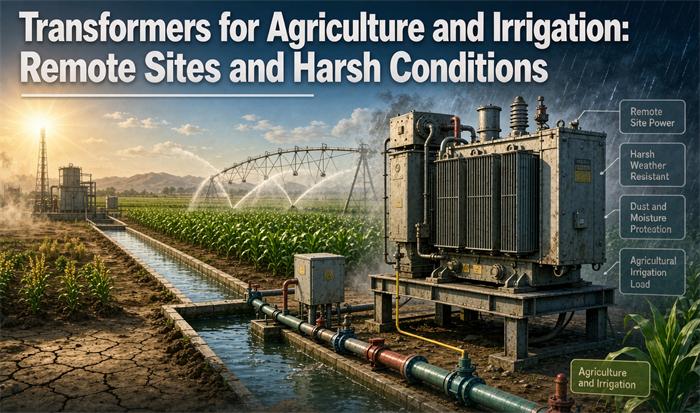
A farm transformer is sized by distance and by season, not by kVA alone. At the same load, a 240 V single-phase run drops four times the voltage of a 480 V three-phase run, and about 82 percent of a pivot transformer’s yearly loss happens while the field is dry. Both numbers change what you order.
Why a farm is not a small factory
A factory sits in one place with a maintenance staff. A farm is a mile of wire with nobody home. That difference shows up as six conditions, and each one moves a decision.
| Condition | What it does electrically | What it changes in the order |
|---|---|---|
| Distance in miles, not feet | Voltage drop sets conductor size, not ampacity | Run 480 V three-phase, or run primary to the load |
| 1,200 to 2,000 running hours | The unit idles 7,000 hours a year | No-load loss beats nameplate efficiency |
| Load is one big motor | 6 to 8 times inrush on start | Buy kVA for starting, not for heat |
| Supply is often single-phase | No three-phase at the pole | A converter, or a converter plus a step-up |
| Livestock in the same dirt | Neutral-to-earth voltage affects animals | Grounding per Article 547, not per habit |
| Nobody on site for weeks | A fault stays until someone drives out | Surge arresters, wildlife guards, remote monitoring |
The first four are cost decisions. The last two are the reason a farm service gets torn out and rebuilt two years after it goes in.
480 volts or 240: the four-to-one rule
Start with the current. At 240 V single-phase a load draws 4.17 amps per kVA. At 480 V three-phase it draws 1.20 amps per kVA. So the same kVA needs 3.5 times the current at the lower voltage.
Then add the drop formula. Single-phase voltage drop is 2 times current times resistance. Three-phase is 1.73 times. Multiply the two effects and you get 4.0.
For the same kVA on the same conductor, a 240 V single-phase run drops four times the voltage of a 480 V three-phase run.
Here it is on 4/0 copper, one thousand feet, which is a short run by farm standards.
| Load | Configuration | Current | Drop over 1,000 ft | Percent |
|---|---|---|---|---|
| 50 kVA | 240 V single-phase | 208 A | 25.3 V | 10.5% |
| 50 kVA | 480 V three-phase | 60 A | 6.3 V | 1.3% |
| 117 kVA | 480 V three-phase | 141 A | 14.8 V | 3.1% |
Ten and a half percent. That is not a design margin, that is a pump that will not start in August. This is why every center pivot in the country is wired 480 V three-phase, and why a 240 V single-phase service is a hard ceiling at about 10 HP.
What 480 V actually buys you
NEC Table 430.250 is the number to keep on your phone. At 460 V, three-phase:
| HP | 5 | 10 | 15 | 20 | 25 | 30 | 40 | 50 | 60 | 75 | 100 | 125 | 150 |
|---|---|---|---|---|---|---|---|---|---|---|---|---|---|
| Amps | 7.6 | 14 | 21 | 27 | 34 | 40 | 52 | 65 | 77 | 96 | 124 | 156 | 180 |
A 100 HP pump is 124 A. That is 103 kVA in round numbers, which fits a 150 kVA transformer. The same motor at 240 V single-phase is not a product anyone sells, because it would draw 372 A and need conductors the size of your arm.
One caveat on the 480
Ask whether the service is 480Y/277 or 480 delta. On a farm you want the grounded wye. A ground fault on a solidly grounded wye trips a breaker in a fraction of a second. A ground fault on an ungrounded delta sits there until something fails, and on a site with a metal pivot, wet soil, and livestock, “sits there” is the wrong answer. The wye also gives you 277 V for yard lighting without a second transformer.
Who owns which transformer
This is the question that costs farmers the most money, and no article in the top five mentions it. Four transformers can sit between the utility line and a pivot. You only buy one of them.
| Location | Typical unit | Owner | Who you call |
|---|---|---|---|
| Pole at the road | 25 to 50 kVA single-phase, or 75 to 150 kVA three-phase | Utility | Utility |
| Meter pedestal, site-isolating device | No transformer, a switch and a meter | You | Electrician |
| Pivot pad at the far end | 75 to 150 kVA, 12.47 kV to 480 V | You | Us |
| Shop, bin fans, office | 480 to 240/120, or 480 to 208/120 | You | Electrician |
The unit on the pole is the utility’s. They size it, they own the losses, they replace it when lightning takes it, and they will not let you specify the impedance. If you need a particular no-load loss or a particular fault current, you have to own the transformer, which means a primary meter and a customer-owned substation. That is a business decision made at the kitchen table, not an electrical one.
The fastest way to lose three weeks is to put a 50 kVA pole-mount on your RFQ when the co-op was going to hang one for free. Call the utility before you call a supplier. A single-phase cylindrical winding unit is the right answer only when you own it.
Sizing a pivot transformer in four steps
Take a half-mile pivot: eight spans, eight 1 HP tower drives, one 100 HP pump, 480 V three-phase. That is a real machine on a quarter section.
Step one, add the nameplate amps. From Table 430.250, the pump is 124 A and each tower drive is 2.1 A. Eight drives come to 16.8 A. Connected load is 140.8 A.
Step two, apply the feeder rule. NEC 430.24 sizes a feeder at 125 percent of the largest motor plus 100 percent of the rest: 1.25 times 124 plus 16.8 equals 171.8 A.
Step three, convert to kVA and pick a standard rung. 140.8 A divided by 1.2028 is 117 kVA. The three-phase ladder goes 75, 112.5, 150. A 112.5 kVA unit is 135 A, which is 4 percent short of the connected load, so it is out. You are buying a 150 kVA distribution unit, which is 180 A.
Step four, check the start. A NEMA Design B motor at 100 HP pulls about 6 times running current for a few seconds. Six times 124 A is 744 A, which is 618 kVA of apparent power during the start. On a 150 kVA unit at 2.5 percent impedance, the voltage dip is roughly 618 divided by 150, times 2.5 percent, or 10.3 percent.
That is over the usual 10 percent guidance. Here is where people spend money badly.
| Option | Starting dip | Notes |
|---|---|---|
| 150 kVA, direct on line | 10.3% | Marginal. Works until the well is deep and the line voltage is low |
| 225 kVA, direct on line | 6.9% | Fixes the dip, costs a full size step, and adds idle loss forever |
| 150 kVA with a soft starter at 3 times | 5.2% | Lower dip than the 225 kVA option, at a fraction of the cost |
A soft starter on a 150 kVA unit beats a bare 225 kVA unit on both counts. It also protects the pump from the thing that actually kills irrigation motors, which is a start at low voltage during a hot afternoon when every pivot on the feeder is running.
Fault current is the other check, and it is good news. A 150 kVA unit with 180 A of full load current and 2.5 percent impedance gives about 7.2 kA of available fault current. At 5.75 percent it gives 3.1 kA. Either way a 10 kA rated panel is fine. Compare that to an industrial plant fed by a 1,000 kVA unit, which sees 20 kA and needs gear rated for it. Farm services are cheap on the switchgear side, and that headroom is worth knowing before someone sells you a 65 kA cabinet you do not need.
Half a mile of copper, or a quarter mile of primary
Now the expensive question. The pump is 2,640 feet from the meter. You can bury a 480 V feeder, or you can run 12.47 kV overhead and put a transformer at the pivot. The two quotes look nothing alike.
Run the 480 V feeder first. 124 A over 2,640 feet at 3 percent drop allows 14.4 volts, which needs a resistance of 0.0254 ohms per thousand feet. That is 500 kcmil copper.
| Approach | Conductor | Drop at 2,640 ft | Copper in the ground |
|---|---|---|---|
| 480 V at 3% | 500 kcmil Cu | 14.6 V, 3.0% | 12,230 lb, 6.1 tons |
| 480 V at 5% | 300 kcmil Cu | 24.3 V, 5.1% | 7,340 lb, 3.7 tons |
| 480 V at 5%, aluminum | 500 kcmil Al | about 5.0% | none |
Six tons of copper to move one pump half a mile. That is the number to put in front of a farmer who thinks the transformer is the expensive part.
When the primary run wins
Now the primary option. The same 117 kVA at 12,470 V draws 5.4 A. On almost any overhead conductor the drop is a rounding error, under 0.2 percent on a quarter mile. You trade six tons of copper for a pole line and one pad-mounted transformer at the pivot.
The honest answer depends on what the trench crosses. Open field, and the 480 V feeder is simpler and has no medium-voltage switching to own. A road, a drainage tile, a creek, or a county tile line, and the primary run wins fast because the trench cost is the whole cost. Get both quotes. Do not let anyone tell you one is always right.
Two things come with the primary option and both are real. You now own medium-voltage switching, which means dead-front elbows, a visible break, and a utility that wants to see your protection settings. And you now have oil at the far end of a field, so ask for the actual oil volume rather than a brochure range, and check it against your spill plan.
NEC 547 is the part nobody quotes
Article 547 is the agricultural buildings article, and it is the reason a farm service is not wired like a shop. Three sections matter to a transformer buyer.
547.9 puts a distribution point on the site. Any agricultural building or structure used for livestock has to be supplied from a distribution point, and more than one is allowed. The site-isolating device at that point has to be pole-mounted or otherwise accessible, capable of being locked open, and marked as the site-isolating device. It is not the service disconnect. That distinction matters because it is the one place where everything on the site can be killed, and it is also where a standby generator gets connected.
547.9(B)(1) makes the ground conductor expensive. The equipment grounding conductor has to be no smaller than the largest supply conductor when both are the same material, or matched through the equivalent size columns of Table 250.122 when they are not. A 4/0 feeder can carry a 4/0 ground. On a barn feeder that is real money, and mixing copper and aluminum without using the equivalent columns is the most common reason a farm submittal comes back.
547.9(B)(4) keeps the neutral isolated. Past the distribution point, the grounded conductor cannot be connected to a grounding electrode or to any equipment grounding conductor. This is the rule that stops normal return current from travelling on the grounding system, and it is the entire point of the section.
There is also an informational note worth reading, because it explains what the code is actually chasing. It suggests four-wire single-phase services, three-wire services sized to limit voltage drop to 2 percent, and line-to-line loads, all to reduce neutral-to-earth voltage. It is a note, not a rule, so an inspector cannot fail you for 3 percent. But the note exists because the problem it describes is the one farmers call about.
The part that is not about the transformer
A potential of one to two volts between a wet concrete floor and a metal waterer is enough to change how a cow drinks. Four legs on wet concrete means four contact points and a step potential that a person standing in boots never feels. The symptom looks like bad feed, bad water, or bad genetics. The cause is usually neutral-to-earth voltage, and the fix is a plane, not a transformer.
NEC 547.10 requires an equipotential plane in indoor confinement areas with concrete floors where metal equipment is accessible to livestock, and in outdoor concrete slabs under the same conditions. The bonding conductor is solid copper, not smaller than 8 AWG, with pressure connectors or clamps of brass, copper, or copper alloy. Poultry is explicitly excluded from the definition of livestock.
One precision point that separates a good submittal from a guessed one: the NEC sets the conductor and the bonding method, but not the grid spacing. That geometry comes from ASABE EP473.2, which 547.10 cites in an informational note. If a contractor tells you “3 foot grid, that’s code,” ask which document. The 8 AWG is code. The spacing is a standard practice.
The commercial version of this for a transformer buyer: if the farm has livestock, the grounding design costs more than the transformer does, and it has to be decided before the concrete is poured. A transformer ordered after the slab is poured cannot fix a plane that is not in it.
When the utility won’t sell you three-phase
Most rural co-ops and plenty of investor-owned utilities will not extend three-phase to one pivot. The answer arrives in a week and it decides the whole design. Ask first.
| Option | What it costs you | When it fits |
|---|---|---|
| Pay for a three-phase extension | Per-pole charge plus months of lead time | Multi-pivot sites, or anything above about 100 HP |
| Rotary phase converter | About 5 percent of the load’s energy, every hour | One pivot, a handful of motors |
| VFD on the pump | 3 to 5 percent, but you get soft start and speed control | Pump only, not tower drives |
| Stay 240 V single-phase | Bigger motors, four times the drop | Under about 10 HP |
The converter has one detail that catches people. A pivot that runs a partial circle and reverses restarts every motor that was off when it stopped, so a converter sized for “half the motors start at once” will stall on the first reversal. Size one frame up if the machine reverses. The other detail is arithmetic: a converter burns roughly 5 percent of everything the pivot uses, all season, which on a 100 HP machine is not a rounding error.
Here is the transformer angle, and it is the one worth asking a supplier about. If the utility can give you 480 V single-phase, which is just two legs of a 480Y/277 bank, a converter can make 480 V three-phase with no transformer at all. If the utility will only give you 240 V single-phase, you need a step-up transformer and a converter, which is two devices, two losses, and two things to fail in July. Same pivot, same field, different hardware list, purely because of what the co-op offers at the road.
If the farm is adding solar to offset pump energy, that is a third case with its own rules, and the renewable energy transformer options are a different selection problem than a grid-fed pivot.
Harsh conditions, ranked by what actually fails
Every supplier lists dust, moisture, and corrosion. Here is the order that matches service calls.
1. Lightning. A rural site sits at the end of a long line, and a 2,640 foot feeder with no arrester at the far end is a 2,640 foot antenna. Arresters at both ends of the run, not just at the service. Ask for the transformer’s basic impulse level: 95 kV is the usual distribution class at 12.47 kV, and a unit on a ridge or at the end of a long single-phase tap is worth stepping up. This is the single most common cause of a farm transformer failing with no load on it.
2. Wildlife. Birds bridge bushings, snakes climb, squirrels chew. A pole-mount with open bushings is a perch. Covered bushings and animal guards are cheap at the factory and expensive as a service call. Where an outage costs a crop, a pad-mount with dead-front connections removes the perch entirely.
3. Ammonia and manure. Poultry and swine buildings destroy ordinary steel, which is why 547.5 already pushes agricultural wiring toward nonmetallic raceways, UF cable, and nonmetallic boxes. For the transformer, the fix is siting: get the unit out of the exhaust plume and off the washdown path. Finish systems help, but no coating survives being parked in the exhaust fan.
4. Heat and dust. Ambient above 40 °C and a sealed enclosure both cut capacity, and they stack. A sealed cabinet runs 10 to 15 K above outside air, so a 40 °C day inside a sealed enclosure is a 52 °C design condition. Run the derating chain before you pick a frame rather than after.
5. Access. NEC 110.26 wants 3 feet of working space in front of 480 V equipment. In a field, the farmer plants to the pad edge and stacks bales against the door. Specify the pad location with a mowed margin and the door facing away from the prevailing wind, or the first service call starts with a brush hook and a jump start.
6. Theft. Copper secondary on a remote pad with no one around. Aluminum, or a locked enclosure, or both.
On oil versus dry type, the split is simple. Oil outdoors on a pad, where the fluid is contained and the unit is far from anything that burns. Sealed cast resin where the unit has to sit close to a building, inside a bin, or anywhere a spill is unacceptable. The comparison between the two comes down to siting and containment more than to price. For exposed sites, an enclosed cast resin unit solves the wildlife and access problems at the same time.
The efficiency floor measures the wrong hour
Here is the part where the standard advice is wrong for a farm, and it is worth doing the arithmetic in front of the buyer.
A 50 kVA single-phase liquid unit has to hit 99.11 percent at 50 percent load under the current federal floor. Run it backwards. At 25 kVA output, the input is 25 divided by 0.9911, which is 25.224 kVA. Total loss is 225 watts.
Split that 225 W into 75 W of no-load loss and 600 W of load loss at rated load. That is a typical small distribution transformer split, and the exact numbers come from the test report, so ask for it. Now give it a pivot duty cycle: 1,500 hours a year at an average 40 percent load.
| Loss component | Calculation | Annual energy |
|---|---|---|
| No-load, 8,760 hours | 75 W times 8,760 | 657 kWh |
| Load, 1,500 hours at 40% | 600 W times 0.16 times 1,500 | 144 kWh |
| Total | 801 kWh |
Eighty-two percent of the annual loss happens while the field is dry. At 10 cents a kWh that is $80 a year, which over 30 years at 7 percent is about $994 in present value. The whole efficiency argument, for the entire life of the transformer, is worth less than a set of tires.
What this means for the order
That changes the buying advice in a way that contradicts most of what is written on the subject.
Buy the kVA you need for starting, and stop optimizing the efficiency number. Moving from 50 to 75 kVA raises no-load loss by about 20 W, which is 175 kWh a year, about $17. Against that, 25 extra kVA removes a 10 percent voltage dip that will eventually cost a pump. The trade is not close. What a seasonal load punishes is not a slightly worse efficiency curve, it is being undersized for a start.
What changes in 2029
The amended standards take effect on April 23, 2029, and the shape of the increase is not uniform. Reading Table 5 and Table 6 of 10 CFR 431.196 side by side:
| kVA | Single-phase now | Single-phase 2029 | Three-phase now | Three-phase 2029 |
|---|---|---|---|---|
| 15 | 98.82 | 98.88 | 98.65 | 98.92 |
| 25 | 98.95 | 99.00 | ||
| 50 | 99.11 | 99.15 | ||
| 75 | 99.19 | 99.23 | 99.03 | 99.22 |
| 150 | 99.16 | 99.33 | ||
| 300 | 99.27 | 99.42 | ||
| 750 | 99.40 | 99.43 |
Two patterns jump out, and neither one is in any of the top five results.
The rule squeezes small three-phase units hardest. A 75 kVA three-phase goes from 99.03 to 99.22, a 0.19 point jump. A 15 kVA three-phase goes up 0.27. Those are big steps in a business where a tenth of a point costs core steel.
It barely touches large three-phase units. A 750 kVA moves 0.03 points. A 2,500 kVA moves 0.02.
So the farm buying a 75 or 150 kVA three-phase unit in 2029 pays for the hardest part of the rule, and the plant buying a 2,500 kVA machine pays almost nothing. If you are planning a pivot or a grain complex that lands after April 2029, that price step is real and it is worth ordering earlier or budgeting for it now.
On the single-phase side the numbers are gentler at the low end, 0.04 points at 50 kVA, which on the duty cycle above is under $10 a year. Which is the honest summary of the whole section: the 2029 rule costs a farm money and saves a farm almost nothing, because it is measured at an hour that does not exist on a farm.
What this comes down to
Distance picks the voltage. For anything past a few hundred feet at irrigation loads, that means 480 V three-phase, and for anything past a quarter mile it is worth pricing a primary run against six tons of copper. Season picks the kVA, and it picks it for starting rather than for efficiency, because the unit idles most of the year. And if there is livestock on the site, Article 547 decides the grounding, which costs more than the transformer and has to be settled before the concrete.
FAQ
What size transformer does a center pivot need?
Add the pump and the tower drive motors using NEC Table 430.250, convert to kVA, then move up to the next standard rating. A half-mile pivot with a 100 HP pump and eight 1 HP tower drives draws 140.8 A, which is 117 kVA at 480 V three-phase. The 112.5 kVA rating is 135 A and comes up 4 percent short, so the answer is 150 kVA. Check the starting dip before you order, because 117 kVA of running load can still start like 618 kVA.
Can I run a 480 V pivot from single-phase power?
Yes, with a phase converter, and the cost is about 5 percent of everything the pivot uses for the season. The clean version is a 480 V single-phase service, which is just two legs of a 480Y/277 bank, feeding a converter with no transformer in the path. If the utility only offers 240 V single-phase, you need a step-up transformer plus the converter, which is two devices and two losses. Size the converter one frame up if the pivot reverses, because a reversal restarts every motor that was off.
Do I need to buy a transformer for a farm service?
Usually not the first one. The pole-mounted unit at the road belongs to the utility, which sizes it, owns its losses, and replaces it after a lightning strike. You buy the transformer only past the meter, which in an irrigation layout is the unit at the pivot pad or the one serving a shop and bin fans. Confirm ownership before you issue an RFQ, because specifying a unit the co-op was going to supply for free is the most expensive mistake in this category.
What does NEC 547 require on a farm transformer installation?
Three things that affect the order. Article 547.9 requires livestock buildings to be supplied from a distribution point with a lockable, marked site-isolating device, and it sets the equipment grounding conductor at no less than the largest supply conductor when materials match. 547.9(B)(4) keeps the neutral unbonded past that point. 547.10 requires an equipotential plane bonded with solid copper no smaller than 8 AWG wherever livestock stand on concrete near metal equipment that could be energized.
How far can I run 480 V to a pivot before I need a transformer at the load?
At 124 A and a 3 percent drop, 2,640 feet needs 500 kcmil copper, which is about 6.1 tons of metal in the ground. At 5 percent, 300 kcmil gets you there with 3.7 tons. Past roughly a quarter mile, price a 12.47 kV overhead run with a pad-mount at the pivot against the feeder, because the same 117 kVA draws only 5.4 A at primary voltage and the drop stops being the constraint.
Is a dry-type transformer acceptable outdoors on a farm?
Yes, if it is a sealed cast resin unit in a suitable enclosure, and siting decides it. Oil on a pad in open ground is usually simpler and handles heat better. Cast resin wins where the unit must sit close to a building, inside a bin, or anywhere a spill is unacceptable. Either way, plan 3 feet of working space per NEC 110.26 with a mowed margin, because a pad in a field gets planted to the edge.
Why does my transformer cost money all winter when nothing is running?
Because no-load loss runs 8,760 hours a year and load loss runs only the irrigation season. On a 50 kVA single-phase unit with 75 W of no-load loss and 1,500 running hours at 40 percent load, the annual loss is 801 kWh and 82 percent of it happens with the field dry. That also explains why oversizing to chase a better efficiency curve is a bad trade: the extra idle loss is real, but it is small next to the cost of an undersized start.