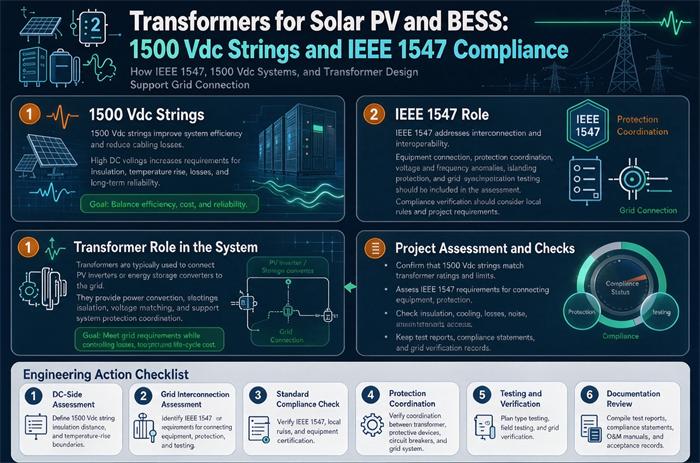
A transformer for a solar PV or BESS site is an inverter-duty unit, not a standard distribution transformer. Most utility-scale projects now run 1500 Vdc strings, which push the AC side to roughly 800 to 900 V, and every unit tied to the grid must clear IEEE 1547 interconnection rules. Here is what that means for your specification.
Why solar and storage transformers are not off-the-shelf
A transformer on a solar or battery site sees duty that a commercial building unit never does. The load swings from zero to full and back to zero every single day. The current carries harmonic content from the inverters. In a BESS, the power flows both directions. The unit sits outdoors for 20-plus years. None of that is captured by a plain kVA and voltage rating.
That is why the phrase “inverter duty” shows up in spec sheets. Treat it as a job description, not a certified rating. You still have to write the actual numbers line by line. This guide covers the four things that decide whether your unit passes commissioning and earns its keep: the 1500 Vdc string reality, IEEE 1547 compliance, inverter-duty specs, and bidirectional duty for storage.
If your project pairs generation with storage, the renewable step-up guide walks through the PV side in more detail. The same principles apply, but BESS adds a twist we cover below.
The 1500 Vdc string reality
For years, 1000 Vdc was the ceiling for utility-scale PV. In 2026, 1500 Vdc is the default for new plants above a few megawatts. The higher string voltage cuts combiner box and cabling cost, and it lets each string inverter push more power. The transformer is where that DC voltage becomes grid-ready AC.
What 1500 Vdc does to the AC side
A 1500 Vdc string feeds an inverter whose AC output lands around 800 to 900 V three-phase. That is well above the 480 V or 600 V you see in a typical commercial panel. The LV winding on your transformer has to be specified for that, not for a legacy 600 V system. Many RFPs still say “standard 600 V class” and then fail commissioning because the bushings and insulation were never rated for the voltage they actually see.
The LV winding insulation catch
A common rule of thumb in the US market is that a 1500 Vdc input calls for an LV winding insulation system rated at 1.2 kV class or higher. Standard 600 V-class windings will not cut it. This is a spec item that gets missed constantly, and it is cheaper to write it correctly than to re-bush a unit in the field. When you review a quote, the insulation class should be stated on the nameplate and matched to your inverter’s AC output, not assumed.
Central vs string inverter topologies
Your inverter architecture decides your transformer topology. A central inverter feeds one large step-up transformer, often a 4 MVA to 4.5 MVA unit on a plant over 100 MW, with a relatively clean waveform because central inverters include output filters. A string-inverter cluster groups 20 to 30 smaller inverters into a single collector transformer, where the LV winding sees the combined harmonic output of every inverter at once. That difference is the single biggest driver of the K-factor you need, which we get to next.
IEEE 1547 compliance: what buyers must verify
IEEE 1547 is the US interconnection standard for distributed energy resources. Any transformer on the inverter side of the point of common coupling is part of a system that must meet it. The transformer itself is not “1547 listed,” but your unit’s impedance, regulation, and test data are what the EPC plugs into the interconnection study. Here is what that standard actually requires the system to do.
Trip, ride-through, and anti-islanding
IEEE 1547-2018 sets how a DER must behave during grid disturbances. It defines trip settings, low- and high-voltage ride-through, and anti-islanding protection so a site cannot keep energizing a dead grid. Your transformer contributes by presenting a known impedance and regulation characteristic that the study models. If those numbers are missing from the factory test report, the interconnection application stalls.
THD and DC injection limits
At the point of common coupling, IEEE 1547-2018 caps total harmonic distortion of current at 5 percent, and it limits DC current injection to 0.5 percent of rated full-output current. Those are system limits, not transformer ratings, but they drive two real transformer specs: the harmonic spectrum the windings must tolerate, and the DC-injection tolerance that keeps core flux from shifting. Ask the inverter maker for the actual current spectrum at your operating points rather than guessing from the carrier frequency.
UL 1741 and the inverter-side chain
IEEE 1547 is the rule; UL 1741 is the listing that proves the inverter and interconnection equipment meet it. The transformer does not carry UL 1741, but it sits in the same chain, so its impedance and step-voltage regulation data have to be supplied so the EPC can model the whole system. Do not let a supplier hand you a transformer with no test data and call it “1547 ready.” Ready means the reports exist.
Inverter-duty specs you cannot skip
These are the line items that separate a solar-rated unit from a general-purpose one. The cooling class write-up matters here because cycling duty changes how you read the nameplate.
K-factor for inverter harmonics
Inverter output is not a clean sine wave. String inverters without heavy filtering inject harmonic currents, with the 5th, 7th, and 11th orders doing the most damage to core and winding eddy losses. A K-factor 4 rating is the usual floor for solar duty. For a string-inverter collector transformer, where many inverters stack their harmonics, K-7 or higher is the safer call. Skipping this is how you end up measuring winding hot-spot temperatures 15 to 20 degrees above the nameplate.
Cyclic loading and thermal time constant
A standard oil-immersed transformer is designed around continuous load. A solar unit sees a 0 to 100 to 0 percent cycle every day, so its thermal time constant has to be designed for cycling, not steady state. That usually means reinforced insulation and a cooling path that dumps top-oil heat fast. It adds a few percent to unit cost and roughly doubles expected insulation life. On a 20-year site, that trade pays for itself.
NEMA 3R and C5-M for the site
Solar plants live outdoors, often in deserts, on coastal flats, or on farmland with blowing dust and salt. NEMA 3R, rain-tight and ventilated, is the floor. If the site is within about 10 km of a coast, you want ISO 12944 C5-M corrosion protection on the enclosure and all exposed hardware, or the padlock will not open by year three. Write the corrosion class into the spec, not into a hope.
Bidirectional power flow for BESS
When your site includes batteries, the transformer must handle power in both directions: from the inverter to the grid during discharge, and from the grid to the battery during charge. Not every transformer is built for that, and the details matter.
DETC on the MV side, not on-load
In a BESS, voltage regulation is handled by the inverter’s reactive power control, not by the transformer. So the tap changer should be a de-energized tap changer on the MV side, not an on-load type. An on-load tap changer adds cost and moving parts you do not need, and it can fight the inverter’s own regulation. Specifying DETC keeps the unit simpler and more reliable for bidirectional duty.
Galvanic isolation and DC blocking
The transformer provides galvanic isolation that lets the array or battery side carry its own grounding arrangement and blocks the DC path between the inverter and the utility. That isolation also stops fault propagation. In transformerless inverter topologies, the external transformer is the only thing providing that interface, so its insulation must withstand thousands of charge-discharge cycles without degrading.
Dry-type vs oil for solar and BESS
Both work. The choice is mostly about site rules, fire code, and service access. The outdoor dry-type option handles exposed sites and coastal corrosion when specified with the right enclosure, while oil units win on cost per kVA at large sizes.
| Factor | Dry-type | Oil-immersed |
|---|---|---|
| Typical use | Container, skid, near personnel | Central plant, large unit substation |
| Fire code | Easier indoors, no secondary containment | Needs SPCC plan, vault or separation |
| Size ceiling | Up to a few MVA practical | Hundreds of MVA |
| Coastal site | C5-M enclosure required | C5-M plus bushings, sealing |
| Service | Easier visual inspection | Sampling, liquid handling |
For most utility-scale PV plus BESS, you will see a pad-mounted or unit-substation oil transformer at the collector or GSU point, and dry-type units inside containerized inverter stations where fire code or footprint drives the call.
DOE efficiency and the 2029 floor
Distribution and medium-voltage transformers headed for the US market fall under DOE 10 CFR 431. The 2016 levels are current law, and the 2024 update takes effect on 2029-04-23. Because solar and BESS units run continuously, no-load loss is the number that quietly dominates the bill: it runs every hour the unit is energized, even at zero load. Specifying a low-loss or amorphous-core design can recover its premium through saved energy over the project life. The standards comparison covers how IEC and ANSI/IEEE efficiency bases differ, which matters if you are sourcing from a mixed supply chain.
A worked specification example
A 50 MWac solar plus 20 MW / 80 MWh BESS site is a realistic shape. The PV side uses 1500 Vdc strings feeding string inverters with roughly 800 to 900 V AC outputs, collected into 2.5 MVA to 3.5 MVA dry-type or unit-substation transformers, then stepped up to 34.5 kV through a GSU. The BESS shares the medium-voltage bus through bidirectional units with DETC on the MV side and K-7 rated LV windings.
Read that from the nameplate guide and you will see the items that prove the spec was met: K-factor, insulation class, impedance, cooling, and the guaranteed losses. The routine testing checklist is what you ask for before the units ship, so a “bargain” does not hide a unit that fails acceptance. A real project of this size is documented in our 50 MW solar step-up case if you want to see the topology in the field.
RFQ checklist for solar and BESS transformers
Write these fields into every request for quotation. Blank lines become change orders later.
| Field | What to state |
|---|---|
| Application | PV only, BESS only, or PV plus BESS combined |
| Inverter AC output | Voltage and whether 1500 Vdc strings are used |
| LV insulation class | 1.2 kV class or higher at 1500 Vdc input |
| K-factor | K-4 minimum, K-7 plus for string collectors |
| Duty cycle | Cyclic 0 to 100 percent, count per day |
| Tap changer | DETC on MV side for BESS bidirectional |
| Enclosure | NEMA 3R, C5-M within 10 km of coast |
| Cooling | ONAN or ONAN or ONAF rated for cycling |
| Losses | Guaranteed no-load and load loss |
| Standards | IEEE C57.12.01, UL 1741 system, IEEE 1547 |
| NEC articles | 690 for PV, 706 for BESS |
The distribution buyers guide expands on supplier vetting, but the table above is the minimum you should never ship a quote without.
Common mistakes buyers make
The first mistake is specifying a “standard” 600 V-class transformer on a 1500 Vdc site and discovering the insulation rating during commissioning. The second is treating K-factor as optional, then watching hot spots climb. The third is forgetting that BESS reverses power flow and specifying an on-load tap changer that fights the inverter. The fourth is omitting the corrosion class on a coastal site. The fifth is buying on first price and ignoring guaranteed losses that run for 20-plus years.
FAQ
What AC voltage does a 1500 Vdc solar string produce? A 1500 Vdc PV string feeds an inverter whose three-phase AC output lands around 800 to 900 V. The transformer LV winding must be insulated for 1.2 kV class or higher, not the legacy 600 V class.
What K-factor rating do solar transformers need? K-4 is the usual minimum for solar duty. For a string-inverter collector transformer where many inverters stack their harmonics, specify K-7 or higher to keep winding hot spots within nameplate limits.
What does IEEE 1547 actually require? IEEE 1547-2018 sets interconnection behavior: trip settings, low and high voltage ride-through, anti-islanding, total harmonic distortion at or below 5 percent, and DC injection at or below 0.5 percent of rated current at the point of common coupling.
Is a 600 V class LV winding acceptable on a 1500 Vdc system? No. A 1500 Vdc input pushes the AC side to roughly 800 to 900 V, so the LV winding needs 1.2 kV class insulation. A 600 V-class winding will fail commissioning when the real voltage appears.
Can one transformer serve both solar and BESS? Yes, if it is rated for bidirectional flow with a de-energized tap changer on the MV side and harmonic-rated LV windings. The inverter handles voltage regulation, so an on-load tap changer is usually unnecessary.
Which NEC articles apply to solar and BESS transformers? NEC Article 690 covers photovoltaic systems and Article 706 covers energy storage systems. Both shape enclosure, disconnect, and wiring requirements around the transformer.
What efficiency rule applies to these transformers? US-bound distribution and medium-voltage units fall under DOE 10 CFR 431. The 2016 levels are current, and the 2024 update takes effect on 2029-04-23, so specify guaranteed low-loss designs for continuously running sites.